10-K
falseFYfalse0001826600falsefalsefalsehttp://fasb.org/us-gaap/2025#NetIncomeLosshttp://fasb.org/us-gaap/2025#NetIncomeLosshttp://fasb.org/us-gaap/2025#NetIncomeLoss2021 2022 2023http://fasb.org/srt/2025#ChiefExecutiveOfficerMember2031-03-310001826600us-gaap:TreasuryStockCommonMember2023-12-310001826600mntk:TermLoansMember2025-12-310001826600us-gaap:LandMember2025-12-310001826600us-gaap:InterestRateSwapMember2025-01-012025-12-310001826600us-gaap:TreasuryStockCommonMember2023-01-012023-12-310001826600us-gaap:TransferredOverTimeMembermntk:RenewableNaturalGasMember2025-01-012025-12-310001826600us-gaap:SalesRevenueNetMembermntk:CustomerCMemberus-gaap:CustomerConcentrationRiskMember2024-01-012024-12-310001826600mntk:TermLoanMember2025-12-310001826600us-gaap:OperatingSegmentsMembermntk:RenewableNaturalGasMember2025-01-012025-12-310001826600us-gaap:TransferredAtPointInTimeMembermntk:NaturalGasCommodityMember2025-01-012025-12-310001826600us-gaap:TransferredOverTimeMember2025-01-012025-12-310001826600us-gaap:TransferredOverTimeMembermntk:RenewableNaturalGasAndRenewableElectricityGenerationMemberus-gaap:CustomerConcentrationRiskMemberus-gaap:RevenueFromContractWithCustomerProductAndServiceBenchmarkMembermntk:RenewableEnergyMember2024-01-012024-12-310001826600us-gaap:RestrictedStockUnitsRSUMembermntk:MontaukRenewablesIncEquityAndIncentiveCompensationPlanMember2023-12-310001826600us-gaap:OperatingSegmentsMember2023-01-012023-12-310001826600us-gaap:OperatingSegmentsMembermntk:RenewableElectricityGenerationMember2024-12-310001826600srt:MaximumMember2025-01-012025-12-310001826600us-gaap:RetainedEarningsMember2023-01-012023-12-310001826600us-gaap:FairValueInputsLevel3Memberus-gaap:FairValueMeasurementsRecurringMember2024-12-310001826600us-gaap:AdditionalPaidInCapitalMember2023-12-310001826600srt:MinimumMemberus-gaap:MiningPropertiesAndMineralRightsMember2025-12-310001826600mntk:TimeBasedRestrictedStockAwardsMember2023-01-012023-12-310001826600srt:MaximumMember2025-12-310001826600us-gaap:RetainedEarningsMember2024-12-310001826600us-gaap:TransferredOverTimeMembermntk:ElectricCommodityMember2025-01-012025-12-310001826600srt:MinimumMemberus-gaap:CustomerContractsMember2025-12-310001826600us-gaap:TreasuryStockCommonMember2025-12-310001826600mntk:MontaukRenewablesIncEquityAndIncentiveCompensationPlanMember2021-01-312021-01-310001826600mntk:RenewableElectricityGenerationSiteMember2023-01-012023-12-310001826600us-gaap:EmployeeStockOptionMembermntk:MontaukRenewablesIncEquityAndIncentiveCompensationPlanMember2024-12-310001826600mntk:IncomeTaxAuthorityNameIdahoMember2024-01-012024-12-310001826600us-gaap:TransferredAtPointInTimeMembermntk:NaturalGasCommodityMember2024-01-012024-12-310001826600us-gaap:SalesRevenueNetMemberus-gaap:CustomerConcentrationRiskMembermntk:CustomerBMember2025-01-012025-12-310001826600mntk:IncomeTaxAuthorityNameOtherMember2023-01-012023-12-310001826600us-gaap:RestrictedStockMembermntk:MontaukRenewablesIncEquityAndIncentiveCompensationPlanMember2024-01-012024-12-310001826600mntk:TermLoanMember2024-12-310001826600us-gaap:AdditionalPaidInCapitalMember2025-12-310001826600us-gaap:RestrictedStockMember2025-01-012025-12-310001826600us-gaap:CorporateAndOtherMembermntk:AssetsDeemedObsoleteOrNon-OperableMember2025-01-012025-12-310001826600us-gaap:TransferredAtPointInTimeMembermntk:NaturalGasEnvironmentalAttributesMember2024-01-012024-12-310001826600us-gaap:SalesRevenueNetMembermntk:CustomerDMembermntk:RenewableNaturalGasMemberus-gaap:CustomerConcentrationRiskMember2024-01-012024-12-310001826600mntk:RenewableElectricityGenerationSiteMembermntk:AssetsDeemedObsoleteOrNon-OperableMember2025-01-012025-12-310001826600us-gaap:DomesticCountryMembermntk:TaxYearTwoThousandAndThirtyNineMember2025-01-012025-12-310001826600us-gaap:FairValueInputsLevel3Memberus-gaap:FairValueMeasurementsRecurringMember2025-12-310001826600mntk:InterconnectionMembersrt:MaximumMember2025-12-310001826600mntk:CustomerAMemberus-gaap:SalesRevenueNetMemberus-gaap:CustomerConcentrationRiskMember2024-01-012024-12-310001826600srt:MaximumMembermntk:MriEicpApril2023AwardsMember2025-01-012025-12-310001826600srt:MinimumMembermntk:MontaukRenewablesIncEquityAndIncentiveCompensationPlanMember2025-01-012025-12-310001826600us-gaap:OperatingSegmentsMembermntk:RenewableElectricityGenerationMember2023-12-310001826600mntk:FiveCustomersMemberus-gaap:AccountsReceivableMemberus-gaap:CustomerConcentrationRiskMember2024-01-012024-12-310001826600us-gaap:BuildingAndBuildingImprovementsMember2025-12-310001826600us-gaap:RelatedPartyMember2021-12-220001826600mntk:RenewableElectricityGenerationSiteMember2024-01-012024-12-310001826600us-gaap:TransferredOverTimeMembermntk:RenewableNaturalGasAndRenewableElectricityGenerationMemberus-gaap:CustomerConcentrationRiskMemberus-gaap:RevenueFromContractWithCustomerProductAndServiceBenchmarkMembermntk:RenewableEnergyMember2023-01-012023-12-310001826600us-gaap:MachineryAndEquipmentMembersrt:MaximumMember2025-12-310001826600us-gaap:CommonStockMember2024-01-012024-12-310001826600mntk:NaturalGasCommodityMemberus-gaap:TransferredOverTimeMember2025-01-012025-12-310001826600us-gaap:TreasuryStockCommonMember2024-01-012024-12-310001826600mntk:MehMembermntk:FromTwoThousandAndTwentyFiveAndUptoTwoThousandAndTwetnySixMembermntk:TermLoansMember2021-12-210001826600us-gaap:SalesRevenueNetMembermntk:RenewableNaturalGasMemberus-gaap:CustomerConcentrationRiskMembermntk:CustomerBMember2025-01-012025-12-310001826600mntk:MriEicpJanuary2023AwardsMember2025-01-012025-12-310001826600us-gaap:SalesRevenueNetMembermntk:CustomerCMembermntk:RenewableNaturalGasMemberus-gaap:CustomerConcentrationRiskMember2023-01-012023-12-310001826600us-gaap:ConstructionInProgressMembermntk:RenewableElectricityGenerationSiteMember2025-01-012025-12-310001826600us-gaap:SalesRevenueNetMemberus-gaap:CustomerConcentrationRiskMembermntk:CustomerBMember2023-01-012023-12-310001826600mntk:MehMembermntk:FromTwoThousandAndTwentyFiveAndUptoTwoThousandAndTwetnySixMembermntk:TermLoansMember2021-12-212021-12-210001826600mntk:IncomeTaxAuthorityNameTexasMember2023-01-012023-12-310001826600us-gaap:TransferredAtPointInTimeMembermntk:RenewableElectricityGenerationMember2024-01-012024-12-310001826600mntk:PioneerRenewableEnergyMarketingLLCMember2025-03-310001826600us-gaap:RestrictedStockUnitsRSUMembermntk:MontaukRenewablesIncEquityAndIncentiveCompensationPlanMember2024-12-310001826600us-gaap:TransferredOverTimeMember2024-01-012024-12-310001826600us-gaap:EmployeeStockOptionMembermntk:MontaukRenewablesIncEquityAndIncentiveCompensationPlanMember2025-12-310001826600srt:MinimumMembermntk:InterconnectionMember2025-12-310001826600us-gaap:OperatingSegmentsMember2024-12-310001826600mntk:ElectricEnvironmentalAttributesMemberus-gaap:TransferredAtPointInTimeMember2024-01-012024-12-310001826600us-gaap:SalesRevenueNetMembermntk:RenewableNaturalGasMemberus-gaap:CustomerConcentrationRiskMembermntk:CustomerBMember2023-01-012023-12-310001826600us-gaap:OperatingSegmentsMember2024-01-012024-12-310001826600us-gaap:TreasuryStockCommonMember2024-12-310001826600us-gaap:RelatedPartyMember2023-12-3100018266002025-03-022025-03-0200018266002024-12-310001826600mntk:RenewableElectricityGenerationSiteMember2025-01-012025-12-310001826600us-gaap:TransferredAtPointInTimeMember2025-01-012025-12-310001826600mntk:NonQualifiedStockOptionsMember2023-01-012023-12-310001826600mntk:RenewableElectricityGenerationSiteMemberus-gaap:InventoryValuationAndObsolescenceMember2024-01-012024-12-310001826600us-gaap:RestrictedStockMember2024-01-012024-12-3100018266002023-01-012023-12-310001826600mntk:CustomerAMemberus-gaap:SalesRevenueNetMemberus-gaap:CustomerConcentrationRiskMember2025-01-012025-12-310001826600mntk:IncomeTaxAuthorityNamePennsylvaniaMember2024-01-012024-12-310001826600us-gaap:RevenueFromContractWithCustomerMemberus-gaap:GeographicConcentrationRiskMembermntk:FiveGeographicalLocationsMember2023-01-012023-12-310001826600mntk:IncomeTaxAuthorityNameOtherMember2024-01-012024-12-310001826600us-gaap:RestrictedStockMember2023-01-012023-12-310001826600us-gaap:CommonStockMember2025-12-310001826600mntk:NewSeniorCreditFacilityMemberus-gaap:SubsequentEventMembermntk:CCH1MEHLenderLLCMember2026-03-092026-03-090001826600us-gaap:DomesticCountryMembermntk:TaxYearTwoThousandAndThirtyNineMember2025-12-310001826600mntk:MontaukRenewablesIncEquityAndIncentiveCompensationPlanMember2025-01-012025-12-310001826600us-gaap:MiningPropertiesAndMineralRightsMembersrt:MaximumMember2025-12-310001826600us-gaap:TreasuryStockCommonMember2022-12-310001826600mntk:NaturalGasCommodityMember2024-01-012024-12-310001826600srt:MinimumMemberus-gaap:BuildingAndBuildingImprovementsMember2025-12-310001826600us-gaap:BuildingAndBuildingImprovementsMember2024-12-310001826600mntk:NonQualifiedStockOptionsMember2024-01-012024-12-310001826600us-gaap:FairValueInputsLevel1Memberus-gaap:FairValueMeasurementsRecurringMember2024-12-310001826600us-gaap:AdditionalPaidInCapitalMember2025-01-012025-12-310001826600us-gaap:SalesRevenueNetMembermntk:CustomerDMemberus-gaap:CustomerConcentrationRiskMember2024-01-012024-12-310001826600us-gaap:OperatingSegmentsMembermntk:RenewableNaturalGasMember2024-12-310001826600us-gaap:TransferredAtPointInTimeMembermntk:NaturalGasEnvironmentalAttributesMember2025-01-012025-12-310001826600us-gaap:FairValueMeasurementsRecurringMember2025-12-3100018266002023-12-310001826600mntk:NaturalGasCommodityMemberus-gaap:TransferredOverTimeMember2024-01-012024-12-310001826600us-gaap:RestrictedStockMembermntk:MontaukRenewablesIncEquityAndIncentiveCompensationPlanMember2025-01-012025-12-310001826600us-gaap:OperatingSegmentsMembermntk:RenewableNaturalGasMember2023-12-310001826600us-gaap:CommonStockMember2022-12-310001826600us-gaap:RestrictedStockUnitsRSUMembermntk:MontaukRenewablesIncEquityAndIncentiveCompensationPlanMember2024-01-012024-12-310001826600us-gaap:CorporateNonSegmentMember2024-01-012024-12-310001826600mntk:LoansAdvancedToRelatedPartiesMembermntk:MnkMember2021-01-262021-01-260001826600mntk:InterconnectionMember2025-12-310001826600us-gaap:CorporateNonSegmentMember2023-01-012023-12-310001826600mntk:CustomerAMemberus-gaap:SalesRevenueNetMembermntk:RenewableNaturalGasMemberus-gaap:CustomerConcentrationRiskMember2024-01-012024-12-310001826600us-gaap:FairValueMeasurementsRecurringMember2024-12-310001826600us-gaap:DrillingRightsMember2024-01-012024-12-3100018266002026-03-060001826600us-gaap:RelatedPartyMembermntk:MnkMembermntk:RP47LoanMember2021-12-012021-12-310001826600srt:MinimumMember2025-01-012025-12-310001826600us-gaap:CorporateNonSegmentMember2025-12-310001826600srt:MaximumMemberus-gaap:BuildingAndBuildingImprovementsMember2025-12-310001826600us-gaap:RetainedEarningsMember2022-12-310001826600mntk:RenewableNaturalGasMemberus-gaap:CustomerContractsMember2025-01-012025-12-310001826600srt:MinimumMembermntk:MriEicpApril2023AwardsMember2025-01-012025-12-310001826600us-gaap:CommonStockMembermntk:MnkMember2025-01-012025-12-310001826600mntk:NaturalGasCommodityMember2023-01-012023-12-310001826600mntk:ElectricEnvironmentalAttributesMember2024-01-012024-12-310001826600mntk:NaturalGasCommodityMember2025-01-012025-12-310001826600mntk:ElectricEnvironmentalAttributesMemberus-gaap:TransferredAtPointInTimeMemberus-gaap:ProductConcentrationRiskMemberus-gaap:RevenueFromContractWithCustomerProductAndServiceBenchmarkMember2023-01-012023-12-310001826600us-gaap:AdditionalPaidInCapitalMember2024-01-012024-12-310001826600us-gaap:DrillingRightsMember2023-01-012023-12-310001826600us-gaap:MachineryAndEquipmentMembersrt:MinimumMember2025-12-310001826600mntk:IncomeTaxAuthorityNamePennsylvaniaMember2023-01-012023-12-310001826600us-gaap:RelatedPartyMember2022-12-220001826600us-gaap:FairValueInputsLevel1Memberus-gaap:FairValueMeasurementsRecurringMember2025-12-310001826600mntk:ElectricEnvironmentalAttributesMember2025-01-012025-12-310001826600mntk:RenewableNaturalGasMembermntk:AssetsDeemedObsoleteOrNon-OperableMember2025-01-012025-12-310001826600mntk:RenewableElectricityGenerationMember2023-01-012023-12-310001826600us-gaap:AdditionalPaidInCapitalMember2023-01-012023-12-310001826600us-gaap:RelatedPartyMember2025-03-020001826600mntk:IncomeTaxAuthorityNameTexasMember2024-01-012024-12-3100018266002025-06-300001826600mntk:ElectricEnvironmentalAttributesMemberus-gaap:TransferredAtPointInTimeMemberus-gaap:ProductConcentrationRiskMemberus-gaap:RevenueFromContractWithCustomerProductAndServiceBenchmarkMember2024-01-012024-12-310001826600mntk:EmissionAllowancesMember2025-01-012025-12-310001826600mntk:ElectricEnvironmentalAttributesMemberus-gaap:TransferredAtPointInTimeMember2025-01-012025-12-310001826600srt:MinimumMember2024-12-310001826600us-gaap:TransferredAtPointInTimeMembermntk:RenewableElectricityGenerationMember2023-01-012023-12-310001826600us-gaap:OtherMachineryAndEquipmentMember2024-12-310001826600mntk:RevolverMember2025-12-310001826600us-gaap:OperatingSegmentsMember2023-12-3100018266002022-12-310001826600us-gaap:SalesRevenueNetMembermntk:RenewableNaturalGasMemberus-gaap:CustomerConcentrationRiskMembermntk:CustomerBMember2024-01-012024-12-310001826600us-gaap:TransferredAtPointInTimeMembermntk:RenewableNaturalGasMember2023-01-012023-12-3100018266002025-10-012025-12-310001826600us-gaap:CommonStockMember2025-01-012025-12-310001826600mntk:SixthAmendedRevolvingCreditFacilityMember2025-01-012025-12-310001826600mntk:FiveCustomersMemberus-gaap:AccountsReceivableMemberus-gaap:CustomerConcentrationRiskMember2025-01-012025-12-310001826600us-gaap:OperatingSegmentsMembermntk:RenewableElectricityGenerationMember2024-01-012024-12-310001826600us-gaap:RetainedEarningsMember2024-01-012024-12-310001826600us-gaap:TransferredOverTimeMembermntk:RenewableElectricityGenerationMember2024-01-012024-12-310001826600mntk:RevolverMember2025-12-310001826600us-gaap:OperatingSegmentsMembermntk:RenewableElectricityGenerationMember2023-01-012023-12-310001826600mntk:NaturalGasEnvironmentalAttributesMember2025-01-012025-12-310001826600us-gaap:TransferredOverTimeMembermntk:ElectricCommodityMember2023-01-012023-12-310001826600mntk:RenewableElectricityGenerationMember2025-01-012025-12-310001826600us-gaap:OperatingSegmentsMembermntk:RenewableNaturalGasMember2024-01-012024-12-310001826600mntk:IncomeTaxAuthorityNameOtherMember2025-01-012025-12-310001826600mntk:TimeBasedRestrictedStockAwardsMember2022-05-312022-05-310001826600mntk:NonQualifiedStockOptionsMember2025-01-012025-12-310001826600mntk:MnkMemberus-gaap:TreasuryStockCommonMember2025-01-012025-12-310001826600mntk:ElectricCommodityMember2025-01-012025-12-310001826600us-gaap:RevenueFromContractWithCustomerMemberus-gaap:GeographicConcentrationRiskMembermntk:FiveGeographicalLocationsMember2024-01-012024-12-310001826600mntk:NewSeniorCreditFacilityMemberus-gaap:SubsequentEventMembermntk:CCH1MEHLenderLLCMember2026-03-090001826600us-gaap:TransferredAtPointInTimeMembermntk:NaturalGasEnvironmentalAttributesMember2023-01-012023-12-310001826600us-gaap:OperatingSegmentsMembermntk:RenewableElectricityGenerationMember2025-01-012025-12-310001826600us-gaap:TransferredOverTimeMembermntk:RenewableElectricityGenerationMember2023-01-012023-12-310001826600us-gaap:SalesRevenueNetMembermntk:CustomerCMemberus-gaap:CustomerConcentrationRiskMember2023-01-012023-12-310001826600us-gaap:OtherMachineryAndEquipmentMember2025-12-310001826600mntk:MehMembermntk:SecondAmendmentMember2019-09-122019-09-120001826600mntk:MriEicpApril2023AwardsMember2025-01-012025-12-310001826600mntk:RenewableNaturalGasMember2023-01-012023-12-310001826600mntk:LandUseRightsMember2025-01-012025-12-310001826600mntk:MehMembermntk:TermLoansMember2019-09-122019-09-120001826600mntk:NaturalGasEnvironmentalAttributesMember2023-01-012023-12-310001826600us-gaap:OperatingSegmentsMember2025-01-012025-12-310001826600us-gaap:CustomerContractsMember2025-12-310001826600mntk:RenewableNaturalGasMember2024-01-012024-12-310001826600us-gaap:ConstructionInProgressMember2024-12-310001826600us-gaap:DomesticCountryMember2025-12-310001826600mntk:IncomeTaxAuthorityNameTexasMember2025-01-012025-12-310001826600mntk:CustomerAMemberus-gaap:SalesRevenueNetMemberus-gaap:CustomerConcentrationRiskMember2023-01-012023-12-310001826600us-gaap:RetainedEarningsMember2025-01-012025-12-310001826600mntk:NewSeniorCreditFacilityMemberus-gaap:SubsequentEventMember2026-03-090001826600us-gaap:OperatingSegmentsMember2025-12-3100018266002024-01-012024-12-310001826600us-gaap:CaliforniaFranchiseTaxBoardMember2023-01-012023-12-310001826600us-gaap:CaliforniaFranchiseTaxBoardMember2025-01-012025-12-310001826600us-gaap:TransferredOverTimeMembermntk:ElectricCommodityMember2024-01-012024-12-310001826600us-gaap:CorporateNonSegmentMember2025-01-012025-12-310001826600us-gaap:TreasuryStockCommonMember2025-01-012025-12-310001826600us-gaap:LetterOfCreditMember2025-12-310001826600us-gaap:InterestRateSwapMember2024-01-012024-12-310001826600mntk:ElectricEnvironmentalAttributesMember2023-01-012023-12-310001826600us-gaap:DrillingRightsMember2024-12-310001826600us-gaap:RevolvingCreditFacilityMember2025-12-310001826600mntk:MehMembermntk:FourthAmendmentMember2021-12-210001826600srt:MaximumMemberus-gaap:CustomerContractsMember2025-12-310001826600us-gaap:StateAndLocalJurisdictionMember2025-12-310001826600us-gaap:AdditionalPaidInCapitalMember2024-12-3100018266002024-02-012024-02-2900018266002024-10-012024-10-310001826600mntk:TimeBasedRestrictedStockAwardsMember2025-01-012025-12-310001826600mntk:RenewableNaturalGasMember2025-01-012025-12-310001826600us-gaap:RestrictedStockMembermntk:MontaukRenewablesIncEquityAndIncentiveCompensationPlanMember2023-12-310001826600us-gaap:TransferredAtPointInTimeMember2023-01-012023-12-310001826600us-gaap:RelatedPartyMembermntk:MnkMember2021-12-012021-12-310001826600us-gaap:SalesRevenueNetMemberus-gaap:CustomerConcentrationRiskMembermntk:CustomerBMember2024-01-012024-12-310001826600mntk:MehMembermntk:SecondAmendmentMember2019-09-120001826600us-gaap:TransferredOverTimeMembermntk:RenewableNaturalGasMember2023-01-012023-12-310001826600mntk:LandUseRightsMember2025-12-310001826600mntk:ElectricEnvironmentalAttributesMemberus-gaap:TransferredAtPointInTimeMemberus-gaap:ProductConcentrationRiskMemberus-gaap:RevenueFromContractWithCustomerProductAndServiceBenchmarkMember2025-01-012025-12-3100018266002025-01-012025-12-310001826600mntk:AssetsDeemedObsoleteOrNon-OperableMember2025-01-012025-12-310001826600us-gaap:SalesRevenueNetMembermntk:CustomerCMembermntk:RenewableNaturalGasMemberus-gaap:CustomerConcentrationRiskMember2024-01-012024-12-310001826600us-gaap:TransferredOverTimeMember2023-01-012023-12-310001826600mntk:CustomerAMemberus-gaap:SalesRevenueNetMembermntk:RenewableNaturalGasMemberus-gaap:CustomerConcentrationRiskMember2023-01-012023-12-310001826600mntk:TimeBasedRestrictedStockAwardsMember2024-01-012024-12-310001826600us-gaap:CorporateNonSegmentMember2024-12-310001826600mntk:SixthAmendedRevolvingCreditFacilityMember2025-12-310001826600mntk:ElectricCommodityMember2024-01-012024-12-310001826600us-gaap:TransferredAtPointInTimeMembermntk:RenewableNaturalGasMember2025-01-012025-12-310001826600us-gaap:TransferredAtPointInTimeMember2024-01-012024-12-310001826600us-gaap:EmployeeStockOptionMembermntk:MontaukRenewablesIncEquityAndIncentiveCompensationPlanMember2025-01-012025-12-310001826600us-gaap:TransferredOverTimeMembermntk:RenewableNaturalGasMember2024-01-012024-12-310001826600mntk:InterconnectionMember2024-12-310001826600us-gaap:LandMember2024-12-310001826600us-gaap:RelatedPartyMembermntk:MnkMembersrt:MaximumMember2021-12-012021-12-3100018266002023-06-212023-06-210001826600us-gaap:CustomerContractsMember2024-12-310001826600us-gaap:RetainedEarningsMember2025-12-310001826600srt:MinimumMember2025-12-310001826600us-gaap:InternalRevenueServiceIRSMember2025-01-012025-12-310001826600us-gaap:OperatingSegmentsMembermntk:RenewableNaturalGasMember2023-01-012023-12-310001826600us-gaap:DrillingRightsMember2025-12-310001826600mntk:ElectricCommodityMember2023-01-012023-12-310001826600mntk:RenewableElectricityGenerationMember2024-01-012024-12-310001826600us-gaap:RetainedEarningsMember2023-12-310001826600us-gaap:RestrictedStockUnitsRSUMembermntk:MontaukRenewablesIncEquityAndIncentiveCompensationPlanMember2025-12-310001826600us-gaap:OperatingSegmentsMembermntk:RenewableNaturalGasMember2025-12-310001826600us-gaap:DrillingRightsMember2025-01-012025-12-310001826600mntk:NaturalGasEnvironmentalAttributesMember2024-01-012024-12-310001826600mntk:IncomeTaxAuthorityNamePennsylvaniaMember2025-01-012025-12-310001826600us-gaap:OperatingSegmentsMembermntk:RenewableElectricityGenerationMember2025-12-310001826600us-gaap:CorporateNonSegmentMember2023-12-3100018266002022-12-222022-12-220001826600mntk:MontaukRenewablesIncMember2025-12-310001826600us-gaap:CaliforniaFranchiseTaxBoardMember2024-01-012024-12-310001826600mntk:CustomerAMemberus-gaap:SalesRevenueNetMembermntk:RenewableNaturalGasMemberus-gaap:CustomerConcentrationRiskMember2025-01-012025-12-310001826600srt:MaximumMembermntk:MontaukRenewablesIncEquityAndIncentiveCompensationPlanMember2025-01-012025-12-310001826600us-gaap:RestrictedStockMembermntk:MontaukRenewablesIncEquityAndIncentiveCompensationPlanMember2024-12-310001826600us-gaap:FairValueInputsLevel3Member2025-12-3100018266002021-01-260001826600mntk:PestaEnergyLLCMember2025-03-3100018266002025-12-3100018266002021-01-262021-01-260001826600us-gaap:RestrictedStockUnitsRSUMembermntk:MontaukRenewablesIncEquityAndIncentiveCompensationPlanMember2025-01-012025-12-310001826600us-gaap:TransferredAtPointInTimeMembermntk:RenewableElectricityGenerationMember2025-01-012025-12-310001826600us-gaap:FairValueInputsLevel2Memberus-gaap:FairValueMeasurementsRecurringMember2024-12-310001826600us-gaap:CommonStockMember2023-01-012023-12-310001826600mntk:SafeHarborContributionMember2025-01-012025-12-310001826600mntk:ElectricEnvironmentalAttributesMemberus-gaap:TransferredAtPointInTimeMember2023-01-012023-12-310001826600us-gaap:TransferredAtPointInTimeMembermntk:NaturalGasCommodityMember2023-01-012023-12-310001826600mntk:IncomeTaxAuthorityNameIdahoMember2023-01-012023-12-310001826600us-gaap:TransferredAtPointInTimeMembermntk:RenewableNaturalGasMember2024-01-012024-12-310001826600us-gaap:AdditionalPaidInCapitalMember2022-12-310001826600srt:MaximumMember2024-12-310001826600us-gaap:GeneralAndAdministrativeExpenseMember2025-01-012025-12-310001826600us-gaap:ConstructionInProgressMember2025-12-310001826600us-gaap:InterestRateSwapMember2023-01-012023-12-310001826600us-gaap:EmployeeStockOptionMembermntk:MontaukRenewablesIncEquityAndIncentiveCompensationPlanMember2024-01-012024-12-310001826600us-gaap:TransferredOverTimeMembermntk:RenewableElectricityGenerationMember2025-01-012025-12-310001826600us-gaap:InventoryValuationAndObsolescenceMembermntk:RenewableNaturalGasMember2024-01-012024-12-310001826600us-gaap:FairValueInputsLevel2Memberus-gaap:FairValueMeasurementsRecurringMember2025-12-310001826600mntk:MehMembermntk:ThroughTwoThousandAndTwentyFourMembermntk:TermLoansMember2021-12-212021-12-210001826600mntk:IncomeTaxAuthorityNameIdahoMember2025-01-012025-12-310001826600us-gaap:CommonStockMember2024-12-310001826600mntk:MontaukRenewablesIncEquityAndIncentiveCompensationPlanMember2021-01-310001826600mntk:NewSeniorCreditFacilityMemberus-gaap:SubsequentEventMembermntk:CCH1MEHLenderLLCMember2026-03-112026-03-110001826600mntk:NaturalGasCommodityMemberus-gaap:TransferredOverTimeMember2023-01-012023-12-310001826600us-gaap:GeneralAndAdministrativeExpenseMember2024-01-012024-12-310001826600mntk:LandUseRightsMember2024-12-310001826600us-gaap:RestrictedStockMembermntk:MontaukRenewablesIncEquityAndIncentiveCompensationPlanMember2025-12-310001826600us-gaap:CommonStockMember2023-12-310001826600mntk:MnkMember2025-12-310001826600us-gaap:EmployeeStockOptionMembermntk:MontaukRenewablesIncEquityAndIncentiveCompensationPlanMember2023-12-310001826600us-gaap:TransferredOverTimeMembermntk:RenewableNaturalGasAndRenewableElectricityGenerationMemberus-gaap:CustomerConcentrationRiskMemberus-gaap:RevenueFromContractWithCustomerProductAndServiceBenchmarkMembermntk:RenewableEnergyMember2025-01-012025-12-310001826600us-gaap:RevenueFromContractWithCustomerMemberus-gaap:GeographicConcentrationRiskMembermntk:FiveGeographicalLocationsMember2025-01-012025-12-31xbrli:purexbrli:sharesiso4217:ZARmntk:ReportableSegmentsmntk:StandardCubicFeetPerMinutemntk:Employeesmntk:Numbersiso4217:USD
.
UNITED STATES
SECURITIES AND EXCHANGE COMMISSION
Washington, D.C. 20549
FORM 10-K
(Mark One)
|
|
☒ |
ANNUAL REPORT PURSUANT TO SECTION 13 OR 15(d) OF THE SECURITIES EXCHANGE ACT OF 1934 |
For the fiscal year ended December 31, 2025;
or
|
|
☐ |
TRANSITION REPORT PURSUANT TO SECTION 13 OR 15(d) OF THE SECURITIES EXCHANGE ACT OF 1934 |
For the transition period from to
Commission File No. 001-39919
MONTAUK RENEWABLES, INC.
(Exact name of registrant as specified in its charter)
|
|
Delaware |
85-3189583 |
(State or other jurisdiction of
incorporation or organization) |
(I.R.S. Employer
Identification No.) |
|
|
5313 Campbells Run Road, Suite 200 Pittsburgh, Pennsylvania |
15205 |
(Address of principal executive offices) |
(Zip Code) |
Registrant’s telephone number, including area code: (412) 747-8700
Securities registered pursuant to Section 12(b) of the Act:
|
|
|
|
|
Title of each class |
|
Trading Symbol |
|
Name of each exchange on which registered |
Common Stock, par value $0.01 per share |
|
MNTK |
|
The Nasdaq Capital Market |
Securities registered pursuant to Section 12(g) of the Act: None
Indicate by check mark if the registrant is a well-known seasoned issuer, as defined in Rule 405 of the Securities Act. Yes ☐ No ☒
Indicate by check mark if the registrant is not required to file reports pursuant to Section 13 or Section 15(d) of the Act. Yes ☐ No ☒
Indicate by check mark whether the registrant (1) has filed all reports required to be filed by Section 13 or 15(d) of the Securities Exchange Act of 1934 during the preceding 12 months (or for such shorter period that the registrant was required to file such reports), and (2) has been subject to such filing requirements for the past 90 days. Yes ☒ No ☐
Indicate by check mark whether the registrant has submitted electronically every Interactive Data File required to be submitted pursuant to Rule 405 of Regulation S-T (§232.405 of this chapter) during the preceding 12 months (or for such shorter period that the registrant was required to submit such files). Yes ☒ No ☐
Indicate by check mark whether the registrant is a large accelerated filer, an accelerated filer, a non-accelerated filer, a smaller reporting company, or an emerging growth company. See the definitions of “large accelerated filer,” “accelerated filer,” “smaller reporting company,” and “emerging growth company” in Rule 12b-2 of the Exchange Act:
|
|
|
|
Large Accelerated Filer |
☐ |
Accelerated Filer |
☒ |
|
|
|
|
Non-accelerated filer |
☐ |
Smaller Reporting Company |
☐ |
|
|
|
|
|
|
Emerging Growth Company |
☒ |
If an emerging growth company, indicate by check mark if the registrant has elected not to use the extended transition period for complying with any new or revised financial accounting standards provided pursuant to Section 13(a) of the Exchange Act. ☐
Indicate by check mark whether the registrant has filed a report on and attestation to its management’s assessment of the effectiveness of its internal control over financial reporting under Section 404(b) of the Sarbanes-Oxley Act (15 U.S.C. 7262(b)) by the registered public accounting firm that prepared or issued its audit report. ☐
If securities are registered pursuant to Section 12(b) of the Act, indicate by check mark whether the financial statements of the registrant included in the filing reflect the correction of an error to previously issued financial statements. ☐
Indicate by check mark whether any of those error corrections are restatements that required a recovery analysis of incentive-based compensation received by any of the registrant’s executive officers during the relevant recovery period pursuant to §240.10D-1(b). ☐
Indicate by check mark whether the registrant is a shell company (as defined in Rule 12b-2 of the Act). Yes ☐ No ☒
The aggregate market value of common stock held by non-affiliates of the registrant, based on the closing price for the registrant’s common stock on the Nasdaq Capital Market on June 30, 2025, the last business day of the registrant’s most recently completed second fiscal quarter, was approximately $102,481,143.
The number of outstanding shares of the registrant’s common stock on March 6, 2026 was 142,341,139 shares.
DOCUMENTS INCORPORATED BY REFERENCE
The information required by Part III of this Annual Report on Form 10-K, to the extent not set forth herein, is incorporated herein by reference from the registrant’s definitive proxy statement relating to the registrant’s Annual Meeting of Shareholders to be held in 2026 (the “Proxy Statement”), which definitive proxy statement shall be filed with the Securities and Exchange Commission not later than 120 days after the end of the fiscal year to which this report relates.
Glossary of Key Terms
This Annual Report on Form 10-K uses several terms of art that are specific to our industry and business. For the convenience of the reader, a glossary of such terms is provided here. Unless we otherwise indicate, or unless the context requires otherwise, any references in this Annual Report on Form 10-K to:
•“ADG” refers to anaerobic digested gas.
•“CARB” refers to the California Air Resource Board.
•“CNG” refers to compressed natural gas.
•“CI” refers to carbon intensity.
•“CWCs” refers to cellulosic waiver credits.
•“D3” refers to cellulosic biofuel with a 60% GHG reduction requirement.
•“D5” refers to advanced biofuels with a 50% GHG reduction requirement.
•“EHS” refers to environment, health and safety.
•“EIA” refers to the U.S. Energy Information Administration.
•“EPA” refers to the U.S. Environmental Protection Agency.
•“Environmental Attributes” refer to federal, state and local government incentives in the United States, provided in the form of RINs, RECs, LCFS credits, rebates, tax credits and other incentives to end users, distributors, system integrators and manufacturers of renewable energy projects, that promote the use of renewable energy.
•“FERC” refers to the U.S. Federal Energy Regulatory Commission.
•“GHG” refers to greenhouse gases.
•“JSE” refers to the Johannesburg Stock Exchange.
•“LCFS” refers to Low Carbon Fuel Standard.
•“LFG” refers to landfill gas.
•“LNG” refers to liquefied natural gas.
•“PPAs” refers to power purchase agreements.
•“QF” refers to “qualifying facility,” as such term is defined in the Public Utility Regulatory Policies Act of 1978.
•“RECs” refers to Renewable Energy Credits.
•“Renewable Electricity” refers to electricity generated from renewable sources.
•“RFS” refers to the EPA’s Renewable Fuel Standard.
•“RINs” refers to Renewable Identification Numbers.
•“RNG” refers to renewable natural gas.
•“RPS” refers to Renewable Portfolio Standards.
•“RVOs” refers to renewable volume obligations.
•“WRRFs” refers to water resource recovery facilities.
Cautionary Note Regarding Forward-Looking Statements
This Annual Report on Form 10-K contains “forward-looking statements” within the meaning of U.S. federal securities laws that involve substantial risks and uncertainties. All statements other than statements of historical or current fact included in this report are forward-looking statements. Forward-looking statements refer to our current expectations and projections relating to our financial condition, results of operations, plans, objectives, strategies, future performance, and business. Forward-looking statements may include words such as “anticipate,” “assume,” “believe,” “can have,” “contemplate,” “continue,” “strive,” “aim,” “could,” “design,” “due,” “estimate,” “expect,” “forecast,” “goal,” “intend,” “likely,” “may,” “might,” “objective,” “plan,” “predict,” “project,” “potential,” “seek,” “should,” “target,” “will,” “would,” and other words and terms of similar meaning in connection with any discussion of the timing or nature of future operational performance or other events. For example, all statements we make relating to our future results of operations, financial condition, expectations and plans, including those related to the Montauk Ag project in North Carolina, the GreenWave joint venture, the Bowerman RNG Facility, the delivery of biogenic carbon dioxide volumes to European Energy, the Emvolon collaboration and pilot project, the Rumpke RNG Relocation project, the Tulsa facility project, the resolution of gas collection issues at the McCarty facility, the delays and cancellations of landfill host wellfield expansion projects, the mitigation of wellfield extraction environmental factors at the Rumpke and Apex facilities, how we may monetize RNG production and weather-related anomalies are forward-looking statements. All forward-looking statements are subject to risks and uncertainties that may cause actual results to differ materially from those that we expect and, therefore, you should not unduly rely on such statements. The risks and uncertainties that could cause those actual results to differ materially from those expressed or implied by these forward-looking statements include but are not limited to:
•our ability to develop and operate new renewable energy projects, including with livestock farms, and related challenges associated with new projects, such as achieving anticipated levels of energy output on a sustained basis, identifying suitable locations, obtaining and refinancing or otherwise repaying acquisition financing, and unexpected delays in construction and development;
•reduction or elimination of government loans, subsidies and other economic incentives to the renewable energy market, as a result of the current presidential administration and otherwise;
•the inability to complete strategic development opportunities;
•widespread manmade, natural and other disasters (including severe weather events), health emergencies, dislocations, geopolitical instabilities or events, domestic protests and other forms of civil unrest, terrorist activities, international hostilities, government shutdowns, political elections, security breaches, cyberattacks or other extraordinary events that impact general economic conditions, financial markets and/or our business and operating results;
•taxes, tariffs, duties or other assessments on equipment necessary to generate or deliver renewable energy or continued inflation that raise our operating costs and increase the construction costs of our existing or new projects;
•rising interest rates increase the borrowing costs of indebtedness;
•the failure to attract and retain qualified personnel or a possible increased reliance on third-party contractors as a result, and the potential unenforceability of non-compete clauses with our employees;
•the length of development and optimization cycles for new projects, including the design and construction processes for our livestock farm and other renewable energy projects;
•dependence on third parties for the manufacture of products and services and our landfill operations;
•the quantity, quality and consistency of our feedstock volumes from both landfill and livestock farm operations;
•reliance on interconnections with and access to electric utility distribution and transmission facilities and gas transportation pipelines for our Renewable Natural Gas and Renewable Electricity Generation segments;
•our ability to renew pathway provider sharing arrangements at historical counterparty share percentages;
•our projects not producing expected levels of output;
•potential benefits associated with the combustion-based oxygen removal condensate neutralization technology;
•concentration of revenues from a small number of customers and projects;
•our outstanding indebtedness, ability to refinance indebtedness at acceptable rates or at all and restrictions under existing and future indebtedness;
•our ability to extend our fuel supply agreements prior to expiration;
•our ability to meet milestone requirements under our PPAs;
•existing regulations and changes to regulations and policies that effect our operations;
•expected impacts of the Production Tax Credit and other tax credit benefits under the Inflation Reduction Act of 2022;
•decline in public acceptance and support of renewable energy development and projects;
•our expectations regarding Environmental Attribute volume requirements and prices and commodity prices;
•our expectations regarding the period during which we qualify as an emerging growth company under the Jumpstart Our Business Startups Act (“JOBS Act”);
•our expectations regarding future capital expenditures, including for the maintenance of facilities;
•our expectations regarding the use of net operating losses before expiration;
•our expectations regarding more attractive CI scores by regulatory agencies for our livestock farm projects;
•market volatility and fluctuations in commodity prices and the market prices of Environmental Attributes and the impact of any related hedging activity;
•regulatory changes in federal, state and international environmental attribute programs and the need to obtain and maintain regulatory permits, approvals, and consents;
•profitability of our planned livestock farm projects;
•sustained demand for renewable energy;
•potential liabilities from contamination and environmental conditions;
•potential exposure to costs and liabilities due to extensive environmental, health and safety laws;
•impacts of climate change, extreme and changing weather patterns and conditions and natural disasters;
•failure of our information technology and data security systems;
•increased competition in our markets;
•ability to keep up with technology innovations;
•concentrated stock ownership by a few stockholders and related control over the outcome of all matters subject to a stockholder vote; and
•the other risks and uncertainties detailed in the section titled “Risk Factors.”
We make many of our forward-looking statements based on our operating budgets and forecasts, which are based upon detailed assumptions. While we believe that our assumptions are reasonable, we caution that it is very difficult to predict the impact of known factors, and it is impossible for us to anticipate all factors that could affect our actual results.
See the “Risk Factors” section and elsewhere in this report for a more complete discussion of the risks and uncertainties mentioned above and for discussion of other risks and uncertainties we face that could cause actual results to differ materially from those expressed or implied by these forward-looking statements. All forward-looking statements attributable to us are expressly qualified in their entirety by these cautionary statements as well as others made in our other Securities and Exchange Commission (“SEC”) filings and public communications. You should evaluate all forward-looking statements made by us in the context of these risks and uncertainties.
We caution you that the risks and uncertainties identified by us may not be all of the factors that are important to you. Furthermore, the forward-looking statements included in this report are made only as of the date hereof. We undertake no obligation to publicly update or revise any forward-looking statement as a result of new information, future events, or otherwise, except as required by law.
Summary of Risks Associated with Our Business
Our business is subject to a number of risks and uncertainties, including those highlighted in the section titled “Risk Factors” in this Annual Report on Form 10-K. Some of these principal risks include the following:
•Our renewable energy projects may not generate expected levels of output.
•The concentration in revenues from five of our projects and geographic concentration of our projects expose us to greater risks of production interruptions from severe weather or other interruptions of production or transmission.
•We have significant customer concentration, with a limited number of customers accounting for a substantial portion of our revenues.
•We are not able to insure our projects against all potential risks and may become subject to higher insurance costs.
•We may face intense competition and may not be able to successfully compete.
•Technological innovation may render us uncompetitive or our processes obsolete.
•Our use and enjoyment of real property rights for our projects may be adversely affected by the rights of lienholders and leaseholders that are superior to those of the grantors of those real property rights to our projects.
•We may not be able to obtamin long-term contracts for the sale of power produced by our projects on favorable terms and we may not meet certain milestones and other performance criteria under existing PPAs.
•Our commercial success depends on our ability to identify, acquire, develop and operate individual renewable energy projects, as well as our ability to maintain and expand production at our current projects.
•There may not be sufficient demand for renewable energy or the associated Environmental Attributes.
•Our fuel supply agreements with site hosts have defined contractual periods, and we cannot assure you that we will be able to successfully extend these agreements at their historic levels or at all.
•Our PPAs, fuel-supply agreements, RNG off-take agreements and other agreements contain complex price adjustments, calculations and other terms based on gas price indices and other metrics, the interpretation of which could result in disputes with counterparties that could affect our results of operations and customer relationships.
•In order to secure contracts for new projects, we typically face a long and variable development cycle that requires significant resource commitments and a long lead time before we realize revenues.
•We plan to expand our business in part through developing RNG recovery projects at landfills and livestock farms, including our Turkey, North Carolina location, but we may not be successful.
•Our dairy farm project has, and any future digester project will have, different economic models and risk profiles than our landfill facilities, and we may not be able to achieve the operating results we expect from these projects.
•While we currently focus on converting methane into renewable energy, in the future we may decide to expand our strategy to include other types of projects. Any future energy projects may present unforeseen challenges and result in a competitive disadvantage relative to our more established competitors.
•Our projects may be limited by our ability to dispense fuel to separate RINs and the volatility of the price of RINs.
•We are exposed to the risk of fluctuations in commodity prices.
•The reduction or elimination of governmental economic incentives for renewable energy projects or other related policies could adversely affect our business, financial condition and results of operation.
•We may be unable obtain, modify, or maintain the regulatory permits, approvals and consents required to construct and operate our projects.
•Negative attitudes toward renewable energy projects from the U.S. government, other lawmakers and regulators, and activists could adversely affect our business, financial condition and results of operations.
•Revenue from any projects we complete may be adversely affected if there is a decline in public acceptance or support of renewable energy, or regulatory agencies, local communities, or other third parties delay, prevent, or increase the cost of constructing and operating our projects.
•Existing regulations and policies, and future changes to these regulations and policies, may present technical, regulatory and economic barriers to the generation, purchase and use of renewable energy, and may adversely affect the market for credits associated with the production of renewable energy.
•In order to benefit from RINs and LCFS credits, our RNG projects are required to be registered and are subject to regulatory audit.
•Our business is subject to the risk of climate change and extreme or changing weather patterns.
•A failure of our IT and data security infrastructure could have a material adverse effect on our business and operations.
•Our business could be negatively affected by security threats, including cybersecurity threats and other information technology-related disruptions.
•Failure of third parties to manufacture quality products or provide reliable services in a timely manner could cause delays in developing and operating our projects, which could damage our reputation, adversely affect our partner relationships or adversely affect our growth.
•Our projects rely on interconnections to distribution and transmission facilities that are owned and operated by third parties, and as a result, are exposed to interconnection and transmission facility development and curtailment risks.
•We are dependent upon our relationships with Waste Management and Republic Services for the operation and maintenance of landfills on which several of our RNG and Renewable Electricity projects operate.
•Our fuel supply agreements with site hosts have defined contractual periods, and we cannot assure you that we will be able to successfully extend these agreements.
•Our senior credit facility contains financial and operating restrictions that may limit our business activities and our access to credit and variable rate indebtedness under the facility may adversely affect our business, financial condition and results of operations.
•We also face risks related to our common stock, being a controlled company, being an emerging growth company, and risks generally applicable to publicly-traded companies. Shares of our common stock trade on more than one stock market and this may result in price variations.
•Certain of our directors reside outside of the United States and it may be difficult to enforce judgments against them in the United States.
PART I
ITEM 1. BUSINESS.
Unless the context requires otherwise, references to “Montauk,” the “Company,” “we,” “us” or “our” refer to Montauk Renewables, Inc. and its consolidated subsidiaries. Additionally, amounts are in thousands unless indicated otherwise.
Overview
We are a renewable energy company specializing in the recovery and processing of biogas from landfills and other non-fossil fuel sources to beneficial use as a replacement to fossil fuels. We develop, own, and operate RNG projects, using proven technologies that supply renewable fuel into the transportation and electrical power sectors. We are one of the largest U.S. producers of RNG, having participated in the industry for over 30 years. We established our currently operating portfolio of eleven RNG and two Renewable Electricity projects and development projects through self-development, partnerships, and acquisitions that span seven states.
In January 2021, we closed the initial public offering of our common stock on the Nasdaq Capital Market with the shares traded under the symbol “MNTK.” Our common stock is also secondarily listed on the Johannesburg Stock Exchange under the trading symbol “MKR.”
Products Sold
The revenues Montauk receives from selling renewable energy consist of two main components. The first component consists of revenues from the commodity value of the natural gas or electricity generated, which we sell through a variety of term-length agreements. The second component consists of revenues from the Environmental Attributes derived from the production of RNG and Renewable Electricity.
Our current operating projects produce either RNG or Renewable Electricity by processing biogas from landfill sites or agricultural waste from livestock farms. Biogas is produced by microbes as they break down organic matter in the absence of oxygen (during a process called anaerobic digestion). Our two current sources of commercial scale biogas are LFG or ADG. We typically secure our biogas feedstock through long-term fuel supply agreements and property lease agreements with biogas site hosts. Once we secure long-term fuel supply rights, we design, build, own, and operate facilities that convert the biogas into RNG or use the processed biogas to produce Renewable Electricity. Once collected, biogas can be processed into pipeline-quality RNG or converted into electricity. The conversion facility is typically located on landfill property away from the active fill operations where additional waste is added to the landfill site. Because we are capturing waste methane and making use of a renewable source of energy, the RNG and Renewable Electricity we produce also generates valuable Environmental Attributes which we can monetize under federal and state renewable initiatives.
RNG
The RNG we process is pipeline-quality and can be used for transportation fuel when compressed or liquefied. Virtually all of the RNG we produce is used as a transportation fuel because this market generally provides the most value for our RNG production. CNG has been the most common fuel used by fleets where medium-duty trucks are close to the fueling station, such as city fleets, local delivery trucks and waste haulers. Additionally, landfill gas and gas from livestock digesters can be processed into pipeline-quality RNG by removing the majority of the non-methane components including carbon dioxide, water, sulfur, nitrogen, and other trace compounds.
RNG, like traditional natural gas, is traded nationally. Once in an interstate pipeline, RNG can be transported to vehicle fueling stations to be used as a transportation fuel, to utilities to generate power, or for use in generating fuel cell energy anywhere within the North American pipeline system. This flexibility enables us to capture value from the renewable attributes of biogas by delivering RNG to markets and customers that place a premium on renewable energy. Although RNG has the same chemical composition as natural gas from fossil sources, government incentive programs assign unique Environmental Attributes to it due to its origin from low-carbon, renewable sources, which we also monetize.
RNG is priced in-line with the wholesale natural gas market, based on Henry Hub pricing, with regional variation according to demand. We sell the RNG produced from our projects under a variety of short-term and medium-term agreements to counterparties, with tenures generally varying from three to five years. Our contracts with counterparties are typically structured to be based on varying natural gas price indices for the RNG produced. We also share a portion of our Environmental Attributes with certain pathway providers as consideration for the counterparty using our RNG as a transportation fuel.
Renewable Electricity
Renewable electricity is generated using gas-fueled engines or turbine-driven electrical generators, which are designed to operate efficiently on medium-Btu gas. As such, electricity generation typically involves producing medium-Btu gas, which is then pumped into a generating facility. Electricity is a commodity that trades and is priced on a regional basis in and among regional control areas. Pricing for commodity-sold electricity can be based on day-ahead prices for scheduled deliveries or hourly, real-time prices for unscheduled deliveries. Prices vary across the country based on weather, load patterns and local or regional power and transmission restrictions. The Renewable Electricity produced at our biogas-to-electricity projects is sold under long-term contracts to creditworthy counterparties, typically under a fixed price with escalators. The terms of these contracts range up to 18 years, excluding renewal periods, with a weighted average remaining tenure of 16 years, based on 2025 electricity production.
Environmental Attributes
When used as a transportation fuel or to produce electricity, RNG can generate additional revenue streams through the generation and sale of Environmental Attributes under various programs, including the national renewable fuels standard and state-level California LCFS. The Environmental Attributes that we generate and sell are composed of RINs and LCFS credits, which are generated from the conversion of biogas to RNG that is used as a transportation fuel, as well as RECs generated from the conversion of biogas to Renewable Electricity. In addition to revenues generated from our product sales, we also generate revenues by providing various value-added services to certain of our biogas site partners. In 2025 and 2024, our projects generated approximately 4.6% and 6.2%, respectively, of all CNG and LNG D3 RINs in the United States. During 2021, we entered into an agreement to sell a portion of our production as a renewable component of refinery fuel exports into the European Union’s Renewable Energy Directive from certain RNG production facilities that have achieved International Sustainability & Carbon Certification registration. This diversification strategy accounted for approximately 0.9% of the reduction in generation of D3 RINs in 2025. We continue to sell a portion of our production as a renewable component of refinery fuel exports.
We seek to mitigate our exposure to commodity and Environmental Attribute pricing volatility. Through contractual arrangements with our site hosts and counterparties, we typically share pricing and production risks while retaining our ability to benefit from potential upside. A portion of the RNG volume we produce is sold under bundled fixed-price arrangements for the RNG and Environmental Attributes, some of which include a sharing arrangement where we benefit from prices above certain thresholds. For our remaining RNG projects, our partners may receive a cash payment instead of in-kind sharing arrangements where our partners receive the Environmental Attributes, thereby sharing in Environmental Attribute pricing risk.
On the electricity side of our business, all of our products and related Environmental Attributes are sold under fixed-price contracts with escalators, limiting our pricing risk. Finally, our contracts with site hosts often require payments to our site hosts in the form of royalties based on realized revenues, direct development contributions, or, in some select cases, based on production volumes.
D3 RINs
RNG has the same chemical composition as natural gas from fossil sources, but has unique Environmental Attributes assigned to it due to its origin from organic sources. These attributes qualify RNG as a renewable fuel under the federal RFS program, established pursuant to the EPACT 2005 and EISA, allowing RNG to generate renewable fuel credits called RINs when the RNG is used as a transportation fuel.
RINs are saleable regulatory credits that represent a quantity of qualifying fuel and are used by refiners and importers to evidence compliance with their RFS obligations. Given that the RFS is a national program, the price of a RIN is the same anywhere in the United States. The RFS program originally contemplated 1.75 billion gallons of fuel from cellulosic biofuels by 2014, the use of which would be tracked through D3 RINs. However, cellulosic biofuel production grew slower than expected and prompted the EPA to expand the definition of biofuels that could qualify for D3 RINs to include fuels from cellulosic biogas, including biogas from landfills, livestock farms, and WRRFs. This significantly increased the quantity of D3 RINs produced, with production increasing to approximately 33 million net RINs in 2014 and approximately 923 million net RINs in 2024. In addition, given the historic shortage in supply of D3 RINs to meet blending requirements, the EPA allows obligated refiners to satisfy RFS compliance obligations for D3 RINs by either purchasing CWC plus D5 RINs or by purchasing D3 RINs. CWC prices were set annually and were typically published by the EPA each November. Historically, the value of a D3 RIN is therefore a derivative of the market price for D5 RINs and CWCs, which in turn, are inversely linked to the wholesale price of gasoline. On July 12, 2023, the EPA issued final rules in the Federal Register which indicated that it will not be utilizing its cellulosic waiver authority to reduce cellulosic biofuel volume for 2023-2025, thus CWCs will not be available unless actual production is lower than the RVO. On December 5, 2024, the EPA proposed rules to partially waive the 2024 cellulosic biofuel volume requirement using the general waiver authority and revise the associated percentage standard under the RFS. This rule was finalized on July 7, 2025. The EPA made CWCs available for purchase under the final rule along with the partial waiver of the 2024 cellulosic biofuel volume requirement. The final rule also requires the use of a new data source for the average wholesale price of gasoline to be used in the calculation of the CWC price.
The EPA proposed the 2026 and 2027 RVOs, and a Partial Waiver of the 2025 Cellulosic Biofuel Volume Requirement on June 17, 2025. On August 22, 2025, the EPA issued decisions on 175 Small Refinery Exemptions (SREs) for the years 2023-2025. EPA subsequently proposed a Supplemental Rule (referred to as the SRE reallocation volume) on September 18, 2025, which would account for the for 2023-2025 exempted RVOs. EPA co-proposed SRE reallocation volumes that would account for 100 percent or 50 percent of the exemptions granted for the 2023-2025 compliance years. EPA is aiming to finalize new biofuel mandates for 2025, 2026 and 2027 along with the Supplemental Rule in late March 2026.
We have been active in the RFS program since 2014 and expect to remain a significant contributor to the overall generation of RINs from RNG. We monetize our portion of the RINs, directly, at auction or through third-party agents or marketers.
CA LCFS
CA LCFS credits are environmental credits generated in California in order to stimulate the use of cleaner, low-carbon fuels. This program encourages the production of low-carbon fuels by setting annual CI standards, which are intended to reduce GHG emissions from the state’s transportation sector. One of the key aspects of the program is that it encourages the use of low-carbon transportation fuel, such as CNG, in vehicles instead of gasoline. This program further encourages use of renewable fuels in vehicles over CNG from fossil fuels.
The value of an CA LCFS credit varies according to the CI value of the fuel source as determined by CARB. Fuels that have a lower CI score benefit from a higher percentage of a CA LCFS credit. RNG from LFG and livestock digester biogas that are used as a transportation fuel both qualify for CA LCFS credits. The number of CA LCFS credits for RNG from livestock digesters is significantly higher than the number of CA LCFS credits for RNG from landfills, due to the relative CI scores of the two fuels. Fuel that is eligible for RINs can also receive CA LCFS credits. As a result, CA LCFS credits represent a revenue stream incremental to the value RNG producers receive for RINs. For livestock digester RNG projects, CA LCFS credits are a substantial revenue driver. We have one project that is currently approved and eligible to earn CA LCFS credits, which is a livestock digester RNG project. Because of the growth in the number of RNG projects developed in 2023-2025, the CA LCFS program has been saturated in credits. As a result, the lower CI score projects (e.g. livestock digester RNG projects) have the financial advantage of being accepted into the LCFS program. The revenue generated by CA LCFS credits will increase as we continue to develop dairy or livestock manure projects as long as construction on these type of projects is started before December 31, 2029. The LCFS program includes a targeted phase-out of all “avoided methane” credits for dairy and livestock manure projects by 2040.
On January 3, 2025, CARB submitted to the State of California Office of Administrative Law proposed amendments to the LCFS regulations. California’s amended LCFS regulations officially took effect on July 1, 2025, setting more aggressive carbon intensity reduction targets, 30% by 2030 and 90% by 2045.
Several states in the United States also have or are considering adopting this model. Oregon’s Clean Fuels Program, enacted in 2009 and implemented in 2016, operates using a credit system similar to the CA LCFS program. Washington’s Clean Fuel Standard was passed in 2021 and implemented in 2023 utilizing a similar credit system as Oregon and California. New Mexico’s Clean Fuel Standard was passed in 2024 with plans to finalize implementation in 2026. Similar to RINs, LCFS credits can be sold separately from the RNG fuel sold, allowing us to monetize LCFS credits for fuel produced and purchased outside of states that have LCFS programs.
RECs
The primary Environmental Attributes derived from the production of electricity from renewable resources are RECs, which translate into additional revenues for units of Renewable Electricity produced. Biogas is considered to be a renewable resource in all 37 states that encourage or mandate the use of renewable energy. Thirty states, the District of Columbia, and Puerto Rico have RPS that require utilities to supply a percentage of power from renewable resources, and seven states have a Renewable Portfolio Goal that is similar to RPS, but it is an objective or goal and not a requirement. Many states allow utilities to comply with RPS through tradable RECs, which provide an additional revenue stream to RNG projects that produce electricity from biogas.
The value of a REC is dependent on each state’s renewable energy requirements as mandated by its RPS. REC values are higher in states that require a percentage of total electricity to come from renewable resources. In states with no renewable energy requirements, RECs can have no value at all. In some markets, we have entered into PPAs under which we sell RECs bundled with the power being sold at a combined price. This occurs where the utility off-take counterparty offers a combined rate for the renewable energy it needs to satisfy RPS or other business requirements that is the best combined price for one of our projects.
Strategic Overview
Our business strategy focuses on the following three areas that we believe present the greatest growth opportunities for the Company at this time.
•Continued Expansion into Agricultural Feedstocks for RNG Production
•Optimize Existing Assets and Project Portfolio and Opportunistically Develop New Projects
•Valued-added Service Offerings
Continued Expansion into Agricultural Feedstocks for RNG Production
As part of our long-term strategy, we are focused on diversifying our project portfolio beyond LFG through expansion into additional methane producing assets, while opportunistically adding third-party developed technology capabilities to boost financial performance and our overall cost competitiveness. We are commercially operating our first agricultural waste project (dairy manure), actively pursuing new fuel supply opportunities in WRRFs, and looking at long-term organic waste and sludge opportunities for the generation of biogas.
We view dairy farms and other forms of organic agricultural waste as a significant opportunity for us to expand our RNG business, as processing biogas from dairy farms and from other forms of organic agricultural waste requires similar expertise and capabilities as processing biogas from landfills. Many of the existing biogas processing in these industries is for electricity production, which creates additional opportunities for acquisition and conversion to higher-value RNG facilities.
Pico Facility
We undertook an agricultural project when we closed on the acquisition of Pico, the anaerobic digester and two Jenbacher engines at the Bettencourt dairy farm in Jerome, Idaho in September 2018. The project sources manure from a dairy farm with up to approximately 18,500 milking cows. While Pico was initially a Renewable Electricity site, we brought an RNG facility at that location online in 2020. The facility sells transportation fuel into the California transportation market. The collection of the fuel supply is potentially easier at dairy farms than at landfills due to higher quality, more uniform feedstock, and potentially less volatility in inlet gas and biogas collection in a more controlled environment. During the second quarter of 2021, we amended our Pico feedstock agreement (“Pico Feedstock Amendment”). The amendment increased the amount of feedstock supplied to the facility for processing over a four-year period.
As part of our overall capacity expansion at the Pico facility, in 2021 and 2024, we undertook significant efforts to improve the performance of the existing digestion process at our Pico facility. We temporarily idled RNG production at this facility in order to clean out settled solids in the digester, replace the cover of the digester, and make various other efficiency improvements. The dairy began delivering the first and second increases in feedstock during the third quarter of 2022 and we have made two payments to the dairy as required in the Pico Feedstock Amendment. The improved efficiencies of our existing digestion process and the water management improvements have enabled us to process the increased feedstock volumes. We completed the design of the digestion capacity expansion project in 2022, commenced construction of the digestion expansion, and commissioned the digestion expansion project in 2024. In 2025, we made the final payment to the dairy as required under the Pico Feedstock Amendment and the dairy began delivering the final increase in feedstock volumes.
CARB finalized in the first quarter of 2023 Pico's initial CI Score Pathway model. We have been recognizing revenues from RINs and LCFS credits since the fourth quarter of 2022.
As a result of the 2025 Annual Fuel Pathway Report ("AFPR") review, our CI score worsened. The worsening CI score is primarily due to increased biogas upgrading and fugitive emissions from the biogas upgrading process. We are currently conducting an analysis to determine the benefit of installing a combustion device to eliminate fugitive emissions. As a result of this, we may be subject to a claw back of LCFS credits related to the overgeneration of LCFS credits using the old CI Score. While we do not believe the penalty applies to us, the legislation does allow for a penalty of four times the number of LCFS credits to be taken away from a producer as a penalty if its score is lowered. As a result, the number of LCFS credits for RNG generated at our dairy farm project will decline.
Montauk Ag Renewables
In 2021, Montauk Ag Renewables purchased technology and assets (the “Montauk Ag Renewables Acquisition”) to recover residual natural resources from swine waste and to refine and recycle such waste products through proprietary and other processes to produce high quality renewable natural gas, renewable electricity, North Carolina swine RECs and micronutrient organic fertilizer alternatives. Upon completion of the first phase of the project, we expect that it will annually produce 41 MWh of electric power, approximately 120 RECs and 870 tons of organic fertilizer alternative. We have entered into a ten-year agreement to sell all of the renewable electricity generated by the project. Furthermore, we have signed a REC agreement with Duke Energy for 47 RECs. We currently expect the first phase capital investment to be approximately $200,000 and have spent approximately $140,000 as of December 31, 2025. We expect our production and revenue generation activities to commence in April 2026.
Other Opportunities
Other industries that present opportunities of scale for biogas conversion include swine farms and WRRFs. Biogas production from swine farms is a nascent biogas industry with great growth potential because swine manure is the second largest source of manure methane from livestock and only a small percentage of farms currently have biogas conversion capabilities. Additionally, while a larger percentage of WRRFs have biogas processing facilities, many process biogas for electricity production creating additional opportunities for acquisition and conversion to RNG facilities. As with LFG and dairy farms, biogas from both swine farms and WRRFs qualify for D3 RINs under the RFS program. We believe our demonstrated versatility to operate processing facilities using multiple fuel supply sources will give us a competitive advantage in these markets relative to other new entrants who have only demonstrated capabilities with one fuel supply source. The drive toward voluntary and most likely regulatory-required organic waste diversion from landfills is of particular interest as we leverage our current experience base. As our biogas processing technology continues to improve and the required energy intensity of the RNG and Renewable Electricity production process is reduced, we expect that we will be able to enter new markets for our products.
Optimize Existing Assets and Project Portfolio and Opportunistically Develop New Projects
Expanding Operations at Existing Project Sites. We monitor biogas supply availability across our portfolio and seek to maximize production at existing projects by expanding operations when economically feasible. Most of our landfill locations continue to accept waste deliveries and the available LFG at these sites is expected to increase over time, which we expect to support expanded production. In 2025, this has allowed us to maintain average production availability of approximately 89% at our RNG projects and 92% at our Renewable Electricity projects.
We treat our existing assets as an integrated portfolio rather than a collection of individual projects. This allows us to utilize any new business practices or technologies across our entire project portfolio quickly, including advances with respect to troubleshooting, optimization, cost savings, and host site interaction. Our integrated, pro-active and value-add approach helps us maintain strong relationships with our partners, which we seek to leverage to optimize the performance of our existing projects.
In addition to monitoring biogas supply, we are incorporating similar collection and processing used for our biogas supply to our byproduct streams to capture, clean, and liquefy biogenic carbon dioxide at our existing projects. In 2024, we announced our first agreement for certain of our Texas facilities related to biogenic carbon dioxide collection.
We also experience organic growth in production at our existing projects as a result of increases in biogas supply at our projects and on-going optimization initiatives. We size our projects to account for this increase in the biogas supply curve over time. For example, at many of our newer projects, such as Apex and Galveston, we expect gradual increases in production as those landfill sites continue to grow. Additionally, many of our capacity expansion efforts to date, such as those at McCarty, Rumpke, and Pico, have helped to optimize our project capacity to take advantage of excess biogas at older landfills that are still open and growing. Not only have our projects achieved an initial increase in production following the capacity expansion project, but we also expect to see continued gradual increases in production over time.
Converting Existing Renewable Electricity Projects to RNG. We periodically evaluate opportunities to convert existing projects from electricity generation to RNG production. These opportunities tend to be attractive for our merchant electricity projects given the favorable economics for RNG plus RIN sales relative to merchant electricity rates plus REC sales. To date, we have converted two projects from LFG-to-electricity to LFG-to-RNG and a third project from ADG-to-electricity to ADG-to-RNG. We will continue to explore the feasibility of other opportunities across our remaining Renewable Electricity portfolio.
Opportunistic Development of New RNG Projects. We apply a financially disciplined model toward new project development that considers the relative risk of a given project and associated feedstock costs, offtake contracts and any other related Environmental Attributes that can be monetized. We are currently developing two project expansion opportunities at existing project sites and one project at a new project site. We regularly analyze potential new projects that are at various stages of negotiation, engineering design and financial review. The potential projects typically include a mix of new project sites and strategic acquisitions. Currently, no new potential projects are subject to definitive agreements and each potential opportunity is subject to competitive market conditions.
Developing LFG to Renewable Electricity Projects. We continue to analyze for future development to include sites from which we would generate renewable electricity. This evaluation of potential new renewable electricity projects would be reviewed with the same financially disciplined model we use to evaluate new LFG-to-RNG projects.
The RNG industry remains highly fragmented. We believe continued industry fragmentation presents an opportunity for further industry consolidation. We are well-positioned to take advantage of this consolidation opportunity because of our scale, operational and managerial capabilities, and execution track record in integrating acquisitions. Over the last ten years, we have acquired 13
projects and members of our current management team have led all of those acquisitions. We expect that as we continue to scale up our business, our increased size, capabilities and access to capital will provide us with increased strategic acquisition opportunities.
Valued-Added Service Offerings
Over our three decades of experience, we have developed the full range of RNG project related capabilities from engineering, construction, management and operations, through EHS oversight and Environmental Attributes management. By vertically integrating across RNG services, we are able to reduce development and operations costs, optimize efficiencies and improve operations. Our full suite of capabilities allows us to serve a multi-project partner for certain project hosts across multiple transactions, including through strategic transactions. To that end, we actively identify and evaluate opportunities to acquire entities that will further our vertically-integrated services.
Our Current Operating Portfolio
We currently own and operate 13 projects, 11 of which are RNG projects and two of which are Renewable Electricity projects. We are currently in the process of expanding two RNG projects from LFG. We are also working on other projects which will repurpose equipment from existing biogas facilities for use at new project sites. The below graphic does not include the Montauk Ag project, which is currently under development.
|
|
|
|
|
|
|
|
|
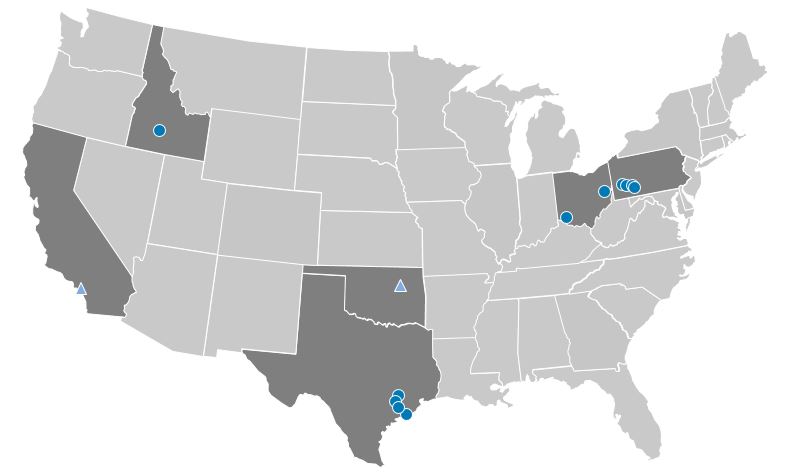
|
|
Renewable Natural Gas |
|
Site |
COD(1) |
Capacity
(MMBtu/
day) (2) |
Source |
|
Rumpke Cincinnati, OH |
1986 |
7,271 |
Landfill |
|
Atascocita Humble, TX |
2002*/ 2018 |
5,570 |
Landfill |
|
McCarty Houston, TX |
1986 |
4,415 |
Landfill |
|
Apex Amsterdam, OH |
2018/2025 |
5,273 |
Landfill |
|
Monroeville Monroeville, PA |
2004 |
2,372 |
Landfill |
|
Valley Harrison City, PA |
2004 |
2,372 |
Landfill |
|
Galveston Galveston, TX |
2019 |
1,857 |
Landfill |
Renewable Electricity Generation |
|
Raeger Johnston, PA |
2006 |
1,857 |
Landfill |
Site |
COD (1) |
Capacity
(MW) |
Source |
|
Shade Cairnbrook, PA |
2007 |
1,857 |
Landfill (3) |
Bowerman Irvine, CA |
2016 |
23.6 |
Landfill |
|
Coastal Plains Alvin, TX |
2020 |
1,775 |
Landfill |
AEL Sand Spring, OK |
2013 |
3.2 |
Landfill |
|
Pico Jerome, ID |
2020 |
903 |
Livestock
(Dairy) |
Total Capacity (MW) |
26.8 |
|
|
Total Capacity (MMBtu) |
35,522 |
|
|
|
 |
= Renewable Natural Gas Project |
 |
= Renewable Electricity Project |
(1)“COD” refers to the commercial operation date of each site.
(2)This is equivalent to the project’s design capacity and assumes inlet methane content of 56% for all sites other than Pico, which assumes inlet methane content of 62%, and process efficiency of 91%.
(3)All of our landfill sites are accepting waste except our Shade site. Our Shade site is closed to accepting new waste, but is currently expected to continue to generate a commercial level of RNG for an additional ten years. Our operating RNG projects have an average expected remaining useful life of approximately 17 years.
We have a long history of operating our projects with partners, with our oldest relationship going back nearly 50 years. On average, we have had an approximate 20-year history with our current project site owners. As of December 31, 2025, our operating RNG projects have an average expected remaining useful life of approximately 17 years and our operating Renewable Electricity projects have an average expected remaining useful life of approximately 33 years, including renewal periods.
Approximately 63% of our 2025 RNG production has been monetized under fuel supply agreements with expiration dates more than 15 years from December 31, 2025. Approximately 94% of our 2025 Renewable Electricity production has been monetized under fuel supply agreements with expiration dates more than 15 years from December 31, 2025. Concurrent with our fuel supply agreements, we typically enter into property leases with our project hosts, which govern access rights, permitted activities, easements and other property rights. We own all equipment and facilities on each leased property, other than equipment provided by utility companies providing services on-site. Lease termination typically requires the restoration of the leased area to its original condition. We have successfully ended leases on six of our former facilities.
Our RNG projects currently utilize three of the four proven commercial technologies available to process raw biogas into RNG, including: pressure swing absorption (“PSA”), Membrane Filtration and solvent scrubbing. We are capable of working with virtually all available biogas processing technologies at our sites. We attend industry conferences and maintain an ongoing dialogue with key equipment providers to ensure we stay informed of the latest technology that could be deployed at our current and future facilities.
Stated capacity reflects the design capacity of each facility. Several of our projects have reserve capacity when comparing design capacity to available biogas feedstock. Several previous acquisitions are gas limited and therefore do not operate at their design capacity. Our larger projects have expansions planned or are being evaluated for future expansions dependent on the availability of excess biogas feedstock.
RNG Projects
We currently own and operate 11 RNG projects across four states: Ohio (two), Pennsylvania (four), Texas (four) and Idaho (one) which, in the aggregate, have a total design capacity of approximately 35,9522 MMBtu/day.
RNG Projects
|
|
|
|
|
Site |
|
Location |
|
Capacity* |
Rumpke |
|
Cincinnati, OH |
|
7,271 MMBtu/day |
Atascocita |
|
Humble, TX |
|
5,570 MMBtu/day |
McCarty |
|
Houston, TX |
|
4,415 MMBtu/day |
Apex (1) |
|
Amsterdam, OH |
|
5,273 MMBtu/day |
Monroeville |
|
Monroeville, PA |
|
2,372 MMBtu/day |
Valley |
|
Harrison City, PA |
|
2,372 MMBtu/day |
Galveston |
|
Galveston, TX |
|
1,857 MMBtu/day |
Raeger Mountain |
|
Johnstown, PA |
|
1,857 MMBtu/day |
Shade |
|
Cairnbrook, PA |
|
1,857 MMBtu/day |
Coastal Plains |
|
Alvin, TX |
|
1,775 MMBtu/day |
Pico |
|
Jerome, ID |
|
903 MMBtu/day |
Total |
|
35,522 MMBtu/day |
(1) Includes the capacity for our second Apex Facility, which was commissioned in 2025.
* Assumes inlet methane content of 56% for all sites other than Pico, which assumes inlet methane content of 62%, and process efficiency of 91%.
Renewable Electricity Projects
We currently own and operate the following two Renewable Electricity projects in California and Oklahoma, which, in the aggregate, have a total design capacity of approximately 29.1 MW. Our Renewable Electricity projects utilize reciprocating engine generator sets to generate electricity at landfills. This does not include the Montauk Ag Renewables project in North Carolina, which is not yet operational.
Renewable Electricity Projects
|
|
|
|
|
Site |
|
Location |
|
Capacity(1) |
Bowerman Power |
|
Irvine, CA |
|
23.6 MW |
Tulsa/AEL |
|
Sand Springs, OK |
|
3.2 MW |
Pico(1) |
|
Jerome, ID |
|
2.3 MW |
|
|
|
Total |
|
29.1 MW |
(1)Beginning in October 2020, we began reporting the result of operations of Pico within RNG, but Pico continues to generate electricity.
* Assumes inlet methane content of 56% and process efficiency of 91%,
A critical component of our business is our ability to negotiate and maintain long-term fuel supply agreements at our project sites. We have developed strong working relationships with our landfill site owners, including eight of 13 operating projects and other potential development projects each with Waste Management and Republic Services, the two largest waste companies in the United States, and actively seek to strategically extend our tenure at our project sites.
Our projects provide our landfill and agricultural partners a solution to monetize biogas from their sites, support their regulatory compliance and provide them with environmental services. We have had working relationships with Republic Services since 1986 and with Waste Management since 2004 and we enable monetization of their biogas while maintaining regulatory compliance. We seek to differentiate ourselves from our competitors through our extensive experience across a variety of commercialized beneficial uses of processed biogas, including pipeline-quality natural gas, power generation and boiler fuel gas products. To date, we have not had any fuel supply agreement terminated by any site partner once we have established a facility on the site, which we believe serves as evidence of our operational expertise, reliability and consistent value delivered to our site partners. The table below is a summary of the expiration periods of those agreements. We are consistently reviewing and pursuing extensions for all of our fuel supply agreements well before their expirations and for future agreements, we continue to target contracts with expirations of 20 years from commencement of operation with options for extension.
Fuel Supply Agreement Summary
RNG Projects
|
|
|
|
|
|
|
|
|
Fuel Supply Agreement Expiration Dates |
|
Current Sites as of December 31, 2025 |
|
|
% of 2025 Total RNG Production |
|
Within 0-5 years |
|
|
2 |
|
|
|
3.0 |
% |
Between 6-15 years |
|
|
3 |
|
|
|
34.0 |
% |
Greater than 15 years |
|
|
6 |
|
|
|
63.0 |
% |
Renewable Electricity Projects
|
|
|
|
|
|
|
|
|
Fuel Supply Agreement Expiration Dates |
|
Current Sites as of December 31, 2025 |
|
|
% of 2025 Total
Renewable
Electricity
Production |
|
Within 0-5 years |
|
|
— |
|
|
|
— |
% |
Between 6-15 years |
|
|
— |
|
|
|
— |
% |
Greater than 15 years(1) |
|
|
2 |
|
|
|
93.8 |
% |
(1)Our Pico project continues to generate both RNG and Renewable Electricity and is accounted for above in the RNG Projects summary.
Customers
Our customers for RNG and RINs typically include large, long-term owner-operators of landfills and livestock farms, local utilities, and large refiners in the natural gas and refining sectors. Royalty structures included in our agreements, as well as the large size of our counterparties, limit their credit risk. Valero and Exxon represented approximately 17.4% and 11.3%, respectively, of our operating revenues in 2025 from the sale of Environmental Attributes. We sell RINs to numerous RIN off-take parties and our largest RIN off-taker as a percentage of revenue can vary year to year given the short-term nature of these contracts. In addition to revenues from sales of RNG and RINs, we also share a portion of our Environmental Attributes with our pathway providers as in-kind consideration for the counterparty using our RNG as a transportation fuel.
Our customers for electricity typically include investor-owned and municipal electricity utilities. For the sale of Renewable Electricity and RECs, the City of Anaheim represented approximately 9.3% of our operating revenues in 2025. These sales occurred under a PPA between us and the City of Anaheim, in which electricity and RECs are sold at fixed prices. In 2025, we converted 100% of the monetization of our Renewable Electricity production and Environmental Attributes under fixed-price agreements. For our electricity sales, all of our customers with whom we have off-take agreements are investment-grade entities with low credit risk.
No other single customer represented more than 10% of our total 2025 operating revenues.
Suppliers and Equipment Vendors
The major technologies used by our projects for gas processing include solvent scrubbing PSA and membrane separation. For electricity generation, we use reciprocating engines. This affords Montauk experience with substantially all major vendors in the sector, and technical expertise in numerous technologies.
We source equipment from a variety of major suppliers with specialties in each technology. We enter into written ordinary-course agreements with suppliers to obtain industry-standard equipment for use in our operations. The contracts generally do not include any intellectual property rights other than for the intended use of the equipment. Membrane separation equipment is primarily provided by UOP and Air Liquide. PSA equipment is primarily provided by Xebec, Guild, Air Products, and BioFerm. Solvent scrubbing is primarily provided by Selexol. RNG ancillary constituent removal is done using equipment provided by Iron Sponge, MV Technologies, Thiopaq, Guild Associates, and PSB Industries. Electricity generation equipment is provided by Solar Turbines, Caterpillar, and Jenbacher.
In 2025, we made a substantial investment in a centralized Enterprise Resource Planning (“ERP”) system Microsoft Dynamics 365. It allows us to better integrate operations across our projects. This system centralizes maintenance operations across all of our projects. Our proactive approach to maintenance, corrective maintenance, root cause analysis, failure reporting, project management, and budgeting are all completed using the ERP system.
Competition
There are several other companies operating in the renewable energy and waste-to-energy space, ranging from other project developers to service or equipment providers.
Our primary competition is from other companies or solutions for access to biogas from waste. Evolving consumer preferences, regulatory conditions, ongoing waste industry trends, and project economics have a strong effect on the competitive landscape and our relative ability to continue to generate revenues and cash flows. We believe that our status as one of the largest operators of LFG-to-RNG projects, our 30-year track record of operating and developing projects, and our deep relationships with some of the largest landfill owners and dairy farms in the country position us very well to continue to operate and grow our portfolio, and respond to competitive pressures. We have demonstrated a track record of strategic flexibility across our 30-year history which has allowed us to pivot towards projects and markets that we believe deliver optimal returns and stockholder value in response to changes in market, regulatory and competitive pressures.
The biogas market is highly fragmented. We believe our size relative to many other LFG companies and our capital structure puts us in a strong position to compete for new project development opportunities or acquisitions of existing projects. However, competition for such opportunities, including the prices being offered for fuel supply, will impact the expected profitability of projects to us, and may make projects unsuitable to pursue. Likewise, prices being offered by our competitors for fuel supply may increase the royalty rates that we pay under our fuel supply agreements when such agreements expire and need to be renewed or when expansion opportunities present themselves at the landfills where our projects currently operate. It is also possible that more landfill owners may seek to install their own LFG projects on their sites, which would reduce the number of opportunities for us to develop new projects. Our overall size, reputation, access to capital, experience and decades of proven execution on LFG project development and operation leave us well-positioned to compete with other companies in our industry.
We are aware of several competitors in the United States that have a similar business model to our own, including Clean Energy Fuels Corp, Opal Fuels, U.S. Gain, Brightmark, Gevo Inc., and AMP Energy, as well as companies with biogas-to-energy facilities as a segment or subsidiary of their operations, including DTE, Ameresco, and British Petroleum (bp, acquired Archaea Energy in 2022). In addition, certain landfill operators, such as Waste Management, have also chosen to selectively pursue biogas conversion projects at their sites. Finally, Republic has entered into a joint venture with bp (formerly through Archaea Energy) to develop certain of its LFG locations.
Government Regulation
Our projects are subject to a range of federal, state and local environmental, health and safety laws and regulations, depending on the nature and configuration of the project, as well as where the project is located. We have established processes and procedures to comply with laws and regulations applicable to our operations, and have partnered with external experts, as needed, to meet applicable compliance requirements. As a renewable energy company, we are committed to being good stewards of the environment and to positively impacting the communities in which we operate.
All of our current Renewable Electricity projects are QFs. As a result, the facilities are exempt from rate regulation under Sections 205 and 206 of the Federal Power Act. We are required to document the QF status of each of our facilities in applications or self-certifications filed with FERC, which typically require disclosure of upstream facility ownership, fuel and size characteristics,
power sales, interconnection matters, and related technical disclosures. Failure to maintain QF status may subject the project to additional regulatory requirements and may require the payment of refunds to customers and other costs or penalties.
We are subject to the Clean Air Act, which regulates the emissions of air pollutants to protect the environmental and public health. The combustion of biogas results in emissions of carbon monoxide, oxides of nitrogen, sulfur dioxide, volatile organic compounds and particulate matter. Federal, state and local laws may require us to obtain permits or impose other burdens, including monitoring, testing, recordkeeping and reporting by us in order for us to conduct operations. In addition, our operations and the operations of landfills may be subject to additional air emissions laws and regulations, such as those designed to address the emission of methane, a potent GHG.
Among other laws, we are subject to Subtitle D of the Resource Conservation and Recovery Act and other federal, state and local laws, which impose conditions on the handling of hazardous and non-hazardous waste, including the emission of methane in landfills. Likewise, we are subject to the Comprehensive Environmental Response Compensation and Liability Act of 1980 and other federal, state and local laws, which govern the investigation and cleanup of sites contaminated with hazardous substances. We have not been identified as a potentially responsible party with respect to environmental remedial costs at any site to date. We also may be required to obtain permits to discharge wastewater and stormwater pursuant to the Clean Water Act’s National Pollutant Discharge Elimination System and other federal, state and local laws governing such discharges.
Our RNG projects are subject to federal RFS program regulations, including the Energy Policy Act of 2005 and the Energy Independence and Security Act. The EPA administers the RFS program with volume requirements for several categories of renewable fuels. The EPA’s RFS regulations establish rules for fuel supplied and administer the RIN system for compliance, trading credits and rules for waivers. The EPA calculates a blending standard for each year based on estimates of gasoline usage from the Department of Energy’s Energy Information Agency. Separate quotas and blending requirements are determined for cellulosic biofuels, BBD, advanced biofuels and total renewable fuel. Further, we are required to register each RNG project with the EPA and relevant state regulatory agencies.
We qualify our RINs through a voluntary Quality Assurance Plan, which typically takes from three to five months from first injection of RNG into the commercial pipeline system. Further, we typically make a large investment in the project prior to receiving the regulatory approval and RIN qualification. In addition to registering each RNG project, we are subject to quarterly audits under the Quality Assurance Plan of our projects to validate our qualification.
Our RNG projects are also subject to state renewable fuel standard regulations. The CA LCFS program requires producers of petroleum-based fuels to reduce the CI of their products, beginning with a quarter of a percent in 2011, a 10% total reduction in 2020, and a 30% total reduction in 2030. Petroleum importers, refiners and wholesalers can either develop their own low-carbon fuel products, or buy CA LCFS credits from other companies that develop and sell low-carbon alternative fuels, such as biofuels, electricity, natural gas or hydrogen. We are subject to a qualification process for CA LCFS credits that is similar to that for RINs, including verification of CI levels and other requirements.
Our RNG projects are also impacted by state and federal gas quality standards. State regulators determine whether RNG may be purchased by the state’s local gas utilities, and whether a site operator may directly sell gas to a retail, or direct end-use, customer. FERC regulates the natural gas pipelines that transport gas in interstate commerce, and specifies or approves a gas pipeline’s tariff that sets the rates, terms and conditions, gas quality, and other requirements applicable to transportation of natural gas on the pipelines, including shipping RNG. Our sites are not permitted, and may not be physically able, to deliver RNG to a FERC regulated pipeline unless the pipeline’s receipt of the gas is consistent with the standards adopted in the pipeline’s FERC tariff. RNG-related gas quality standards may vary by pipeline and may be revised at any time, subject to all required regulatory approvals. We routinely test the RNG produced at our facilities in order to ensure compliance with applicable pipeline gas quality standards.
We monitor regulatory trends and developments in the U.S. regarding the regulation of greenhouse gas emissions. The EPA published final regulations for methane emissions, a greenhouse gas, from oil and gas facilities in March 2024. The regulation does not apply to our operations and could, combined with another public policy and private sector initiatives, increase interest in developing more renewable energy projects in the U.S. We will continue to monitor greenhouse gas regulatory initiatives in the U.S. and assess their potential relevance to our business and operations.
We routinely conduct compliance audits on our projects to proactively identify and correct potential compliance deficiencies or risks. Additionally, we closely monitor emerging regulatory developments that may impact our operations or business strategy. Montauk also participates in industry trade groups, such as the RNG Coalition and American Biogas Council, to advocate policies and regulatory frameworks that support continued expansion of renewable energy in the United States.
The operation of our business may expose us to certain liabilities and compliance costs related to environmental matters. These liabilities or compliance costs did not have a material effect on our capital expenditures or competitive position for fiscal 2024, nor do
we expect them to have a material effect in the future. We believe we are in material compliance with all environmental regulations applicable to our operations.
Tax Regulation. The Inflation Reduction Act ("IRA" or the "Act") will be administered by multiple federal agencies including EPA, U.S. Department of Energy and the Internal Revenue Service of the U.S. Department of the Treasury. The goals of the IRA include incentivizing the development and production of renewable energy. We cannot speculate on exactly how the IRA will be implemented; however, the Act does contain numerous incentives for the production of clean energy which may impact our products. President Trump signed Executive Order 14154 in January 2025, which immediately paused the disbursement of funds under the IRA. The funding pause has been challenged by several states and the District of Columbia. The One Big Beautiful Bill Act was signed into law in July 2025 and, while we are still analyzing its potential impacts, we do not think that it will materially impact us.
Employees and Human Capital Resources
Employee Profile
We employed 189 people on December 31, 2025, located in California, Idaho, Ohio, Oklahoma, Pennsylvania, North Carolina and Texas. Our employee population is comprised of a mix of field operations personnel and office-based professionals. As of December 31, 2025, none of our employees were represented by a collective bargaining unit or labor union. We consider our employee relations to be good across our organization.
Health and Safety
Safety, including the health of our employees, is one of our core values and a priority across our operations. We are committed to developing a strong health and safety culture that reduces injuries and illness whenever possible. Our health and safety strategy is designed to proactively identify, mitigate and eliminate conditions that could result in serious injury or fatality. We also routinely train our employees on health and safety practices applicable to their job function and provide them all necessary personal protective equipment to perform their job in a safe manner.
Our recordable cases and total recordable incident rate (“TRIR”), excluding COVID-19 related incidents, was 1.06 and 2.89 in 2025 and 2024, respectively. The 2024 TRIR national average was 2.4 for all industries. We continue to focus on practices and measures to lower our TRIR.
Employee Development and Training
The success and growth of our business is significantly correlated with our ability to recruit, train, promote and retain talented individuals at all levels of our organization. To succeed in a competitive labor market, we have developed and implemented various recruitment and retention strategies. These include competitive salary structures, bonus programs and competitive benefits, as well as paid time off, sick leave, disability coverage, group term life insurance, and a retirement savings program. We also offer our employees tuition reimbursement for job-related education and training opportunities. We continue to provide leadership and developmental training for our executive, director and manager level employees.
Intellectual Property
We rely on a combination of patent, trademark, copyright and trade secret laws, employee and third-party nondisclosure/confidentiality agreements and non-compete and license agreements to protect our intellectual property. We acquired certain technology in the Montauk Ag Renewables Acquisition for which we received a patent during 2021 with a term of 20 years. In 2022, we filed a provisional patent application pertaining to a combustion-based oxygen removal condensate neutralization technology we developed. The provisional patent covers a new low pH neutralization technology designed to mitigate unfavorable pH condensate that is produced when wastewater is removed from the biogas conversion process. In 2024, we filed a provisional patent application pertaining to a renewable natural gas processing skid that we developed. In 2025, we filed a provisional patent application pertaining to a mobile swine waste separation, collection and removal apparatus and method as well as a provisional patent application for a mixing and solids removal system that we developed for our manure digester in Jerome, Idaho. Further, GreenWave Energy Partners, LLC (“GreenWave”), of which we own 51%, has a provisional patent application filed in 2025 for dispensing of RNG through expanded Transportation Fuel uses under the RFS.
Segments and Geographic Information
We have two operating segments: Renewable Natural Gas and Renewable Electricity Generation. For information regarding revenues and other information regarding our results of operations for each of our last two financial years, please refer to our financial
statements included in this report and within “Item 7.—Management’s Discussion and Analysis of Financial Condition and Results of Operations” of this report.
Corporate Information
Montauk Renewables, Inc. is incorporated in the State of Delaware. Our principal executive offices are located at 5313 Campbells Run Road, Suite 200, Pittsburgh, PA 15205. Our telephone number is (412) 747-8700.
We are required to file annual, quarterly and current reports, proxy statements and other information with the SEC. The SEC maintains an Internet site that contains reports, proxy and information statements, and other information regarding issuers that file electronically with the SEC at http://www.sec.gov.
We also make financial information, news releases and other information available on our corporate investor relations website at www.ir.montaukrenewables.com. Our annual reports on Form 10-K, quarterly reports on Form 10-Q, current reports on Form 8-K, and any amendments to those reports filed or furnished pursuant to Section 13(a) or 15(d) of the Securities Exchange Act of 1934, as amended (the “Exchange Act”), are available free of charge on this website as soon as reasonably practicable after we file these reports and amendments with, or furnish them to, the SEC. The information contained on or connected to our website is not incorporated by reference into this Annual Report on Form 10-K and should not be considered part of this or any other report filed with the SEC.
We are an “emerging growth company” as defined in the Jumpstart Our Business Startups Act of 2012. As an emerging growth company, we may take advantage of certain reduced reporting requirements that are otherwise applicable generally to public companies. We currently intend to take advantage of several of these reduced reporting requirements, including the extended transition periods for complying with new or revised accounting standards. See “Item 1A. Risk Factors—Emerging Growth Company Risks” for certain risks related to our status as an emerging growth company.
We are a “controlled company” within the meaning of the Nasdaq Stock Market LLC (“Nasdaq”) corporate governance standards. Certain stockholders, which are affiliates of two of our directors, Mr. John A. Copelyn and Theventheran G. Govender, own approximately 52.3% of our common stock and have entered into a Consortium Agreement (the “Consortium Agreement”) whereby the parties thereto will agree to act in concert with respect to voting our common stock, including in the election of directors, among other matters. As a controlled company, we may elect not to comply with certain Nasdaq corporate governance standards. See “Item 1A. Risk Factors—Common Stock Risks” for certain risks related to our status as a controlled company.
This report includes estimates, projections, and other information concerning our industry and market data, including data regarding the estimated size of the market, projected growth rates, and perceptions and preferences of consumers. We obtained this data from industry sources, third-party studies, including market analyses and reports, and internal company surveys. Industry sources generally state that the information contained therein has been obtained from sources believed to be reliable. Although we are responsible for all of the disclosure contained in this report, and we believe the industry and market data to be reliable as of the date of this report, this information could prove to be inaccurate.
Information About Our Executive Officers
Below is a list of the names, ages, and positions of our executive officers, and a brief summary of the business experience of our executive officers (ages as of March 1, 2026).
|
|
|
|
|
Name |
|
Age |
|
Position |
Sean F. McClain |
|
51 |
|
President and Chief Executive Officer, Director |
Kevin A. Van Asdalan |
|
48 |
|
Chief Financial Officer and Treasurer |
James A. Shaw |
|
54 |
|
Chief Operating Officer |
John Ciroli |
|
55 |
|
Chief Legal Officer and Secretary |
Sharon Frank |
|
69 |
|
Vice President of Environmental, Health and Safety |
Sean F. McClain. Mr. McClain has served as our President and Chief Executive Officer and a member of our Board of Directors since January 2021. Prior to the Reorganization Transactions, Mr. McClain served as President and Chief Executive Officer of Montauk Holdings USA and as a member of its Board of Directors. From April 2011 until September 2019, Mr. McClain served as Chief Financial Officer of Montauk Holdings USA and Montauk Energy Holdings. Prior to joining Montauk in 2011, he held various management positions with BPL Global Limited, Bayer and Dick’s Sporting Goods and was in public accounting at Arthur Andersen LLP. He is a certified public accountant and has over 25 years of business and financial management experience.
Kevin A. Van Asdalan. Mr. Van Asdalan has served as our Chief Financial Officer and Treasurer since January 2021. Prior to the Reorganization Transactions, Mr. Van Asdalan served as Chief Financial Officer of Montauk Holdings USA and as a member of its Board of Directors. From March 2018 until September 2019, Mr. Van Asdalan served as Controller of Montauk Energy Holdings and Montauk Holdings USA. Prior to joining Montauk in 2018, Mr. Van Asdalan served as a lines of business controller and manager of external reporting at L.B. Foster Company, a manufacturer, distributor and service provider for transportation and energy infrastructure, from July 2011 to March 2018. Prior to L.B. Foster, Mr. Van Asdalan held senior associate accounting positions at PricewaterhouseCoopers LLP and Sisterson & Co LLP. He is a certified public accountant and chartered global management accountant with nearly 25 years of business and financial management experience and holds a Master of Business Administration from the University of Pittsburgh Katz Graduate School of Business.
James A. Shaw. Mr. Shaw has served as our Chief Operating Officer since October 2025. He served as our Vice President of Operations from January 2021 until September 2025 and as the Vice President of Operations of Montauk Energy Holdings from September 2019 until December 2020. He previously served as North Region Manager of Montauk Energy Holdings from May 2016 until September 2019 and held positions of increasing responsibility as a site manager from 2010 until 2016. Prior to joining Montauk, Mr. Shaw was a facility manager for SONY Electronics at the world’s first vertically integrated television manufacturing facilities. Mr. Shaw has more than 25 years of experience in facilities operations and management.
John Ciroli. Mr. Ciroli has served as our Chief Legal Officer since January 2023. He served as our Vice President, General Counsel and Secretary from January 2021 until January 2023 and in the same role with Montauk Energy Holdings upon joining in July 2020. From July 2016 to July 2020, Mr. Ciroli was the North American Counsel and HR Manager for the North American subsidiaries of FAAC Group, a company that designs solutions for pedestrian and vehicle needs, representing the entities in their American and Canadian portfolio. From 2014 to July 2016, Mr. Ciroli was a Senior Litigation Counsel with the Housing Authority of the City of Pittsburgh. Mr. Ciroli has over 25 years of experience representing and advising domestic and international corporations and government entities in the areas of contracts, mergers and acquisitions, litigation, employment and governmental procurement and regulatory affairs. He was also a professor for Concord Law School, now Purdue Global, in the areas of Contracts, Constitutional Law, Torts and Evidence and is a member of the Pennsylvania State Bar and the bar of the U.S. Supreme Court.
Sharon Frank. Ms. Frank has served as our Vice President of Environmental, Health and Safety since October 2021. She served as our Director of Environmental, Health and Safety from April 2020 until October 2021 and as Manager of Environmental Compliance from June 2007 until April 2020. Prior to joining Montauk, from 2000 to 2007, Ms. Frank was Manager of Environmental Affairs for Duquesne Light Company’s unregulated business group. Ms. Frank has over 30 years of regulatory and environmental compliance experience.
ITEM 1A. RISK FACTORS.
This Annual Report on Form 10-K contains forward-looking information based on our current expectations. Because our business is subject to many risks and our actual results may differ materially from any forward-looking statements made by or on behalf of us, this section includes a discussion of important factors that could affect our business, operating results, financial condition and the trading price of Montauk common stock. You should carefully consider these risk factors, together with all of the other information included in this Annual Report on Form 10-K as well as our other publicly available filings with the SEC. Although the risks are organized by headings, and each risk is discussed separately, many are interrelated.
Operational Risks
Our renewable energy projects may not generate expected levels of output.
Landfills contain organic material whose decomposition causes the generation of gas consisting primarily of methane, which our RNG projects use to generate power or renewable natural gas, and carbon dioxide. The estimation of landfill gas production volume is an inexact process and dependent on many site-specific conditions, including the estimated annual waste volume, composition of waste, regional climate and the capacity and construction of the landfill. Production levels are subject to a number of additional risks, including a failure or wearing out of our or our landfill operators’, customers’ or utilities’ equipment; an inability to find suitable replacement equipment or parts; less than expected supply or quality of the project’s source of biogas and faster than expected diminishment of such biogas supply; or volume disruption in our fuel supply collection system. Any extended interruption and/or volume disruption in the project’s operation, or failure of the project for any reason to generate the expected amount of output, could adversely affect our business and operating results. For example, certain of our Houston-based operating sites were impacted by severe weather events during the first nine month of 2024 including multiple day extended outages from Hurricane Beryl in July 2024. Furthermore, we produced fewer MMBtu and MWh in the third quarter of 2023 compared with the third quarter of 2022 due to dry weather conditions and higher ambient temperatures. In addition, we have in the past, and may in the future, incur material asset impairment charges if any of our renewable energy projects has operational issues that indicate our expected future cash flows from the project are less than the project’s carrying value. Any such impairment charge could adversely affect our operating results in the period in which the charge is recorded.
In addition, to maximize collection of LFG, we need to take various measures, such as drilling additional gas wells in the landfill to increase LFG collection, balancing the pressure on the gas field based on the data collected by the landfill operator from the gas wells to ensure optimum landfill gas utilization and ensuring that we match availability of engines and related equipment to availability of LFG. There can be no guarantee that we will be able to take all necessary measures to maximize collection. For example, we do not operate the wellfields at all sites. In addition, the LFG available to our projects is dependent in part on the actions of other persons, such as landfill operators. We may not be able to ensure responsible management of the landfill site by owners and operators or there could be a change in operations and maintenance providers that results in less effective operations. This could result in less-than-optimal gas generation or increase the likelihood of “hot spots” occurring. Hot spots can temporarily reduce the volume of gas which may be collected from a landfill site, resulting in a lower gas yield. Landfill owner negligence such as covering gas wells with landfill material and breaking gas lines could also result in decreased output. Other events that result in a reduction in LFG output include: extreme hot or cold temperatures or drought or excessive rainfall; liquid levels within a landfill increasing; oxidation within a landfill, which can kill the anaerobic microbes that produce landfill gas; and the buildup of sludge or inorganic materials (such as construction materials) that do not produce gases as they decompose.
The occurrence of these or any other changes within any of the landfills where our projects operate could lead to a reduction in the amount of LFG available to operate our projects, which could have a material adverse effect on our business, financial condition and results of operations.
The concentration in revenues from five of our projects and geographic concentration of our projects expose us to greater risks of production interruptions from severe weather or other interruptions of production or transmission.
A substantial portion of our revenues are generated from five project sites. For the years ended December 31, 2025 and 2024, excluding the effect of derivative instruments, approximately 67.7% and 69.1%, respectively, of operating revenues derived from these locations. During 2025, RNG production at our Rumpke, Atascocita, McCarty and Apex facilities accounted for approximately 20.7%, 20.3%, 16.0% and 7.7% of our RNG revenues, respectively, and 20.7%, 20.3%, 16.0% and 7.7% of the RNG we produced, respectively. During 2025, Renewable Electricity production at our Bowerman facility accounted for approximately 94.9% of our Renewable Electricity Generation revenues and 85.5% of the Renewable Electricity we produced during 2025. A lengthy interruption of production or transmission of renewable energy from one or more of these projects, due to a severe weather event, failure or degradation of our or a landfill operator’s equipment or interconnection transmission problems could have a disproportionate effect on our revenues and cash flow.
Our Atascocita, McCarty, Galveston and Coastal Plains projects are located within 20 miles of each other near Houston, Texas and six of our other RNG projects are in relatively close proximity to each other in Pennsylvania and Ohio. Regional events, such as gas transmission interruptions, regional availability of replacement parts and service in the event of equipment failures and severe weather events in either of those geographic regions have previously adversely affected, and if the future could adversely affect, our RNG production and transmission. These impacts are greater than would be if our business was more geographically diverse.
We have significant customer concentration, with a limited number of customers accounting for a substantial portion of our revenues.
In 2025, RIN sales to Valero and ExxonMobil represented approximately 17.4% and 11.3%, respectively, of our operating revenue. In 2024, RIN sales to Valero, GE Warren, ExxonMobil and Mercuria represented approximately 17.6%, 15.7%, 13.8 and 11.8%, respectively, of our operating revenue. Five customers made up approximately 68.2% of our accounts receivable as of December 31, 2025 and December 31, 2024. Revenues from our largest customers may fluctuate from time to time based on our customers’ business needs, market conditions or other factors outside of our control. If any of our largest customers terminates its relationship with us, such termination could adversely affect our revenues and results of operations.
Our projects are not able to insure against all potential risks and may become subject to higher insurance premiums.
Our projects are exposed to the risks inherent in the construction and operation of renewable energy projects, such as breakdowns, manufacturing defects, extreme weather, natural disasters, terrorist attacks and sabotage. We are also exposed to environmental risks.
We have insurance policies covering certain risks associated with our business. Our insurance policies do not, however, cover all losses, including, in some situations, those because of force majeure, which is generally defined as events that are beyond the control of the parties. Even if insurance policies for some of our projects cover losses as a result of certain types of force majeure events, such coverage is subject to important limitations. Furthermore, insurance liabilities are difficult to assess and quantify due to unknown factors, including the severity of an injury, the determination of our liability in proportion to other parties, the number of incidents not reported and the effectiveness of our safety program. Insurance coverage is not always available on commercially reasonable terms (if at all) and is often capped at predetermined limits. In addition, our insurance policies are subject to annual review by our insurers and may not be renewed on similar or favorable terms or at all. A serious uninsured loss or a loss significantly exceeding the limits of our insurance policies could adversely affect our business, financial condition and results of operations.
Competition Risks
We may face intense competition and may not be able to successfully compete.
There are a number of other companies operating in the renewable energy and waste-to-energy markets. These include other renewable energy companies and service or equipment providers, consultants, managers and strategic investors.
We may not have the resources to compete with our existing competitors or with any new competitors, including in a competitive bidding process. Some of our competitors have significantly larger personnel, financial and managerial resources than we have, and we may fail to maintain or expand our business. Our competitors may also offer energy solutions at prices below cost, devote significant sales forces to competing with us or attempt to recruit our key personnel by increasing compensation, any of which could improve their competitive positions. Moreover, if the demand for renewable energy increases, new companies may enter the market, and the influx of added competition will pose an increased risk to us.
Further, certain of our strategic partners and other landfill or agricultural operators could decide to manage, recover and convert biogas from waste to renewable energy on their own which would further increase our competition, limit the number of commercially viable landfill sites available for our projects or require us to reduce our profit margins to maintain or acquire projects.
Our success depends, in part, on technological innovation to stay ahead of market competitors.
Our success depends on our ability to create and maintain a competitive position in the renewable energy industry. We do not have exclusive rights to many of the technologies that we utilize, and our competitors may currently use and may be planning to use identical, similar or superior technologies. In addition, our technologies may ultimately prove ineffective, may be hampered by frequent mechanical breakdowns, or rendered obsolete or uneconomical by technological advances, more efficient and cost-effective processes or entirely different approaches developed by one or more of our competitors or others.
We may also face competition based on technological developments that reduce demand for electricity, increase power supplies through existing infrastructure or otherwise compete with our projects. We also encounter competition in the form of potential customers electing to develop solutions or perform services internally rather than engaging an outside provider such as us.
Our use and enjoyment of real property rights for our projects may be adversely affected by the rights of lienholders and leaseholders that are superior to those of the grantors of those real property rights to our projects.
Our projects generally are, and any of our future projects are likely to be, located on land occupied pursuant to long-term easements, leases and rights of way. The ownership interests in the land subject to these easements, leases and rights-of-way may be subject to mortgages securing loans or other liens (such as tax liens) and other easements, lease rights and rights-of-way of third parties (such as leases of oil or mineral rights) that were created prior to our projects’ easements, leases and rights-of-way. As a result, certain of our projects’ rights under these easements, leases or rights-of-way may be subject, and subordinate, to the rights of those third parties. In the future, our existing projects may need new easements or rights-of-way and there is no guaranty that we will be able to secure these. For example, our Shade facility in Johnstown needs a change in the easement due to road construction. We may not be able to protect our operating projects against all risks of loss of our rights to use the land on which our projects are located, and any such loss or curtailment of our rights to use the land on which our projects are located and any increase in rent due on such lands could adversely affect our business, financial condition and results of operations.
We may not be able to obtain long-term contracts for the sale of power produced by our projects on favorable terms and we may not meet certain milestones and other performance criteria under existing PPAs.
Obtaining long-term contracts for the sale of power produced by our projects at prices and on other terms favorable to us is essential for the long term success of our business. We must compete for PPAs against other developers of renewable energy projects. This intense competition for PPAs has resulted in downward pressure on PPA pricing for newly contracted projects. The inability to compete successfully against other power producers or otherwise enter into PPAs favorable to us would negatively affect our ability to develop and finance our projects and negatively affect our revenues. In addition, the availability of PPAs depends on utility and corporate energy procurement practices that could evolve and shift allocation of market risks over time. Further, PPA availability and terms are a function of a number of economic, regulatory, tax, and public policy factors, which are also subject to change.
Our PPAs typically require us to meet certain milestones and other performance criteria. Our failure to meet these milestones and other criteria, including minimum quantities, may result in price concessions, in which case we would lose any future cash flow from the relevant project. In addition, we have in the past and, in the future, may be required to pay fees and penalties to our counterparty. We cannot assure you that we will be able to perform our obligations under such agreements, that fees and penalties will remain insignificant, or that we will have sufficient funds to pay any fees or penalties thereunder.
Business Strategy Risks
Our commercial success depends on our ability to identify, acquire, develop and operate individual renewable energy projects, as well as our ability to maintain and expand production at our current projects.
We aim to maintain and grow our position as a leading producer of RNG in the United States. Our specific focus on the renewable energy sector exposes us to risks related to the supply of, demand for and the ultimate price of energy commodities and Environmental Attributes, inflation, taxes, tariffs, duties, or other assessments on necessary equipment, the cost of capital expenditures, government regulation, world and regional events and economic conditions, labor market conditions and the acceptance of alternative power sources. As a renewable energy producer, we may also be negatively affected by lower energy output resulting from variable inputs, mechanical breakdowns, faulty technology, competitive electricity markets or changes to the laws and regulations that mandate the use of renewable energy sources by refiners and importers of gasoline and diesel fuel and electric utilities.
In addition, several other factors related to the development and operation of individual renewable energy projects could adversely affect our business, including:
•regulatory changes and statements and policies of the current presidential administration that make it more difficult and expensive for us to borrow and raise capital, reduce investment in the infrastructure we rely on and affect the demand for and supply of our RNG, REG, and the Environmental Attributes and the prices thereof, which have a significant effect on the financial performance of our projects and the number of potential projects with attractive economics;
•changes in energy commodity prices, such as natural gas and wholesale electricity prices, which could have a significant effect on our revenues;
•changes in pipeline gas quality standards or other regulatory changes that may limit our ability to transport RNG on pipelines for delivery to third parties or increase the costs of processing RNG to allow for such deliveries;
•changes in the broader waste collection industry, including changes affecting the waste collection and biogas potential of the landfill industry, which could impede the LFG resource that we currently target for our projects;
•substantial construction risks, including the risk of delay that may arise due to forces outside of our control, including those related to reduced parts supply, delays in parts supply, increased costs of parts, engineering and environmental problems, labor shortages and disruptions and adverse weather conditions;
•operating risks and the effect of disruptions on our business, weather conditions, catastrophic events such as fires, explosions, earthquakes, droughts and acts of terrorism, and other force majeure events on us, our customers, suppliers, distributors and subcontractors;
•the ability to obtain financing for a project on acceptable terms or at all and the need for substantially more capital than initially budgeted to complete projects and exposure to liabilities as a result of unforeseen costs or environmental, construction, technological or other complications;
•entering into markets where we have less experience, such as our projects for biogas recovery at livestock farms;
•exposure to liabilities as a result of unforeseen environmental, construction, technological or other complications;
•failures or delays in obtaining desired or necessary land rights, including ownership, leases, easements, zoning rights and building permits;
•a decrease in the availability and timeliness of delivery of raw materials and components necessary for the projects to develop and function, such as our collaboration with European Energy which relies on parts from Denmark, or an increase in the costs of raw materials and components due to, among other reasons, inflation, tariffs, duties, taxes or assessments;
•obtaining and keeping in good standing permits, authorizations and consents from local city, county, state and U.S. federal governments as well as local and U.S. federal governmental organizations;
•penalties, including potential termination, under short-term and long-term contracts for failing to deliver RNG, RECs, or REG in accordance with our contractual obligations;
•unknown regulatory changes with respect to RECs, RINs, REG, or RNG which may increase the transportation cost for delivering under contracts in place;
•the consent and authorization of local utilities or other energy development off-takers to ensure successful interconnection to energy grids to enable power sales; and
•difficulties in identifying, obtaining and permitting suitable sites for new projects.
In addition, new projects have no operating history and may employ recently developed technology and equipment. The technology may not be successful or our use of intellectual property may be challenged for infringement. A new project may be unable to fund principal and interest payments under its debt service obligations or may operate at a loss, which may adversely affect our business, financial condition or results of operations. This may also make it more difficult to obtain capital for new projects.
We may also experience delays and cost overruns in converting existing facilities from Renewable Electricity to RNG production. During the conversation projects, there is a gap in production and relating revenue while the electricity project is offline until it commences operation as an RNG facility, which adversely affects our financial condition and results of operations.
Any of these factors could prevent us from identifying, completing or operating our projects, or otherwise adversely affect our business, financial condition and results of operations.
If there is not sufficient demand for renewable energy, or the associated Environmental Attributes, or if renewable energy projects do not develop or take longer to develop than we anticipate, we may be unable to achieve our investment objectives.
If demand for renewable energy or Environmental Attributes fails to grow sufficiently, we may be unable to achieve our business objectives. In addition, demand for renewable energy projects and Environmental Attributes in the markets and geographic regions that we target may not develop or may develop more slowly than we anticipate. Many factors will influence the widespread adoption of renewable energy and demand for renewable energy projects, including:
•cost-effectiveness of renewable energy technologies as compared with conventional and competitive technologies;
•performance and reliability of renewable energy products as compared with conventional and non-renewable products;
•fluctuations in economic and market conditions that impact the viability of conventional and competitive alternative energy sources;
•increases or decreases in the prices of oil, coal and natural gas;
•continued deregulation of the electric power industry and broader energy industry; and
•availability or effectiveness of government subsidies and incentives.
Our fuel supply agreements with site hosts have defined contractual periods, and we cannot assure you that we will be able to successfully extend these agreements at their historic revenue levels or at all.
Fuel supply rights are issued by the landfill owner to operators for a contractual period. As operators, we have already invested resources in the development of existing sites and the ability to extend these contracts on expiration would enable us to achieve operational efficiency in continuing to generate revenues from a site without significant additional capital investments. We cannot assure you that we will be able to extend existing fuel supply agreements at their historic revenue levels or at all when they expire.
Our agreements contain complex price adjustments, calculations and other terms based on gas price indices and other metrics, the interpretation of which could result in disputes with counterparties that could affect our results of operations and customer relationships.
Certain of our PPAs, fuel supply agreements, RNG off-take agreements and other agreements require us to make payments or adjust prices to counterparties based on past or current changes in gas price indices, project productivity or other metrics and involve complex calculations. Moreover, the underlying indices governing payments under these agreements are subject to change, may be discontinued or replaced. The interpretation of these price adjustments and calculations and the potential discontinuation or replacement of relevant indices or metrics have resulted, and in the future, could result in disputes with the counterparties with respect to these agreements. Any such disputes could adversely affect project revenues, expense margins, customer or supplier relationships, or lead to costly litigation, the outcome of which we would be unable to predict.
In order to secure contracts for new projects, we typically face a long and variable development cycle that requires significant resource commitments and a long lead time before we realize revenues.
The development, design and construction process for our renewable energy projects generally lasts from 18 to 36 months, on average. This extended development process requires the dedication of significant time and resources from our sales and management personnel, with no certainty of success or recovery of our expenses. A potential site host may go through the entire sales process and not accept our proposal. Further, upon commencement of operations, it typically takes 12 months or longer for the project to ramp up to our expected production level. All of these factors, and in particular, increased spending that is not offset by increased revenues, can contribute to fluctuations in our quarterly financial performance and increase the likelihood that our operating results in a particular period will fall below investor expectations.
We plan to expand our business in part through developing RNG recovery projects at landfills and livestock farms, including our Turkey, North Carolina location, but we may not be successful.
We plan to continue to develop new RNG projects at landfills and livestock farms but we may be unable to implement this growth strategy. We may not be able to identify suitable landfills and livestock farms on which to develop projects, reach agreements with landfill or livestock farm owners to develop RNG projects or arrange required financing for new projects. While the EPA has identified an additional 444 landfills as candidates for biogas projects, we believe that approximately 32 of these sites produce sufficient quantities of LFG to support commercial-scale projects, with 24 of the approximately 32 sites being operated by Waste Management or Republic Waste, with whom we would need to negotiate with to secure sufficient LFG rights to support an RNG project. In the future, additional candidate landfills may become economically viable as their growth increases LFG production and requires installation of LFG collection systems. However, the time and effort involved in attempting to identify suitable sites and development of new projects may divert members of our management from our operations.
While our Montauk AG swine manure facility in Turkey, North Carolina is scheduled to begin commercial operations in April 2026, we have experienced delays due to inclement weather, construction delays, mechanical breakdowns and failure of technology to perform as expected. As of December 31, 2025, we have spent approximately $142 million to develop the facility and expect that total capital investment will be approximately $200 million. There can be no assurances that the facility will produce the projected amount of renewable electricity and swine RECs or that the project will not need additional capital investment to become fully operational. Furthermore, while we are contracted to sell a portion of the swine RECs produced, we do not have a contract to sell all projected swine RECs we produce. There is no established market for swine RECs so we are unsure at what price we will be able to sell them, if we are able to sell them at all.
Our dairy farm project has, and any future digester project will have, different economic models and risk profiles than our landfill facilities, and we may not be able to achieve the operating results we expect from these projects.
Our Pico dairy farm project produces significantly less RNG than our landfill facilities. As a result, we are even more dependent on the LCFS credits and RINs produced at our dairy farm project than on the RINs produced at our landfill facilities for the project’s commercial viability. As a result of the 2025 AFPR review, our CI score worsened. The worsening CI score is primarily due to increased biogas upgrading and fugitive emissions from the biogas upgrading process. We are currently conducting an analysis to determine the benefit of installing a combustion device to eliminate fugitive emissions. As a result of this, we may be subject to a claw back of LCFS credits related to the overgeneration of LCFS credits using the old CI Score. While we do not believe the penalty applies to us, the legislation does allow for a penalty of four times the number of LCFS credits to be taken away from a producer as a penalty if its score is lowered. As a result, the number of LCFS credits for RNG generated at our dairy farm project will decline. Additionally, revenue from LCFS credits also depends on the price per LCFS credit, which is driven by various market forces, including the supply of and demand for LCFS credits, which in turn depends on the demand for traditional transportation fuel and the supply of renewable fuel from other renewable energy sources, and mandated CI targets, which determine the number of LCFS credits required to offset LCFS deficits, and which increase over time. Fluctuations in the price of LCFS credits or the number of LCFS credits assigned will have a significantly greater impact on the success of our dairy farm project than the value that RINs have on our landfill facilities. A significant decline in the value of LCFS credits could require us to incur an impairment charge on our dairy farm project and could adversely affect our business, financial condition and results of operations.
While we currently focus on converting methane into renewable energy, in the future we may decide to expand our strategy to include other types of projects. Any future energy projects may present unforeseen challenges and result in a competitive disadvantage relative to our more established competitors.
Our business is currently focused on converting methane into renewable energy. In the future, we may expand our strategy to include other types of projects. We cannot assure you that we will be able to identify attractive opportunities outside of our current area of focus or acquire or develop such projects at a price and on terms that are attractive or that, once acquired or developed, such projects will operate profitably. Risks include a lack of supply offtake, lower than expected prices for generated supplies, malfunctioning equipment, unsuccessful new technologies, and intellectual property challenges. In addition, these projects could expose us to increased operating costs, unforeseen liabilities or risks, and regulatory and environmental concerns associated with entering into new sectors of the energy industry, including requiring a disproportionate amount of our management’s attention and resources, which could adversely affect our business, as well as place us at a competitive disadvantage relative to more established market participants. A failure to successfully integrate such new projects into our existing project portfolio as a result of unforeseen operational difficulties or otherwise, could adversely affect our business, financial condition and results of operations.
The profitability of our renewable fuel projects may be limited by our ability to dispense fuel to separate RINs and the volatility of the price of RINs.
A RIN is separated by dispensing RNG through permitted channels. If we are unable to dispense RNG through such permitted channels because of a lack of demand, we are unable to separate RINs. Furthermore, if the supply of RNG to be separated through the permitted channels is greater than the demand for the RNG, the price we pay to separate the RIN could be higher.
Furthermore, the price of Environmental Attributes, including RINs, is driven by various market forces, including regulatory action, gasoline prices and the availability of renewable fuel from other renewable energy sources and conventional energy sources. For example, following the EPA’s issuance of annual Renewable Volume Obligations in recent years, market prices for certain RIN categories have experienced significant volatility in response to changes in mandated volumes, compliance flexibility, and market expectations. In addition, refiners are permitted to carry over up to 20% of RINs generated for one calendar year to satisfy their RVOs for the following year. As a result, we are generally only able to sell RINs on a forward basis for the year in which the RINs are generated and the subsequent year.
We may be unable to manage the risk of volatility in RIN pricing for all or a portion of our revenues from RINs, which would expose us to the volatility of commodity prices with respect to all or the portion of RINs that we are unable to sell through forward contracts, including risks resulting from changes in regulations, general economic conditions and changes in the level of renewable energy generation. We expect quarterly variations in the revenues from the projects in which we generate revenue from the sale of RINs that we are unable to sell through forward contracts and may experience reduced revenues if we are unable to separate RINs through the dispensing of produced RNG through permitted channels or reduced net income if we must pay a higher price to separate such RINs due to excess supply.
Our revenues may be subject to the risk of fluctuations in commodity prices.
The operations and financial performance of projects in the renewable energy sectors may be affected by the prices of energy commodities, such as natural gas, wholesale electricity and other energy-related products. For example, the price of renewable energy resources changes in relation to the market prices of natural gas and electricity. The market price for natural gas is sensitive to cyclical demand and capacity supply, changes in weather patterns (including extreme temperatures spells), natural gas storage levels, natural gas production levels, general economic and geopolitical conditions (including the current conflict in the Middle East) and the volume of natural gas imports and exports. The market price of electricity is sensitive to changes in demand and capacity supply (including both cyclical demand and increased long term demand due to, among others, data storage centers and artificial intelligence), and in the economy and geopolitical conditions, as well as to regulatory trends and developments impacting electricity market rules and pricing, transmission development and investment to power markets within the United States and in other jurisdictions through interconnects and other external factors outside of the control of renewable energy power-producing projects. Volatility of commodity prices also creates volatility in the prices of Environmental Attributes, which are inversely related to the wholesale price of unleaded gasoline. In addition, volatility of commodity prices, such as the market price of gas and electricity, may also make it more difficult for us to raise any additional capital for our renewable energy projects that may be necessary to operate, to the extent that market participants perceive that a project’s performance may be tied directly or indirectly to commodity prices. Accordingly, the potential revenues and cash flows of these projects may be volatile and adversely affect the value of our investments.
Our off-take agreements for the sale of RNG are typically shorter in duration than our fuel supply agreements. Accordingly, if we are unable to renew or replace an off-take agreement for a project for which we continue to produce RNG, we would be subject to the risks associated with selling the RNG produced at that project at then-current market prices. We may be required to make such sales at a time when the market price for natural gas as a whole or in the region where that project is located is depressed. If this were to occur, we would be subject to the volatility of gas prices and be unable to predict our revenues from such project, and the sales prices for such RNG may be lower than what we could sell the RNG for under an off-take agreement.
We are exposed to the risk of failing to meet our contractual commitments to sell RINs from our production.
We may sell forward a portion of our RINs under contracts to fix the revenues from such attributes for financing purposes or to manage our risk against future declines in prices of such Environmental Attributes. If our RNG projects do not generate the amount of RINs sold under such forward contracts we may be required to make up the shortfall of RINs under such forward contracts through purchases on the open market or the payment of liquidated damages. Forward selling our RINs could result in realized prices monetized in a year which do not correspond directly to index prices.
Regulatory Risks
The reduction or elimination of governmental economic incentives for renewable energy projects or other related policies could adversely affect our business, financial condition and results of operation.
We depend on Environmental Attributes, which are federal, state and local government incentives in the United States, provided in the form of RINs, RECs, LCFS credits, rebates, tax credits and other incentives to end users, distributors, system integrators and manufacturers of renewable energy projects, that promote the use of renewable energy. RINs are created through the RFS program administered by the EPA, which requires transportation fuel sold in the United States to contain a minimum volume of renewable fuel and has historically permitted refineries and importers of transportation fuel to satisfy their RVOs by purchasing either (i) D5 RINs and cellulosic waiver credits (“CWCs”) or (ii) D3 RINs. In a December 1, 2022 proposed rule, EPA proposed to not utilize its cellulosic waiver authority for the years 2023-2025. However, if actual production is lower than the RVO, the EPA will have discretion to utilize CWC. This rule was finalized on July 12, 2023. On December 12, 2024, EPA proposed a partial waiver of 2024 Cellulosic Biofuel Volume Requirements due to the projected shortfall of D3 RINs available to meet the 2024 RVO. This rule was finalized on July 7, 2025. EPA made CWCs available for purchase under the final rule along with the partial waiver of the 2024 cellulosic biofuel volume requirement. The final rule also requires the use of a new data source for the average wholesale price of gasoline to be used in the calculation of the CWC price. The EPA proposed the 2026 and 2027 RVOs and a Partial Waiver of the 2025 Cellulosic Biofuel Volume Requirement on June 17, 2025. On August 22, 2025, the EPA issued decisions on 175 Small Refinery Exemptions (SREs) for the years 2023-2025. EPA subsequently proposed a Supplemental Rule (referred to as the SRE reallocation volume) on September 18, 2025, which would account for the for 2023-2025 exempted RVOs. EPA co-proposed SRE reallocation volumes that would account for 100 percent or 50 percent of the exemptions granted for the 2023-2025 compliance years. EPA is aiming to finalize new biofuel mandates for 2025, 2026 and 2027 along with the Supplemental Rule in late March 2026. RECs are created through state law requirements for utilities to purchase a portion of their energy from renewable energy sources. Approximately, 67% and 74% of our operating revenues for 2025 and 2024, respectively, were generated from the sale of Environmental Attributes. These government economic incentives could be reduced or eliminated altogether or interpretations of existing regulations or the categories of renewable energy qualifying for such government economic incentives could be changed. These renewable energy program incentives are subject to regulatory oversight and could be administratively or legislatively changed
in a manner that could adversely affect our operations. Reductions in, changes to, or eliminations or expirations of governmental incentives could result in decreased demand for, and lower revenues from, our projects. Changes in the level or structure of the RPS of a state for electricity could also result in a decline in our revenues or decreased demand for, and lower revenues from, our electricity projects.
We may be unable to obtain, modify or maintain the regulatory permits, approvals and consents required to construct and operate our projects.
Our operations are subject to various federal, state, and local EHS laws and regulations, including those relating to the release, emission or discharge of materials into the air, water and ground, the generation, storage, handling, use, transportation and disposal of hazardous materials and wastes, the health and safety of our employees and other persons, and the generation of RINs and LCFS credits.
These laws and regulations impose numerous obligations applicable to our operations, including the acquisition of permits before construction and operation of our projects; the restriction of types, quantities and concentration of materials that can be released into the environment; the limitation or prohibition of our activities on certain lands lying within wilderness, wetlands and other protected areas; the application of specific health and safety criteria addressing worker protection; and the imposition of substantial liabilities for pollution resulting from the ownership or operation of our properties. These laws, regulations and permits can require expensive pollution control equipment or operational changes to limit actual or potential impacts to the environment.
Numerous governmental entities have the power to enforce difficult and costly compliance measures or corrective actions pursuant to these laws and regulations and the permits issued under them. We may be required to make significant capital and operating expenditures on an ongoing basis, or to perform remedial or other corrective actions at our properties, to comply with the requirements of these environmental laws and regulations or the terms or conditions of our permits. Failure to comply with these laws and regulations may result in the assessment of sanctions, including administrative, civil or criminal penalties, the imposition of investigatory or remedial obligations, and the issuance of orders limiting or prohibiting some or all of our operations. In addition, we may experience delays in obtaining or be unable to obtain required environmental regulatory permits or approvals, which may delay or interrupt our operations and limit our growth and revenue.
Our operations inherently risk incurring significant environmental costs and liabilities due to the need to manage waste from our processing facilities. Spills or other releases of regulated substances, including spills and releases that occur in the future, could expose us to material losses, expenditures and liabilities under applicable environmental laws, rules and regulations. Under certain such laws and regulations, we could be held strictly liable for the removal or remediation of previously released materials or property contamination, regardless of whether we were responsible for the release or contamination and even if our operations met previous standards in the industry at the time they were conducted. In connection with certain acquisitions, we could acquire, or be required to provide indemnification against, environmental liabilities that could expose us to material losses. In addition, claims for damage to persons or property, including natural resources, may result from the EHS impacts of our operations. Our insurance may not cover all environmental risks and costs or may not provide sufficient coverage if an environmental claim is made against us.
New laws, changes to existing laws, new interpretations of existing laws, increased governmental enforcement of environmental laws or other developments could require us to make significant additional expenditures and these additional expenditures may result in us terminating new projects or ceasing operations of existing projects. Present and future federal and state environmental laws and regulations, and interpretations of those laws and regulations, applicable to our operations, more vigorous enforcement policies and discovery of currently unknown conditions may require substantial expenditures that could have a material adverse effect on our results of operations and financial condition. On January 7, 2026, President Trump signed a presidential memorandum to exit the United Nations Framework Convention on Climate Change (UNFCCC) along with the Intergovernmental Panel on Climate Change (IPCC) and over 60 other international organizations, arguing they did not serve U.S. interests. While federal support for renewable projects may decline, states and the private sector are expected to continue driving development.
Our ability to generate revenue from sales of RECs, RINs and LCFS credits depends on our strict compliance with these federal and state programs, which are complex and can involve a significant degree of judgment. If the agencies that administer and enforce these programs disagree with our judgments, otherwise determine that we are not in compliance, conduct reviews of our activities or make changes to the programs, then our ability to generate or sell these credits could be temporarily restricted pending completion of reviews or as a penalty, permanently limited or lost entirely, and we could also be subject to fines or other sanctions. Moreover, the inability to sell RINs and LCFS credits could adversely affect our business.
In order to construct, modify and operate our projects, we will need to obtain or may need to modify numerous environmental and other regulatory permits, approvals and consents from federal, state and local governmental entities, including air permits, wastewater discharge permits, stormwater permits, permits or consents related to the management of municipal solid waste landfills and permits or consents related to the management and disposal of waste. A number of these permits, approvals and consents must be obtained prior to the start of development of a project. Other permits, approvals and consents are required to be obtained at, or prior to,
the time of first commercial operation or within prescribed time frames following commencement of commercial operations. Any failure to successfully obtain or modify the necessary environmental and other regulatory permits, approvals and consents on a timely basis could delay the construction, modification or commencement of commercial operation of our projects. In addition, once a permit, approval or consent has been issued or acquired for a project, we must take steps to comply with the conditions of each permit, approval or consent conditions, including conditions requiring timely development and commencement of the project. Failure to comply with certain conditions within a permit, approval or consent could result in the revocation or suspension of such permit, approval or consent; the imposition of penalties; or other enforcement action by governmental entities. We also may need to modify permits, consents or approvals we have already obtained to reflect changes in project design or requirements, which could trigger a legal or regulatory review under a standard more stringent than the standard under which the permits, approvals or consents were originally issued.
Obtaining and modifying necessary permits, approvals and consents is a time-consuming and expensive process, and we may not be able to obtain or modify them on a timely or cost-effective basis or at all. In the event that we fail to obtain or modify all necessary permits, approvals or consents, we may be forced to delay construction or operation of a project or abandon the project altogether, which could adversely affect our business, financial condition and results of operations. In addition, we may be required to make capital expenditures on an ongoing basis to comply with increasingly stringent federal, state, provincial and local EHS laws, regulations and permits.
Negative attitudes toward renewable energy projects from the U.S. government, other lawmakers and regulators, and activists could adversely affect our business, financial condition and results of operations.
Parties with an interest in other energy sources, including lawmakers, regulators, policymakers, environmental and advocacy organizations or other activists may invest significant time and money in efforts to delay, repeal or otherwise negatively influence regulations and programs that promote renewable energy. Many of these parties have substantially greater resources and influence than we have. Further, changes in U.S. federal, state or local political, social or economic conditions, including a lack of legislative focus on these programs and regulations, could result in their modification, delayed adoption or repeal. Any failure to adopt, delay in implementing, expiration, repeal or modification of these programs and regulations, or the adoption of any programs or regulations that encourage the use of other energy sources (such as coal) over renewable energy, could adversely affect our business, financial condition and results of operations. The current presidential administration’s focus on maximizing coal, oil, and gas production primarily hurts the renewable energy sector by reducing and eliminating financial incentives, pausing wind/solar projects on public lands, and creating regulatory uncertainty. Policies aimed at reversing climate change progress and prioritizing fossil fuels have slowed investment, though market forces and state-level actions continue to drive clean energy growth.
On January 20, 2025, Executive Order 14154 was signed and directed agencies to review agency actions that may “impose an undue burden” on domestic energy resources. In particular, President Trump directed the EPA to make a recommendation within 30 days regarding the legality and continuing applicability of the 2009 Endangerment Finding for greenhouse gas emissions under the Clean Air Act.
On March 12, 2025, the EPA Administrator Zeldin announced that the EPA would reconsider the 2009 Endangerment Finding, as well as “regulations and actions that rely on that Finding,” which likely include EPA’s 2024 GHG performance standards for the electric utility sector, the 2024 methane performance standards for the refining sector, and various light-, medium-, and heavy-duty vehicle emission standards, among other actions. On June 11, 2025, Zeldin proposed to repeal all “greenhouse gas” emissions standards for fossil fuel-fired power plants. On February 12, 2026, the EPA formally repealed the 2009 Greenhouse Gas Endangerment Finding, a foundational policy that determined carbon dioxide and other greenhouse gases pose a threat to public health and welfare. This action, described by officials as the largest deregulatory move in U.S. history, removes the legal basis for federal regulation of greenhouse gas emissions from vehicles, power plants, and oil and gas operations. While these policies aim to boost fossil fuels, economic trends suggest that clean energy is increasingly competitive, leading some to view this approach as a temporary obstacle rather than a permanent halt to the energy transition.
Revenue from any projects we complete may be adversely affected if there is a decline in public acceptance or support of renewable energy, or regulatory agencies, local communities, or other third parties delay, prevent, or increase the cost of constructing and operating our projects.
Certain persons, associations and groups could oppose renewable energy projects in general or our projects specifically, citing, for example, misuse of water resources, landscape degradation, land use, food scarcity or price increase and harm to the environment. Moreover, regulation may restrict the development of renewable energy plants in certain areas. In order to develop a renewable energy project, we are typically required to obtain, among other things, environmental impact permits or other authorizations and building permits, which in turn require environmental impact studies to be undertaken and public hearings and comment periods to be held during which any person, association or group may oppose a project. Any such opposition may be considered by government officials responsible for granting the relevant permits, which could result in the permits being delayed or not being granted or being granted
solely on the condition that we carry out certain corrective measures to the proposed project. Opposition to our projects’ requests for permits or successful challenges or appeals to permits issued for our projects could adversely affect our operating plans.
As a result, we cannot guarantee that the renewable energy plants we currently plan to develop or, to the extent applicable, are developing, will ultimately be authorized or accepted by the local authorities or the local population. For example, the local population could oppose the construction of a renewable energy plant or infrastructure at the local government level, which could in turn lead to the imposition of more restrictive requirements. This type of negative response may lead to legal, public relations or other challenges that could impede our ability to meet our construction targets, achieve commercial operations for a project on schedule, address the changing needs of our projects over time or generate revenues.
In certain jurisdictions, if a significant portion of the local population were to mobilize against a renewable energy plant, it may become difficult, or impossible, for us to obtain or retain the required building permits and authorizations. Moreover, such challenges could result in the cancellation of existing building permits or even, in extreme cases, the dismantling of, or the retroactive imposition of changes in the design of, existing renewable energy plants.
Authorization for the use, construction, and operation of systems and associated transmission facilities on federal, state, and local lands will also require the assessment and evaluation of mineral rights, private rights-of-way, and other easements; environmental, agricultural, cultural, recreational, and aesthetic impacts; and the likely mitigation of adverse effects to these and other resources and uses. The inability to obtain the required permits and other federal, state and local approvals, and any excessive delays in obtaining such permits and approvals due, for example, to litigation or third-party appeals, could potentially prevent us from successfully constructing and operating such projects in a timely manner and could result in the potential forfeiture of any deposit we have made with respect to a given project. Moreover, project approvals subject to project modifications and conditions, including mitigation requirements and costs, could affect the financial success of a given project. Changing regulatory requirements and the discovery of unknown site conditions could also adversely affect the financial success of a given project.
A decrease in acceptance of renewable energy plants by local populations, an increase in the number of legal challenges, or an unfavorable outcome of such legal challenges could adversely affect our business, financial condition and results of operations. We may also be subject to labor unavailability due to multiple simultaneous projects in a geographic region. If we are unable to grow and manage the capacity that we expect from our projects in our anticipated timeframes, it could adversely affect our business, financial condition and results of operations.
Existing regulations and policies, and future changes to these regulations and policies, may present technical, regulatory and economic barriers to the generation, purchase and use of renewable energy, and may adversely affect the market for credits associated with the production of renewable energy.
The market for renewable energy is influenced by U.S. federal, state and local government regulations and policies concerning renewable energy. These regulations and policies are continuously being modified, which could result in a significant future reduction in the potential demand for renewable energy, including RINs, RECs and LCFS credits, renewable energy project development and investments. For example, on December 12, 2024, EPA proposed a partial waiver of 2024 Cellulosic Biofuel Volume Requirements due to the projected shortfall of D3 RINs available to meet the 2024 RVO. This rule was finalized on July 7, 2025. EPA made CWCs available for purchase under the final rule along with the partial waiver of the 2024 cellulosic biofuel volume requirement. Any new government regulations applicable to our renewable energy projects or markets for renewable energy may result in significant additional expenses or related development costs and, as a result, could cause a significant reduction in demand for our renewable energy. For additional information on regulatory developments, see “Item 7A.—Management’s Discussion and Analysis of Financial Condition and Results of Operations —Key Trends—Regulatory, Environmental and Social Trends.”
In order to benefit from RINs and LCFS credits, our RNG projects are required to be registered and are subject to regulatory audit.
We are required to register an RNG project with the EPA and relevant state regulatory agencies to generate Environmental Attributes. As a participant of the EPA's RFS program, we qualify our RINs through a voluntary Quality Assurance Plan, which typically takes from three to five months from first injection of RNG into the commercial pipeline system. The Biogas Regulatory Reform Rule ("BRRR") implemented changes to the RFS program effective January 1, 2025. The BRRR requires that all unseparated K3 RINs generated by the RNG producer on RNG volumes injected into the commercial pipeline distribution system only become valid for sale once they are separated with the support of dispensing statements by a registered dispenser or RIN separator. This process has proven to result in delays to the RNG producer's receipt of the separated K2 RINs from the dispenser. This rule change could also result in a RNG producer's failure to generate K3 RINs for a given gas flow month if the registered biogas producer negligently fails to generate the necessary biogas tokens before the end of the subsequent gas flow month. Furthermore, although no similar qualification process currently exists for LCFS credits, we expect such a process to be implemented and would expect to seek qualification on a state-by-state basis under such future programs. Changes to the LCFS program require annual verification of the CI
score assigned to a project. Annual verification could significantly affect the profitability of a project, particularly in the case of a livestock farm project. Delays in obtaining registration, RIN qualification, and any future LCFS credit qualification, or change in CI scores through CARB annual audits, of a new project could delay future revenues from the project and could adversely affect our cash flow. Further, we typically make a large investment in the project prior to receiving the regulatory approval and RIN qualification. BRRR now requires that all RNG producers register their projects and use a Quality Assurance Plan (QAP). QAPs required third-party audits and semi-annual on-site visits of projects to validate generated RINs and overall compliance with the RFS program. We are also subject to a separate third party’s annual attestation review. The QAP provides a process for RIN owners to follow, for an affirmative defense to civil liability, if used or transferred QAP verified RINs were invalidly generated. A project’s failure to comply could result in remedial action by the EPA, including penalties, fines, retirement of RINs, or termination of the project’s registration, any of which could adversely affect our business, financial condition and results of operations. For additional information on recent developments in this area, including the Pico facility’s CI score, see “Item 7A.—Management’s Discussion and Analysis of Financial Condition and Results of Operations—Key Trends—Regulatory, Environmental and Social Trends.”
Our business is subject to the risk of extreme or changing weather patterns.
Extreme weather patterns related to climate change could cause changes in rainfall and storm patterns and intensities, water shortages and changing temperatures, which could result in significant volatility in the supply and prices of energy. In addition, legislation and increased regulation regarding climate change could impose significant costs on us and our suppliers, including costs related to capital equipment, environmental monitoring and reporting and other costs to comply with such regulations.
Furthermore, extreme weather events, such as lightning strikes, ice storms, tornados, extreme wind, hurricanes and other severe storms, wildfires and other unfavorable weather conditions or natural disasters, such as droughts, floods, fires, earthquakes, and rising sea-levels, could adversely affect the input and output commodities associated with the renewable energy sector. Such weather events or natural disasters could also require us to temporarily or permanently shut down the equipment associated with our renewable energy projects, such as our access to power and our power to biogas collection, separation and transmission systems, which would impede the ability of our projects to operate and decrease production levels and our revenue. Operational problems, such as degradation of our project’s equipment due to wear or weather or capacity limitations or outages on the electrical transmission network, could also affect the amount of energy that our projects are able to deliver. Any of these events, to the extent not fully covered by insurance, could adversely affect our business, financial condition and results of operations.
These events could result in significant volatility in the supply and prices of energy. This volatility may create fluctuations in commodity or energy prices and earnings of companies in the renewable energy sectors. See “—Operational Risks—“The concentration in revenues from five of our projects and geographic concentration of our projects expose us to greater risks of production interruptions from severe weather or other interruptions of production or transmission” for additional information.
Cybersecurity and Information Technology Risks
A failure of our IT and data security infrastructure could have a material adverse effect on our business and operations.
We rely upon the capacity, reliability and security of our IT and data security infrastructure and our ability to expand and continually update this infrastructure in response to the changing needs of our business. Our existing IT systems and any new IT systems may not perform as expected. We also face the challenge of supporting our older systems and implementing necessary upgrades. If we experience a problem with the functioning of an important IT system or a security breach of our IT systems, including during system upgrades or new system implementations, the resulting disruptions could have a material adverse effect on our business.
We and some of our third-party vendors receive and store personal information in connection with our human resources operations and other aspects of our business. Our IT systems and those of our third-party vendors, are vulnerable to damages from computer viruses, natural disasters, fire, power loss, telecommunications failures, personnel misconduct, human error, unauthorized access, physical or electronic security breaches, cyber-attacks (including malicious and destructive code, phishing attacks, ransomware, and denial of service attacks), and other similar disruptions. We continue to develop our processes relating to identification, mitigation and response to potential cybersecurity threats, and such processes may prove to be inadequate. Such attacks or security breaches may be perpetrated by bad actors internally or externally (including computer hackers, persons involved with organized crime, or foreign state or foreign state-supported actors). Cybersecurity threat actors employ a wide variety of methods and techniques that are constantly evolving, increasingly sophisticated, and difficult to detect and successfully defend against. Cybersecurity incidents involving our IT systems or those of our third-party vendors could expose us to claims, litigation, regulatory or other governmental investigations, administrative fines and potential liability. Any system failure, accident or security breach could result in disruptions to our operations. A material network breach in the security of our IT systems or those of our third-party vendors could include the theft of our trade secrets, customer information, human resources information or other confidential data, including but not limited to personally identifiable information, that could have a material adverse effect on our business, financial condition, or results of operations. To the extent that any material disruptions or security breaches result in a loss or damage to our data, or an inappropriate disclosure of confidential, proprietary or customer information, it could materially cause damage to our reputation,
affect our relationships with our customers and strategic partners, lead to claims against us from governments and private plaintiffs, and ultimately have a material adverse effect on our business. While we have been the previous target of cyberattacks and security breaches, none of these attacks or breaches to date have had a material adverse effect on us. We cannot guarantee that future cyberattacks, if successful, will not have a material effect on our business or financial results.
Many governments have enacted laws requiring companies to provide notice of cyber incidents involving certain types of data, including personal data. Any compromise of our security could result in a violation of applicable domestic and foreign security, privacy or data protection, consumer and other laws, regulatory or other governmental investigations, enforcement actions, and legal and financial exposure, including potential contractual liability that could have a material adverse effect on our business. In addition, we may be required to incur significant costs to protect against and remediate damage caused by these disruptions or security breaches in the future that could have a material adverse effect on our business.
We rely on the technology, infrastructure, and software applications of certain third parties in order to host or operate some of our business. Additionally, we rely on computer hardware purchased in order to operate our business. We do not have control over the operations of the facilities of the third parties that we use. However, our recent adoption of a governance, risk and compliance platform to manage third party risk will help us establish and maintain a formalized program. If any of these third-party services experience errors, disruptions, security issues, or other performance deficiencies, if these services, software, or hardware fail or become unavailable due to extended outages, interruptions, defects, or otherwise, or if they are no longer available on commercially reasonable terms or prices (or at all), these issues could result in material errors or defects in our platforms (including causing our platforms to fail), our revenue and margins could materially decline, or our reputation and brand to be materially damaged. Additionally, we could be exposed to material legal or contractual liability, our expenses could materially increase, our ability to manage our operations could be materially interrupted, and our processes for servicing our customers could be materially impaired until equivalent services or technology, if available, are identified, procured, and implemented, all of which may take significant time and resources, increase our costs, and could materially and adversely affect our business. Many of these third-party providers attempt to impose limitations on their liability for such errors, disruptions, defects, performance deficiencies, or failures, and if such limitations are enforceable, we may have additional liability to our customers or third-party providers that could have a material adverse effect on our business. A failure to maintain our relationships with our third-party providers (or obtain adequate replacements), and to receive services from such providers that do not contain any material errors or defects, could adversely affect our ability to deliver effective products and solutions to our customers and adversely affect our business and results of operations.
Our business could be negatively affected by security threats, including cybersecurity threats and other disruptions.
As a renewable energy producer, we face various security threats, including among others, computer viruses, malware, ransomware, telecommunication and electrical failures, cyber-attacks or cyber-intrusions over the internet, attachments to emails, persons with access to systems inside our organization, cybersecurity threats to gain unauthorized access to sensitive information or to expose, exfiltrate, alter, delete or render our data or systems unusable, threats to the security of our projects and infrastructure or third-party facilities and infrastructure, such as processing projects and pipelines, natural disasters, threats from terrorist acts and war.
As cyber incidents become more frequent and the sophistication of threat actors increases, our associated cybersecurity costs have and are expected to continue to increase. Recent advancements in our cybersecurity program, such as the adoption of a governance, risk, and compliance platform, provide us with more information to manage and report on our technical controls environment, maintain a functional cyber risk register, evaluate third party risk and measure our cyber initiatives against standard industry frameworks. Despite our ongoing and anticipated cybersecurity efforts, a successful cybersecurity incident could lead to additional material costs, including those related to the loss of sensitive information, repairs to infrastructure or capabilities essential to our operations, responding to litigation or regulatory investigations, and those related to a material and adverse impact on our reputation, financial position, results of operations, or cash flows.
Third-Party Partner Risks
Failure of third parties to manufacture quality products or provide reliable services in a timely manner could cause delays in developing and operating our projects, which could damage our reputation, adversely affect our partner relationships or adversely affect our growth.
Our success depends on our ability to develop and operate projects in a timely manner, which depends in part on the ability of third parties to provide us with timely and reliable products and services. In developing and operating our projects, we rely on products meeting our design specifications and components manufactured and supplied by third parties, and on services performed by subcontractors. We also rely on subcontractors to perform substantially all of the construction and installation work related to our projects, and we often need to engage subcontractors with whom we have no experience.
If any of our subcontractors are unable to provide services that meet or exceed our customers’ expectations or satisfy our contractual commitments, our reputation, business and operating results could be harmed. For example, our development of the Montauk AG project in Turkey, North Carolina has been delayed due to the inability of the construction company to meet agreed upon deadlines. Furthermore, suppliers for this project have been unable to provide need materials to complete construction in a timely manner. In addition, if we are unable to avail ourselves of warranties and other contractual protections with providers of products and services, we may incur liability to our customers or additional costs related to the affected products and services, which could adversely affect our business, financial condition and results of operations. Moreover, any delays, malfunctions, inefficiencies or interruptions in these products or services could adversely affect the quality and performance of our projects and require considerable expense to maintain and repair our projects. This could cause us to experience interruption in our production and distribution of renewable energy and generation of related Environmental Attributes, difficulty retaining current relationships and attracting new relationships, or harm our brand, reputation or growth.
Our projects rely on interconnections with and access to electric distribution and transmission facilities and gas transportation pipelines that are owned and operated by third parties, and as a result, are exposed to risks related to such facilities’ development and operational curtailment risks.
Our projects are interconnected with electric distribution and transmission facilities owned and operated by regulated utilities necessary to deliver the Renewable Electricity that we produce. Our RNG projects are similarly interconnected with gas distribution and interstate pipeline systems required to deliver RNG. A failure or delay in the operation or development of these distribution or transmission facilities could result in a loss of revenues or breach of contract because such a failure or delay could limit the amount of RNG and Renewable Electricity that our operating projects deliver or delay the completion of our construction projects. In addition, certain of our operating projects’ generation may be curtailed without compensation due to distribution and transmission limitations, reducing our revenues and impairing our ability to capitalize fully on a particular project’s potential. Such a failure or curtailment at levels above our expectations could impact our ability to satisfy our supply agreements and adversely affect our business. Additionally, we experience work interruptions from time to time due to federally required maintenance shutdowns.
We are dependent upon our relationships with Waste Management and Republic Services for the operation and maintenance of landfills on which several of our RNG and Renewable Electricity projects operate.
We currently operate seven renewable energy projects (six RNG projects and one Renewable Electricity project) on landfills operated by Waste Management and two RNG projects on landfills operated by Republic Services. Our projects located on Waste Management operated landfills represented 36.8%, 38.5% and 37.3% of our revenue in 2025, 2024, and 2023, respectively. Our projects located on Republic Services operated landfills represented 19.9%, 24.6% and 22.2% of our revenue in 2025, 2024 and 2023, respectively. We are dependent upon Waste Management and Republic Services to operate and maintain their landfill facilities and provide a continuous supply of waste for conversion to RNG and Renewable Electricity. Further, we consider our relationship with these landfill operators an important factor in our growth strategy for additional projects. In the event that we fall out of favor with either of these landfill operators due to a dispute, problems with our operations at one of their facilities or otherwise, the landfill operator may seek to terminate the related project and be less inclined to work with us on future projects.
Additionally, Waste Management and Republic Services could seek to develop their own waste-to-renewable energy conversion projects at other existing landfill locations in lieu of contracting with us for these projects. Failure to maintain these favorable relationships could adversely affect our business, growth strategy, financial condition and results of operations.
Capital and Credit Risks
Our senior credit facility may not be sufficient to meet our financial needs and contains financial and operating restrictions that may limit our business activities and our access to other forms of credit.
On March 9, 2026, we established a new senior credit facility that consists of up to $200.0 million in senior indebtedness, of which $155.0 million is outstanding as of March 11, 2026. This facility may not be sufficient to meet our financial needs as our business grows. The senior credit facility matures in March 2031 and we may be unable to extend or replace it on acceptable terms, or at all. Furthermore, the credit agreement governing our facility (the “Credit Agreement”) imposes business restrictions and contains other covenants that require us to meet specified financial ratios and financial tests. Under the Credit Agreement, which became applicable upon entry into the new facility on March 9, 2026, we are required to maintain:
•a fixed charge coverage ratio of at least 1.20 to 1.00;
•a total leverage ratio of not more than 4.00 to 1.00;
•minimum Liquidity (as defined in the Credit Agreement) of at least $10.0 million, and
•minimum Consolidated EBITDA (as defined in the Credit Agreement) of at least $10.0 million.
The Credit Agreement is subject to customary events of default, and contemplates that we would be in default if, for any fiscal quarter, the average monthly D3 RIN price is less than $1.00 per RIN. Additional information regarding the senior credit facility and the Credit Agreement can be found in Item 7 “Management’s Discussion and Analysis of Financial Condition and Results of Operations—Liquidity and Capital Resources.”
Our failure to comply with these covenants could result in the declaration of an event of default and cause us to be unable to borrow under the Credit Agreement. In addition to preventing additional borrowings under the Credit Agreement, an event of default, if not cured or waived, could result in the acceleration of the maturity of indebtedness outstanding under the facility, which would require us to immediately repay all amounts outstanding. If an event of default occurs, we may not be able to cure it within any applicable cure period, or at all.
We may be required to write-off or impair capitalized costs or intangible assets in the future or we may incur restructuring costs or other charges, each of which would harm our earnings.
In accordance with GAAP, we capitalize certain expenditures and advances relating to our acquisitions, pending acquisitions, project development costs, interest costs related to project financing and certain energy assets. In addition, we have considerable unamortized assets. In 2025, we recorded impairment charges of $3.2 million of which $2.7 related to an RNG development project interconnection for which the local utility is no longer accepting RNG into its distribution system and $0.5 million of RNG and REG assets that were deemed obsolete or inoperable for current operations. In 2024, we recorded impairment charges of $1.6 million of which $1.0 related to RNG and REG assets that were deemed obsolete or inoperable for current operations, $0.3 million related to an REG site that ceased operations and was subsequently sold, and $0.3 related to REG assets following initial startup testing failures for one of our construction work in progress sites. In 2023, we recorded impairment charges of $0.9 million of which $0.8 million related to specifically identified RNG machinery and feedstock processing equipment that were no longer in operational use and $0.1 related to obsolete REG critical spares. In addition, from time to time in future periods, we may be required to incur a charge against earnings in an amount equal to any unamortized capitalized expenditures and advances, net of any portion thereof that we estimate will be recoverable, through sale or otherwise, relating to: (i) any operation or other asset that is being sold, permanently shut down, impaired or has not generated or is not expected to generate sufficient cash flow; (ii) any pending acquisition that is not consummated; (iii) any project that is not expected to be successfully completed; and (iv) any goodwill or other intangible assets that are determined to be impaired. A material write-off or impairment change could adversely affect our ability to comply with the financial covenants under the Credit Agreement, and otherwise adversely affect our business, financial condition and results of operations.
Emerging Growth Company Risks
We are in our last year of being an emerging growth company and will soon be required to comply with certain requirements that apply to other public companies.
For so long as we rely on any of the exemptions available to emerging growth companies, you will receive less information about our executive compensation and internal control over financial reporting than issuers that are not emerging growth companies. We cannot predict whether investors will find our common stock less attractive because we will rely on these exemptions. If some investors find our common stock to be less attractive as a result, there may be a less active trading market for our common stock and our stock price may be more volatile.
Starting with our 2026 Form 10-K to be filed in the first quarter of 2027, we will no longer qualify as an emerging growth company, as defined in the JOBS Act. We will then be required to, among other things: (i) provide an auditor’s attestation report on management’s assessment of the effectiveness of our system of internal control over financial reporting pursuant to Section 404(b) of the Sarbanes-Oxley Act; (ii) comply with any new requirements adopted by the PCAOB requiring mandatory audit firm rotation or a supplement to the auditor’s report in which the auditor would be required to provide additional information about the audit and the financial statements of the issuer; (iii) provide additional comprehensive disclosures regarding executive compensation required of larger public companies; and (iv) hold nonbinding advisory votes on executive compensation and any golden-parachute payments not previously approved.
As a public company, we are subject to the reporting requirements of the Exchange Act, the Sarbanes-Oxley Act of 2002, the Dodd-Frank Act, the listing requirements of The Nasdaq Stock Market LLC, and other applicable securities rules and regulations. Despite reforms made possible by the JOBS Act, compliance with these rules and regulations have nonetheless increased our legal and financial compliance costs, made some activities more difficult, time-consuming or costly, and increased demand on our systems and resources, and such compliance costs will be exacerbated after we are no longer an emerging growth company.
If we identify material weaknesses in the future or otherwise fail to maintain an effective system of internal controls, we may be unable to accurately or timely report our financial condition or results of operations, which may adversely affect our business.
We are required to comply with the SEC’s rules implementing Sections 302 and 404 of the Sarbanes-Oxley Act, which require management to certify financial and other information in our quarterly and annual reports and provide an annual management report on the effectiveness of controls over financial reporting. As an emerging growth company, our independent registered public accounting firm will not be required to formally attest to the effectiveness of our internal controls over financial reporting pursuant to Section 404 until our Form 10-K for the year ended December 31, 2026. At such time, our independent registered public accounting firm may issue a report that is adverse if it is not satisfied with the level at which our controls are documented, designed or operating.
If we identify material weaknesses in our internal controls over financial reporting or are unable to comply with the requirements of Section 404 or assert that our internal controls over financial reporting are effective, or if our independent registered public accounting firm is unable to express an opinion as to the effectiveness of our internal controls over financial reporting, investors may lose confidence in the accuracy and completeness of our financial reports and the market price of our common stock could be negatively affected. In addition, we could become subject to investigations by the SEC or other regulatory authorities, which could require additional financial and management resources. Failure to remedy any material weakness in our internal control over financial reporting or to implement or maintain other effective control systems required of public companies could also restrict our future access to capital markets.
Compiling the system and processing documentation necessary to perform the evaluation needed to comply with Section 404 is costly and challenging. Our compliance with Section 404 requires that we incur substantial accounting expense and expend significant management efforts. We have hired and may need to continue to hire additional accounting and financial staff with appropriate public company experience and technical accounting knowledge and compile the system and process documentation necessary to maintain effective internal control over financial reporting.
Common Stock Risks
Our shares of common stock may trade on more than one market and this may result in price variations.
The Company’s common stock is traded on the Nasdaq Capital Market under the ticker symbol of “MNTK” and on the JSE under the ticker symbol of “MKR.” Trading in our common stock takes place in USD on the Nasdaq Capital Market and ZAR on the JSE, and at different times, resulting from different time zones, trading days and public holidays in the United States and South Africa. The trading prices of our common stock on these two markets may differ due to these and other factors. Any decrease in the price of our common stock on either exchange could cause a corresponding decrease in the trading price of the common stock on the other exchange.
Future sales of our common stock in the public market could cause the market price of our common stock to decline.
Sales of a substantial number of shares of our common stock in the public market, or the perception that these sales might occur, could depress the market price of our common stock and could impair our ability to raise capital through the sale of additional equity securities. Many of our existing equity holders have substantial unrecognized gains on the value of the equity they hold and may take steps to sell their shares or otherwise secure the unrecognized gains on those shares.
We are a “controlled company” within the meaning of the Nasdaq rules and, as a result, qualify for, and intend to rely on, exemptions and relief from certain governance requirements.
Stockholder affiliates of Mr. Copelyn and Mr. Govender have entered into a Consortium Agreement whereby they agree to act together when voting our common stock in the election of directors, among other matters. The parties to the Consortium Agreement beneficially owned, in the aggregate, approximately 52.3% of our common stock as of February 28, 2026. As a result, we are a “controlled company” within the meaning of the Nasdaq corporate governance standards. Under these corporate governance standards, a company of which more than 50% of the voting power in the election of directors is held by an individual, group or another company is a “controlled company” and may elect not to comply with certain corporate governance requirements. For example, controlled companies are not required to have:
•a board that is composed of a majority of “independent directors,” as defined under the Nasdaq rules;
•a compensation committee that is composed entirely of independent directors; and
•director nominations that are made, or recommended to the full board of directors, by its independent directors, or by a nominations/governance committee that is composed entirely of independent directors.
We may rely on any or all of these exemptions so long as we remain a controlled company.
The concentration of our capital stock ownership may limit our stockholders’ ability to influence corporate matters and may involve other risks.
As a result of the Consortium Agreement, certain stockholders control matters requiring stockholder approval, including the election of our directors and approval of significant corporate transactions. This concentration of ownership may also have the effect of delaying or preventing a change in control that may be otherwise viewed as beneficial by stockholders other than management. Accordingly, other stockholders may not have any influence over significant corporate transactions and other corporate matters. There is also a risk that certain controlling stockholders may have interests which are different from other stockholders and that they will pursue an agenda which is beneficial to themselves at the expense of other stockholders.
Certain of our directors reside outside of the United States and it may be difficult to enforce judgments against them in the United States.
One of our directors, all of our executive officers and all of our operating assets reside in the United States. Directors Copelyn, Govender, Ahmed and Shaik are residents of South Africa. As a result, it may not be possible for you to effect service of legal process, within the United States or elsewhere, upon certain of our directors, including matters arising under U.S. federal securities laws. This may make it difficult or impossible to bring an action against these individuals in the United States in the event that a person believes that their rights have been violated under applicable law or otherwise. Even if an action of this type is successfully brought, the laws of the United States and South Africa may render a judgment unenforceable.
General Risk Factors
If securities or industry analysts do not publish research or publish inaccurate or unfavorable research about our business, our share price and trading volume could decline.
The trading market for our common stock will be influenced by the research and reports that securities or industry analysts publish about us. If securities or industry analysts initiate coverage and one or more of the analysts who cover us downgrade our common stock or publish inaccurate or unfavorable research about our company, our common stock share price would likely decline. If analysts publish target prices for our common stock that are below historical sales prices or the then-current public price of our common stock, it could cause our stock price to decline significantly. Further, if one or more of these analysts cease coverage of us or fail to publish reports on us regularly, demand for our common stock could decrease, which might cause our common stock price and trading volume to decline.
We are highly dependent on our senior management team and other highly skilled personnel, and if we are not successful in attracting or retaining highly qualified personnel, we may not be able to successfully implement our business strategy.
Our success depends, in significant part, on the continued services of our senior management team and on our ability to attract, motivate, develop and retain a sufficient number of other highly skilled personnel, including engineering, design, finance and support personnel. Our senior management team has extensive experience in the renewable energy industry, and we believe that their depth of experience is instrumental to our continued success. The loss of any one or more members of our senior management team, for any reason, including resignation or retirement, could impair our ability to execute our business strategy and adversely affect our business, financial condition and results of operations.
Competition for qualified highly skilled personnel can be strong, and we cannot assure you that we will be successful in attracting or retaining such personnel now or in the future. Any inability to recruit, develop and retain qualified employees may result in high employee turnover and may force us to pay significantly higher wages, which may harm our profitability. Additionally, we do not carry key personnel insurance for any of our management executives, and the loss of any key employee or our inability to recruit, develop and retain these individuals as needed, could adversely affect our business, financial condition and results of operations.
None.
ITEM 1C. CYBERSECURITY.
We have processes in place for identifying, assessing and managing material risks associated with cybersecurity threats. For a discussion of how risks from cybersecurity threats affect our business, please see our Risk Factors discussion under the heading, “Cybersecurity and Information Technology Risks” in this Form 10-K.
Risk Management and Strategy
Enterprise risk management is the responsibility of our executive management team consisting of our chief executive officer, chief financial officer, chief legal officer, chief operations officer and our vice president of environmental, health and safety. Our executive management team meets on a weekly basis and discusses cybersecurity on an ad hoc basis when it is relevant. Our chief information officer, who reports directly to our chief executive officer, and our director of Internal Audit are primarily responsible for management of cybersecurity risk. Our chief information officer is an active ISC2 accredited member with 16 years of information technology experience, namely in developing solutions focused on private and hybrid cloud computing systems for small scale organizations. In accordance with our overall enterprise risk management process, our executive management team supervises our chief information officer to assess, identify, report and manage material risks from cybersecurity threats and relies on our director of Internal Audit to assess, identify and report those risks. As part of this process, we rely significantly on third-party providers to assist us with our cybersecurity risk management and strategy. These providers supply ongoing services including consulting services, access to a virtual CISO, threat monitoring and detection, threat response and mitigation strategies, updates on emerging trends and developments with policy and procedure guidance. Other service providers offer targeted assistance such as security and forensic expertise on an as needed basis. We also maintain cybersecurity insurance.
With respect to our employees, we run a multi-faceted security awareness program that includes regular, mandatory trainings for our personnel on data protection and malware detection, policy and process awareness, periodic phishing simulations and other kinds of preparedness testing.
As part of our Sarbanes-Oxley controls, our Internal Audit department tests our IT policies including those pertaining to passwords, backup and recovery, user access, change control and hardware and software maintenance. These audits assess key information security and cybersecurity risks in the environment that may affect the confidentiality, integrity and availability of financial reporting systems and data. Additionally, key employees complete a survey containing questions about cybersecurity in connection with the quarterly Sarbanes-Oxley certification process. If any control deficiencies that represent material cybersecurity risks are identified in connection with these audits, those would be reported to the Audit Committee and Board of Directors. We also obtain SOC 2 certifications from certain of our third-party service providers.
As of the date of this Annual Report on Form 10-K, we have not implemented formal processes to oversee and identify risks from cybersecurity threats associated with our use of third parties. We are working toward the implementation of a third-party risk management program. We believe that this program will better enable us to identify and manage material risks from cybersecurity threats related to our third-party service providers.
As of December 31, 2025, we have not identified any risks from cybersecurity threats (including any previous cybersecurity incidents) that have materially affected us, our business strategy, our results of operations or our financial condition. For a discussion of risks from cybersecurity threats that could be reasonably likely to materially affect us, please see our Risk Factors discussion under the heading, “Cybersecurity and Information Technology Risks” in this Form 10-K.
Governance
The Audit Committee is tasked with overseeing our risks related to cybersecurity, including reviewing the state of our cybersecurity, emerging cybersecurity developments and threats, and our strategy to mitigate cybersecurity risks. From time to time, members of our executive management team and our directors of Information Technology and Internal Audit provide updates to the Audit Committee and the Board of Directors regarding cybersecurity incidents and cybersecurity planning.
ITEM 2. PROPERTIES.
We own approximately 216 acres in Turkey, NC for which we are using to develop Montauk Ag Renewables. Montauk Ag Renewables is reported in our Renewable Electricity Generation segment.
Our principal executive office is located in Pittsburgh, Pennsylvania. We lease an approximate 24,000 square foot office space at this site for approximately $45,000 per month pursuant to a lease which expires on April 30, 2033.
We also lease an 8,400 square foot regional office and warehouse to service our sites in Houston, Texas, pursuant to a lease which expires on December 31, 2026, for approximately $8,000 per month. We currently own and operate 13 projects, 11 of which are RNG projects and two of which are Renewable Electricity projects. See “Item 1. Business—Our Current Operating Portfolio” for further descriptions of our projects, which information is incorporated into this item by reference.
ITEM 3. LEGAL PROCEEDINGS.
From time to time we and our subsidiaries may be parties to legal proceedings arising in the normal course of our business. We and our subsidiaries are currently not a party, nor is our property subject, to any material pending legal proceedings. None of our directors, officers, affiliates, or any owner of record or beneficial owner of more than 5% of our common stock, is involved in a material proceeding adverse to us or our subsidiaries or has a material interest adverse to us or our subsidiaries.
ITEM 4. MINE SAFETY DISCLOSURES.
Not Applicable.
PART II
ITEM 5. MARKET FOR REGISTRANT’S COMMON EQUITY, RELATED STOCKHOLDER MATTERS AND ISSUER PURCHASES OF EQUITY SECURITIES.
Market Information
The Company’s common stock has traded on the Nasdaq Capital Market under the ticker symbol of “MNTK” and on the JSE under the ticker symbol of “MKR” since January 22, 2021. Prior to that time, there was no established public trading market for the Company’s common stock.
Holders of Montauk Common Stock
As of March 6, 2026, there were 12 holders of record of 143,717,391 shares of Montauk common stock outstanding as of such date. The number of holders of record of Montauk common stock does not reflect the number of beneficial holders whose shares are held by depositaries, brokers or other nominees.
Performance Graph
The following stock performance graph compares our total stock return with the total return for (a) NASDAQ Composite Index and (b) an industry peer group. Our 2025 and 2024 peer group, which is comprised of companies that we believe have comparable characteristics and are in the same industry or line-of-business, consists of Ameresco, Inc., Aemetis, Inc., Anaergia, Inc., Clean Energy Fuels Corp., Gevo, Inc., and Opal Fuels, Inc. The graph assumes that on January 22, 2021, the date our common stock began trading on the Nasdaq Capital Market, $100 was invested in our common stock and in each index based on the closing market price on that day and that all dividends were reinvested. The returns shown are based on historical events and are not intended to suggest future performance.
The following performance graph and related information is being furnished and shall not be deemed “soliciting material” or “filed” with the SEC for purposes of Section 18 of the Exchange Act or otherwise subject to the liabilities under that section, nor shall such information be incorporated by reference into any future filing under the Securities Act or the Exchange Act, except to the extent we specifically incorporate it into reference into such filing.
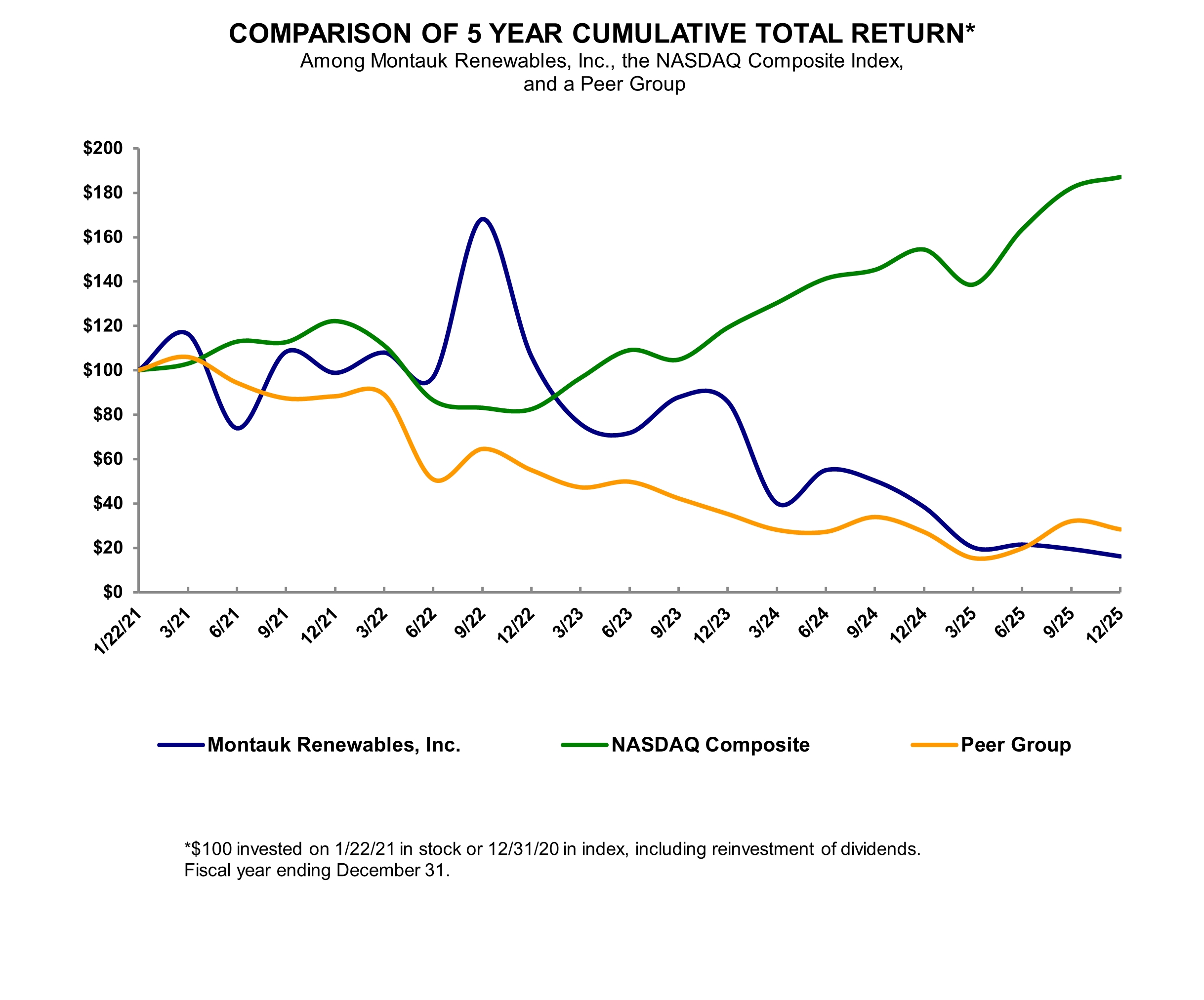
|
|
|
|
|
|
|
|
|
|
|
|
|
|
|
|
|
|
|
|
|
|
|
|
|
|
|
|
|
|
|
|
|
|
|
|
|
|
|
1/22/21 |
|
|
3/31/21 |
|
|
6/30/21 |
|
|
9/30/21 |
|
|
12/31/21 |
|
|
3/31/22 |
|
|
6/30/22 |
|
|
9/30/22 |
|
|
12/31/22 |
|
Montauk Renewables, Inc. |
|
|
100.00 |
|
|
|
116.49 |
|
|
|
73.87 |
|
|
|
108.29 |
|
|
|
98.84 |
|
|
|
108.00 |
|
|
|
96.91 |
|
|
168.18 |
|
|
106.36 |
|
NASDAQ Composite |
|
|
100.00 |
|
|
|
102.95 |
|
|
|
112.92 |
|
|
|
112.66 |
|
|
|
122.18 |
|
|
|
111.25 |
|
|
|
86.46 |
|
|
83.08 |
|
|
82.43 |
|
Peer Group |
|
|
100.00 |
|
|
|
121.76 |
|
|
|
85.76 |
|
|
|
78.41 |
|
|
|
54.99 |
|
|
|
65.34 |
|
|
|
34.06 |
|
|
38.35 |
|
|
34.48 |
|
|
|
|
|
|
|
|
|
|
|
|
|
|
|
|
|
|
|
|
|
|
|
|
|
|
|
|
|
|
|
3/31/23 |
|
|
6/30/23 |
|
|
9/30/23 |
|
|
12/31/23 |
|
|
3/31/24 |
|
|
6/30/24 |
|
|
9/30/24 |
|
|
12/31/24 |
|
|
3/31/25 |
|
Montauk Renewables, Inc. |
|
|
75.89 |
|
|
|
71.75 |
|
|
|
87.85 |
|
|
|
85.92 |
|
|
|
40.12 |
|
|
|
54.97 |
|
|
|
50.24 |
|
|
|
38.38 |
|
|
|
20.15 |
|
NASDAQ Composite |
|
|
96.48 |
|
|
|
109.07 |
|
|
|
104.77 |
|
|
|
119.22 |
|
|
|
130.32 |
|
|
|
141.36 |
|
|
|
145.26 |
|
|
|
154.48 |
|
|
|
138.62 |
|
Peer Group |
|
|
47.23 |
|
|
|
49.77 |
|
|
|
42.25 |
|
|
|
35.22 |
|
|
|
28.09 |
|
|
|
27.16 |
|
|
|
33.85 |
|
|
|
27.12 |
|
|
|
15.36 |
|
|
|
|
|
|
|
|
|
|
|
|
|
|
|
|
|
|
|
|
|
|
|
|
|
|
|
|
|
|
|
6/30/25 |
|
|
9/30/25 |
|
|
12/31/25 |
|
|
|
|
|
|
|
|
|
|
|
|
|
|
|
|
|
|
|
Montauk Renewables, Inc. |
|
|
21.41 |
|
|
|
19.38 |
|
|
|
16.10 |
|
|
|
|
|
|
|
|
|
|
|
|
|
|
|
|
|
|
|
NASDAQ Composite |
|
|
163.52 |
|
|
|
182.18 |
|
|
|
187.14 |
|
|
|
|
|
|
|
|
|
|
|
|
|
|
|
|
|
|
|
Peer Group |
|
|
19.72 |
|
|
|
31.97 |
|
|
|
28.27 |
|
|
|
|
|
|
|
|
|
|
|
|
|
|
|
|
|
|
|
Dividend Policy
The Company did not pay any dividends in the fiscal year ended December 31, 2025 and currently intends to retain future earnings, if any, to finance the operations, growth and development of its business. Any future determination as to the declaration and payment of dividends, if any, will be at the discretion of our Board of Directors, subject to compliance with contractual restrictions and covenants in the agreements governing our current and future indebtedness and the DGCL. Any such determination will also depend upon our business prospects, results of operations, financial condition, cash requirements and availability, and other factors that our Board of Directors may deem relevant.
Securities Authorized for Issuance Under Equity Compensation Plans
The information required by Item 5 of Form 10-K regarding equity compensation plans is incorporated herein by reference to Item 12 of Part III of this Annual Report.
Issuer Repurchases of Equity Securities
None.
Recent Sales of Unregistered Securities
None.
ITEM 6. RESERVED
ITEM 7. MANAGEMENT’S DISCUSSION AND ANALYSIS OF FINANCIAL CONDITION AND RESULTS OF OPERATIONS.
The following discussion and analysis of our financial condition and results of operations should be read in conjunction with our financial statements and the related notes to those statements included elsewhere in this Annual Report on Form 10-K. Amounts are in thousands unless indicated otherwise.
In addition to historical financial information, the following discussion and analysis contains forward-looking statements that involve risks, uncertainties, and assumptions. Our actual results may differ materially from those anticipated in these forward-looking statements as a result of many factors, including those discussed under “Cautionary Note Regarding Forward-Looking Statements” and “Item 1A.–Risk Factors” and elsewhere in this report.
This section generally discusses our results of operations for the year ended December 31, 2025 compared to the year ended December 31, 2024. For discussion and analysis of our results for the year ended December 31, 2024 compared to the year ended December 31, 2023, refer to “Management’s Discussion and Analysis of Financial Condition and Results of Operations” in Part II, Item 7 of our Annual Report on Form 10-K filed with the SEC on March 14, 2025.
Overview
Montauk is a renewable energy company specializing in the recovery and processing of biogas from landfills and other non-fossil fuel sources for beneficial use as a replacement to fossil fuels. We develop, own, and operate RNG projects, using proven technologies that supply RNG into the transportation industry and use RNG to produce Renewable Electricity. We are one of the largest U.S. producers of RNG, having participated in the industry for over 30 years. We established our currently operating portfolio of 11 RNG and two Renewable Electricity and development projects through self-development, partnerships, and acquisitions that span seven states.
Biogas is produced by microbes as they break down organic matter in the absence of oxygen (during a process called anaerobic digestion). Our two current sources of commercial scale biogas are LFG and ADG, which is produced inside an airtight tank used to breakdown organic matter, such as livestock waste. We typically secure our biogas feedstock through long-term fuel supply agreements and property lease agreements with biogas site hosts. Once we secure long-term fuel supply rights, we design, build, own, and operate facilities that convert the biogas into RNG or use the processed biogas to produce Renewable Electricity. We sell the RNG and Renewable Electricity through a variety of short-, medium-, and long-term agreements. Because we are capturing waste methane and making use of a renewable source of energy, our RNG and Renewable Electricity generate valuable Environmental Attributes, which we are able to monetize under federal and state initiatives.
Recent Developments
RINs Generated but Unsold
Our profitability is highly dependent on the market price of Environmental Attributes, including the market price for RINs. As we self-market a significant portion of our RINs, a decision not to commit to transfer available RINs during a period will impact our revenue and operating profit. We expect the timing between RINs generated and unseparated and RINs available for sale to only impact 2025 which is the year BRRR became effective. We have entered into commitments to transfer all RINs generated and available for sale from 2025 RNG production. We had approximately 190 RINs generated and unseparated at December 31, 2025. We have entered into commitments to transfer approximately 2,500 RINs generated and available for sale from 2026 RNG production. The average D3 RIN index price for the fourth quarter of 2025 and January 2026 through February 28, 2026 was approximately $2.39 and $2.41, respectively. The following table summarizes select historical data related to RINs generated, RINs sold, and RINs generated but unsold. As we self-market a significant portion of our RINs and as the RFS is based on annual compliance, any strategic decision to not monetize available RINs in a quarter could impact the timing of operating revenues recognized during a fiscal year. Realized prices for Environmental Attributes monetized in a year may not correspond directly to index prices due to the forward selling of commitments. The timing of RIN transfers can vary year over year and by period within a year and is contingent on various factors including, but not limited to: (a) the Company’s expectations on RIN index price, (b) operational needs of the Company, (c) obligated parties’ purchase needs, or (d) the type of customer among other matters.
|
|
|
|
|
|
Calendar Quarter |
RINs Available for Sale |
RINs Sold |
RINs sold as % of RINs Available |
RINs Available but Unsold |
RINs Unsold as % of RINs Available |
2024 First Quarter |
11,240 |
7,889 |
70.2% |
3,351 |
29.8% |
2024 Second Quarter |
14,707 |
10,000 |
68.0% |
4,707 |
32.0% |
2024 Third Quarter |
15,895 |
15,750 |
99.1% |
145 |
0.9% |
2024 Fourth Quarter |
9,822 |
3,000 |
30.5% |
6,822 |
69.5% |
2025 First Quarter |
13,801 |
9,885 |
71.6% |
3,916 |
28.4% |
2025 Second Quarter |
11,158 |
11,050 |
99.0% |
108 |
1.0% |
2025 Third Quarter |
12,421 |
12,411 |
99.9% |
10 |
0.1% |
2025 Fourth Quarter |
10,786 |
10,786 |
100.0% |
- |
0.0% |
Capital Development Summary
The following summarizes our ongoing development growth plans, expected capacity contribution, anticipated commencement of operations, and capital expenditure estimate, excluding the Montauk Ag Renewables Development project:
|
|
|
|
Development Opportunity |
Estimated Capacity Contribution (MMBtu/day) |
Anticipated Commencement Date |
Estimated Capital Expenditure |
Bowerman RNG Facility |
3,600 |
2027 |
$85,000-$95,000 |
European Energy Facilities |
N/A |
TBD |
$65,000-$75,000 |
Tulsa RNG Facility |
1,500 |
2027 |
$25,000-$35,000 |
Rumpke RNG Relocation Project |
7,500 |
2028 |
$70,000-$90,000 |
Pico Digestion Capacity Increase
In 2025, we began processing the final tranche of increased feedstock. Upon receipt of the final tranche, we made the final contractual payment to the dairy host. As a result of the increased digestion capacity, we produced approximately 31.8% more MMBtu during 2025 as compared to 2024. During 2025, our digestion inlet feedstock averaged approximately 458 gallons per day, approximately 17% in excess of our contracted minimums of 390 gallons per day. We are currently evaluating additional development expansion opportunities to ensure beneficial processing of all available feedstock volumes.
Second Apex RNG Facility
In 2025, we successfully completed the construction and commissioning of a second RNG processing facility at the Apex landfill. The construction of a second facility under our existing fuel supply agreement was triggered by biogas feedstock volumes exceeding production capabilities, discussions with the landfill host, and the host's waste intake forecasted projections. We continue to expect there will be a period where we have excess availability capacity after the second facility is commissioned while the landfill host increases its waste intake. We continue to collaborate with the landfill host to mitigate impacts from wellfield extraction factors
which could impact capacity utilization. In connection with the commissioning of the second facility, we produced approximately 7.8% more MMBtu during 2025 as compared to 2024.
Blue Granite RNG Project
In 2025, we received notice from the utility that it will no longer accept RNG into its distribution system, which was in opposition of the letter of intent that was issued when we were awarded the gas rights to the site. As a result, we impaired the capital associated with the interconnection and equipment. We continue to have $1,000 recorded associated with the payment upon award of the gas rights agreement. We continue to review various alternatives related to interconnection opportunities as part of our considerations for offtake options with the understanding those alternatives may differ from initial development project assumptions, including physical and virtual and fixed interconnections. We are also reviewing alternatives for this site around producing energy other than RNG. We have paused capital expenditures related to this site while we consider all alternatives and continue discussions with the landfill host.
Tulsa REG Conversion to RNG
In 2025, we announced the conversion of our Tulsa, Oklahoma Renewable Electric Generation facility to RNG project. The project will offer a variable inlet capacity, ranging from 550 scfm to 2,250 scfm per day, providing average production capacity we target to be approximately 1,500 MMBtu per day and designed to beneficially process all of available inlet gas feedstock from its landfill host. We expect commissioning in 2027 and to continue incurring capital expenditures for long lead items. For the second half of 2025, our wellfield development initiatives have yielded increased feedstock totaling an overage of 1200 scfm per day.
GreenWave Joint Venture
In 2025, through our wholly-owned subsidiary Pesta Energy, LLC, we entered into an agreement with Pioneer Renewables Energy Marketing, LLC to form a joint venture, GreenWave Energy Partners, LLC (“Greenwave”). The primary goal of the joint venture is to help address the limited capacity of RNG utilization for transportation by offering third party RNG volumes access to exclusive unique and proprietary pathways. In the third quarter of 2025, Greenwave began matching available RNG volumes to dispensing opportunities through Greenwaves's transportation pathways. The joint venture has matched available dispensing capacity with available third party RNG volumes to separate RINs. We recorded income from Greenwave of $1,485 in 2025. Our capital investment in the joint venture is estimated to be up to approximately $4,500, subject to various and certain requirements as defined in the underlying agreements.
Carbon Dioxide Beneficial Use Opportunity
In 2024, we signed a contract for the delivery of 140 thousand tons per year of biogenic carbon dioxide (“CO2”) from our four Texas facilities. We intend to capture, clean and liquefy CO2 at select Texas facilities, at which point it will be transported to EE North America (“EENA”), a Texas-based e-methanol facility. The delivery term is expected to last at least 15 years with first delivery expected to begin in 2027. In 2025, we have been recognizing an exclusivity fee related to the minimum tons of CO2. The annual price per ton under the contract is adjusted annually by the U.S. consumer price index. The agreement with EENA includes a 50% sharing component of any available tax attributes generated by us under code section 45Q, Carbon dioxide sequestration credit, in the Inflation Reduction Act, as applicable. We have completed the initial site surveys related to location of the CO2 processing equipment, evaluated equipment suppliers, and started engineering design. We believe that we can fulfill the contracted volumes with the development of CO2 at two of our Texas facilities. We continue to match our capital investment in these project opportunities with the development timeline of EENA’s facility.
Montauk Ag Asset Acquisition
In 2021, Montauk Ag Renewables purchased technology and assets (the “Montauk Ag Renewables Acquisition”) to recover residual natural resources from swine waste and to refine and recycle such waste products through proprietary and other processes to produce high quality renewable electricity, North Carolina swine RECs, and micronutrient organic fertilizer alternatives. Upon completion of the first phase of the project, we expect that it will annually produce 41 MWh of electric power, approximately 121 RECs and 8.7 tons of organic fertilizer alternative.
Regulatory Developments
In 2024, the North Carolina Utilities Commission ("NCUC") approved our Turkey, North Carolina location for a New Renewable Energy Facility (“NREF”) designation and Certificate of Public Convenience and Necessity. In October 2024, our amended NREF application was approved. In 2024, the North Carolina legislature approved a statutory change to its Clean Energy and Energy Efficiency Portfolio Standards ("CEPS") governing the generation of RECs from swine waste that established a REC multiplier for swine waste produced in a Tier 1 county, which includes Sampson County, the location of our Turkey facility. For
qualifying projects, for each swine REC generated, 2 enhanced RECs will be credited for a total three RECs for a period of 8 years, followed by one enhanced REC for a total two RECs for a period of 6 years and a credit of one REC thereafter. There is a limit of 80 enhanced RECs in a year.
In September 2025, a joint motion was filed with the NCUC by various entities seeking to modify and delay certain aspects of the CEPS, specifically, the portfolio standards relating to swine RECs. In October 2025, we filed response comments to the joint motion with the NCUC requesting they grant modifications or delays only to individual power supplies that have demonstrated need, require power suppliers that have not achieved 100% compliance in 2025 to apply any cumulatively acquired swine RECs to the suppliers unsatisfied 2025 pro rata obligation, and modify the swine REC set-aside for 2026 and beyond to match the requirement originally set by North Carolina in 2018. In January 2026, the NCUC denied the request for waivers and determined that parties must use banked RECs to meet 2025 compliance targets with the ability to use solar RECs to fill any compliance shortage. The compliance obligations for those utilities filing the September 2025 joint motion continue to increase through 2029.
Offtake Developments
We have entered into a ten-year agreement to sell all of the renewable electricity generated by the project. Furthermore, we expect the annual REC capacity of the Turkey location to be approximately 120 RECs and have signed a REC agreement with Duke Energy for 47 RECs. We continue to optimize our monetization strategies for the currently uncontracted portion of annually generated RECs and are in various stages of negotiation and responses to requests from obligated purchasers. Many of these agreements contain competitive details and, while there remains a limited active swine REC market in North Carolina, we believe the prices we are negotiating will be market based. We believe the price per swine REC could fall within the range of $200 to $400 per REC.
Feedstock Collection
At full first phase capacity, we anticipate the ability to process feedstock from approximately 400 to 450 hog spaces per day, which equates to approximately 35 tons of annual waste collection. We have entered into long term agreements with over forty separate farming locations to provide access to waste from at least 300 hog spaces to support our expected processing needs under our first phase for the Turkey location. We continue to install collection equipment at these separate farms to access the waste. We currently estimate capital investment of approximately $250 at each farm related to the installed collection equipment. We intend to contract with additional farms to secure feedstock sources for future production processes. In advance of commercial operation date, feedstock collection has begun with collecting the dewatered feedstock from each farm and transporting to the project site for pelletization and storage.
Capital Investment and Progress towards Commercial Operation Date (COD)
We currently expect the first phase capital investment to be approximately $200,000 and have spent approximately $140,000 as of December 31, 2025. Winter storms in the Carolinas early 2026 and project deliveries have caused only nominal project delays. We have begun to commission the facility and expect our production and revenue generation activities to commence in April 2026.
We estimate our Montauk Ag Renewables project to potentially generate tax attributes once placed into service consisting mainly of a mix of federal investment tax and production tax credits and North Carolina state tax attributes. Based on our Pico digestion expansion project experience, for other large and qualifying projects we believe that 50-75% of project capital will quality for IRC code section 48 investment tax credits and, depending on a variety of factors for projects started within various safe harbor guidelines, the tax benefits could be up to 30%. For qualifying projects which do not meet the various safe harbor guidelines, we expect the tax benefits to range between 6-12% for qualifying assets. As it relates to our capital expenditures and future electric power production, we estimate IRC code section 48 investment tax credits and production tax credits could range between $6,000 - $20,000. We give no assurances that our estimates on tax attributes for our Montauk Ag Renewables project will meet these expectations.
Bowerman RNG Project
In 2023, we announced a planned development of a renewable natural gas landfill project in Irvine, CA at the Frank R. Bowerman Landfill to process the large and growing volumes of biogas in excess of the existing capacity of the REG facility. We expect facility commissioning in 2027 and the capital investment to range between $85,000 - $95,000. As part of the agreement to develop the RNG plant, we agreed to work with the landfill host on the landfill's management of its wellfield and flare facility permit requirements and this work remains ongoing. The project is anticipated to have production nameplate capacity of approximately 3,600 MMBtu per day, assuming currently forecasted biogas feedstock volumes projected to be available from the host landfill at the time of commissioning. We continue to incur capital expenditures for this project. During 2025, wellfield initiatives have resulted in
approximately 4,100 scfm of averaged unprocessed gas which is more than the anticipated inlet of the RNG facility currently under development.
Rumpke RNG Relocation Project
In connection with our gas rights agreement with our landfill host at our Rumpke RNG location, in 2025, we began the process of relocating our existing Rumpke RNG facility. The timing of this project and requirement to relocate the facility coincides with the landfill's filling practices moving into the existing area of our Rumpke RNG facility and is contractually obligated. We expect facility commissioning in 2028 and the capital expenditures to range between $70,000 - $90,000, which is dependent on the timing of capital expenditures and potential other production capabilities requested by the landfill host. We continue to incur capital expenditures for this project. Additionally, the landfill host has requested a modification of our current development design to accommodate a large CNG filling station for their fleet.
Key Trends
Market Trends Affecting the Renewable Fuel Market
We believe rising demand for RNG is attributable to a variety of factors, including growing public support for renewable energy, U.S. governmental actions to increase energy independence, environmental concerns increasing demand for natural gas-powered vehicles, job creation, and increasing investment in the renewable energy sector.
Key drivers for the long-term growth of RNG include the following factors:
•Regulatory or policy initiatives, including the federal RFS program and state-level low-carbon fuel programs in states such as California and Oregon, that drive demand for RNG and its derivative Environmental Attributes (as further described below).
•Efficiency, mobility and capital cost flexibility in RNG operations enable it to compete successfully in multiple markets. Our operating model is nimble, as we commonly use modular equipment; our RNG processing equipment is more efficient than its fossil-fuel equivalents.
•Demand for compressed natural gas (“CNG”) from natural gas-fueled vehicles. The RNG we create is pipeline-quality and can be used for transportation fuel when converted to CNG. CNG is commonly used by medium-duty fleets that are close to fueling stations, such as city fleets, local delivery trucks and waste haulers.
•Regulatory requirements, market pressure and public relations challenges increase the time, cost and difficulty of permitting new fossil fuel-fired facilities.
Factors Affecting Our Future Operating Results:
Acquisition and Development Pipeline
The timing and extent of our development pipeline affects our operating results due to:
•Impact of Higher Selling, General and Administrative Expenses Prior to the Commencement of a Project’s Operation: We incur significant expenses in the development of new RNG projects.
•Shifts in Revenue Composition for Projects from New Fuel Sources: As we expand into livestock farm projects, our revenue composition from Environmental Attributes will change. We believe that livestock farms offer us a lucrative opportunity, as the value of LCFS credits for dairy farm projects, for example, are a multiple of those realized from landfill projects due to the significantly more attractive CI score of livestock farms.
•Incurrence of Expenses Associated with Pursuing Prospective Projects That Do Not Come to Fruition: We incur expenses to pursue prospective projects with the goal of a site host accepting our proposal or being awarded a project in a competitive bidding process. Historically, we have evaluated opportunities which we decided not to pursue further due to the prospective project not meeting our internal investment thresholds or a lack of success in a competitive bidding process. To the extent we seek to pursue a greater number of projects or bidding for projects becomes more competitive, our expenses may increase.
Regulatory, Environmental and Social Trends
Regulatory, environmental and social factors are key drivers that incentivize the development of RNG and Renewable
Electricity projects and influence the economics of these projects. We are subject to the possibility of legislative and regulatory
changes to certain incentives, such as RINs, RECs and GHG initiatives. On July 12, 2023, the EPA issued final rules in the Federal
Register for the RFS volume requirements for 2023-2025. Final volumes for cellulosic biofuel were set at 838, 1,090 and 1,376 RINs
for the three years 2023, 2024 and 2025, respectively. The final rule also included significant changes to the existing RFS program,
referred to as BRRR, that required the RNG industry to modify how all RINs are generated as of January 1, 2025. We have registered
all of our facilities under the BRRR provisions and have obtained Q-RIN status for RIN generation starting January 1, 2025. Under the
BRRR provisions, the EPA finalized a limitation that biogas from one facility has a single use under the RFS as proposed (i.e.,
biointermediate, RNG or CNG/LNG via biogas closed distribution system). The EPA clarified that this does not preclude non-RFS
uses at same facility.
On June 13, 2025, the EPA released both the Partial Waiver of the 2024 Cellulosic Biofuel Volume Requirement (Final Rule) and RFS Standards for 2026 and 2027, Partial Waiver of 2025 Cellulosic Biofuel Volume Requirement, and Other Changes (Proposed Rule). The final 2024 cellulosic biofuel volume requirement was reduced from 1,090 to 1,010 million D3 RINs. This reduction was based on actual volumes of D3 RINs generated in 2024. In addition, the EPA is making Cellulosic Waiver Credits ("CWCs") available for 2024 as an additional compliance flexibility for obligated parties.
In the EPA’s proposed rule released on June 13, 2025, the cellulosic biofuel volumes for 2025 were proposed to be reduced
from 1,376 to 1,190 RINs and make CWCs available for 2025. The proposed cellulosic biofuel volume requirements for 2026 and
2027 are 1,300 and 1,360 D3 RINs, respectively. These volumes are less than the EPA had previously finalized for 2025 and are
based on their belief that cellulosic RIN generation from biogas-derived CNG/LNG during 2026-2030 will be constrained by the total
usage capacity of CNG/LNG as transportation fuel. These proposed rules are subject to comment periods prior to finalization.
On August 22, 2025, EPA issued decisions on 175 Small Refinery Exemption (SRE) petitions. EPA granted full exemption (100%) to 63 petitions and partial exemptions (50%) to 77 petitions. The SRE decisions exempted corresponding volumes of gasoline and diesel for the 2023 and 2024 compliance years, and increased the number of RINs available for obligated parties to use for compliance with their RFS obligations. Taking into consideration the expected impacts of the SRE decisions on the RFS market, on September 16, 2025, EPA co-proposed a Supplemental Rule that provides additional volumes in 2026 and 2027 RVOs that will represent complete (100%) reallocation or partial (50%) reallocation for SREs granted in full or in part, respectively, for 2023 and 2024, as well as those projected to be granted for 2025.
EPA has indicated an intention to finalize the Supplemental Rule & the RVOs for 2025, 2026 and 2027 by the end of 2025, however, the duration of the US federal government shut down and any residual impacts on EPA staffing after the shutdown concludes may extend finalization of these items into 2026.
In December 2023, CARB released the formal proposal for new LCFS rules. The proposed rules will increase the stringency of CI reduction targets from 20% to 30% in 2030 and 90% by 2045. This reduction would have the potential impact of reducing the number of net credits in the program. On July 1, 2025, CARB’s amended LCFS rules officially took effect setting the aggressive
carbon intensity reduction targets listed above. The industry may see3 gradual increases in LCFS credit prices over the next year. The rules also phase out avoided methane crediting for dairy and swine manure pathways by 2040 for CNG usage and through 2045 for RNG used to produce hydrogen. The RNG deliverability/book and claim provisions for out-of-region projects are eliminated for all projects that break ground after 2030. These projects will be required to demonstrate physical deliverability requirements beginning in 2041. Changes to the LCFS program require annual verification of the CI score assigned to a project. Annual verification could significantly affect the profitability of a project, particularly in the case of a livestock farm project. In June 2025, California lawmakers introduced California Senate Bill SB-237, which includes a potential cap on LCFS credit prices of approximately $75/ton.
On March 15, 2025, the Full-Year Continuing Appropriations and Extensions Act, 2025 was signed into law. In May 2025, we
were informed that the law eliminated the United States Department of Agriculture Advanced Biofuel Payment Program. We
received approximately $200 annually since 2021 under this program. In November 2025, we received notice that the program was reinstated and that retroactive payments would be issued for the missed quarters while the program was closed.
Factors Affecting Revenue
Our total operating revenues include renewable energy and related sales of Environmental Attributes. Renewable energy sales primarily consist of the sale of biogas, including LFG and ADG, which is either sold or converted to Renewable Electricity. Environmental Attributes are generated and monetized from the renewable energy.
The BRRR requires that all unseparated K3 RINs generated by the RNG producer on RNG volumes injected into the commercial pipeline distribution system only become valid for sale once they are separated with the support of dispensing statements by a registered dispenser or RIN separator. This process could result in delays to the RNG producer's receipt of the separated K2 RINs from the dispenser. This rule change could also result in a RNG producer's failure to generate K3 RINs for a given gas flow month if the registered biogas producer negligently fails to generate the necessary biogas tokens before the end of the subsequent gas flow month.
We report revenues from two operating segments: Renewable Natural Gas and Renewable Electricity Generation. Corporate relates to additional discrete financial information for the corporate function; primarily used as a shared service center for maintaining
functions such as executive, accounting, treasury, legal, human resources, tax, environmental, engineering, and other operations functions not otherwise allocated to a segment. As such, the corporate entity is not determined to be an operating segment but is discretely disclosed for purposes of reconciliation to the Company’s consolidated financial statements.
•Renewable Natural Gas Revenues: We record revenues from the production and sale of RNG and the generation and sale of the Environmental Attributes derived from RNG, such as RINs and LCFS credits. Our RNG revenues from Environmental Attributes are recorded net of a portion of Environmental Attributes shared with off-take counterparties as consideration for such counterparties using the RNG as a transportation fuel. We had certain pathway provider sharing arrangements expiring throughout 2024 and 2025. We have entered into pathway renewals in the third quarter of 2025 for certain volumes at percentages consistent with our historical percentages. Historically, we have monetized less than 25% of our RNG volumes under these fixed-price agreements.
•Renewable Electricity Generation Revenues: We record revenues from the production and sale of Renewable Electricity and the generation and sale of the Environmental Attributes, such as RECs, derived from Renewable Electricity. All of our Renewable Electricity production is monetized under fixed-price PPAs from our existing operating projects.
•Corporate Revenues: Corporate reports realized and unrealized gains or losses under our gas hedge programs. We do not have any active gas hedge programs. Corporate also relates to additional discrete financial information for the corporate function; primarily used as a shared service center for maintaining functions such as executive, accounting, treasury, legal, human resources, tax, environmental, engineering and other operations functions not otherwise allocated to a segment. Revenues from RINs distributed from GreenWave, not included in our operating metrics table.
Our operating revenues are priced based on published index prices which can be influenced by factors outside our control, such as market impacts on commodity pricing and regulatory developments. With our royalty payments structured as a percentage of revenue, royalty payments fluctuate with changes in revenues. We place a primary focus on managing production volumes and operating and maintenance expenses as these factors are more controllable by us.
RNG Production
Our RNG production levels are subject to fluctuations based on numerous factors, including:
Disruptions to Production: Disruptions to waste placement operations at our active landfill sites, severe weather events, or failure or degradation of our or a landfill operator’s equipment or interconnection or transmission problems could result in a reduction of our RNG production. We strive to proactively address any issues that may arise through preventative maintenance, process improvement and flexible redeployment of equipment to maximize production and useful life.
•In 2024, we began to experience trends with several of our landfill hosts delaying their installation of or delaying our ability to install wellfield collection infrastructure in active waste placement areas, a practice historically common and critical to our projections of feedstock gas and, therefore, production. These landfill-driven delays impact the timing of collection system enhancement installations and the resulting timing of our production increases. We expect these trends to continue throughout 2026.
•Similar wellfield extraction environmental factors continue to impact gas extraction at our Apex site. We are collaborating with the landfill to mitigate these impacts and these mitigation efforts have continued in 2025. These wellfield extraction environmental factors could impact and lengthen the period during which we have excess available combined production capacity at our Apex site.
•Changes made by the landfill host to the wellfield collection system at the McCarty facility have contributed to elevated nitrogen in the feedstock received by our facility. Additionally, the landfill host modified the wellfield bifurcation approach which has reduced the quantity of feedstock received at our facility. We are working with the landfill host but continue to have lower volumes of feedstock available to be processed at the McCarty facility. We expect these trends to continue through 2026.
•Quality of Biogas: We are reliant upon the quality and availability of biogas from our site partners. The quality of the waste at our landfill project sites is subject to change based on the volume and type of waste accepted. Variations in the quality of the biogas could affect our RNG production levels. At three of our projects, we operate the wellfield collection system, which allows greater control over the quality and consistency of the collected biogas. At our McCarty projects, we have operating and management agreements by which we earn revenue for managing the wellfield collection systems. Additionally, our dairy farm project benefits from the consistency of feedstock and controlled environment of collection of waste to improve biogas quality.
•RNG Production from Our Growth Projects: We anticipate increased production at certain of our existing projects as open landfills continue to take in additional waste and the amount of gas available for collection increases. Delays in commencement of production or extended commissioning issues at a new project or a conversion project, such as those
we are currently experiencing at Blue Granite as described above, would delay any realization of production from that project.
Pricing
Our Renewable Natural Gas and Renewable Electricity Generation segments’ revenues are primarily driven by the prices under our off-take agreements and PPAs and the amount of RNG and Renewable Electricity that we produce. We sell the RNG produced from our projects under a variety of short-term and medium-term agreements to counterparties, with contract terms varying from three years to five years. Our contracts with counterparties are typically structured to be based on varying natural gas price indices for the RNG produced. All of the Renewable Electricity produced at our biogas-to-electricity projects is sold under long-term contracts to creditworthy counterparties, typically under a fixed price arrangement with escalators.
The pricing of Environmental Attributes, which accounts for a substantial portion of our revenues, is subject to volatility based on a variety of factors, including regulatory and administrative actions and commodity pricing.
The sale of RINs, which is subject to market price fluctuations, accounts for a substantial portion of our revenues. We manage against the risk of these fluctuations through forward sales of RINs, although currently we only sell RINs in the calendar year they are generated. We have entered into commitments to transfer approximately 2,500 RINs generated and available for sale from 2026 RNG production at an average price of $2.42. Realized prices for Environmental Attributes monetized in a year may not correspond directly to index prices due to the forward selling of commitments.
Factors Affecting Operating Expenses
Our operating expenses include royalties, transportation, gathering and production fuel expenses, project operating and maintenance expenses, general and administrative expenses, depreciation and amortization, net loss (gain) on sale of assets, impairment loss and transaction costs.
•Operating and Maintenance Expenses: Operating and maintenance expenses primarily consist of expenses related to the collection and processing of biogas, including biogas collection system operating and maintenance expenses, biogas processing, operating and maintenance expenses, and related labor and overhead expenses. At the project level, this includes all labor and benefit costs, ongoing corrective and proactive maintenance, project level utility charges, rent, health and safety, employee communication, and other general project level expenses. Unanticipated feedstock processing or gas conditioning equipment failures occurring outside our planned preventative maintenance program can increase project operating and maintenance expenses and reduce production volumes. The timing of gas conditioning and process equipment preventative maintenance intervals could impact the timing and amount of our operating and maintenance expenses within a given quarter. Expenses from RINs distributed from GreenWave and the costs related to pathway dispensing are not included in our operating metrics table.
•Royalties, Transportation, Gathering and Production Fuel Expenses: Royalties represent payments made to our facility hosts, typically structured as a percentage of revenue. Transportation and gathering expenses include capacity and metering expenses representing the costs of delivering our RNG and Renewable Electricity production to our customers. These expenses include payments to pipeline operators and other agencies that allow for the transmission of our gas and electricity commodities to end users. Production fuel expenses generally represent alternative royalty payments based on quantity usage of biogas feedstock.
•General and Administrative Expenses: General and administrative expenses primarily consist of corporate expenses and unallocated support functions for our operating facilities, including personnel costs for executive, finance, accounting, investor relations, legal, human resources, operations, engineering, environmental registration and reporting, health and safety, IT and other administrative personnel and professional fees and general corporate expenses. From time to time, we may be parties to legal proceedings arising in the normal course of business which could increase our legal expenses. We continue to see increased general and administrative expenses associated with our ongoing development of Montauk Ag Renewables in 2025. We account for share-based compensation related to grants made through our equity and incentive compensation plan under FASB ASC 718. In 2025, we recognized $1,550 of onetime non-cash stock compensation expense within general and administration expenses as a result of the termination which we do not anticipate will recur in 2026. For more information, see Note 15 to our audited consolidated financial statements.
•Depreciation, Depletion and Amortization: Expenses related to the recognition of the useful lives of our intangible and fixed assets. We spend significant capital to build and own our facilities. In addition to development capital, we annually reinvest to maintain these facilities.
•Impairment Loss: Expenses related to reductions in the carrying value(s) of fixed and/or intangible assets based on periodic evaluations whenever events or changes in circumstances indicate that the carrying amount of an asset may not be recoverable.
•Transaction Costs: Transaction costs primarily consist of expenses incurred for due diligence and other activities related to potential acquisitions and other strategic transactions.
Key Operating Metrics
Total operating revenues reflect both sales of renewable energy and sales of related Environmental Attributes. As a result, our revenues are primarily affected by unit production of RNG and Renewable Electricity, production of Environmental Attributes, and the prices at which we monetize such production. Set forth below is an overview of these key metrics:
•Production Volumes: We review performance by site based on unit of production calculations for RNG and Renewable Electricity, measured in terms of MMBtu and MWh, respectively. While unit of production measurements can be influenced by schedule facility maintenance schedules, the metric is used to measure the efficiency of operations and the impact of optimization improvement initiatives. We monetize a majority of our RNG commodity production under variable-price agreements, based on indices. A portion of our Renewable Natural Gas segment commodity production is monetized under fixed-priced contracts. Our Renewable Electricity Generation segment commodity production is primarily monetized under fixed-priced PPAs.
•Production of Environmental Attributes: We monetize Environmental Attributes derived from our production of RNG and Renewable Electricity. We may carry-over a portion of the RINs generated from RNG production to the following year and monetize the carried over RINs in such following calendar year. A majority of our Renewable Natural Gas segment Environmental Attributes are self-monetized. A majority of our Renewable Electricity Generation segment Environmental Attributes are monetized as a component of our fixed-price PPAs.
•Average realized price per unit of production: Our profitability is highly dependent on the commodity prices for natural gas and electricity, and the Environmental Attribute prices for RINs, LCFS credits, and RECs. Realized prices for Environmental Attributes monetized in a year may not correspond directly with that year’s production as attributes may be carried over and subsequently monetized. We may elect to not commit to transfer all available RINs in a given period which could impact our revenue and operating profit. Realized prices for Environmental Attributes monetized in a year may not correspond directly to index prices due to the forward selling of commitments.
Comparison of Years Ended December 31, 2025 and 2024
The following table summarizes the key operating metrics described above, which metrics we use to measure performance.
|
|
|
|
|
|
|
|
|
|
|
|
|
|
|
|
|
|
|
For the year ended
December 31, |
|
|
|
|
|
Change |
|
|
|
2025 |
|
|
2024 |
|
|
Change |
|
|
% |
|
(in thousands, unless otherwise indicated) |
|
|
|
|
|
|
|
|
|
|
|
|
Revenues |
|
|
|
|
|
|
|
|
|
|
|
|
Renewable Natural Gas Total Revenues |
|
$ |
155,736 |
|
|
$ |
157,983 |
|
|
$ |
(2,247 |
) |
|
|
(1.4 |
%) |
Renewable Electricity Generation Total Revenues |
|
$ |
17,231 |
|
|
$ |
17,753 |
|
|
$ |
(522 |
) |
|
|
(2.9 |
%) |
|
|
|
|
|
|
|
|
|
|
|
|
|
RNG Metrics |
|
|
|
|
|
|
|
|
|
|
|
|
CY RNG production volumes (MMBtu) |
|
|
5,644 |
|
|
|
5,587 |
|
|
|
57 |
|
|
|
1.0 |
% |
Less: Current period RNG volumes under fixed/floor-price contracts |
|
|
(1,907 |
) |
|
|
(1,546 |
) |
|
|
(361 |
) |
|
|
23.4 |
% |
Plus: Prior period RNG volumes dispensed in current period |
|
|
291 |
|
|
|
358 |
|
|
|
(67 |
) |
|
|
(18.7 |
%) |
Less: Current period RNG production volumes not dispensed |
|
|
(354 |
) |
|
|
(291 |
) |
|
|
(63 |
) |
|
|
21.6 |
% |
Total RNG volumes available for RIN generation (1) |
|
|
3,674 |
|
|
|
4,108 |
|
|
|
(434 |
) |
|
|
(10.6 |
%) |
|
|
|
|
|
|
|
|
|
|
|
|
|
RIN Metrics |
|
|
|
|
|
|
|
|
|
|
|
|
Current RIN generation ( x 11.6935) (2) |
|
|
42,970 |
|
|
|
48,177 |
|
|
|
(5,207 |
) |
|
|
(10.8 |
%) |
Less: Counterparty share (RINs) |
|
|
(5,470 |
) |
|
|
(4,824 |
) |
|
|
(646 |
) |
|
|
13.4 |
% |
Plus: Prior period RINs carried into current period |
|
|
6,822 |
|
|
|
108 |
|
|
|
6,714 |
|
|
|
6216.7 |
% |
Less: RINs generated but unseparated |
|
|
(190 |
) |
|
|
— |
|
|
|
(190 |
) |
|
|
0.0 |
% |
Less: CY RINs carried into next CY |
|
|
— |
|
|
|
(6,822 |
) |
|
|
6,822 |
|
|
|
(100.0 |
%) |
Total RINs available for sale (3) |
|
|
44,132 |
|
|
|
36,639 |
|
|
|
7,493 |
|
|
|
20.5 |
% |
Less: RINs sold |
|
|
(44,132 |
) |
|
|
(36,639 |
) |
|
|
(7,493 |
) |
|
|
20.5 |
% |
RIN Inventory |
|
|
— |
|
|
|
— |
|
|
|
— |
|
|
|
0.0 |
% |
RNG Inventory (volumes not dispensed for RINs) (4) |
|
|
354 |
|
|
|
291 |
|
|
|
63 |
|
|
|
21.6 |
% |
Average Realized RIN price |
|
$ |
2.33 |
|
|
$ |
3.28 |
|
|
$ |
(0.95 |
) |
|
|
(29.0 |
%) |
|
|
|
|
|
|
|
|
|
|
|
|
|
Operating Expenses |
|
|
|
|
|
|
|
|
|
|
|
|
Renewable Natural Gas Operating Expenses |
|
$ |
90,095 |
|
|
$ |
82,916 |
|
|
$ |
7,179 |
|
|
|
8.7 |
% |
Operating Expenses per MMBtu (actual) |
|
$ |
15.96 |
|
|
$ |
14.84 |
|
|
$ |
1.12 |
|
|
|
7.5 |
% |
|
|
|
|
|
|
|
|
|
|
|
|
|
REG Operating Expenses |
|
$ |
16,670 |
|
|
$ |
14,734 |
|
|
$ |
1,936 |
|
|
|
13.1 |
% |
$/MWh (actual) |
|
$ |
94.18 |
|
|
$ |
79.22 |
|
|
$ |
14.96 |
|
|
|
18.9 |
% |
|
|
|
|
|
|
|
|
|
|
|
|
|
Other Metrics |
|
|
|
|
|
|
|
|
|
|
|
|
Renewable Electricity Generation Volumes Produced (MWh) |
|
|
177 |
|
|
|
186 |
|
|
|
(9 |
) |
|
|
(4.8 |
%) |
Average Realized Price $/MWh (actual) |
|
$ |
97.35 |
|
|
$ |
95.45 |
|
|
$ |
1.90 |
|
|
|
2.0 |
% |
(1)RINs are generated in the month that the gas is dispensed to generate RINs, which occurs the month after the gas is produced. Volumes under fixed/floor-price arrangements generate RINs which we do not self-market. K3 RIN separation occurs after the gas is dispensed (RINs generated but unseparated).
(2)One MMBtu of RNG has the same energy content as 11.6935 gallons of ethanol, and thus may generate 11.6935 RINs under the RFS program.
(3)Represents RINs available to be self-marketed by us during the reporting period.
(4)Represents gas production on which RINs are not generated.
Results of Operations
Comparison of Years Ended December 31, 2025 and 2024
The following table summarizes our revenues, expenses and net income for the periods set forth below:
|
|
|
|
|
|
|
|
|
|
|
|
|
|
|
|
|
|
|
For the year ended
December 31, |
|
|
|
|
|
Change |
|
|
|
2025 |
|
|
2024 |
|
|
Change |
|
|
% |
|
Total operating revenues |
|
$ |
176,382 |
|
|
$ |
175,736 |
|
|
$ |
646 |
|
|
|
0.4 |
% |
Operating expenses: |
|
|
|
|
|
|
|
|
|
|
|
|
Operating and maintenance expenses |
|
|
77,646 |
|
|
|
66,663 |
|
|
|
10,983 |
|
|
|
16.5 |
% |
General and administrative expenses |
|
|
31,736 |
|
|
|
36,286 |
|
|
|
(4,550 |
) |
|
|
(12.5 |
)% |
Royalties, transportation, gathering and production fuel |
|
|
32,945 |
|
|
|
31,502 |
|
|
|
1,443 |
|
|
|
4.6 |
% |
Depreciation, depletion and amortization |
|
|
29,972 |
|
|
|
23,515 |
|
|
|
6,457 |
|
|
|
27.5 |
% |
Impairment loss |
|
|
3,231 |
|
|
|
1,586 |
|
|
|
1,645 |
|
|
|
103.7 |
% |
Transaction costs |
|
|
- |
|
|
|
61 |
|
|
|
(61 |
) |
|
|
(100.0 |
)% |
Total operating expenses |
|
|
175,530 |
|
|
|
159,613 |
|
|
|
15,917 |
|
|
|
10.0 |
% |
Operating income |
|
$ |
852 |
|
|
$ |
16,123 |
|
|
$ |
(15,271 |
) |
|
|
(94.7 |
)% |
Other expenses: |
|
|
3,339 |
|
|
|
3,946 |
|
|
|
(607 |
) |
|
|
(15.4 |
)% |
Net (loss) income before income taxes: |
|
|
(2,487 |
) |
|
|
12,177 |
|
|
|
(14,664 |
) |
|
|
(120.4 |
)% |
Income tax (benefit) expense |
|
|
(4,235 |
) |
|
|
2,443 |
|
|
|
(6,678 |
) |
|
|
(273.4 |
)% |
Net income |
|
$ |
1,748 |
|
|
$ |
9,734 |
|
|
$ |
(7,986 |
) |
|
|
(82.0 |
)% |
Revenues for the Years Ended December 31, 2025 and 2024
Total revenues in 2025 were $176,382, an increase of $646 (0.4%) compared to $175,736 in 2024. The increase is driven by the number of RINs we self-marketed during 2025 due to a strategic decision to not self-market 6,822 RINs in the fourth quarter of 2024. Offsetting the increase, is a decrease in the 2025 average realized RIN price of $2.33, which decreased approximately 29.0% compared to $3.28 in 2024, and an increase in our current period RNG volumes sold under fixed/floor-price contracts. Our margin sharing revenues increased approximately $1,016 in 2025 as compared to 2024. The natural gas index price increased approximately 51.1% from $2.27 in 2024 to $3.43 in 2025.
Renewable Natural Gas Revenues
We produced 5,644 MMBtu of RNG during 2025, an increase of 57 MMBtu (1.0%) compared to 5,587 MMBtu in 2024. We increased our production when considering our 2024 fourth quarter sale of our Southern facility which produced 85 MMBtu in 2024. Our Rumpke facility produced 218 MMBtu more in 2025 compared to 2024 as a result of increased volumes of feedstock gas. Our McCarty facility produced 76 MMBtu less in 2025 compared to 2024. The decrease is related to the landfill host wellfield bifurcation and changes to the wellfield collection system.
Revenues from the Renewable Natural Gas segment in 2025 were $155,736, a decrease of $2,247 (1.4%) compared to $157,983 in 2024. Average commodity pricing for natural gas for 2025 was 51.1% higher than the prior year. During 2025, we self-marketed 44,132 RINs, representing an 7,493 increase (20.5%) compared to 36,639 in 2024. The increase was primarily related to the decision to not self-market a significant amount of RINs in inventory in the fourth quarter of 2024. Average pricing realized on RIN sales during 2025 was $2.33 as compared to $3.28 in 2024, a decrease of 29.0%. This compares to the average D3 RIN index price for 2025 of $2.34 being approximately 25.0% lower than the average D3 RIN index price in 2024 of $3.12. At December 31, 2025, we had approximately 354 MMBtu available for RIN generation, 190 RINs generated and unseparated, and no RINs generated and unsold. At December 31, 2024,we had approximately 291 MMBtus available for RIN generation and had approximately 6,822 RINs generated and unsold. We have entered into commitments and transferred all of our RINs related to our 2025 RNG production.
Renewable Electricity Generation Revenues
We produced 177 MWh in Renewable Electricity in 2025, a decrease of approximately 9 MWh (4.8%) compared to 186 MWh in 2024. Our Security facility produced 6 MWh less in 2025 compared to 2024 as a result of us ceasing operations in connection with the 2024 sale of the gas rights back to the landfill host. Our Bowerman facility produced approximately 2 fewer MWh in 2025 compared to 2024 primarily related to the planned preventative engine maintenance that was completed in 2025.
Revenues from Renewable Electricity facilities in 2025 were $17,231, a decrease of $522 (2.9%) compared to $17,753 in 2024. The decrease is primarily driven by the decrease in our Security facility production volumes.
General and Administrative Revenues
We recorded approximately $3,415 in Environmental Attribute revenues from RINs distributed from GreenWave. We sold approximately 1,483 RINs distributed from GreenWave, which are not included within our operating metrics table. As a result of the services performed by GreenWave, we recorded income from GreenWave of $1,485.
Expenses for the Years Ended December 31, 2025 and 2024
General and Administrative Expenses
Total general and administrative expenses were $31,736 in 2025, a decrease of $4,550 (12.5%) compared to $36,286 in 2024. Employee related costs, including stock-based compensation costs were $18,356 in 2025, a decrease of $4,743 (20.5%) compared to $23,099 in 2024. The decrease was primarily related to the accelerated vesting of certain restricted share awards as a result of the termination of an employee in 2024. Our corporate insurance fees decreased approximately $843 (15.4%) in 2025 compared to 2024.
Renewable Natural Gas Expenses
Operating and maintenance expenses for our RNG facilities in 2025 were $59,108, an increase of $5,721 (10.7%) compared to $53,387 in 2024. Our Apex facility operating and maintenance expenses increased approximately $2,258 primarily driven by increased utility expense, the timing of maintenance related to gas processing equipment, increased media change outs and disposal costs, as well as a wellfield operational enhancement program. Our Atascocita facility operating and maintenance expenses increased approximately $1,450 primarily driven by gas processing equipment maintenance, a wellfield operational enhancement program, media change outs, and utility expense. Our Rumpke facility operating and maintenance expenses increased approximately $1,348 as a result of a wellfield operational enhancement program and increased utility expense. Our Raeger facility operating and maintenance expenses increased approximately $917 as a result of a wellfield operational enhancement program and increased media change outs and disposal costs.
We recorded approximately $3,428 in environmental attribute expense related to the cost of RINs distributed from GreenWave and the costs related to pathway dispensing associated with our dispensing RNG in exclusive unique and proprietary pathways, which are not included within our operating metrics table. There were no such expenses incurred during 2024.
Royalties, transportation, gathering and production fuel expenses for our RNG facilities in 2025 were $30,986, an increase of $1,457 (4.9%) compared to $29,529 in 2024. Our Pico facility earnout expense increased approximately 22.6% during 2025 compared to 2024. We settled the Pico earnout obligation in 2025 resulting in a payment of $4,176. Royalties, transportation, gathering and production fuel expenses increased as a percentage of RNG revenues to 19.9% for 2025 from 18.7% in 2024.
Renewable Electricity Expenses
Operating and maintenance expenses for our Renewable Electricity facilities in 2025 were $14,711, an increase of $1,951 (15.3%) compared to $12,760 in 2024. The primary driver of the increase was operating and maintenance expenses at our Montauk Ag Renewables project which increased approximately $1,708 as a result of non-capitalizable costs.
Royalties, transportation, gathering and production fuel expenses for our Renewable Electricity facilities for 2025 were $1,959, a decrease of $14 (0.7%) compared to $1,973 in 2024, and as a percentage of Renewable Electricity Generation segment revenues increased from 11.1% for 2024 to 11.4% for 2025.
Royalty Payments
Royalties, transportation, gathering, and production fuel expenses in 2025 were $32,945, an increase of $1,443 (4.6%) compared to $31,502 in 2024. We make royalty payments to our fuel supply site partners on the commodities we produce and the associated Environmental Attributes. These royalty payments are typically structured as a percentage of revenue subject to a cap, with fixed minimum payments when Environmental Attribute prices fall below a defined threshold. To the extent commodity and Environmental Attributes’ prices fluctuate, our royalty payments may fluctuate upon renewal or extension of a fuel supply agreement or in connection with new projects. Our fuel supply agreements are typically structured as 20-year contracts, providing long-term visibility into the margin impact of future royalty payments.
Depreciation, Depletion and Amortization
Depreciation, depletion and amortization in 2025 was $29,972, an increase of $6,457 (27.5%) compared to $23,515 in 2024. The increase was primarily driven by the timing of wellfield and maintenance capital investments and our Second Apex RNG Facility project being placed into service.
Impairment loss
We calculated and recorded impairment losses of $3,231 for 2025, an increase of $1,645 (103.7%) compared to $1,586 for 2024. The impairment losses in 2025 primarily relate to an RNG development project for which the local utility is no longer accepting RNG into its distribution system. The impairment losses in 2024 primarily relate to the remaining book value of assets at the Security facility, various RNG equipment that was deemed obsolete for current operations, and REG assets that were impacted under initial startup testing for one of our REG construction work-in-progress sites.
Other Expenses
Other expenses in 2025 were $3,339, a decrease of $607 (15.4%) compared to $3,946 in 2024. The primary driver of the decrease is decreased interest expense of $461. In 2025, we recorded $1,485 in income related to our joint venture investment in GreenWave. In 2024, we recorded proceeds of $1,000 from the sale of gas rights ahead of the fuel supply agreement expiration of our Security facility.
Income Tax (Benefit) Expense
As of December 31, 2025 and 2024, we utilized all of our non-limited NOLs. A wholly-owned subsidiary continues to carry from 2024 to 2025 approximately $12,986 of federal net operating losses that are not expected to be realizable due to loss limitation rules.
As of December 31, 2025 and 2024, we had approximately $17,339 and $12,274, respectively, federal tax credit carryforwards that expire 20 years from the date incurred, which will begin to expire in tax year 2026. As of December 2025, we have no remaining state NOL’s. Additionally, we have created a federal net operating loss of $407 in 2025.
For the year ended December 31, 2025, we had an income tax benefit of $4,235 and for the year ended December 31 2024, we had income tax expense of $2,443. The 2025 effective tax rate was 170.3% and the 2024 effective tax rate was 20.1%.
Operating Profit (Loss) for the Years Ended December 31, 2025 and 2024
Operating profit in 2025 was $852, a decrease of $15,271 (94.7%) compared to $16,123 in 2024. RNG operating profit for 2025 was $38,173, a decrease of $17,859 (31.9%) compared to $56,032 in 2024. Renewable Electricity Generation operating loss for 2025 was $4,870, an increase of $2,047 (72.5%) compared to $2,823 in 2024.
Non-GAAP Financial Measures:
The following table presents EBITDA and Adjusted EBITDA, non-GAAP financial measures for each of the periods presented below. We present EBITDA and Adjusted EBITDA because we believe the measures assist investors in analyzing our performance across reporting periods on a consistent basis by excluding items that we do not believe are indicative of our core operating performance. In addition, EBITDA and Adjusted EBITDA are financial measurements of performance that management and the Board of Directors use in their financial and operational decision-making and in the determination of certain compensation programs. EBITDA and Adjusted EBITDA are supplemental performance measures that are not required by, or presented in accordance with GAAP. EBITDA and Adjusted EBITDA should not be considered alternatives to net income or any other performance measure derived in accordance with GAAP, or as an alternative to cash flows from operating activities or a measure of our liquidity or profitability.
The following table provides our EBITDA and Adjusted EBITDA for the periods presented, as well as a reconciliation to net income:
|
|
|
|
|
|
|
|
|
|
|
For the year ended
December 31, |
|
|
|
2025 |
|
|
2024 |
|
Net income |
|
$ |
1,748 |
|
|
$ |
9,734 |
|
Depreciation, depletion and amortization |
|
|
29,972 |
|
|
|
23,515 |
|
Interest expense |
|
|
4,816 |
|
|
|
5,277 |
|
Income tax (benefit) expense |
|
|
(4,235 |
) |
|
|
2,443 |
|
Consolidated EBITDA |
|
|
32,301 |
|
|
|
40,969 |
|
|
|
|
|
|
|
|
Impairment loss (1) |
|
|
3,231 |
|
|
|
1,586 |
|
Net loss on sale of assets |
|
|
36 |
|
|
|
— |
|
Transaction costs |
|
|
— |
|
|
|
61 |
|
Adjusted EBITDA |
|
$ |
35,568 |
|
|
$ |
42,616 |
|
(1)For the year ended December 31, 2025, we recorded impairments of $3,231 for costs related to a development project RNG interconnection for which the local utility is no longer accepting RNG into its distribution system, identified assets deemed obsolete or non-operable. For the year ended December 31, 2024, we recorded impairments of $1,586 for specifically related to the remaining book value of assets at the Security facility, various RNG equipment that was deemed obsolete for current operations, and REG assets that were impacted under initial startup testing for one of our REG construction work-in-progress sites.
Liquidity and Capital Resources
Sources of Liquidity
At December 31, 2025 and 2024, our cash and cash equivalents, net of restricted cash, was $23,752 and $45,621, respectively. We believe our credit refinancing with will afford us increased flexibility with securing project based additional financing for our in progress development projects. We believe that we will have sufficient cash flows from operations and borrowing availability under our credit facility to meet our debt service obligations and anticipated required capital expenditures (including for projects under development) for the next 12 to 24 months. However, we are subject to business, operational, and political risks that could adversely affect our cash flows and liquidity.
At December 31, 2025, we had debt before debt issuance costs of $129,000, compared to debt before debt issuance costs of $56,000 at December 31, 2024.
Our debt before issuance costs (in thousands) is as follows:
|
|
|
|
|
|
|
|
|
|
|
December 31, 2025 |
|
|
December 31, 2024 |
|
Term loan |
|
$ |
44,000 |
|
|
|
56,000 |
|
Revolving credit facility |
|
|
85,000 |
|
|
|
— |
|
Debt before debt issuance costs |
|
$ |
129,000 |
|
|
$ |
56,000 |
|
Amended Credit Agreement
On December 31, 2025, we entered into the Sixth Amendment to the Second Amended and Restated Revolving Credit and Term Loan Agreement (the “Amended Credit Agreement”), with Comerica Bank (“Comerica”) and certain other financial institutions. The Amended Credit Agreement, which is secured by substantially all of our assets and assets of certain of our subsidiaries, provides for a five-year $80,000 term loan and a five-year $120,000 revolving credit facility.
The Amended Credit Agreement contains customary covenants applicable to us and certain of our subsidiaries, including financial covenants. The Amended Credit Agreement is subject to customary events of default, and contemplates that we would be in default if, for any fiscal quarter (x) the average monthly D3 RIN price (as determined in accordance with the Amended Credit Agreement) is less than $0.80 per RIN and (y) the consolidated EBITDA for such quarter is less than $6,000. Consolidated EBITDA is defined under the Amended Credit Agreement as net income plus (a) income tax expense, (b) interest expense, (c) depreciation, depletion, and amortization expense, (d) non-cash unrealized derivative expense and (e) any other extraordinary, unusual, or non-recurring adjustments to certain components of net income, as agreed upon by Comerica and in certain circumstances.
Under the Amended Credit Agreement, we are required to maintain the following:
•a Total Net Leverage Ratio (as defined in the Amended Credit Agreement) of not more than 3.50 to 1.00 as of the end December 31, 2025; stepping down to 3.00 to 1.00 on March 31, 2026 and thereafter; and
•as of the end of each fiscal quarter, a Fixed Charge Coverage Ratio (as defined in the Amended Credit Agreement) of not less than 1.2 to 1.0.
•requires that MEH provide additional financial information and analysis to the lenders within fifteen business days of the end of each month
As of December 31, 2025, $44,000 was outstanding under the term loan and we had $85,000 of outstanding borrowings under the revolving credit facility. The term loan amortizes in quarterly installments of $3,000 quarterly through 2026 with a final payment of $32,000, on December 21, 2026. Interest rates were 6.44% and 6.01% at December 31, 2025 and 2024, respectively. The revolving and term loans under the Amended Credit Agreement bore interest at the BSBY Margin or Base Rate Margin based on our Total Leverage Ratio (in each case, as those terms are defined in the Amended Credit Agreement) as of December 31, 2025. The BSBY ceased publication on November 15, 2024, and the current debt agreement was amended to utilize the Secured Overnight Financing Rate Index ("SOFR"), plus applicable margin.
As of December 31, 2025, we were in compliance with all financial covenants related to the Amended Credit Agreement.
New Senior Credit Facility
On March 9, 2026, we entered into a new five year senior credit facility ("New Senior Credit Facility") with CCH1 MEH Lender LLC (a wholly owned subsidiary of Hannon Armstong Capital LLC) ("HASI") that provides up to $200,000 in senior indebtedness. The New Senior Credit Facility has a 24 month availability period during which only interest is payable quarterly. After the availability period, we will be subject to quarterly principal payments equal to 1.25% of the total outstanding principal balance. The New Senior Credit Facility has an interest rate of 10.25% and matures in 2031.
The New Senior Credit Facility is subject to customary financial covenants. The New Senior Credit Facility is subject to customary events of default and contemplates that we would be in default if, for any fiscal quarter (x) the average monthly D3 RIN price is less than $1.00 per RIN and (y) the consolidated average quarterly trailing EBITDA over the previous four quarters is less than $10,000. The New Senior Credit Facility includes various affirmative and negative covenants that require us to meet specified financial ratios and financial tests, as defined in the underlying agreement.
Under the New Senior Credit Facility, we are required to maintain the following, which became applicable upon entry into the new facility on March 9, 2026:
•Total Net Leverage Ratio of not more than 4.00 to 1.00,
•As of the end of each fiscal quarter, a Fixed Charge Coverage Ratio of not less than 1.20 to 1.00, and
•Various other financial covenants or mandatory prepayments .
As of March 9, 2026, $155,000 was outstanding under the New Senior Credit Facility.
For additional information regarding the Amended Credit Agreement and the New Senior Credit Facility, see Note 13 to our audited consolidated financial statements.
Capital Expenditures
We have historically funded our growth and capital expenditures with our working capital, cash flow from operations and debt financing. We expect our non-development 2026 capital expenditures to range between $20,000 and $25,000. Our 2026 non-development capital plans include preventative maintenance expenditures, wellfield expansion projects, critical spare expenditures, other specific facility improvements, and information technology improvements. The increase in 2026 non-development capital expenditures relate to original equipment manufacturer required lifecycle expenditures on our engines at our Bowerman facility. We expect this process to continue through 2027. Additionally, we currently estimate that our existing 2026 development capital expenditures will range between $100,000 and $150,000. The majority of our 2026 development capital expenditures relate to our ongoing development of Montauk Ag Renewables, Bowerman RNG project, Rumpke RNG Relocation Project, and our EENA CO2 project. Our focus is on achieving COD for the Montauk Ag Renewables project which we expect to be funded by the undrawn $200,000 Senior Secured Credit Facility with HASI. We believe our credit refinancing with HASI will afford us increased flexibility with securing project based additional financing for our in progress development projects. We believe that our existing cash and cash
equivalents, cash generated from operations, and credit availability under our Senior Credit Facility will meet our debt service obligations and anticipated required capital expenditures (including for projects under development) for the next 12 to 24 months.
Cash Flow
The following table presents information regarding our cash flows and cash equivalents for years ended December 31, 2025 and 2024:
|
|
|
|
|
|
|
|
|
|
|
For the year ended
December 31, |
|
|
|
2025 |
|
|
2024 |
|
Net cash provided by (used in): |
|
|
|
|
|
|
Operating activities |
|
$ |
30,334 |
|
|
$ |
43,795 |
|
Investing activities |
|
|
(120,487 |
) |
|
|
(62,191 |
) |
Financing activities |
|
|
68,339 |
|
|
|
(9,842 |
) |
Net decrease in cash and cash equivalents |
|
|
(21,814 |
) |
|
|
(28,238 |
) |
Restricted cash, end of the period |
|
|
438 |
|
|
|
383 |
|
Cash and cash equivalents, end of period |
|
|
24,190 |
|
|
|
46,004 |
|
For the year ended December 31, 2025, we generated $30,334 of cash from operating activities, a 30.7% decrease compared to $43,795 for the year ended December 31, 2024. For the year ended December 31, 2025, income and adjustments to income from operating activities provided $37,348 compared to $44,961 in 2024. Working capital and other assets and liabilities used $7,014 in 2025 compared to $1,166 in 2024.
Our net cash flows used in investing activities has historically focused on project development and facility maintenance. For 2025, our capital expenditures were $116,542, of which $80,978, $8,726, and $7,735, were related to the ongoing development of the Montauk Ag Renewables, Rumpke RNG relocation project, and second Apex RNG facility, respectively. For 2024, our capital expenditures were $62,323, of which $27,847, $12,643, and $8,759, were related to the ongoing development of the Montauk Ag Renewables, second Apex RNG facility, and Bowerman RNG project, respectively.
Our net cash flows in financing activities provided $68,339 for 2025 increased by $78,181 compared to cash used in financing activities of $9,842 in 2024. We had $105,000 in increased borrowings on our revolver in 2025 as compared to none in 2024. Offsetting this amount of cash were increased repayments of $24,000 on our debt in 2025 as compared to 2024.
Related-Party Transactions
On January 26, 2021, we entered into a Loan Agreement and Secured Promissory Note (the “Initial Promissory Note”) with Montauk Holdings Limited (“MNK”). MNK is our affiliate and certain of our directors are also directors of MNK. Pursuant to the Initial Promissory Note, we advanced a cash loan of $5,000 to MNK for MNK to pay its dividend's tax liability arising from the Reorganization Transactions under the South African Income Tax Act, 1962 (Act No. 58 of 1962), as amended. As a result of several amendments, the current principal balance of the loan is $10,690, the due date is December 31, 2033 and the security interest is 976,623 shares of our common stock held by MNK (as amended the “Fifth Amended Promissory Note”).
In December 2021, Rivetprops 47 Proprietary Limited (“RP47”) entered into an agreement to loan MNK up to 10,000 South African Rand (the “RP47 Loan”). The principal balance and accrued interest was 11,713 Rand or approximately $650 US Dollars. There was no collateral pledged for this loan. This loan became due on December 31, 2024 (“Maturity Date”) when MNK and RP47 did not extend the maturity of the loan agreement. Associated with a modification on December 31, 2024 of the Transaction Implementation Agreement ("TIA") between us and MNK, we became obligated to repay the RP47 Loan on MNK’s behalf. Prior to the RP47 Loan repayment, we concluded that RP47, a related party of us through RP47’s ownership of MNK, was the primary beneficiary of MNK under the variable interest entity model. In connection with the modification under the TIA, RP47 retained its power over MNK but no longer held significant benefits in MNK. Substantially all of MNK’s activities are conducted on our behalf as MNK’s only asset is the 976,623 shares of our common stock held as security for the Fifth Amended Promissory Note. MNK’s only obligation is its loan to us and thus, we became the primary beneficiary of MNK on December 31 2024. In accordance with ASC 810, we consolidated MNK on December 31, 2024.
We consolidated MNK’s current assets ($85), current liabilities ($632) and long-term liabilities ($16). The Fifth Amended Promissory Note became an intercompany loan and was eliminated in consolidation. MNK’s investment of $10,178 in the Company is also eliminated in consolidation. There is no gain or loss on the initial consolidation of MNK as the transaction is a common control transaction. We also recorded a noncash acquisition of Treasury Stock ($8,309) related to the consolidation of the 976,623 shares of our Common Stock collateralizing the Fifth Amended Promissory Note. On February 2, 2025, our Board of Directors approved the
repayment of the RP47 Loan under the TIA and on March 5, 2025 we repaid the RP47 loan as required under the TIA. The amount repaid is included in the principal balance of the Fifth Amended Promissory Note described above.
Contractual Obligations and Commitments
Off-balance sheet arrangements comprise those arrangements that may potentially impact our liquidity, capital resources and results of operations, even though such arrangements are not recorded as liabilities under GAAP. Our off-balance sheet arrangements are limited to the outstanding letters of credit and operating leases described below. Although these arrangements serve a variety of our business purposes, we are not dependent on them to maintain our liquidity and capital resources, and we are not aware of any circumstances that are reasonably likely to cause the off-balance sheet arrangements to have a material adverse effect on liquidity and capital resources.
We have contractual obligations involving asset retirement obligations. See Note 9 to our audited consolidated financial statements for further information regarding the asset retirement obligations.
We have contractual obligations under our debt agreement, including interested payments and principal repayments. See Note 13 to our audited consolidated financial statements for further discussion of the contractual commitments under our debt agreements, including the timing of principal repayments. During 2025, we had $2,571 of off-balance sheet arrangements of outstanding letters of credit. These letters of credit reduce the borrowing capacity of our revolving credit facility under our Amended Credit Agreement. Certain of our contracts require these letters of credit to be issued to provide additional performance assurances. There have been no usage against these outstanding letters of credit. During 2024, we did not have off-balance sheet arrangements other than outstanding letters of credit of approximately $2,185.
We have contractual obligations involving operating leases. See Note 19 to our audited consolidated financial statements for further information related to the lease obligations.
We have other contractual obligations associated with our fuel supply agreements. The expiration of these agreements range between 2-18 years. The minimum royalty and capital obligation associated with these agreements range from $8 to $1,746.
Internal Control Over Financial Reporting
There were no changes during 2025 that have materially affected, or are reasonably likely to materially affect, our internal control over financial reporting.
Critical Accounting Policies and Estimates
Our consolidated financial statements are prepared in conformity with GAAP and require our management to make estimates and assumptions that affect the reported amounts of assets, liabilities, revenues, costs and expenses and related disclosures. We base our estimates on historical experience and on various other assumptions that we believe to be reasonable under the circumstances. Actual results may differ from these estimates, and such estimates may change if the underlying conditions or assumptions change.
Revenue Recognition
Our revenues are comprised of renewable energy and the related Environmental Attribute sales provided under a variety of short-term and medium-term agreements with our customers. All revenue is recognized when we satisfy our performance obligation(s) under the contract (either implicit or explicit) by transferring the promised product to the customer either when (or as) the customer obtains control of the product. A performance obligation is a promise in a contract to transfer a distinct product or service to a customer. A contract’s transaction price is allocated to each distinct performance obligation. We allocate the contract’s transaction price to each performance obligation using the product’s observable market standalone selling price for each distinct product in the contract.
Revenue is measured as the amount of consideration we expect to receive in exchange for transferring our products. As such, revenue is recorded net of allowances and customer discounts as well as net of transportation and gathering costs incurred. To the extent applicable, sales, value add, and other taxes collected from customers and remitted to governmental authorities are accounted for on a net (excluded from revenues) basis.
The nature of our contracts may give rise to several types of variable consideration, such as periodic price increases. This variable consideration is outside of our influence as the variable consideration is dictated by the market. Therefore, the variable consideration associated with the long-term contracts is considered fully constrained. Refer to Item 7A for an estimate of the impact of decreases in the wholesale price of gas on our operating profit.
RINs
We generate D3 RINs through our production and sale of RNG used for transportation purposes as prescribed under the RFS program. Our operating costs are associated with the production of RNG. The RINs are government incentives that are generated through our renewable operating projects and not a result of physical attributes of our RNG production. The RINs that we generate are able to be separated and sold as credits independently from the energy produced. Therefore, no cost is allocated to the RIN when it is generated. Revenue is recognized on these Environmental Attributes when there is an agreement in place to monetize the credits at an agreed upon price with a customer and transfer of control has occurred. We enter into forward commitments to transfer RINs. These forward commitments are based on D3 RIN index prices at the time of the commitment. Realized prices for RINs monetized in a year may not correspond directly to index prices due to the forward selling of commitments. Refer to Item 7A for an estimate of the impact of decreases in the realized price per RIN on our operating profit.
RECs
We generate RECs through our production and conversion of landfill methane into Renewable Electricity in various states, including California and Oklahoma. These states have various laws requiring utilities to purchase a portion of their energy from renewable resources. Our operating costs are associated with the production of Renewable Electricity. The RECs are generated as an output of our renewable operating projects. The RECs that we generate are able to be separated and sold independently from the electricity produced. Therefore, no cost is allocated to the REC when it is generated. Revenue is recognized on these Environmental Attributes when there is an agreement in place to monetize the credits at an agreed upon price with a customer and transfer of control has occurred.
Income Taxes
We are subject to income taxes in the U.S. federal jurisdiction and various state and local jurisdictions. Tax regulations within each jurisdiction are subject to the interpretation of the related tax laws and regulations and require significant judgment to apply.
Our net deferred tax asset position is a result of NOLs, fixed assets, intangibles, and tax credit carryforwards. The realization of deferred tax assets is dependent upon our ability to generate sufficient future taxable income during the periods in which those temporary differences become deductible, prior to the expiration of the tax attributes. The evaluation of deferred tax assets requires judgment in assessing the likely future tax consequences of events that have been recognized in our financial statements or tax returns and forecasting future profitability by tax jurisdiction.
We evaluate our deferred tax assets at reporting periods on a jurisdictional basis to determine whether adjustments to the valuation allowance are appropriate considering changes in facts or circumstances. As of each reporting date, management considers new evidence, both positive and negative, when determining the future realization of our deferred tax assets. We account for uncertain tax positions using a “more-likely-than-not” threshold for recognizing and resolving uncertain tax positions. The evaluation of uncertain tax positions is based on factors that include, but are not limited to, changes in tax law, the measurement of tax positions taken or expected to be taken in tax returns, the effective settlement of matters subject to audit, new audit activity and changes in facts or circumstances related to a tax position. Given our current level of pre-tax earnings and forecasted future pre-tax earnings, we expect to generate income before taxes in the United States in future periods at a level that would fully utilize our U.S. federal NOL carryforwards and the majority of its state NOL carryforwards prior to their expiration. See Note 14 to our audited consolidated financial statements for additional information.
Intangible Assets
Separately identifiable intangible assets are recorded at their fair values upon acquisition. We account for intangible assets in accordance with ASC 350, Intangibles—Goodwill and Other. Finite-lived intangible assets include interconnections, customer contracts, and trade names and trademarks. The interconnection intangible asset is the exclusive right to utilize an interconnection line between the operating project and a utility substation to transmit produced electricity. Included in that right is full maintenance provided on this line by the utility. Intangible assets with finite useful lives are amortized on a straight-line basis over their estimated useful life. We evaluate our finite-lived intangible assets for impairment as events or changes in circumstances indicate the carrying value of these assets may not be fully recoverable. Events that could result in an impairment include, among others, a significant decrease in the market price or the decision to close a site.
Indefinite-lived intangible assets are not amortized and include emission allowances and land use rights. Emission allowances consist of credits that need to be applied to nitrogen oxide (“NOx”) emissions from internal combustion engines. These engines emit levels of NOx for which environmental permits are required in certain regions in the United States. Except for permanent allocations of NOx credits, allowances available for use each year are capped at a level necessary for ozone attainment per the National Ambient Air Quality Standards. We assess the impairment of intangible assets that have indefinite lives at least on an annual basis or whenever events or changes in circumstances indicate that the carrying value of the asset may not be recoverable.
If finite-lived or indefinite-lived intangible assets are considered to be impaired, the impairment to be recognized is measured by the amount by which the carrying amount of the assets exceeds the fair value of the assets. The fair value is determined based on the present value of expected future cash flows. We use our best estimates in making these evaluations, however, actual future pricing, operating costs and discount rates could vary from the assumptions used in our estimates and the impact of such variations could be material.
Our assessment of the recoverability of finite-lived and indefinite-lived intangible assets is determined by performing monitoring assessment of the future cash flows associated with the underlying gas rights agreements. The cash flows estimates are performed at the operating unit level and based on the average remaining length of the gas rights agreements. Based on our analysis, we concluded the cashflows generated to be well in excess of the carrying amounts. Changes in market conditions related to the various price indexes used in estimating these cash flows could adversely effect these estimates.
Finite-Lived Asset Impairment
In accordance with FASB ASC Topic 360, Property, Plant and Equipment and intangible assets with finite useful lives are evaluated for impairment whenever events or changes in circumstances indicate that the carrying amount of an asset may not be recoverable. Recoverability of assets to be held and used is measured by comparing the carrying amount of an asset or asset group to future undiscounted cash flows expected to be generated by the asset or asset group. Such estimates are based on certain assumptions, which are subject to uncertainty and may materially differ from actual results, including considering project specific assumptions for long-term credit prices, escalated future project operating costs and expected site operations. If such assets are considered to be impaired, the impairment to be recognized is measured by the amount by which the carrying amount of the assets exceeds the fair value of the assets. Fair value is generally determined by considering (i) internally developed discounted cash flows for the asset group, (ii) third-party valuations, and/or (iii) information available regarding the current market value for such assets. We use our best estimates in making these evaluations and consider various factors, including future pricing and operating costs. However, actual future market prices and project costs could vary from the assumptions used in our estimates and the impact of such variations could be material. Based on our annual cash flow assessment conduction for monitoring potential indicators of impairment, we concluded the cashflows to be generated are significantly in excess of their carrying value of our operating sites primarily due to the lengths of the underlying gas rights agreements.
As to the remaining long lived asset groups, the Company further concluded, based on our annual cashflow assessment conducted for monitoring potential indicators of impairment, that the cashflows to be generated are significantly in excess of their carrying values of our operating sites primarily due to the lengths of the underlying gas rights agreements and the Company did not record any other impairments related to its cash flows assessment. Separate from our cash flows assessment, we identified discrete events and recorded impairment of $3,231 and $1,586 for 2025 and 2024, respectively. See Note 3 to our audited consolidated financial statements for further information related to asset impairments.
Emerging Growth Company
We are an emerging growth company, as defined in the JOBS Act. The JOBS Act allows emerging growth companies to delay the adoption of new or revised accounting standards until such time as those standards apply to private companies. We intend to utilize these transition periods, which may make it difficult to compare our financial statements to those of non-emerging growth companies and other emerging growth companies that have opted out of the transition periods afforded under the JOBS Act.
Recent Accounting Pronouncements
For a description of our recently adopted accounting pronouncements and recently issued accounting standards not yet adopted, see Note 2 to our consolidated financial statements.
ITEM 7A. QUANTITATIVE AND QUALITATIVE DISCLOSURES ABOUT MARKET RISK.
We are exposed to market risks related to Environmental Attribute pricing, commodity pricing, changes in interest rates and credit risk with our contract counterparties. We currently have no foreign exchange risk and do not hold any derivatives or other financial instruments purely for trading or speculative purposes.
We employ various strategies to economically hedge these market risks, including derivative transactions relating to commodity pricing and interest rates. Any realized or unrealized gains or losses from our derivative transactions are reported within corporate revenue in our consolidated financial statements. For information about our realized or unrealized gains or losses with respect to our derivative transactions and the fair value of such financial instruments, see Note 10 and Note 11 to our audited consolidated financial statements.
RIN and Environmental Attribute Pricing Risk
We attempt to negotiate the best prices for our Environmental Attributes and to competitively price our products to reflect the fluctuations in market prices. Reductions in the market prices of Environmental Attributes may have a material adverse effect on our revenues and profits as they directly reduce our revenues. To manage this market risk, we use a mix of short-, medium-, and long-term sales contracts and sell a portion of our Environmental Attributes at fixed-prices, through floor-price margin share agreements and pursuant to forward contracts with terms between one and two years. We also sell our Environmental Attributes bundled with RNG in contracts between two to five years.
We have prepared a sensitivity analysis to estimate our exposure to market risk with respect to RIN prices. Our analysis, which may differ from actual results, was based on a 2026 estimated D3 RIN Index price of approximately $2.40 and our actual 2025 RINs sold. The estimated annual impact of a hypothetical 10% decrease in the average realized price per RIN would have a negative effect on our operating profit of approximately $8.5 million.
RNG and Renewable Electricity Pricing Risk
The price of RNG and Renewable Electricity changes in relation to the market prices of wholesale gas and wholesale electricity, respectively. Pricing for wholesale gas and wholesale electricity is volatile and we expect this volatility to continue in the future. Further, volatility of wholesale gas and electricity prices also creates volatility in the prices of Environmental Attributes.
We use a mix of short-, medium-, and long-term sales contracts and commodity hedging derivatives to manage our exposure to our pricing risk. We did not enter into a derivative contract to hedge a portion of our RNG production for 2025 or 2024.
We have prepared a sensitivity analysis to estimate our exposure to market risk with respect to the market price of wholesale gas. Our analysis, which may differ from actual results, was based on a 2025 estimated NYMEX average Index Price of approximately $4.687/MMBtu and our actual 2025 gas production sold pursuant to contracts that do not provide for a fixed or floor price. The estimated annual impact of a hypothetical 10% decrease in the market price of wholesale gas would have a negative effect on our operating profit of approximately $1.4 million.
Interest Rate Risk
We previously utilized our Amended Credit Facility, which bore interest at a variable rate based on the Secured Overnight Financing Rate (“SOFR”) plus an applicable margin determined by our Total Leverage Ratio, as defined in the Amended Credit Agreement. To manage exposure to variability in cash flows associated with changes in interest rates, we entered into interest rate swap agreements that effectively converted variable-rate borrowings under the Amended Credit Facility to fixed-rate obligations.
As of December 31, 2025, we had $129.0 million outstanding under the Amended Credit Facility. The weighted average interest rate on our variable debt balances during the year ended December 31, 2025 was approximately 6.44%.
We performed a sensitivity analysis to estimate our exposure to market risk with respect to changes in interest rates. Based on our analysis, a hypothetical 10% increase in our effective borrowing rate as of December 31, 2025 would not have had a material impact on our annual interest expense or consolidated financial statements, primarily due to the effect of our interest rate swap agreements. This analysis is based on certain assumptions and does not represent a forecast of future results.
On March 9, 2026, we repaid in full all outstanding borrowings under the Amended Credit Facility in connection with entering into the Senior Credit Facility. As a result, we no longer have exposure to variable interest rate risk associated with the Amended Credit Facility. The Senior Credit Facility bears interest at a fixed rate, we do not expect material exposure to changes in market interest rates with respect to borrowings under this facility. Accordingly, our exposure to interest rate risk following the refinancing is expected to be significantly reduced compared to our prior variable-rate borrowings.
Credit Risk
We have certain financial and derivative instruments that subject us to credit risk. These consist of our commodity hedging derivatives and interest rate swaps contracts. We are exposed to credit losses in the event of non-performance by the counterparties to our financial and derivative instruments.
We are also subject to credit risk due to concentration of our RNG receivables with a limited number of significant customers. This concentration increases our exposure to credit risk on our receivables, since the financial insolvency of these customers could have a significant impact on our results of operations.
ITEM 8. FINANCIAL STATEMENTS AND SUPPLEMENTARY DATA.
REPORT OF INDEPENDENT REGISTERED PUBLIC ACCOUNTING FIRM
Board of Directors and Stockholders
Montauk Renewables, Inc.
Opinion on the financial statements
We have audited the accompanying consolidated balance sheets of Montauk Renewables, Inc. (a Delaware corporation) and subsidiaries (the “Company”) as of December 31, 2025 and 2024, the related consolidated statements of operations, stockholders’ equity, and cash flows for each of the three years in the period ended December 31, 2025, and the related notes (collectively referred to as the “consolidated financial statements”). In our opinion, the consolidated financial statements present fairly, in all material respects, the financial position of the Company as of December 31, 2025 and 2024, and the results of its operations and its cash flows for each of the three years in the period ended December 31, 2025, in conformity with accounting principles generally accepted in the United States of America.
Basis for opinion
These consolidated financial statements are the responsibility of the Company’s management. Our responsibility is to express an opinion on the Company’s consolidated financial statements based on our audits. We are a public accounting firm registered with the Public Company Accounting Oversight Board (United States) (“PCAOB”) and are required to be independent with respect to the Company in accordance with the U.S. federal securities laws and the applicable rules and regulations of the Securities and Exchange Commission and the PCAOB.
We conducted our audits in accordance with the standards of the PCAOB. Those standards require that we plan and perform the audit to obtain reasonable assurance about whether the financial statements are free of material misstatement, whether due to error or fraud. The Company is not required to have, nor were we engaged to perform, an audit of its internal control over financial reporting. As part of our audits we are required to obtain an understanding of internal control over financial reporting but not for the purpose of expressing an opinion on the effectiveness of the Company’s internal control over financial reporting. Accordingly, we express no such opinion.
Our audits included performing procedures to assess the risks of material misstatement of the financial statements, whether due to error or fraud, and performing procedures that respond to those risks. Such procedures included examining, on a test basis, evidence regarding the amounts and disclosures in the financial statements. Our audits also included evaluating the accounting principles used and significant estimates made by management, as well as evaluating the overall presentation of the financial statements. We believe that our audits provide a reasonable basis for our opinion.
/s/ GRANT THORNTON LLP
We have served as the Company’s auditor since 2007.
Pittsburgh, Pennsylvania
March 11, 2026
MONTAUK RENEWABLES, INC.
CONSOLIDATED BALANCE SHEETS
|
|
|
|
|
|
|
|
|
(in thousands, except per share data) |
|
|
|
|
|
|
|
|
as of December 31, |
|
ASSETS |
|
2025 |
|
|
2024 |
|
Current assets: |
|
|
|
|
|
|
Cash and cash equivalents |
|
$ |
23,752 |
|
|
$ |
45,621 |
|
Accounts and other receivables |
|
|
9,167 |
|
|
|
8,172 |
|
Current restricted cash |
|
|
8 |
|
|
|
8 |
|
Income tax receivable |
|
|
702 |
|
|
|
41 |
|
Current portion of derivative instruments |
|
|
220 |
|
|
|
471 |
|
Prepaid insurance and other current assets |
|
|
3,306 |
|
|
|
2,911 |
|
Total current assets |
|
$ |
37,155 |
|
|
$ |
57,224 |
|
Non-current restricted cash |
|
$ |
430 |
|
|
$ |
375 |
|
Property, plant and equipment, net |
|
|
341,395 |
|
|
|
252,288 |
|
Goodwill and intangible assets, net |
|
|
19,605 |
|
|
|
18,113 |
|
Deferred tax assets |
|
|
5,550 |
|
|
|
1,272 |
|
Non-current portion of derivative instruments |
|
— |
|
|
|
298 |
|
Operating lease right-of-use assets |
|
|
9,082 |
|
|
|
7,064 |
|
Finance lease right-of-use assets |
|
|
39 |
|
|
|
110 |
|
Equity method investment |
|
|
3,824 |
|
|
— |
|
Other assets |
|
|
18,380 |
|
|
|
12,271 |
|
Total assets |
|
$ |
435,460 |
|
|
$ |
349,015 |
|
|
|
|
|
|
|
|
LIABILITIES AND STOCKHOLDERS' EQUITY |
|
|
|
|
|
|
Current liabilities: |
|
|
|
|
|
|
Accounts payable |
|
$ |
15,638 |
|
|
$ |
8,856 |
|
Accrued liabilities |
|
|
11,735 |
|
|
|
10,069 |
|
Related party payable |
|
— |
|
|
|
625 |
|
Current portion of operating lease liability |
|
|
3,287 |
|
|
|
2,049 |
|
Current portion of finance lease liability |
|
|
32 |
|
|
|
76 |
|
Current portion of long-term debt |
|
|
2,733 |
|
|
|
11,853 |
|
Total current liabilities |
|
$ |
33,425 |
|
|
$ |
33,528 |
|
Long-term debt, less current portion |
|
$ |
126,000 |
|
|
$ |
43,763 |
|
Non-current portion of operating lease liability |
|
|
5,880 |
|
|
|
5,138 |
|
Non-current portion of finance lease liability |
|
|
8 |
|
|
|
36 |
|
Asset retirement obligations |
|
|
6,960 |
|
|
|
6,338 |
|
Other liabilities |
|
|
39 |
|
|
|
2,795 |
|
|
|
|
|
|
|
|
Total liabilities |
|
$ |
172,312 |
|
|
$ |
91,598 |
|
|
|
|
|
|
|
|
Commitments and contingencies (Note 20) |
|
|
|
|
|
|
|
|
|
|
|
|
|
STOCKHOLDERS’ EQUITY |
|
|
|
|
|
|
|
|
|
|
|
|
|
Common stock, $0.01 par value, authorized 690,000,000 shares; 143,912,811 and 143,792,811 shares issued at December 31, 2025 and December 31, 2024, respectively; 143,244,544 and 142,711,797 shares outstanding at December 31, 2025 and December 31, 2024, respectively |
|
$ |
1,431 |
|
|
$ |
1,426 |
|
Treasury stock, at cost, 2,521,886 and 2,308,524 shares December 31, 2025 and December 31, 2024, respectively |
|
|
(21,681 |
) |
|
|
(21,262 |
) |
Additional paid-in capital |
|
|
226,302 |
|
|
|
221,905 |
|
Retained earnings |
|
|
57,096 |
|
|
|
55,348 |
|
Total stockholders' equity |
|
$ |
263,148 |
|
|
$ |
257,417 |
|
Total liabilities and stockholders' equity |
|
$ |
435,460 |
|
|
$ |
349,015 |
|
The accompanying notes to the consolidated financial statements are an integral part of these statements.
MONTAUK RENEWABLES, INC.
CONSOLIDATED STATEMENTS OF OPERATIONS
|
|
|
|
|
|
|
|
|
|
|
|
|
|
|
For The Year Ended December 31, |
|
|
|
2025 |
|
|
2024 |
|
|
2023 |
|
Total operating revenues |
|
$ |
176,382 |
|
|
$ |
175,736 |
|
|
$ |
174,904 |
|
|
|
|
|
|
|
|
|
|
|
Operating expenses: |
|
|
|
|
|
|
|
|
|
Operating and maintenance expenses |
|
|
77,646 |
|
|
|
66,663 |
|
|
|
59,762 |
|
General and administrative expenses |
|
|
31,736 |
|
|
|
36,286 |
|
|
|
34,403 |
|
Royalties, transportation, gathering and production fuel |
|
|
32,945 |
|
|
|
31,502 |
|
|
|
34,861 |
|
Depreciation, depletion and amortization |
|
|
29,972 |
|
|
|
23,515 |
|
|
|
21,158 |
|
Impairment loss |
|
|
3,231 |
|
|
|
1,586 |
|
|
|
902 |
|
Transaction costs |
|
|
— |
|
|
|
61 |
|
|
|
178 |
|
Total operating expenses |
|
$ |
175,530 |
|
|
$ |
159,613 |
|
|
$ |
151,264 |
|
Operating income |
|
$ |
852 |
|
|
$ |
16,123 |
|
|
$ |
23,640 |
|
|
|
|
|
|
|
|
|
|
|
Other expenses (income): |
|
|
|
|
|
|
|
|
|
Interest expense |
|
$ |
4,816 |
|
|
$ |
5,277 |
|
|
$ |
5,753 |
|
Income from equity investment |
|
|
(1,485 |
) |
|
— |
|
|
— |
|
Other expense (income) |
|
|
8 |
|
|
|
(1,331 |
) |
|
|
(479 |
) |
Total other expenses |
|
$ |
3,339 |
|
|
$ |
3,946 |
|
|
$ |
5,274 |
|
(Loss) income before income taxes |
|
$ |
(2,487 |
) |
|
$ |
12,177 |
|
|
$ |
18,366 |
|
|
|
|
|
|
|
|
|
|
|
Income tax (benefit) expense |
|
|
(4,235 |
) |
|
|
2,443 |
|
|
|
3,418 |
|
Net income |
|
$ |
1,748 |
|
|
$ |
9,734 |
|
|
$ |
14,948 |
|
|
|
|
|
|
|
|
|
|
|
Income per share: |
|
|
|
|
|
|
|
|
|
Basic |
|
$ |
0.01 |
|
|
$ |
0.07 |
|
|
$ |
0.11 |
|
Diluted |
|
$ |
0.01 |
|
|
$ |
0.07 |
|
|
$ |
0.11 |
|
|
|
|
|
|
|
|
|
|
|
Weighted-average common shares outstanding: |
|
|
|
|
|
|
|
|
|
Basic |
|
|
143,020,271 |
|
|
|
142,279,079 |
|
|
|
141,727,905 |
|
Diluted |
|
|
143,076,091 |
|
|
|
142,397,493 |
|
|
|
142,151,640 |
|
The accompanying notes to the consolidated financial statements are an integral part of these statements.
MONTAUK RENEWABLES, INC.
CONSOLIDATED STATEMENTS OF STOCKHOLDERS’ EQUITY
|
|
|
|
|
|
|
|
|
|
|
|
|
|
|
|
|
|
|
|
|
|
|
|
|
|
|
|
|
|
|
Common stock |
|
|
Treasury stock |
|
|
|
|
|
|
|
|
|
|
|
|
Shares |
|
|
Amount |
|
|
Shares |
|
|
Amount |
|
|
Additional paid-in capital |
|
|
Retained earnings |
|
|
Total equity |
|
Balance at December 31, 2022 |
|
|
141,633,417 |
|
|
$ |
1,416 |
|
|
|
971,306 |
|
|
$ |
(11,051 |
) |
|
$ |
206,060 |
|
|
$ |
30,666 |
|
|
$ |
227,091 |
|
Vesting of stock awards |
|
|
352,772 |
|
|
|
4 |
|
|
|
— |
|
|
|
— |
|
|
|
— |
|
|
|
— |
|
|
|
4 |
|
Treasury stock |
|
|
— |
|
|
|
— |
|
|
|
13,456 |
|
|
|
(122 |
) |
|
|
— |
|
|
|
— |
|
|
|
(122 |
) |
Net income |
|
|
— |
|
|
|
— |
|
|
|
— |
|
|
|
— |
|
|
|
— |
|
|
|
14,948 |
|
|
|
14,948 |
|
Stock-based compensation |
|
|
— |
|
|
|
— |
|
|
|
— |
|
|
|
— |
|
|
|
8,318 |
|
|
|
— |
|
|
|
8,318 |
|
Balance at December 31, 2023 |
|
|
141,986,189 |
|
|
$ |
1,420 |
|
|
|
984,762 |
|
|
$ |
(11,173 |
) |
|
$ |
214,378 |
|
|
$ |
45,614 |
|
|
$ |
250,239 |
|
Vesting of stock awards |
|
|
725,608 |
|
|
|
6 |
|
|
|
— |
|
|
|
— |
|
|
|
— |
|
|
|
— |
|
|
|
6 |
|
Treasury stock |
|
|
— |
|
|
|
— |
|
|
|
1,323,762 |
|
|
|
(10,089 |
) |
|
|
— |
|
|
|
— |
|
|
|
(10,089 |
) |
Consolidation of VIE |
|
|
— |
|
|
|
— |
|
|
|
— |
|
|
|
— |
|
|
|
(2,432 |
) |
|
|
— |
|
|
|
(2,432 |
) |
Net income |
|
|
— |
|
|
|
— |
|
|
|
— |
|
|
|
— |
|
|
|
— |
|
|
|
9,734 |
|
|
|
9,734 |
|
Stock-based compensation |
|
|
— |
|
|
|
— |
|
|
|
— |
|
|
|
— |
|
|
|
9,959 |
|
|
|
— |
|
|
|
9,959 |
|
Balance at December 31, 2024 |
|
|
142,711,797 |
|
|
$ |
1,426 |
|
|
|
2,308,524 |
|
|
$ |
(21,262 |
) |
|
$ |
221,905 |
|
|
$ |
55,348 |
|
|
$ |
257,417 |
|
Vesting of stock awards |
|
|
532,747 |
|
|
|
5 |
|
|
|
— |
|
|
|
— |
|
|
|
— |
|
|
|
— |
|
|
|
5 |
|
Treasury stock |
|
|
— |
|
|
|
— |
|
|
|
213,362 |
|
|
|
(419 |
) |
|
|
— |
|
|
|
— |
|
|
|
(419 |
) |
Consolidation of VIE |
|
|
— |
|
|
|
— |
|
|
|
— |
|
|
|
— |
|
|
|
(47 |
) |
|
|
— |
|
|
|
(47 |
) |
Net income |
|
|
— |
|
|
|
— |
|
|
|
— |
|
|
|
— |
|
|
|
— |
|
|
|
1,748 |
|
|
|
1,748 |
|
Stock-based compensation |
|
|
— |
|
|
|
— |
|
|
|
— |
|
|
|
— |
|
|
|
4,444 |
|
|
|
— |
|
|
|
4,444 |
|
Balance at December 31, 2025 |
|
|
143,244,544 |
|
|
$ |
1,431 |
|
|
|
2,521,886 |
|
|
$ |
(21,681 |
) |
|
$ |
226,302 |
|
|
$ |
57,096 |
|
|
$ |
263,148 |
|
The accompanying notes to the consolidated financial statements are an integral part of these statements.
MONTAUK RENEWABLES, INC.
CONSOLIDATED STATEMENTS OF CASH FLOWS
|
|
|
|
|
|
|
|
|
|
|
|
|
(in thousands): |
|
For The Year Ended December 31, |
|
|
|
2025 |
|
|
2024 |
|
|
2023 |
|
Cash flows from operating activities: |
|
|
|
|
|
|
|
|
|
Net income |
|
$ |
1,748 |
|
|
$ |
9,734 |
|
|
$ |
14,948 |
|
Adjustments to reconcile net income to net cash provided by operating
activities: |
|
|
|
|
|
|
|
|
|
Depreciation, depletion and amortization |
|
|
29,972 |
|
|
|
23,515 |
|
|
|
21,158 |
|
(Benefit) provision for deferred income taxes |
|
|
(4,278 |
) |
|
|
804 |
|
|
|
1,876 |
|
Stock-based compensation |
|
|
4,444 |
|
|
|
9,959 |
|
|
|
8,318 |
|
Derivative mark-to-market adjustments and settlements |
|
|
549 |
|
|
|
486 |
|
|
|
560 |
|
Net loss on disposal of assets |
|
|
36 |
|
|
— |
|
|
|
94 |
|
(Decrease) increase in earn-out liability |
|
|
594 |
|
|
|
(1,703 |
) |
|
|
1,266 |
|
Accretion of asset retirement obligations |
|
|
485 |
|
|
|
445 |
|
|
|
407 |
|
Liabilities associated with properties sold |
|
— |
|
|
|
(225 |
) |
|
|
— |
|
Amortization of debt issuance costs |
|
|
391 |
|
|
|
360 |
|
|
|
367 |
|
Impairment loss |
|
|
3,231 |
|
|
|
1,586 |
|
|
|
902 |
|
Non cash expense - RINs sold from equity method investment |
|
|
1,661 |
|
|
— |
|
|
— |
|
Income from equity method investment |
|
|
(1,485 |
) |
|
— |
|
|
— |
|
Cash provided (used) by changes in assets and labilities: |
|
|
|
|
|
|
|
|
|
Accounts receivable |
|
|
(995 |
) |
|
|
4,580 |
|
|
|
(5,531 |
) |
Royalty offset long term receivable |
|
|
(4,595 |
) |
|
|
(3,089 |
) |
|
|
(3,515 |
) |
Income tax receivable |
|
|
(661 |
) |
|
|
(354 |
) |
|
|
(89 |
) |
Critical spare inventory |
|
|
(1,694 |
) |
|
|
472 |
|
|
|
(1,012 |
) |
Accounts payable and Accrued liabilities |
|
|
735 |
|
|
|
(2,298 |
) |
|
|
1,326 |
|
Other |
|
|
196 |
|
|
|
(477 |
) |
|
|
(22 |
) |
Net cash provided by operating activities |
|
$ |
30,334 |
|
|
$ |
43,795 |
|
|
$ |
41,053 |
|
Cash flows from investing activities: |
|
|
|
|
|
|
|
|
|
Capital expenditures |
|
$ |
(116,542 |
) |
|
$ |
(62,323 |
) |
|
$ |
(63,091 |
) |
Asset acquisition |
|
|
— |
|
|
|
(820 |
) |
|
|
— |
|
Capital contributions to equity method investments |
|
|
(4,000 |
) |
|
|
— |
|
|
|
— |
|
Cash collateral deposits |
|
|
55 |
|
|
|
(48 |
) |
|
|
2 |
|
Proceeds from sale of assets |
|
|
— |
|
|
|
1,000 |
|
|
|
2 |
|
Net cash used in investing activities |
|
$ |
(120,487 |
) |
|
$ |
(62,191 |
) |
|
$ |
(63,087 |
) |
Cash flows from financing activities: |
|
|
|
|
|
|
|
|
|
Repayments of long-term debt |
|
$ |
(12,000 |
) |
|
$ |
(8,000 |
) |
|
$ |
(8,000 |
) |
Borrowings on revolver |
|
|
105,000 |
|
|
|
— |
|
|
|
— |
|
Repayments on revolver |
|
|
(20,000 |
) |
|
|
— |
|
|
|
— |
|
Contingent consideration payments |
|
|
(4,176 |
) |
|
|
— |
|
|
|
— |
|
Common stock issuance |
|
|
5 |
|
|
|
6 |
|
|
|
4 |
|
Treasury stock purchase |
|
|
(419 |
) |
|
|
(1,780 |
) |
|
|
(122 |
) |
Related party receivable |
|
|
— |
|
|
|
— |
|
|
|
(1,138 |
) |
Finance lease payments |
|
|
(71 |
) |
|
|
(68 |
) |
|
|
(74 |
) |
Net cash provided (used) in financing activities |
|
$ |
68,339 |
|
|
$ |
(9,842 |
) |
|
$ |
(9,330 |
) |
Net decrease in cash and cash equivalents and restricted cash |
|
$ |
(21,814 |
) |
|
$ |
(28,238 |
) |
|
$ |
(31,364 |
) |
Cash and cash equivalents and restricted cash at beginning of period |
|
$ |
46,004 |
|
|
$ |
74,242 |
|
|
$ |
105,606 |
|
Cash and cash equivalents and restricted cash at end of period |
|
$ |
24,190 |
|
|
$ |
46,004 |
|
|
$ |
74,242 |
|
Reconciliation of cash, cash equivalents, and restricted cash at end of period: |
|
|
|
|
|
|
|
|
|
Cash and cash equivalents |
|
$ |
23,752 |
|
|
$ |
45,621 |
|
|
$ |
73,811 |
|
Restricted cash and cash equivalents - current |
|
|
8 |
|
|
|
8 |
|
|
|
8 |
|
Restricted cash and cash equivalents - non-current |
|
|
430 |
|
|
|
375 |
|
|
|
423 |
|
|
|
$ |
24,190 |
|
|
$ |
46,004 |
|
|
$ |
74,242 |
|
The accompanying notes to the consolidated financial statements are an integral part of these statements.
MONTAUK RENEWABLES, INC.
CONSOLIDATED STATEMENTS OF CASH FLOWS
|
|
|
|
|
|
|
|
|
|
|
|
|
|
|
For The Year Ended December 31, |
|
|
|
2025 |
|
|
2024 |
|
|
2023 |
|
Supplemental cash flow information: |
|
|
|
|
|
|
|
|
|
Cash paid for interest, net of $1,308 and $0 capitalized respectively |
|
$ |
4,058 |
|
|
$ |
4,300 |
|
|
$ |
5,003 |
|
Cash paid for income taxes |
|
|
783 |
|
|
|
1,993 |
|
|
|
1,915 |
|
Accrual for purchase of property, plant and equipment included in accounts payable and accrued liabilities |
|
|
11,785 |
|
|
|
4,699 |
|
|
|
5,471 |
|
Non-cash purchase of Treasury stock |
|
|
— |
|
|
|
8,309 |
|
|
|
— |
|
Non-cash RIN distribution from equity method investment |
|
|
1,661 |
|
|
|
— |
|
|
|
— |
|
The accompanying notes to the consolidated financial statements are an integral part of these statements.
MONTAUK RENEWABLES, INC.
NOTES TO CONSOLIDATED FINANCIAL STATEMENTS
NOTE 1—DESCRIPTION OF BUSINESS
Operations and organization
Montauk Renewables’ Business
Montauk Renewables, Inc. (the “Company” or “Montauk Renewables”) is a renewable energy company specializing in the management, recovery and conversion of biogas into Renewable Natural Gas (“RNG”). The Company captures methane, preventing it from being released into the atmosphere, and converts it into either RNG or electrical power for the electrical grid (“Renewable Electricity”). The Company, headquartered in Pittsburgh, Pennsylvania, has more than 30 years of experience in the development, operation and management of landfill methane-fueled renewable energy projects. The Company has current operations at 13 operating projects located in California, Idaho, Ohio, Oklahoma, Pennsylvania, North Carolina and Texas. The Company sells RNG and Renewable Electricity, taking advantage of Environmental Attribute premiums available under federal and state policies that incentivize their use.
Two of the Company’s key revenue drivers are sales of captured gas and sales of Renewable Identification Numbers (“RINs”) to fuel blenders. The Renewable Fuel Standard (“RFS”) is an Environmental Protection Agency (“EPA”) administered federal law that requires transportation fuel to contain a minimum volume of renewable fuel. RNG derived from landfill methane, agricultural digesters and wastewater treatment facilities used as a vehicle fuel qualifies as a D3 (cellulosic biofuel with a 60% greenhouse gas reduction requirement) RIN. The RINs are compliance units for fuel blenders that were created by the RFS program in order to reduce greenhouse gases and imported petroleum into the United States.
An additional program utilized by the Company is the Low Carbon Fuel Standard (“LCFS”). This is state specific and is designed to stimulate the use of low-carbon fuels. To the extent that RNG from the Company’s facilities is used as a transportation fuel in states that have adopted an LCFS program, it is eligible to receive an Environmental Attribute additional to the RIN value under the federal RFS.
Another key revenue driver is the sale of captured electricity and the associated environmental premiums related to renewable sales. The Company’s electric facilities are designed to conform to and monetize various state renewable portfolio standards requiring a percentage of the electricity produced in that state to come from a renewable resource. Such premiums are in the form of Renewable Energy Credits (“RECs”). The Company’s largest electric facility, located in California, receives revenue for the monetization of RECs as a part of a purchase power agreement.
Collectively, the Company benefits from federal and state government incentives in the United States, provided in the form of RINs, RECs, LCFS credits, tax credits and other incentives to end users, distributors, system integrators and manufacturers of renewable energy projects, that promote the use of renewable energy, as Environmental Attributes.
Background and Reorganization Transactions
On January 4, 2021, the Company, Montauk Holdings Limited (“MNK”) and Montauk Holdings USA, LLC (a direct wholly-owned subsidiary of MNK at the time, “Montauk USA”) entered into a series of transactions, including an equity exchange and a distribution collectively referred to as the “Reorganization Transactions,” that resulted in the Company owning all of the assets and entities (other than Montauk USA) previously owned by Montauk USA, and Montauk Renewables became a direct wholly-owned subsidiary of MNK. Prior to the Reorganization Transactions, MNK’s business and operations were conducted entirely through Montauk USA and its U.S. subsidiaries, and MNK held no substantial assets other than equity of Montauk USA. The Company had no significant operations or assets prior to January 4, 2021 when it engaged in the equity exchange with Montauk USA and MNK.
After completion of the Reorganization Transactions, (i) Montauk USA ceased to own any substantial assets and (ii) all entities through which MNK’s business and operations were conducted became owned, directly or indirectly, by the Company. MNK adopted a plan contemporaneously with the completion of the Reorganization Transactions that authorized the liquidation and dissolution of MNK.
On January 15, 2021, MNK sold the membership interest of Montauk USA to a third party. On January 26, 2021, MNK distributed all of the outstanding shares of the Company’s common stock as a pro rata dividend to the holders of MNK’s ordinary shares (the “Distribution”), subject to any tax withholding obligations under applicable South African law. Each ordinary share of MNK outstanding on January 21, 2021, the record date for the Distribution (the “Record Date”), entitled the holder thereof to receive one share of the Company’s common stock.
On January 26, 2021, the Company closed the initial public offering of its common stock on the Nasdaq Capital Market (the “IPO”) with the shares traded under the symbol “MNTK”. Montauk Renewables issued 2,702,500 shares at $8.50 per share and received gross proceeds of $22,971. The Company’s common stock was also secondarily listed on the Johannesburg Stock Exchange (“JSE”) under the trading symbol “MKR”.
On January 26, 2021, the Company entered into a Loan Agreement and Secured Promissory Note (as amended on February 22, 2021, December 22, 2021, December 22, 2022, December 27, 2023 and March 5, 2025) with MNK pursuant to which the Company advanced a cash loan to MNK for MNK to pay its dividends tax liability arising from the Reorganization Transactions under the South African Income Tax Act, 1962 (Act No. 58 of 1962), as amended. The terms of the loan following the amendments are substantially similar to the initial loan agreement and were primarily entered into to (1) increase the principal amount outstanding under the loan to $10,690 in the aggregate (2) extended the maturity date to December 31, 2033 also, in accordance with Montauk Renewables’ obligations set forth in the Transaction Implementation Agreement ("TIA"). This loan became due on December 31, 2024 (“Maturity Date”) when MNK and RP47 did not extend the maturity of the loan agreement. Associated with a modification on December 31, 2024 of the TIA between us and MNK, we became obligated to repay the RP47 Loan on MNK’s behalf as MNK did not have sufficient funds to repay the RP47 Loan. On February 2, 2025, our Board of Directors approved the repayment of the RP47 Loan under the TIA. On March 5, 2025 and in connection with the Fifth Amended and Restated Loan Agreement and Secured Promissory Note", the Company repaid the RP47 loan as required under the TIA. In connection with the modification under the TIA, RP47 retained its power over MNK but no longer held significant benefits in MNK. Substantially all of MNK’s activities are conducted on our behalf as MNK’s only asset is the 976,623 shares of our common stock held as security for the Fifth Amended and Restated Loan Agreement and Secured Promissory Note. MNK’s only obligation was its loan to us and thus, we became the primary beneficiary of MNK on December 31, 2024. The Fifth Amended Promissory Note became an intercompany loan and was eliminated in consolidation. MNK’s investment of $10,178 in the Company was also eliminated in consolidation. There was no gain or loss on the initial consolidation of MNK as the transaction was a common control transaction. We also recorded a noncash acquisition of Treasury Stock ($8,309) related to the consolidation of the 976,623 shares of our Common Stock collateralizing the Fifth Amended Promissory Note. MNK is currently an affiliate of the Company and certain of the Company’s directors are also directors of MNK. See Note 17 for more information.
MNK was delisted from the JSE on January 26, 2021. The MNK Board of Directors and Shareholders held its annual general meeting in March 2023 and voted to take MNK private.
NOTE 2—SUMMARY OF SIGNIFICANT ACCOUNTING POLICIES
Principles of Consolidation
The historical consolidated financial information included reflects the historical results of operations and financial position of Montauk USA through January 4, 2021 when MNK sold the membership interest of Montauk USA. The consolidated financial statements of Montauk USA became the Company’s historical financial statements following the IPO. Certain historical financial information included relates to periods prior to the Reorganization Transactions. On December 31, 2024, the Company re-assessed its determination of the primary beneficiary of the Variable Interest Entity ("VIE") MNK under the guidance in ASC 810, Consolidation. Refer to Note 17 – Related Parties for further information. All intercompany balances and transactions have been eliminated in consolidation.
The Company utilizes the equity method of accounting for companies where its ownership is greater than 50% and significant but controlling interest does not exist.
Reclassifications
Certain prior period amounts have been reclassified to conform to the current period financial statement presentation. These
reclassifications had no effect on the previously reported total assets, total liabilities, stockholders’ equity, results of operations or cash
flows.
Segment Reporting
The Company reports segment information in two segments: RNG and Renewable Electricity Generation. This is consistent with the internal reporting provided to the chief operating decision maker who evaluates operating results and performance. The aforementioned business services and offerings described in Note 1 are defined by management as two distinct operating segments: RNG and Renewable Electricity Generation. Below is a description of the Company’s operating segments and other activities.
The RNG segment represents the sale of gas sold at fixed-price contracts, counterparty share RNG volumes and applicable Environmental Attributes. This business unit represents the majority of the revenues generated by the Company. The Renewable
Electricity Generation segment represents the sale of captured electricity and applicable Environmental Attributes. Corporate & Other relates to additional discrete financial information for the corporate function. It is primarily used as a shared service center for maintaining functions such as executive, accounting, treasury, legal, human resources, tax, environmental, engineering and other operations functions not otherwise allocated to a segment. As such, the corporate entity is not determined to be an operating segment but is discretely disclosed for purposes of reconciliation to the Company’s consolidated financial statements.
Use of Estimates
The preparation of financial statements, in conformity with accounting principles generally accepted in the United States (“GAAP”), requires management to make estimates and assumptions that affect the reported amounts of assets and liabilities and disclosure of contingent assets and liabilities at the date of the financial statements and the reported amounts of revenues and expenses during the reporting period. Actual results could differ from those estimates.
Cash, Cash Equivalents and Restricted Cash
Cash and cash equivalents include highly liquid investments with maturity dates of three months or less from the date of purchase and are recorded at cost. The Company may hold cash in excess of federally insured limits. Restricted cash is classified as current or non-current based on the terms of the underlying agreements and represents cash held as deposits, cash held in escrow and cash collateral for financial letters of credit.
Accounts and Other Receivables
Accounts and other receivables on the Consolidated Balance Sheets represent outstanding billings for goods and services delivered to customers on an unsecured basis as well as reimbursable expenses. In evaluating its allowance for doubtful accounts for accounts receivable, the Company performs ongoing reviews of its outstanding receivables to determine if any amounts are uncollectible and adjusts the allowance for doubtful accounts accordingly.
Property, Plant and Equipment
Property, plant and equipment purchases are stated at cost, except for asset retirement obligations, which are recorded at estimated fair value at inception date. Depreciation and amortization are based on costs less estimated salvage values, primarily using the straight-line method over the estimated useful lives or, if applicable, the term of the related gas rights agreements or power purchase agreements, whichever is shorter. Maintenance and repairs are expensed as incurred. Major improvements that extend the useful lives of property are capitalized.
The estimated useful lives of the Company’s property, plant and equipment reflect the expected consumption of the economic benefit of these assets as noted in the following table:
|
|
Buildings and improvements |
5 - 30 years |
Machinery and equipment |
1 - 43 years |
Gas mineral rights |
15 - 25 years |
Goodwill and Intangible Assets
Goodwill is the cost of an acquisition less the fair value of the identified net assets of the acquired business.
Separately identifiable intangible assets are recorded at their fair values upon acquisition. The Company accounts for its intangible assets in accordance with ASC 350, Intangibles—Goodwill and Other (“ASC 350”). Finite-lived intangible assets include interconnections, customer contracts and trade names & trademarks. The interconnection intangible asset is the exclusive right to utilize an interconnection line between the operating plant and a utility substation to transmit produced natural gas and electricity. Included in that right is full maintenance provided on this line by the utility. Intangible assets with finite useful lives are amortized on a straight-line basis over their estimated useful life as depicted in the chart below. Indefinite intangible assets are not amortized and include emission allowances and land use rights.
The estimated useful lives of separately identified intangible assets are as follows:
|
|
Interconnection |
10 - 25 years |
Customer contracts |
2 - 15 years |
Emissions allowances |
Indefinite |
Land use rights |
Indefinite |
Leases
The Company assesses leases in accordance with ASU 2016-02, Leases, (“ASU 2016-02”). This ASU requires lessees to recognize a right-of-use asset and lease liability on the Consolidated Balance Sheet for leases classified as either operating or finance leases. For leases with a term of 12 months or less, a lessee is permitted to make an accounting policy election by class of underlying asset not to recognize a right-of-use asset and lease liability. Additionally, when measuring assets and liabilities arising from a lease, optional payments should be included only if the lessee is reasonably certain to exercise an option to extend the lease, exercise a purchase option, or not exercise an option to terminate the lease. A right-of-use asset represents an entity’s right to use the underlying asset for the lease term, and a lease liability represents an entity’s obligation to make lease payments. The measurement, recognition and presentation of expenses and cash flows arising from leases by a lessee remains the same. The Company has included further lease disclosures in Note 19.
Long-lived Asset Impairment
In accordance with ASC 360, Property, plant, equipment and intangible assets with finite useful lives are evaluated for impairment whenever events or changes in circumstances indicate that the carrying amount of an asset may not be recoverable. Recoverability of assets to be held and used is measured by comparing the carrying amount of an asset or asset group to future undiscounted cash flows expected to be generated by the asset or asset group. Such estimates are based on certain assumptions, which are subject to uncertainty and may materially differ from actual results. If such assets are considered to be impaired, the impairment to be recognized is measured by the amount by which the carrying amount of the assets exceeds the fair value of the assets.
A summary of impairment losses on tangible and intangible assets for the year ended December 31, 2025, 2024 and 2023 is included in Note 3.
Indefinite-Lived Asset Impairment
Indefinite-lived intangible assets are required to be evaluated for impairment at least annually or whenever events or changes in circumstances indicate that the carrying value of the asset may not be recoverable. The evaluation of impairment under ASC 350 requires the use of projections, estimates and assumptions as to the future performance of the Company’s operations, including anticipated future revenues, expected operating costs and the discount factor used. Actual results may differ from projections. If such indefinite-lived assets are considered to be impaired, the impairment to be recognized is measured by the amount by which the carrying amount of the assets exceeds the fair value of the assets.
Asset Retirement Obligations
The Company accounts for asset retirement obligations as required under ASC 410, Asset Retirement and Environmental Obligations, (“ASC 410”). ASC 410 requires the fair value of a liability for an asset retirement obligation be recognized in the period in which the legal obligation arises, with the associated discounted asset retirement costs being capitalized as a part of the carrying amount of the long-lived asset and the annual accretion expense recorded in operations. The Company has recorded in the consolidated financial statements estimates for asset retirement obligations related to the decommissioning and removal requirements for specific gas processing and distribution assets, as required by their associated gas rights agreements.
Revenue
The Company recognizes revenue in accordance with ASC 606, Revenue from Contracts with Customers (“ASC 606”). Revenue from the Company’s point in time product sales is recognized when products are transferred, or services are invoiced and control transferred. Revenue from the Company’s product and service sales provided under long-term agreements is recognized as the Company transfers control of the product or renders service to its customers, which approximates the time when the customer is invoiced. The Company has presented the disclosures required by ASC 606 in Note 4.
Income Taxes
The Company is treated as a corporation for income tax purposes. Therefore, income taxes are accounted for under the liability method on a consolidated basis by the Company and its consolidated subsidiaries in accordance with ASC 740, Income Taxes (“ASC 740”). Deferred tax assets and liabilities are determined based on differences between financial reporting and tax bases of assets and liabilities and are measured using the enacted tax rates and laws. The provision for income taxes includes federal and state income taxes.
The Company recognizes the financial statement benefit of a tax position only after determining the relevant tax authority would more-likely-than-not sustain the position following an audit. For tax positions meeting the more-likely-than-not threshold, the amount recognized in the consolidated financial statements is the largest benefit that has a greater than 50 percent likelihood of being realized upon ultimate settlement with the relevant tax authority. The Company recognizes accrued interest and penalties related to unrecognized tax benefits in income tax expense.
The Company applies the provisions of ASC 815, Derivatives and Hedging, (“ASC 815”). ASC 815 requires each derivative instrument to be recorded in the Consolidated Balance Sheets at its fair value. Changes in a derivative instrument’s fair value are recognized currently in earnings.
Fair Value of Financial Instruments
The Company employs varying methods and assumptions in estimating the fair value of each class of financial instruments for which it is practical to estimate fair value. For cash and cash equivalents, receivables and payables, the carrying amounts approximate fair value due to the short maturity of these instruments. For long-term debt, the carrying amounts approximate fair value as the interest rates obtained by the Company approximate the prevailing interest rates available to the Company for similar instruments.
In accordance with ASC 820, Fair Value Measurement (“ASC 820”), a hierarchy is established which requires an entity to maximize the use of observable inputs and minimize the use of unobservable inputs when measuring fair value. The hierarchy defines three levels of inputs that may be used to measure fair value:
Level 1—Unadjusted quoted prices in active markets for identical unrestricted assets and liabilities that the reporting entity has the ability to access at the measurement date.
Level 2—Inputs other than quoted prices included within Level 1 that are observable for the assets and liabilities or can be corroborated with observable market data for substantially the entire contractual term of the assets or liabilities.
Level 3—Unobservable inputs that reflect the entity’s own assumptions about the assumptions market participants would use in the pricing of the assets or liabilities and are consequently not based on market activity but rather through particular valuation techniques. The Company uses the fair value methodology to value the assets and liabilities recorded at fair value, including the Company’s asset retirement obligations and earn out liability.
The values of the Level 2 interest rate derivatives were determined using a model, which incorporates market inputs including the implied forward interest rate yield curve for the same period as the future interest rate swap settlement. The Company has also considered both its own credit risk and counterparty credit risk in determining fair value and determined these adjustments were insignificant for the years ended December 31, 2025 and 2024. The Company’s asset retirement obligations are recorded at fair value at the time the liability is incurred if a reasonable estimate of fair value can be made. Fair value is determined by calculating the estimated present value of the cost to retire the asset as determined by qualified engineers, based on currently available information and inflation estimates and is considered a Level 3 measurement. The Company’s earn-out liability fair value is determined by calculating the estimated present value of future obligations based on currently available information and the discount factor used and is considered a Level 3 measurement.
A summary of changes in the fair values of the Company’s Level 3 instruments, attributable to asset retirement obligations and the earn out liability, for the years ended December 31, 2025 and 2024 is included in Note 11.
Renewable Identification Numbers (“RINs”)
The Company generates D3 RINs through its production and sale of RNG used for transportation purposes as prescribed under the Federal Renewable Fuel Standard. The RINs that the Company generates as government incentives through its renewable operating projects can be separated and sold as credits independent from the energy produced and not a result of physical attributes of the Company’s production. Therefore, no cost is allocated to the RIN when it is generated. Revenue is recognized on these
Environmental Attributes when there is an agreement in place to monetize the credits at an agreed upon price with a customer and transfer of control has occurred. Realized prices for Environmental Attributes monetized in a year may not correspond directly to index prices due to the forward selling of commitments. The Company had zero and 6.8 million RINs generated and unsold as of December 31, 2025 and 2024, respectively.
Renewable Energy Credits (“RECs”)
The Company generates RECs through its production and sale of landfill methane into renewable electric energy as prescribed by the State of California Renewables Portfolio Standard or the EPA. The RECs that the Company generates as government incentives through its renewable operating projects are able to be separated and sold as credits independent from the electricity produced and not a result of physical attributes of the Company’s production. Therefore, no cost is allocated to the REC when it is generated. Revenue is recognized on these Environmental Attributes when there is an agreement in place to monetize the credits at an agreed upon price with a customer and transfer of control has occurred.
Equity-Based Compensation
The Company accounts for equity-based compensation under the provisions of ASC 718, Compensation—Stock Compensation, (“ASC 718”). ASC 718 requires compensation costs related to share-based payment transactions, measured based on the fair value of the instruments issued, be recognized in the consolidated financial statements over the requisite service period of the award. Stock options are initially measured on the grant date using the Black-Scholes valuation model, which requires the use of subjective assumptions related to the expected stock price volatility, term, risk-free interest rate and dividend yield. For restricted stock shares, the Company determines the grant date fair value based on the closing market price of the stock on the date of the grant. Forfeitures are recognized when they occur.
Employee Benefits
Leave entitlement
Employee entitlements to annual leave are recognized when they accrue to employees. An accrual is made for the estimated liability to the employees for annual leave up to the financial year end date. This liability is included in “Accrued liabilities” in the Consolidated Balance Sheets.
Bonus Plans
The Company recognizes a liability and an expense for incentive compensation bonuses awarded based on the achievement of Company and personnel goals where contractually obliged or where there is a past practice that has created a constructive obligation. An accrual is maintained for the appropriate proportion of the expected bonuses which would become payable at year end.
Recently Adopted Accounting Standards
In December 2025, the FASB issued ASU No. 2025-07, Derivatives and Hedging (Topic 815) and Revenue from Contracts with Customers (Topic 606): derivatives scope refinements and scope clarification for share-based noncash consideration from a customer in a revenue contract. This ASU (1) refines the scope of the guidance on derivatives in ASC 815 (Issue 1) and (2) clarifies the guidance on share-based payments from a customer in ASC 606 (Issue 2). The Company has adopted the standard retrospectively, as of December 31, 2025.
In December 2023, the FASB issued ASU No. 2023-09, Income Taxes (Topic 740): Improvements to Income Tax Disclosures. The amendments in 2023-09 aim to enhance the transparency and decision usefulness of income tax disclosures. ASU 2023-09 is effective for the Company's Annual Report on Form 10-K for the year ended December 31, 2025, with early adoption permitted. The Company has adopted the standard retrospectively, and the enhanced expense disclosures can be found in Note 14.
Recently Issued Accounting Standards
In November 2024, the FASB issued ASU 2024-03, Income Statement — Reporting Comprehensive Income — Expense Disaggregation Disclosures (Subtopic 220-40): Disaggregation of Income Statement Expenses. This ASU requires public business entities to disclose, on an annual and interim basis, disaggregated information about certain income statement expense line items. The ASU also requires disclosure of the total amount of selling expenses recognized in continuing operations on an annual and interim basis and disclosure of a public business entity’s definition of selling expenses on an annual basis (or in interim reporting periods if the definition is changed). Public business entities are required to apply the guidance prospectively but are permitted to apply it retrospectively. The ASU is effective for fiscal years beginning after December 15, 2026, and interim periods within fiscal years beginning after December 15, 2027. The Company is currently evaluating the impact of this standard on its consolidated financial statements.
NOTE 3—ASSET IMPAIRMENT
The Company recorded $3,231, $1,586 and $902 in impairment losses for the years ended December 31, 2025, 2024 and 2023, respectively. In 2025, $2,676 was impaired for costs related to an RNG development project for which the local utility is no longer accepting RNG into its distribution system. All associated costs other than a gas rights development payment related to the project were impaired. The remaining 2025 impairments of $555 were for specifically identified assets deemed obsolete or non-operable and consisted of $432 within the RNG segment, $120 within the REG segment and $3 within the Corporate segment. In 2024, for one of its REG sites, the Company entered into a bill of sale, assignment and assumption agreement to sell its rights to the existing fuel supply agreement and property back to the site host in advance of the fuel supply agreement termination date and received $1,000 in proceeds. The effective date of the sale, assignment and assumption agreement was October 1, 2024. The Company elected to cease operations prior to the assignment date and consequently the remaining book value of long lived assets and intangibles were impaired for $312. The $1,000 in proceeds received was recognized as Other income in the Consolidated Statement of Operations. In addition, $329 in REG impaired assets were due to initial startup testing failures for one of its REG construction work in progress sites. Remaining 2024 impairments, $843 in RNG assets and $102 in REG assets, were for various equipment that was deemed obsolete or inoperable for current operations. 2023 impairments included $777 for specifically identified RNG machinery and feedstock processing equipment that were no longer in operational use and recorded in the Company's RNG segment. The remaining $125 in impairments were for specifically identified obsolete REG critical spares.
Impairment loss was recorded under Operating expenses within the Consolidated Statements of Operations for the years ended December 31, 2025, 2024, and 2023.
NOTE 4—REVENUES FROM CONTRACTS WITH CUSTOMERS
The Company’s revenues are comprised of renewable energy and related Environmental Attribute sales provided under short, medium and long term contracts with its customers. All revenue is recognized when (or as) the Company satisfies its performance obligation(s) under the contract (either implicit or explicit) by transferring the promised product or service to its customer either when (or as) its customer obtains control of the product or service. A performance obligation is a promise in a contract to transfer a distinct product or service to a customer. A contract’s transaction price is allocated to each distinct performance obligation. The Company allocates the contract’s transaction price to each performance obligation using the product’s observable market standalone selling price for each distinct product in the contract. The Company's typical invoicing terms are payment due within 30 days.
Revenue is measured as the amount of consideration the Company expects to receive in exchange for transferring its products or services to customers. Revenue is recorded net of allowances and customer discounts. Transportation and gathering costs incurred by customers after the transfer of control of the commodities are netted from revenue, as the Company does not control these services and acts as an agent with respect to such costs. To the extent applicable, sales, value add and other taxes collected from customers and remitted to governmental authorities are accounted for on a net (excluded from revenues) basis. In certain cases, the Company's performance obligation under its sale of RNG contracts include variable components, whose consideration is based on subsequent monetization of environmental attribute credits by third parties. These variable components are recognized over time to the extent it is probable that a significant reversal will not occur.
The Company’s performance obligations related to the sale of renewable energy (i.e. RNG and Renewable Electricity) are generally satisfied over time. Revenue related to the sale of renewable energy is generally recognized over time using an output based upon the product quantity delivered to the customer. This measure is used to best depict the Company’s performance to date under the terms of the contract. Revenue from products transferred to customers over time accounted for 33%, 26% and 24% of revenue for the years ended December 31, 2025, 2024 and 2023, respectively.
The Company’s performance obligations related to the sale of Environmental Attributes are generally satisfied at a point in time and were 67%, 74% and 76% of revenue for the years ended December 31, 2025, 2024 and 2023, respectively. The Company recognizes Environmental Attribute revenue at the point in time in which the customer obtains control of the Environmental Attributes, which is generally when the title of the Environmental Attribute passes to the customer upon delivery. In limited cases, title does not transfer to the customer and revenue is not recognized until the customer has accepted the Environmental Attributes.
The following tables display the Company’s disaggregated revenue by major source, based on product type and timing of transfer of goods and services for the years ended December 31, 2025, 2024 and 2023:
|
|
|
|
|
|
|
|
|
|
|
|
|
|
|
Year Ended December 31, 2025 |
|
|
|
Goods transferred at a point in time |
|
|
Goods transferred over time |
|
|
Total |
|
Major goods/Service line: |
|
|
|
|
|
|
|
|
|
Natural gas commodity |
|
$ |
— |
|
|
$ |
48,530 |
|
|
$ |
48,530 |
|
Natural gas environmental attributes |
|
|
110,060 |
|
|
|
— |
|
|
|
110,060 |
|
Electric commodity |
|
|
— |
|
|
|
10,326 |
|
|
|
10,326 |
|
Electric environmental attributes |
|
|
7,466 |
|
|
|
— |
|
|
|
7,466 |
|
|
|
$ |
117,526 |
|
|
$ |
58,856 |
|
|
$ |
176,382 |
|
Operating segment: |
|
|
|
|
|
|
|
|
|
RNG |
|
$ |
110,060 |
|
|
$ |
48,530 |
|
|
$ |
158,590 |
|
REG |
|
|
7,466 |
|
|
|
10,326 |
|
|
|
17,792 |
|
|
|
$ |
117,526 |
|
|
$ |
58,856 |
|
|
$ |
176,382 |
|
|
|
|
|
|
|
|
|
|
|
|
|
|
|
|
Year Ended December 31, 2024 |
|
|
|
Goods transferred at a point in time |
|
|
Goods transferred over time |
|
|
Total |
|
Major goods/Service line: |
|
|
|
|
|
|
|
|
|
Natural gas commodity |
|
$ |
— |
|
|
$ |
35,039 |
|
|
$ |
35,039 |
|
Natural gas environmental attributes |
|
|
122,463 |
|
|
|
— |
|
|
|
122,463 |
|
Electric commodity |
|
|
— |
|
|
|
10,648 |
|
|
|
10,648 |
|
Electric environmental attributes |
|
|
7,586 |
|
|
|
— |
|
|
|
7,586 |
|
|
|
$ |
130,049 |
|
|
$ |
45,687 |
|
|
$ |
175,736 |
|
Operating segment: |
|
|
|
|
|
|
|
|
|
RNG |
|
$ |
122,463 |
|
|
$ |
35,039 |
|
|
$ |
157,502 |
|
REG |
|
|
7,586 |
|
|
|
10,648 |
|
|
|
18,234 |
|
|
|
$ |
130,049 |
|
|
$ |
45,687 |
|
|
$ |
175,736 |
|
|
|
|
|
|
|
|
|
|
|
|
|
|
|
|
Year Ended December 31, 2023 |
|
|
|
Goods transferred at a point in time |
|
|
Goods transferred over time |
|
|
Total |
|
Major goods/Service line: |
|
|
|
|
|
|
|
|
|
Natural gas commodity |
|
$ |
— |
|
|
$ |
30,207 |
|
|
$ |
30,207 |
|
Natural gas environmental attributes |
|
|
125,874 |
|
|
|
— |
|
|
|
125,874 |
|
Electric commodity |
|
|
— |
|
|
|
11,301 |
|
|
|
11,301 |
|
Electric environmental attributes |
|
|
7,522 |
|
|
|
— |
|
|
|
7,522 |
|
|
|
$ |
133,396 |
|
|
$ |
41,508 |
|
|
$ |
174,904 |
|
Operating segment: |
|
|
|
|
|
|
|
|
|
RNG |
|
$ |
125,874 |
|
|
$ |
30,207 |
|
|
$ |
156,081 |
|
REG |
|
|
7,522 |
|
|
|
11,301 |
|
|
|
18,823 |
|
|
|
$ |
133,396 |
|
|
$ |
41,508 |
|
|
$ |
174,904 |
|
Practical expedients and remaining performance obligations
The Company recognizes the sale of natural gas and electric commodities using the right to invoice practical expedient. The Company determined that the revenues recognized as of period end correspond directly with the value transferred to customers and the Company's satisfaction of the performance obligations to date. Furthermore, with the application of the right to invoice practical expedient and in consideration that contracts related to future environmental attributes sales do not exceed one year, there are no remaining unsatisfied or partially satisfied performance obligations as of December 31, 2025.
NOTE 5—EQUITY METHOD INVESTMENTS
In March 2025, the Company entered into a joint venture, GreenWave Energy Partners, LLC, ("GreenWave"). The investees in the joint venture are Pesta Energy, LLC, a wholly owned subsidiary of the Company, with an ownership percentage of 51% and Pioneer Renewable Energy Marketing, LLC ("PREM"), with an ownership percentage of 49%. Although the Company holds a 51%
ownership interest, GreenWave is jointly controlled by each party, and no single entity has the unilateral ability to direct the activities that most significantly impact GreenWave’s economic performance; accordingly, consolidation is not required. As of December 31, 2025, the Company has contributed $4,000. Additionally, the Company provided for a $167 short-term loan. Subject to various and certain requirements as defined in the underlying agreements, the Company could be required to make additional short term loans up to $333. Any additional funding, if required, would be evaluated at the time of funding to determine the appropriate accounting treatment. The joint venture is primarily intended to help address the limited capacity of RNG usage in transportation by dispensing RNG through expanded Transportation Fuel uses under the RFS. While the joint venture is not expected to use RNG produced by the Company, it is expected to provide access to exclusive unique and proprietary pathways for other industry producers of RNG. PREM facilitates access to these pathways and the Company provides for the efficient RIN separation for the joint venture. As part of the agreement, the Company receives separated RINs as distributions. For the year ended December 31, 2025, the Company received 706 RINs with a distribution value of $1,661. The distributions of separated RINs are accounted for as a return on investment and are recognized based on the Company’s share of GreenWave’s earnings, with any excess distributions treated as a return of investment and recorded as a reduction of the carrying amount of the equity method investment. For the year ended December 31, 2025, the Company recorded $1,485 in income from the joint venture. As of December 31, 2025, the Company had a non-consolidated equity method investment of $3,824.
The Company utilizes the equity method of accounting related to this joint venture. Refer to Note 2 – Summary of
Significant Accounting Policies.
NOTE 6—ACCOUNTS AND OTHER RECEIVABLES
The Company extends credit based upon an evaluation of the customer’s financial condition. Credit terms are consistent with industry standards and practices. Accounts Receivable consist of sales to large creditworthy energy and utility companies. Reserves for uncollectible accounts, if any, are recorded as part of general and administrative expenses in the Consolidated Statements of Operations. No reserve expense was recorded for the years ended December 31, 2025, 2024 and 2023.
Accounts and other receivables consist of the following as of December 31, 2025, 2024 and 2023:
|
|
|
|
|
|
|
|
|
|
|
December 31, 2025 |
|
December 31, 2024 |
|
December 31, 2023 |
|
Accounts receivables |
$ |
6,578 |
|
$ |
7,869 |
|
$ |
12,557 |
|
Other receivables |
|
2,589 |
|
|
294 |
|
|
148 |
|
Reimbursable expenses |
— |
|
|
9 |
|
|
47 |
|
Accounts and other receivables, net |
$ |
9,167 |
|
$ |
8,172 |
|
$ |
12,752 |
|
NOTE 7—PROPERTY, PLANT AND EQUIPMENT, NET
Property, plant and equipment consists of the following as of December 31, 2025 and 2024:
|
|
|
|
|
|
|
|
December 31, 2025 |
|
December 31, 2024 |
|
Land |
$ |
1,568 |
|
$ |
1,568 |
|
Buildings and improvements |
|
38,914 |
|
|
36,434 |
|
Machinery and equipment |
|
321,834 |
|
|
275,692 |
|
Gas mineral rights |
|
35,526 |
|
|
35,526 |
|
Construction work in progress |
|
163,277 |
|
|
95,551 |
|
Total |
$ |
561,119 |
|
$ |
444,771 |
|
Less: Accumulated depreciation and amortization |
|
(219,724 |
) |
|
(192,483 |
) |
Property, plant & equipment, net |
$ |
341,395 |
|
$ |
252,288 |
|
Depreciation expense for Property, plant and equipment was $28,420, $22,096 and $19,624 and Depletion expense for gas mineral rights was $364, $365 and $489 for the years ended December 31, 2025, 2024 and 2023, respectively.
Construction work in progress consists of RNG and REG capital expenditures on developmental projects and improvements to existing sites. Projects, on average, last between 18 to 36 months, and when completed for their intended use, costs are placed in service and begin depreciating.
In February 2024, the Company completed an Asset acquisition with a privately-held entity. The Company paid $820 for land located in North Carolina. The Asset acquisition was accounted for as an asset purchase in accordance with ASC 805, Business
Combinations, and the purchase price has been allocated all to land within Property, plant and equipment, net on the Company's consolidated balance sheet.
In February 2024, for one of its REG sites, the Company entered into a bill of sale, assignment and assumption agreement to sell its rights to the existing fuel supply agreement and property back to the site host in advance of the fuel supply agreement termination date and received $1,000 in proceeds. The effective date of the sale, assignment and assumption agreement was October 2024. See Note 3 for impairment charges related to this site.
In October 2024, the Company entered into an asset purchase agreement to sell one of its immaterial RNG sites for a purchase price of $1,000. The Company entered into this agreement with the site host in advance of the expiration of the gas rights agreement. The company sold all of the site's assets and a $73 gain was recognized for the year ended December 31, 2024.
NOTE 8—GOODWILL AND INTANGIBLE ASSETS, NET
Goodwill and Intangible assets consist of the following as of December 31, 2025 and December 31, 2024:
|
|
|
|
|
|
|
|
|
|
|
December 31, 2025 |
|
|
December 31, 2024 |
|
Goodwill |
|
$ |
60 |
|
|
$ |
60 |
|
Intangible assets with indefinite lives: |
|
|
|
|
|
|
Land use rights |
|
|
230 |
|
|
|
230 |
|
Total intangible assets with indefinite lives: |
|
$ |
230 |
|
|
$ |
230 |
|
Intangible assets with finite lives: |
|
|
|
|
|
|
Interconnection, net of accumulated amortization
of $5,344 and $4,593 |
|
$ |
13,972 |
|
|
$ |
14,614 |
|
Customer contracts, net of accumulated
amortization of $17,841 and $17,476 |
|
|
5,343 |
|
|
|
3,209 |
|
Total intangible assets with finite lives: |
|
$ |
19,315 |
|
|
$ |
17,823 |
|
Total Goodwill and Intangible assets |
|
$ |
19,605 |
|
|
$ |
18,113 |
|
The weighted average remaining useful life of the customer contracts and interconnections are approximately 12 and 13 years, respectively. Amortization expense was $1,117, $986 and $972 for the years ended December 31, 2025, 2024 and 2023, respectively.
Amortization expense for customer contracts and interconnections for the next five years is as follows:
|
|
|
|
|
|
|
|
|
|
|
Customer |
|
|
Inter- |
|
Year ending |
|
Contracts |
|
|
connections |
|
2026 |
|
$ |
427 |
|
|
$ |
751 |
|
2027 |
|
|
427 |
|
|
|
751 |
|
2028 |
|
|
427 |
|
|
|
751 |
|
2029 |
|
|
427 |
|
|
|
751 |
|
2030 |
|
|
427 |
|
|
|
751 |
|
Thereafter |
|
|
3,208 |
|
|
|
10,217 |
|
NOTE 9—ASSET RETIREMENT OBLIGATIONS
The Company accounts for asset retirement obligations by recording the fair value of the liability in the period in which it is incurred. The Company estimates the fair value of asset retirement obligations by calculating the estimated present value of the cost to retire the asset. Factors that are considered when determining the present value of the cost to retire the asset include future inflation and discount rates, along with estimates date(s) of retiring the asset. Additionally, changes in legal, regulatory, environmental, and political environments can affect the fair value of the obligations. As such, asset retirement obligations are considered a level 3 financial instrument.
The 2025 $137 ARO addition was due an RNG expansion project placed into service. The $218 change in estimates for the year ended December 31, 2024 was due to RNG fuel supply agreement extensions and an RNG project that necessitated reassessment. The $225 reduction in the liability was due to an REG site sale as described in Note 3.
The following table summarizes the activity associated with asset retirement obligations of the Company for the years ended December 31, 2025, 2024 and 2023:
|
|
|
|
|
|
|
|
|
|
|
|
|
For The Year Ended December 31, |
|
|
2025 |
|
|
2024 |
|
|
2023 |
|
Asset retirement obligations—beginning of period |
$ |
6,338 |
|
|
$ |
5,900 |
|
|
$ |
5,493 |
|
Accretion expense |
|
485 |
|
|
|
445 |
|
|
|
407 |
|
New asset retirement obligation |
|
137 |
|
|
|
|
|
|
|
Changes in estimate |
— |
|
|
|
218 |
|
|
— |
|
Liabilities associated with properties sold |
— |
|
|
|
(225 |
) |
|
— |
|
Asset retirement obligations—end of period |
$ |
6,960 |
|
|
$ |
6,338 |
|
|
$ |
5,900 |
|
NOTE 10—DERIVATIVE INSTRUMENTS
To mitigate market risk associated with fluctuations in interest rates, the Company utilizes various derivative contracts to secure interest rates under a board-approved program. The Company does not apply hedge accounting to any of its derivative instruments, and all realized and unrealized gains and losses from changes in derivative values are recognized in earnings each period. As a result of the economic hedging strategies employed, the Company had the following interest expense in the Consolidated Statements of Operations for the years ended December 31, 2025, 2024 and 2023:
|
|
|
|
|
|
|
|
|
|
|
|
|
For The Year Ended December 31, |
|
|
|
Derivative Instrument |
Location |
2025 |
|
2024 |
|
2023 |
|
Interest rate swaps |
Interest expense |
|
(549 |
) |
|
(486 |
) |
|
(560 |
) |
Net loss |
|
$ |
(549 |
) |
$ |
(486 |
) |
$ |
(560 |
) |
NOTE 11—FAIR VALUE OF FINANCIAL INSTRUMENTS
The Company’s assets and liabilities that are measured at fair value on a recurring basis include the following as of December 31, 2025 and 2024, set forth by level, within the fair value hierarchy:
|
|
|
|
|
|
|
|
|
|
|
|
|
|
December 31, 2025 |
|
|
Level 1 |
|
Level 2 |
|
Level 3 |
|
Total |
|
Interest rate swap derivative asset |
$ |
— |
|
$ |
220 |
|
$ |
— |
|
$ |
220 |
|
Asset retirement obligations |
|
— |
|
|
— |
|
|
(6,960 |
) |
|
(6,960 |
) |
|
$ |
— |
|
$ |
220 |
|
$ |
(6,960 |
) |
$ |
(6,740 |
) |
|
|
|
|
|
|
|
|
|
|
|
|
|
|
December 31, 2024 |
|
|
Level 1 |
|
Level 2 |
|
Level 3 |
|
Total |
|
Interest rate swap derivative asset |
$ |
— |
|
$ |
769 |
|
$ |
— |
|
$ |
769 |
|
Asset retirement obligations |
|
— |
|
|
— |
|
|
(6,338 |
) |
|
(6,338 |
) |
Pico earn-out liability |
|
— |
|
|
— |
|
|
(3,406 |
) |
|
(3,406 |
) |
|
$ |
— |
|
$ |
769 |
|
$ |
(9,744 |
) |
$ |
(8,975 |
) |
Interest rate swap derivatives are classified as Level 2 financial instruments and are valued utilizing Secured Overnight Financing Rates. In addition, certain assets are measured at fair value on a non-recurring basis when an indicator of impairment is identified and the assets’ fair values are determined to be less than its carrying value. See Note 3 for additional information.
A summary of changes in the fair value of the Company’s Level 3 instrument, attributable to asset retirement obligations, for the years ended December 31, 2025, 2024 and 2023 is included in Note 9. The Company’s earn-out fair value liability at its Idaho agricultural digester site was determined by calculating the estimated present value of the future obligation. The present value was assessed quarterly and was based on macro-economic factors such as inflation and risk free US Treasury rates. Company specific estimates utilized included current and future interest rates, digester inlet gas flow and projected EBITDA. A weighted average probability approach was utilized for the variables discussed above. The undiscounted maximum payout of the earn-out ranged between 5% and 20% of EBITDA based on average inlet gas production ranging from 641 standard cubic feet per minute ("scfm") to greater than 944 scfm for each semiannual period in the remaining term, as defined in the underlying agreement. In December 2025, the Company settled the earnout obligation for $4,000. The earn-out was classified as a Level 3 financial instrument and changes in
the balance are recorded in Accrued liabilities and Other liabilities within the Consolidated Balance Sheets and in Royalties, transportation, gathering and production fuel within the Consolidated Statements of Operations.
There were no transfer of assets or liabilities between Levels 1, 2 or 3 of the fair value hierarchy as of December 31, 2025 and 2024.
NOTE 12—ACCRUED LIABILITIES
The Company’s accrued liabilities consists of the following as of December 31, 2025 and December 31, 2024:
|
|
|
|
|
|
|
|
December 31, 2025 |
|
December 31, 2024 |
|
Accrued expenses |
$ |
3,342 |
|
$ |
2,701 |
|
Payroll and related benefits |
|
2,865 |
|
|
3,401 |
|
Royalty |
|
2,962 |
|
|
1,266 |
|
Utility |
|
1,588 |
|
|
1,655 |
|
Accrued interest |
|
813 |
|
|
962 |
|
Other |
|
165 |
|
|
84 |
|
Accrued liabilities |
$ |
11,735 |
|
$ |
10,069 |
|
NOTE 13—DEBT
On March 9, 2026, the Company refinanced its entire debt maturing in December 2026 with a New Senior Credit Facility with a new lender. Under ASC 470-10-45-14 guidance, the Company classified its existing debt as $2,733 as short term debt and $126,000 as long term debt as of December 31, 2025. Please refer to Note 22 – Subsequent Events for further discussion.
The Company’s debt consists of the following as of December 31, 2025 and December 31, 2024:
|
|
|
|
|
|
|
|
December 31, 2025 |
|
December 31, 2024 |
|
Term loans |
$ |
44,000 |
|
$ |
56,000 |
|
Revolver |
|
85,000 |
|
— |
|
Less: current principal maturities |
|
(3,000 |
) |
|
(12,000 |
) |
Less: debt issuance costs (on long-term debt) |
— |
|
|
(237 |
) |
Long-term debt |
$ |
126,000 |
|
$ |
43,763 |
|
Current portion of long-term debt |
|
2,733 |
|
|
11,853 |
|
Total debt |
$ |
128,733 |
|
$ |
55,616 |
|
Amended Credit Agreement
On December 12, 2018, Montauk Energy Holdings LLC (“MEH”) entered into the Second Amended and Restated Revolving Credit and Term Loan Agreement (as amended, “Credit Agreement”), by and among MEH, the financial institutions from time to time party thereto as lenders and Comerica Bank, as the administrative agent, sole lead arranger and sole bookrunner (“Comerica”). The Credit Agreement (i) amended and restated in its entirety MEH’s prior revolving credit and term loan facility, dated as of August 4, 2017, as amended, with Comerica and certain other financial institutions and (ii) replaced in its entirety the prior credit agreement, dated as of August 4, 2017, as amended, between Comerica and Bowerman Power LFG, LLC, a wholly-owned subsidiary of MEH.
On March 21, 2019, MEH entered into the first amendment to the Credit Agreement which clarified a variety of terms, definitions and calculations in the Credit Agreement. The Credit Agreement requires the Company to maintain customary affirmative and negative covenants, including certain financial covenants, which are measured at the end of each fiscal quarter.
On August 28, 2019, the Company received a temporary waiver for an anticipated Event of Default (as defined in the Credit Agreement) for the consecutive three-month period ended on August 31, 2019 (the “Specified Event of Default”). The Specified Event of Default was waived through October 1, 2019.
On September 12, 2019, the Company entered into the second amendment to the Credit Agreement (the "Second Amendment"). Among other matters, the Second Amendment redefined the Fixed Charge Coverage Ratio (as defined in the Credit Agreement), reduced the commitments under the revolving credit facility to $80,000, redefined the Total Leverage Ratio (as defined in the Credit Agreement) and eliminated the RIN Floor (as defined in the Second Amendment) as an Event of Default. In connection with the
Second Amendment, the Company paid down the outstanding term loan by $38,250 and the resulting quarterly principal installments were reduced to $2,500
On January 4, 2021, the Company, Montauk Holdings Limited (“MNK”) and Montauk Holdings USA, LLC (a direct wholly-owned subsidiary of MNK at the time, “Montauk USA”) entered into a series of transactions, including an equity exchange and a distribution collectively referred to as the “Reorganization Transactions,” that resulted in the Company owning all of the assets and entities (other than Montauk USA) previously owned by Montauk USA, and Montauk Renewables became a direct wholly-owned subsidiary of MNK. In connection with the completion of the Reorganization Transactions and the IPO, the Company entered into the third amendment to the Credit Agreement (the “Third Amendment”). This amendment permitted the change of control provisions, as defined in the underlying agreement, to permit the Reorganization Transactions and the IPO to be completed.
On December 21, 2021, MEH entered into the Fourth Amendment to the Second Amended and Restated Revolving Credit and Term Loan Agreement. The current credit agreement, which is secured by a lien on substantially all assets of the Company and certain of its subsidiaries, provides for a $80,000 term loan and a $120,000 revolving credit facility. The term loan amortizes in quarterly installments of $2,000 through 2024, then increases to $3,000 from 2025 to 2026 with a final payment of $32,000 in late 2026.
The Company accounted for the Fourth amendment as both a debt modification and debt extinguishment in accordance with ASC 470, Debt (“ASC 470”). In connection with the Credit Agreement, the Company paid $2,027 in fees. Of this amount, $326 was expensed and $1,701 was capitalized and will be amortized over the life of the Credit Agreement. Amortized debt issuance expense in the amount of $391, $360 and $367 for the years ended December 31, 2025, 2024 and 2023, respectively, was recorded in interest expense in the Consolidated Statement of Operations. Unamortized debt issuance cost on the revolver was $601 and $479 as of December 31, 2025 and 2024, respectively.
On November 8, 2024, MEH entered into the Fifth Amendment to the Second Amended and Restated Revolving Credit and Term Loan Agreement. The Fifth amendment replaced the Bloomberg Short-Term Bank Yield Index Rate utilized for interest rates with the Secured Overnight Financing Rate Index ("SOFR"), plus applicable margin.
On December 31, 2025, MEH entered into the Sixth Amendment to the Second Amended and Restated Revolving Credit and Term Loan Agreement. The Sixth Amendment redefined the Total Net Leverage Ratio and accelerated the presentment of monthly unaudited financial statements to Comerica, along with the requirement of an engineering study and independent engineer's certificate as it relates to operations in North Carolina by June 3, 2026. As part of the Sixth Amendment, the Company was required to pay $515 to Comerica and the bank syndicate. Of this amount, $120 was expensed and the remainder amount was capitalized and will be amortized over the life of the Credit Agreement.
As of December 31, 2025, $44,000 and $85,000 was outstanding under the term loan and revolver, respectively. In addition, the Company had $2,571of outstanding letters of credit as of December 31, 2025. Amounts available under the revolving credit facility are reduced by any amounts outstanding under letters of credit. As of December 31, 2025, the Company’s capacity available for borrowing under the revolving credit facility was $32,429. Borrowings of the term loan and revolving credit facility bear interest at the Secured Overnight Financing Rate plus an applicable margin. Interest rates as of December 31, 2025 and 2024 were 6.44% and 6.01%, respectively.
As of December 31, 2025, the Company was in compliance with all applicable debt covenants related to the Credit Agreement with Comerica Bank. Please refer to Note 22 – Subsequent Events for discussion of the New Senior Credit Facility that the Company entered into on March 9, 2026.
Annual Maturities of Long-Term Debt
The following is a summary of annual principal maturities of long-term debt as of December 31, 2025:
|
|
|
|
Year ending |
Amount |
|
2026 |
|
129,000 |
|
Total |
$ |
129,000 |
|
NOTE 14—INCOME TAXES
The Company is subject to income taxes in the U.S. federal jurisdiction and various state and local jurisdictions. Tax regulations within each jurisdiction are subject to the interpretation of the related tax laws and regulations and require significant judgment to apply.
|
|
|
|
|
|
|
|
|
|
|
|
|
|
|
Year Ended December 31, |
|
|
|
2025 |
|
|
2024 |
|
|
2023 |
|
(Loss) income before income taxes: |
|
|
|
|
|
|
|
|
|
Domestic |
|
$ |
(2,444 |
) |
|
$ |
12,177 |
|
|
$ |
18,366 |
|
Foreign |
|
|
(43 |
) |
|
|
— |
|
|
|
— |
|
|
|
$ |
(2,487 |
) |
|
$ |
12,177 |
|
|
$ |
18,366 |
|
The following table details the components of the Company’s income tax provision for the years ended December 31, 2025, 2024 and 2023:
|
|
|
|
|
|
|
|
|
|
|
|
|
|
|
Year Ended December 31, |
|
|
|
2025 |
|
|
2024 |
|
|
2023 |
|
Current expense: |
|
|
|
|
|
|
|
|
|
Federal |
|
$ |
— |
|
|
$ |
1,041 |
|
|
$ |
1,006 |
|
State |
|
|
44 |
|
|
|
597 |
|
|
|
536 |
|
|
|
$ |
44 |
|
|
$ |
1,638 |
|
|
$ |
1,542 |
|
|
|
|
|
|
|
|
|
|
|
Deferred (benefit) expense: |
|
|
|
|
|
|
|
|
|
Federal |
|
$ |
(4,348 |
) |
|
$ |
635 |
|
|
$ |
1,869 |
|
State |
|
|
69 |
|
|
|
170 |
|
|
|
7 |
|
|
|
$ |
(4,279 |
) |
|
$ |
805 |
|
|
$ |
1,876 |
|
|
|
|
|
|
|
|
|
|
|
Income tax (benefit) expense |
|
$ |
(4,235 |
) |
|
$ |
2,443 |
|
|
$ |
3,418 |
|
The following table illustrates the deferred tax assets and liabilities as of December 31, 2025 and December 31, 2024:
|
|
|
|
|
|
|
|
|
|
|
December 31, 2025 |
|
|
December 31, 2024 |
|
Deferred tax assets: |
|
|
|
|
|
|
Net operating loss carry forwards |
|
$ |
4,147 |
|
|
$ |
4,100 |
|
Federal tax credits |
|
|
17,339 |
|
|
|
12,274 |
|
Book reserves |
|
|
2,107 |
|
|
|
1,824 |
|
Intangible asset amortization |
|
|
4,693 |
|
|
|
5,297 |
|
Stock compensation |
|
|
1,360 |
|
|
|
1,657 |
|
Impairment |
|
|
990 |
|
|
|
387 |
|
Lease liabilities |
|
|
2,075 |
|
|
|
2,815 |
|
VIE Loss on investment |
|
|
565 |
|
|
|
565 |
|
Total deferred tax assets |
|
|
33,276 |
|
|
|
28,919 |
|
Less: valuation analysis |
|
|
(4,542 |
) |
|
|
(4,542 |
) |
Net deferred tax assets |
|
$ |
28,734 |
|
|
$ |
24,377 |
|
|
|
|
|
|
|
|
Deferred tax liabilities: |
|
|
|
|
|
|
Property depreciation |
|
$ |
(21,130 |
) |
|
$ |
(20,319 |
) |
Right of use assets |
|
|
(2,054 |
) |
|
|
(2,786 |
) |
Total deferred tax liabilities |
|
|
(23,184 |
) |
|
|
(23,105 |
) |
Net deferred tax assets |
|
|
5,550 |
|
|
|
1,272 |
|
As of December 31, 2025, the Company has $2,727 (tax affected) of federal net operating losses carryforwards that are not expected to be realizable due to restrictive loss limitation rules. As such a full valuation allowance has been recorded to offset the value of the related carryforward. As of December 31, 2025, the Company has $1,335 state net operating loss carryforwards. A partial valuation allowance has been recorded to recognize that some attributes may expire before utilization. Additionally, the Company has $17,339 of federal tax credit carryforwards that expire 20 years from the date earned. The credits available as of December 31, 2025 will begin to expire in 2039.
The following table details the components of the Company’s income tax provision for the years ended December 31, 2025, 2024 and 2023:
|
|
|
|
|
|
|
|
|
|
|
|
|
|
|
|
|
|
|
|
|
|
|
|
Year Ended December 31, |
|
|
|
2025 |
|
|
2024 |
|
|
2023 |
|
U.S. federal tax at statutory rate |
|
$ |
(522 |
) |
|
21 |
% |
|
$ |
2,557 |
|
|
21 |
% |
|
$ |
3,857 |
|
|
21 |
% |
State and local income taxes, net of federal income tax effect |
|
|
104 |
|
|
-4 |
% |
|
|
642 |
|
|
5 |
% |
|
|
430 |
|
|
2 |
% |
Tax credits: |
|
|
|
|
|
|
|
|
|
|
|
|
|
|
|
Energy-related tax credits |
|
|
(4,822 |
) |
|
194 |
% |
|
|
(2,381 |
) |
|
-20 |
% |
|
|
(2,324 |
) |
|
-13 |
% |
Changes in valuation allowances |
|
|
— |
|
|
— |
|
|
|
— |
|
|
— |
|
|
|
— |
|
|
— |
|
Nontaxable or nondeductible items: |
|
|
|
|
|
|
|
|
|
|
|
|
|
|
|
Share-based payment awards |
|
|
1,322 |
|
|
-53 |
% |
|
|
1,298 |
|
|
11 |
% |
|
|
(175 |
) |
|
-1 |
% |
Limitation on executive compensation |
|
|
(343 |
) |
|
14 |
% |
|
|
184 |
|
|
2 |
% |
|
|
1,530 |
|
|
8 |
% |
Other |
|
|
18 |
|
|
-1 |
% |
|
|
143 |
|
|
1 |
% |
|
|
114 |
|
|
1 |
% |
Changes in unrecognized tax benefits |
|
|
— |
|
|
— |
|
|
|
— |
|
|
— |
|
|
|
— |
|
|
— |
|
Other adjustments |
|
|
8 |
|
|
— |
|
|
|
— |
|
|
— |
|
|
|
(14 |
) |
|
0 |
% |
Total income tax (benefit) expense and effective rate |
|
$ |
(4,235 |
) |
|
170 |
% |
|
$ |
2,443 |
|
|
20 |
% |
|
$ |
3,418 |
|
|
19 |
% |
State taxes in Pennsylvania and Texas comprise the majority of the state and local income taxes, net of federal effect category in all presented years.
As of December 31, 2025, the tax years 2022, 2023 and 2024 are open for examination by the IRS.
|
|
|
|
|
|
|
|
|
|
|
|
|
|
|
Year Ended December 31, |
|
|
|
2025 |
|
|
2024 |
|
|
2023 |
|
Federal: |
|
$ |
250 |
|
|
$ |
1,560 |
|
|
$ |
1,111 |
|
|
|
|
|
|
|
|
|
|
|
State: |
|
|
|
|
|
|
|
|
|
California |
|
|
114 |
|
|
|
78 |
|
|
|
20 |
|
Idaho |
|
|
68 |
|
|
|
— |
|
|
|
84 |
|
Pennsylvania |
|
|
107 |
|
|
|
118 |
|
|
|
372 |
|
Texas |
|
|
240 |
|
|
|
235 |
|
|
|
328 |
|
Other |
|
|
4 |
|
|
|
2 |
|
|
|
— |
|
Net cash paid for income taxes |
|
$ |
783 |
|
|
$ |
1,993 |
|
|
$ |
1,915 |
|
Valuation Allowance
The Company annually reviews its deferred tax assets for the possibility they will not be realized. A valuation allowance will be recorded if it is determined more than a 50% likelihood exists that a deferred tax asset will not be realized. A $4,542 valuation allowance exists as of December 31, 2025 and 2024, which represents the Company’s deferred tax assets that are not expected to be realized. $565 of the valuation allowance represents MNK's investment deferred tax assets that the Company does not expect to realize. Refer to Note 17, Related Party Transactions for further information regarding the consolidation of MNK on December 31, 2024.
Uncertain Tax Position
The calculation of the Company’s tax liabilities involves dealing with uncertainties in the application of complex tax laws and regulations in both federal and state jurisdictions. ASC 740 states that a tax benefit from an uncertain tax position may be recognized when it is more likely than not that the position will be sustained upon examination, including resolutions of any related appeals or litigation processes, on the basis of each situation’s technical merits.
At this point in time the Company is not aware of any tax positions taken that would give rise to recording an uncertain tax position. As such, the Company has not recorded any liability for unrecognized tax benefits as of December 31, 2025 or 2024. The Company records interest and penalties as a component of income tax expense. However, as there are no unrecognized tax benefits for the years ended December 31, 2025 and December 31, 2024, the Company has no penalties or interest accrued at December 31, 2025 and 2024, respectively.
NOTE 15—SHARE-BASED COMPENSATION
The board of directors of Montauk Renewables adopted the Montauk Renewables, Inc. Equity and Incentive Compensation Plan (“MRI EICP”) in January 2021. Following the closing of the IPO, the board of directors of Montauk Renewables approved the grant of non-qualified stock options, restricted stock units and restricted share awards to the employees of Montauk Renewables and its subsidiaries in January 2021. In connection with the restricted share awards, the officers of the Company made elections under Section 83(b) of the Code. Pursuant to such elections, the Company withheld 950,214 shares of common stock from such awards at a price of $11.38 per share from such awards. The Company records and reports restricted shares and restricted stock units when vested and in the case of options, when such awards are settled in the Company’s common stock. Stock compensation expense related to these awards was $718, $1,470 and $1,723 for the years ended December 31, 2025, 2024 and 2023, respectively.
In connection with a May 2021 asset acquisition, 1,250,000 restricted share awards (“RS Awards”) were granted to two employees that were hired by the Company in connection with the acquisition. The RS Awards were to vest over a five-year period and subject to the achievement of time and performance-based vesting criteria over such period. In May 2022, the RS Awards were amended to remove the performance-based vesting criteria and were only subjected to time-based vesting requirements over a five-year period. The awards were revalued at $15,500. Stock compensation expense related to the two awards was $1,862, $5,866 and $4,908 for the year ended December 31, 2025, 2024 and 2023, respectively. Due to two employee terminations, $1,550 and $2,911 in accelerated noncash stock compensation expense was recognized in 2025 and 2024, respectively, within the line item General and administration expense. No additional compensation expense remains for these RS awards.
In 2023, the board of directors of the Company approved the grant of non-qualified stock options to the executive officers of the Company, which vest ratably over a period of three to five years. Stock compensation expense related to these awards was $1,869, $2,629 and $1,692 for the years ended December 31, 2025, 2024 and 2023, respectively.
The restricted shares, restricted stock units and option awards are subject to vesting schedules and are subject to the terms and conditions of the MRI EICP and related award agreements including, in the case of the restricted share awards, each officer having made an election under Section 83(b) of the Code.
Options granted under the MRI EICP allow the recipient to receive the Company’s common stock equal to the appreciation in the fair market value of the Company’s common stock between the grant date and the exercise and settlement of options into shares as of the exercise date(s). The fair value of the MRI EICP options was estimated using the Black-Scholes option pricing model with the following weighted-average assumptions (no dividends were expected):
|
|
|
|
|
|
|
|
|
|
|
April 2023 Awards |
|
Options awarded |
|
|
2,100,000 |
|
Risk-free interest rate |
|
3.71%-3.97% |
|
Expected volatility |
|
78%-80% |
|
Expected option life (in years) |
|
3.5-5.5 |
|
Grant-date fair value |
|
$ |
4.25 |
|
|
|
|
|
|
|
January 2021 Awards |
|
Options awarded |
|
|
950,214 |
|
Risk-free interest rate |
|
0.5% |
|
Expected volatility |
|
32% |
|
Expected option life (in years) |
|
|
5.5 |
|
Grant-date fair value |
|
$ |
3.44 |
|
The following table summarizes the restricted shares, restricted stock units and options outstanding under the MRI EICP for the years ended December 31, 2025, 2024 and 2023:
|
|
|
|
|
|
|
|
|
|
|
|
|
|
|
|
|
|
|
|
|
|
|
|
|
|
|
|
|
|
|
|
|
|
|
|
|
|
|
|
|
|
|
|
|
|
Restricted Shares |
|
|
Restricted Stock Units |
|
|
Options |
|
|
|
Number of
shares |
|
|
Weighted
Average
Grant Date
Fair Value |
|
|
Number of
shares |
|
|
Weighted
Average
Grant Date
Fair Value |
|
|
Number of
shares |
|
|
Weighted
Average
Exercise
Price |
|
End of period - December 31, 2023 |
|
|
1,638,678 |
|
|
$ |
11.91 |
|
|
|
150,000 |
|
|
$ |
10.09 |
|
|
|
2,325,000 |
|
|
$ |
7.04 |
|
Beginning of period - January 1, 2024 |
|
|
1,638,678 |
|
|
$ |
11.91 |
|
|
|
150,000 |
|
|
$ |
10.09 |
|
|
|
2,325,000 |
|
|
$ |
7.04 |
|
Granted |
|
|
— |
|
|
|
— |
|
|
|
80,000 |
|
|
|
4.41 |
|
|
|
— |
|
|
|
— |
|
Vested |
|
|
(1,012,570 |
) |
|
|
11.89 |
|
|
|
(60,000 |
) |
|
|
9.49 |
|
|
|
— |
|
|
|
— |
|
End of period - Balance at December 31, 2024 |
|
|
626,108 |
|
|
$ |
11.93 |
|
|
|
170,000 |
|
|
$ |
7.63 |
|
|
|
2,325,000 |
|
|
$ |
7.04 |
|
|
|
|
|
|
|
|
|
|
|
|
|
|
|
|
|
|
|
|
End of period - December 31, 2024 |
|
|
626,108 |
|
|
$ |
11.93 |
|
|
|
170,000 |
|
|
$ |
7.63 |
|
|
|
2,325,000 |
|
|
$ |
7.04 |
|
Beginning of period - January 1, 2025 |
|
|
626,108 |
|
|
$ |
11.93 |
|
|
|
170,000 |
|
|
$ |
7.63 |
|
|
|
2,325,000 |
|
|
$ |
7.04 |
|
Granted |
|
|
— |
|
|
— |
|
|
|
80,000 |
|
|
|
1.77 |
|
|
|
— |
|
|
|
— |
|
Vested |
|
|
(626,108 |
) |
|
|
11.93 |
|
|
|
(120,000 |
) |
|
|
6.60 |
|
|
|
— |
|
|
|
— |
|
Forfeited |
|
|
— |
|
|
|
— |
|
|
|
— |
|
|
|
— |
|
|
|
(225,000 |
) |
|
|
9.57 |
|
End of period - December 31, 2025 |
|
|
— |
|
|
$ |
— |
|
|
|
130,000 |
|
|
$ |
4.97 |
|
|
|
2,100,000 |
|
|
$ |
6.77 |
|
|
|
Unrecognized MRI EICP compensation expense for awards the Company expects to vest as of December 31, 2025, was $2,945 and will be recognized over approximately 2.3 years.
NOTE 16—DEFINED CONTRIBUTION PLAN
The Company maintains a 401(k) defined contribution plan for eligible employees. The Company matches 50% of an employee’s deferrals up to 4%. The Company also contributes 3% of eligible employee’s compensation expense as a safe harbor contribution. The matching contributions vest ratably over four years of service, while the safe harbor contributions vest immediately. Incurred expense related to the 401(k) plan was $867, $796 and $640 for the years ended December 31, 2025, 2024 and 2023, respectively.
NOTE 17—RELATED-PARTY TRANSACTIONS
Related Party Loan
On January 26, 2021, the Company entered into a Loan Agreement and Secured Promissory Note (the “Initial Promissory Note”) with Montauk Holdings Limited (“MNK”). MNK is currently an affiliate of the Company and certain of the Company’s directors are also directors of MNK. Pursuant to the Initial Promissory Note, the Company advanced a cash loan of $5,000 to MNK for MNK to pay its dividend's tax liability arising from the Reorganization Transactions under the South African Income Tax Act, 1962 (Act No. 58 of 1962), as amended (the “South African Income Tax Act”). On February 22, 2021, the Company and MNK entered into an Amended and Restated Promissory Note (the “Amended Promissory Note”) to increase the principal amount of the loan to a total of $7,140, in the aggregate, on December 22, 2021 entered into the Second Amended and Restated Loan Agreement and Secured Promissory Note (the “Second Amended Promissory Note”) to increase the principal amount of the loan to a total of $8,940, in the aggregate, and on December 22, 2022 entered into the First Amendment of the Second Amended and Restated Loan Agreement and Secured Promissory Note (the “First Amendment of Second Amended Promissory Note”) to amend the maturity date to June 30, 2023, and on June 21, 2023 entered into the Third Amended and Restated Loan Agreement and Secured Promissory Note (the "Third Amended and Restated Loan Agreement and Secured Promissory Note") to increase the principal amount of the loan to a total of $10,040, in the aggregate and extend the maturity date of the loan to December 31, 2023 and on December 27, 2023 entered into the Fourth Amended and Restated Loan Agreement and Secured Promissory Note to extend the maturity date of the loan to December 31, 2033, and on March 5, 2025 entered into the Fifth Amended and Restated Loan Agreement and Secured Promissory Note (the "Fifth Amended and Restated Loan Agreement and Secured Promissory Note") to increase the principal amount of the loan to a total of $10,690, in the aggregate, each in accordance with the Company’s obligations set forth in the TIA entered into by and among the Company, MNK and the other party thereto, dated November 6, 2020, and amended on January 14, 2021 and on December 31, 2024.
The "Third Amended and Restated Loan Agreement and Secured Promissory Note" increased the security interest of the Company from 800,000 shares of the common stock of the Company owned by MNK to 976,623 shares of the Company. MNK is required to use the proceeds of any such sale of the shares to repay the note. The Amended Promissory Note has default provisions where MNK will deliver any unsold shares of the Company back to the Company to satisfy repayment of the note No other terms were amended under the Fifth Amended and Restated Loan Agreement and Secured Promissory Note and the security interest of the Company from MNK remains 976,623 shares of the Company and the maturity remains December 31, 2033.
In December 2021, Rivetprops 47 Proprietary Limited (“RP47”) entered into an agreement to loan MNK up to 10,000 South African Rand (the “RP47 Loan”). The principal balance and accrued interest as of December 31, 2024 was 11,713 Rand or approximately $650 US Dollars. There was no collateral pledged for this loan. This loan became due on December 31, 2024 (“Maturity Date”) when MNK and RP47 did not extend the maturity of the loan agreement. Associated with a modification on December 31, 2024 of the TIA between us and MNK, we became obligated to repay the RP47 Loan on MNK’s behalf as MNK did not have sufficient funds to repay the RP47 Loan. On February 2, 2025, our Board of Directors approved the repayment of the RP47 Loan under the TIA. On March 5, 2025 and in connection with the Fifth Amended and Restated Loan Agreement and Secured Promissory Note", the Company repaid the RP47 loan as required under the TIA.
Variable Interest Entities
Under ASC 810-10-25-38A and 38B, a reporting entity is deemed to have a controlling financial interest in a VIE if it possesses both of the following characteristics: the power to direct the activities of the VIE that most significantly impact its economic performance, and the obligation to absorb losses of the VIE that could potentially be significant or the right to receive benefits from the VIE that could potentially be significant.
Under ASC 810, the Company determined that MNK is a variable interest entity. The Company does not hold any equity interest in MNK but has entered into the Fifth Amended and Restated Loan Agreement and Secured Promissory Note between the Company and MNK.
Prior to the RP47 Loan repayment, we concluded that RP47, a related party of us through RP47’s ownership of MNK, was the primary beneficiary of MNK under the variable interest entity model. In connection with the modification under the TIA, RP47 retained its power over MNK but no longer held significant benefits in MNK. Substantially all of MNK’s activities are conducted on our behalf as MNK’s only asset is the 976,623 shares of our common stock held as security for the Fifth Amended and Restated Loan Agreement and Secured Promissory Note. MNK’s only obligation is its loan to us and thus, we became the primary beneficiary of MNK on December 31, 2024. In accordance with ASC 810, we consolidated MNK on December 31, 2024. The Fifth Amended Promissory Note became an intercompany loan and was eliminated in consolidation. MNK’s investment of $10,178 in the Company was also eliminated in consolidation. There was no gain or loss on the initial consolidation of MNK as the transaction is a common control transaction. We also recorded a noncash acquisition of Treasury stock ($8,309) related to the consolidation of the 976,623 shares of our Common stock collateralizing the Fifth Amended Promissory Note. As of December 31, 2025, MNK amounts consolidated into MRI's consolidated balance sheet were $66 cash, $45 other current assets, $32 accrued liabilities and $39 in other long term liabilities.
Employment Transactions
The Company signed a long-term immaterial lease in December 2023 with a landowner in North Carolina. This lease enabled the Company to construct a feedstock collection system on the property which is owned by the Company. In September 2024, the Company hired the landowner as an employee to assist in the procuring of additional long-term leases on farms for additional collection system installations related to feedstock in North Carolina.
NOTE 18—SEGMENT INFORMATION
The Company’s reportable segments for the years ended December 31, 2025, 2024 and 2023 are Renewable Natural Gas and Renewable Electricity Generation. Renewable Natural Gas includes the production of RNG. Renewable Electricity Generation includes generation of electricity at biogas-to-electricity plants. The Corporate entity is not determined to be an operating segment and though not an operating segment, certain corporate costs are disclosed as reconciling items to the Company’s consolidated results. The following tables are consistent with the manner in which the Chief Executive Officer, who is the Company's chief operating decision maker ("CODM"), evaluates the performance of each segment and allocates the Company's resources. The CODM evaluates the performance of the segments based on segment operating income (loss). The Company maintains discrete financial information for its operating sites, which meet the definition of an operating segment, but are aggregated into reportable segments based on the type of commodity produced, as these operating sites have similar economic characteristics, including production processes, customer types and regulatory environments. Total Assets and Capital expenditures by segment are also provided within the tables below, as these
amounts are regularly reviewed by the CODM. “RNG” refers to Renewable Natural Gas and “REG” refers to Renewable Electricity Generation.
|
|
|
|
|
|
|
|
|
|
|
|
|
For The Year Ended December 31, 2025 |
|
|
|
RNG |
|
|
REG |
|
|
Total |
|
Operating segment revenue |
|
$ |
155,736 |
|
|
$ |
17,231 |
|
|
$ |
172,967 |
|
|
|
|
|
|
|
|
|
|
|
Corporate and other revenue |
|
|
|
|
|
|
|
|
3,415 |
|
Total consolidated revenue |
|
|
|
|
|
|
|
$ |
176,382 |
|
|
|
|
|
|
|
|
|
|
|
Less (1) |
|
|
|
|
|
|
|
|
|
Payroll and related expenses |
|
|
9,242 |
|
|
|
3,143 |
|
|
|
12,385 |
|
Wellfield operating and maintenance |
|
|
7,220 |
|
|
|
3,035 |
|
|
|
10,255 |
|
Plant expense |
|
|
2,276 |
|
|
|
1,501 |
|
|
|
3,777 |
|
Waste disposal |
|
|
2,415 |
|
|
|
161 |
|
|
|
2,576 |
|
Preventative maintenance |
|
|
15,045 |
|
|
|
3,189 |
|
|
|
18,234 |
|
Breakdown expenses |
|
|
2,069 |
|
|
|
1,368 |
|
|
|
3,437 |
|
Utility expense |
|
|
16,376 |
|
|
|
514 |
|
|
|
16,890 |
|
Royalties, transportation, gathering and production fuel |
|
|
30,986 |
|
|
|
1,959 |
|
|
|
32,945 |
|
Depreciation, depletion and amortization |
|
|
24,377 |
|
|
|
5,332 |
|
|
|
29,709 |
|
Impairment |
|
|
3,107 |
|
|
|
120 |
|
|
|
3,227 |
|
Other operating expenses (2) |
|
|
4,450 |
|
|
|
1,779 |
|
|
|
6,229 |
|
Operating segment expenses |
|
$ |
117,563 |
|
|
$ |
22,101 |
|
|
$ |
139,664 |
|
|
|
|
|
|
|
|
|
|
|
Corporate and other operating expenses (3) |
|
|
|
|
|
|
|
|
35,866 |
|
Total consolidated operating expenses |
|
|
|
|
|
|
|
$ |
175,530 |
|
|
|
|
|
|
|
|
|
|
|
Operating segment income (loss) |
|
$ |
38,173 |
|
|
$ |
(4,870 |
) |
|
$ |
33,303 |
|
|
|
|
|
|
|
|
|
|
|
Corporate and other operating loss |
|
|
|
|
|
|
|
|
(32,451 |
) |
Total consolidated operating income |
|
|
|
|
|
|
|
$ |
852 |
|
|
|
|
|
|
|
|
|
|
|
Operating segment other expenses |
|
$ |
15 |
|
|
$ |
50 |
|
|
$ |
65 |
|
Corporate and other expenses (4) |
|
|
|
|
|
|
|
|
3,274 |
|
Total consolidated other expenses |
|
|
|
|
|
|
|
$ |
3,339 |
|
|
|
|
|
|
|
|
|
|
|
Operating segment income (loss) before income taxes |
|
$ |
38,158 |
|
|
$ |
(4,920 |
) |
|
$ |
33,238 |
|
|
|
|
|
|
|
|
|
|
|
Corporate and other loss before income taxes |
|
|
|
|
|
|
|
|
(35,725 |
) |
Total consolidated loss before income taxes |
|
|
|
|
|
|
|
$ |
(2,487 |
) |
|
|
|
|
|
|
|
|
|
|
Operating segment assets |
|
$ |
201,056 |
|
|
$ |
192,152 |
|
|
$ |
393,208 |
|
Corporate and other assets |
|
|
|
|
|
|
|
|
42,252 |
|
Total consolidated assets |
|
|
|
|
|
|
|
$ |
435,460 |
|
|
|
|
|
|
|
|
|
|
|
Operating segment capital expenditures |
|
$ |
38,693 |
|
|
$ |
77,618 |
|
|
$ |
116,311 |
|
Corporate and other capital expenditures |
|
|
|
|
|
|
|
|
231 |
|
Total consolidated capital expenditures |
|
|
|
|
|
|
|
$ |
116,542 |
|
(1) Significant expenses regularly reviewed by the CODM.
(2) The majority of other operating expenses for RNG and REG are consumables, rent, environmental compliance and general and administrative expenses.
(3) The majority of operating expenses for Corporate and other are payroll and related expenses of $19,152, insurance of $4,646 and professional and IT fees of $4,843.
(4) The majority of other expense (income) for Corporate and other are interest expense of $4,816 and income from equity investment of ($1,485).
|
|
|
|
|
|
|
|
|
|
|
|
|
For The Year Ended December 31, 2024 |
|
|
|
RNG |
|
|
REG |
|
|
Total |
|
Operating segment revenue |
|
$ |
157,983 |
|
|
$ |
17,753 |
|
|
$ |
175,736 |
|
|
|
|
|
|
|
|
|
|
|
Corporate and other revenue |
|
|
|
|
|
|
|
|
- |
|
Total consolidated revenue |
|
|
|
|
|
|
|
$ |
175,736 |
|
|
|
|
|
|
|
|
|
|
|
Less (1) |
|
|
|
|
|
|
|
|
|
Payroll and related expenses |
|
|
8,516 |
|
|
|
2,226 |
|
|
|
10,742 |
|
Wellfield operating and maintenance |
|
|
5,104 |
|
|
|
3,537 |
|
|
|
8,641 |
|
Plant expense |
|
|
2,262 |
|
|
|
1,133 |
|
|
|
3,395 |
|
Waste disposal |
|
|
2,353 |
|
|
|
54 |
|
|
|
2,407 |
|
Preventative maintenance |
|
|
13,677 |
|
|
|
3,607 |
|
|
|
17,284 |
|
Breakdown expenses |
|
|
1,736 |
|
|
|
469 |
|
|
|
2,205 |
|
Utility expense |
|
|
15,571 |
|
|
|
310 |
|
|
|
15,881 |
|
Royalties, transportation, gathering and production fuel |
|
|
29,529 |
|
|
|
1,973 |
|
|
|
31,502 |
|
Depreciation, depletion and amortization |
|
|
18,192 |
|
|
|
5,099 |
|
|
|
23,291 |
|
Impairment |
|
|
843 |
|
|
|
743 |
|
|
|
1,586 |
|
Other operating expenses (2) |
|
|
4,168 |
|
|
|
1,425 |
|
|
|
5,593 |
|
Operating segment expenses |
|
$ |
101,951 |
|
|
$ |
20,576 |
|
|
$ |
122,527 |
|
|
|
|
|
|
|
|
|
|
|
Corporate and other operating expenses (3) |
|
|
|
|
|
|
|
|
37,086 |
|
Total consolidated operating expenses |
|
|
|
|
|
|
|
$ |
159,613 |
|
|
|
|
|
|
|
|
|
|
|
Operating segment income (loss) |
|
$ |
56,032 |
|
|
$ |
(2,823 |
) |
|
$ |
53,209 |
|
|
|
|
|
|
|
|
|
|
|
Corporate and other operating loss |
|
|
|
|
|
|
|
|
(37,086 |
) |
Total consolidated operating income |
|
|
|
|
|
|
|
$ |
16,123 |
|
|
|
|
|
|
|
|
|
|
|
Operating segment other income |
|
$ |
(32 |
) |
|
$ |
(1,010 |
) |
|
$ |
(1,042 |
) |
Corporate and other expenses (4) |
|
|
|
|
|
|
|
|
4,988 |
|
Total consolidated other expenses |
|
|
|
|
|
|
|
$ |
3,946 |
|
|
|
|
|
|
|
|
|
|
|
Operating segment income (loss) before income taxes |
|
$ |
56,064 |
|
|
$ |
(1,813 |
) |
|
$ |
54,251 |
|
|
|
|
|
|
|
|
|
|
|
Corporate and other loss before income taxes |
|
|
|
|
|
|
|
|
(42,074 |
) |
Total consolidated income before income taxes |
|
|
|
|
|
|
|
$ |
12,177 |
|
|
|
|
|
|
|
|
|
|
|
Operating segment assets |
|
$ |
187,438 |
|
|
$ |
107,519 |
|
|
$ |
294,957 |
|
Corporate and other assets |
|
|
|
|
|
|
|
|
54,058 |
|
Total consolidated assets |
|
|
|
|
|
|
|
$ |
349,015 |
|
|
|
|
|
|
|
|
|
|
|
Operating segment capital expenditures |
|
$ |
25,403 |
|
|
$ |
36,280 |
|
|
$ |
61,683 |
|
Corporate and other capital expenditures |
|
|
|
|
|
|
|
|
640 |
|
Total consolidated capital expenditures |
|
|
|
|
|
|
|
$ |
62,323 |
|
(1) Significant expenses regularly reviewed by the CODM.
(2) The majority of other operating expenses for RNG and REG are consumables, rent, environmental compliance and general and administrative expenses.
(3) The majority of operating expenses for Corporate and other are payroll and related expenses of $23,847, insurance of $5,488 and professional and IT fees of $4,141.
(4) The majority of other expense (income) for Corporate and other is interest expense of $5,276.
|
|
|
|
|
|
|
|
|
|
|
|
|
For The Year Ended December 31, 2023 |
|
|
|
RNG |
|
|
REG |
|
|
Total |
|
Operating segment revenue |
|
$ |
156,455 |
|
|
$ |
18,449 |
|
|
$ |
174,904 |
|
|
|
|
|
|
|
|
|
|
|
Corporate and other revenue |
|
|
|
|
|
|
|
|
- |
|
Total consolidated revenue |
|
|
|
|
|
|
|
$ |
174,904 |
|
|
|
|
|
|
|
|
|
|
|
Less (1) |
|
|
|
|
|
|
|
|
|
Payroll and related expenses |
|
|
7,620 |
|
|
|
1,850 |
|
|
|
9,470 |
|
Wellfield operating and maintenance |
|
|
3,659 |
|
|
|
2,080 |
|
|
|
5,739 |
|
Plant expense |
|
|
2,874 |
|
|
|
806 |
|
|
|
3,680 |
|
Waste disposal |
|
|
2,103 |
|
|
|
24 |
|
|
|
2,127 |
|
Preventative maintenance |
|
|
10,202 |
|
|
|
3,822 |
|
|
|
14,024 |
|
Breakdown expenses |
|
|
2,711 |
|
|
|
832 |
|
|
|
3,543 |
|
Utility expense |
|
|
15,168 |
|
|
|
579 |
|
|
|
15,747 |
|
Royalties, transportation, gathering and production fuel |
|
|
32,876 |
|
|
|
1,985 |
|
|
|
34,861 |
|
Depreciation, depletion and amortization |
|
|
15,720 |
|
|
|
5,193 |
|
|
|
20,913 |
|
Impairment |
|
|
777 |
|
|
|
125 |
|
|
|
902 |
|
Other operating expenses (2) |
|
|
3,458 |
|
|
|
1,749 |
|
|
|
5,207 |
|
Operating segment expenses |
|
$ |
97,168 |
|
|
$ |
19,045 |
|
|
$ |
116,213 |
|
|
|
|
|
|
|
|
|
|
|
Corporate and other operating expenses (3) |
|
|
|
|
|
|
|
|
35,051 |
|
Total consolidated operating expenses |
|
|
|
|
|
|
|
$ |
151,264 |
|
|
|
|
|
|
|
|
|
|
|
Operating segment income (loss) |
|
$ |
59,287 |
|
|
$ |
(596 |
) |
|
$ |
58,691 |
|
|
|
|
|
|
|
|
|
|
|
Corporate and other operating loss |
|
|
|
|
|
|
|
|
(35,051 |
) |
Total consolidated operating income |
|
|
|
|
|
|
|
$ |
23,640 |
|
|
|
|
|
|
|
|
|
|
|
Operating segment other expenses (income) |
|
$ |
16 |
|
|
$ |
(24 |
) |
|
$ |
(8 |
) |
Corporate and other expenses (4) |
|
|
|
|
|
|
|
|
5,282 |
|
Total consolidated other expenses |
|
|
|
|
|
|
|
$ |
5,274 |
|
|
|
|
|
|
|
|
|
|
|
Operating segment income (loss) before income taxes |
|
$ |
59,271 |
|
|
$ |
(572 |
) |
|
$ |
58,699 |
|
|
|
|
|
|
|
|
|
|
|
Corporate and other loss before income taxes |
|
|
|
|
|
|
|
|
(40,333 |
) |
Total consolidated income before income taxes |
|
|
|
|
|
|
|
$ |
18,366 |
|
|
|
|
|
|
|
|
|
|
|
Operating segment assets |
|
$ |
176,951 |
|
|
$ |
73,369 |
|
|
$ |
250,320 |
|
Corporate and other assets |
|
|
|
|
|
|
|
|
99,918 |
|
Total consolidated assets |
|
|
|
|
|
|
|
$ |
350,238 |
|
|
|
|
|
|
|
|
|
|
|
Operating segment capital expenditures |
|
$ |
41,325 |
|
|
$ |
21,682 |
|
|
$ |
63,007 |
|
Corporate and other capital expenditures |
|
|
|
|
|
|
|
|
84 |
|
Total consolidated capital expenditures |
|
|
|
|
|
|
|
$ |
63,091 |
|
(1) Significant expenses regularly reviewed by the CODM.
(2) The majority of other operating expenses for RNG and REG are consumables, rent, environmental compliance and general and administrative expenses.
(3) The majority of operating expenses for Corporate and other are payroll and related expenses of $20,396, insurance of $5,951 and professional and IT fees of $5,399.
(4) The majority of other expense (income) for Corporate and other is interest expense of $5,753.
For the years ended December 31, 2025, 2024 and 2023, two, four and three customers, respectively, made up greater than 10% of our total revenues.
|
|
|
|
|
|
|
|
|
|
|
|
|
|
|
|
|
|
|
Year Ended December 31, 2025 |
|
|
|
RNG |
|
|
REG |
|
|
Corporate |
|
|
Total |
|
|
|
|
|
|
|
|
|
|
|
|
|
|
Customer A |
|
|
17.4 |
% |
|
|
— |
|
|
|
— |
|
|
|
17.4 |
% |
Customer B |
|
|
11.3 |
% |
|
|
— |
|
|
|
— |
|
|
|
11.3 |
% |
|
|
|
|
|
|
|
|
|
|
|
|
|
|
|
Year Ended December 31, 2024 |
|
|
|
RNG |
|
|
REG |
|
|
Corporate |
|
|
Total |
|
Customer A |
|
|
17.6 |
% |
|
|
— |
|
|
|
— |
|
|
|
17.6 |
% |
Customer B |
|
|
15.7 |
% |
|
|
— |
|
|
|
— |
|
|
|
15.7 |
% |
Customer C |
|
|
13.8 |
% |
|
|
— |
|
|
|
— |
|
|
|
13.8 |
% |
Customer D |
|
|
11.8 |
% |
|
|
— |
|
|
|
— |
|
|
|
11.8 |
% |
|
|
|
|
|
|
|
|
|
|
|
|
|
|
|
Year Ended December 31, 2023 |
|
|
|
RNG |
|
|
REG |
|
|
Corporate |
|
|
Total |
|
Customer A |
|
|
22.0 |
% |
|
|
— |
|
|
|
— |
|
|
|
22.0 |
% |
Customer B |
|
|
11.7 |
% |
|
|
— |
|
|
|
— |
|
|
|
11.7 |
% |
Customer C |
|
|
11.7 |
% |
|
|
— |
|
|
|
— |
|
|
|
11.7 |
% |
NOTE 19—LEASES
The Company leases office space and other office equipment under operating lease arrangements (with initial terms greater than twelve months), expiring in various years through 2033. These leases have been entered into to better enable the Company to conduct business operations. Office space is leased to provide adequate workspace for all employees in Pittsburgh, Pennsylvania and Houston, Texas. Landfill site operating leases include gas monitoring devices that serve to improve production efficiencies and alert technicians to issues and safety concerns occurring at the well head. Office space, office equipment and gas monitoring equipment agreements that exceed 12 months are accounted for as operating leases in accordance with ASC 842, Leases.
The Company also leases safety equipment for the various operational sites in the United States. The term of certain equipment exceeds twelve months and is accordingly classified as a finance lease under ASC 842. The finance leases expire in 2026 and were entered into in order to provide a safe work environment for operational employees.
The Company determines if an arrangement is, or contains, a lease at inception based on whether that contract conveys the right to control the use of an identified asset in exchange for consideration for a period of time. For all operating and finance lease arrangements, the Company presents at the commencement date: a lease liability, which is a lessee’s obligation to make lease payments arising from a lease, measured on a discounted basis; and a right-of-use asset, which is an asset that represents the lessee’s right to use, or control the use of, a specified asset for the lease term.
The Company has elected, as a practical expedient, not to separate non-lease components from lease components, and instead account for each separate component as a single lease component for all lease arrangements, as lessee. In addition, the Company has elected, as a practical expedient, not to apply lease recognition requirements to short-term lease arrangements, generally those with a lease term of less than twelve months for all classes of underlying assets. In determination of the lease term, the Company considers the likelihood of lease renewal options and lease termination provisions.
The Company uses its incremental borrowing rate, as the basis to calculate the present value of future lease payments, at lease commencement. The incremental borrowing rate represents the rate of interest a lessee would have to pay to borrow an amount equal to the total lease payments on a collateralized basis over a similar term in a similar economic environment.
As of December 31, 2025, there were no leases entered into which have not yet commenced and that would entitle the Company to significant rights or create additional obligations. The total lease cost included in our consolidated financial statements of operations for the years ended December 31, 2025, 2024 and 2023 were $3,080, $859, and $695, respectively.
Leases with an initial term of 12 months or less are not recorded on the Consolidated Balance Sheet and the lease expense for those leases is recognized on a straight-line basis. The short-term lease expense for the years ended December 31, 2025, 2024 and 2023 were $3,711, $3,927 and $2,960, respectively.
Supplemental information related to operating lease arrangements was as follows as of and for the year ended December 31, 2025, 2024 and 2023:
|
|
|
|
|
|
|
|
|
|
|
|
|
|
|
For The Year Ended December 31, |
|
|
|
2025 |
|
|
2024 |
|
|
2023 |
|
Cash paid for amounts included in the measurement of
operating lease liabilities |
|
$ |
3,056 |
|
|
$ |
922 |
|
|
$ |
431 |
|
Weighted average remaining lease term (in years) |
|
|
2.80 |
|
|
|
3.48 |
|
|
|
5.24 |
|
Weighted average discount rate |
|
5.00%-6.00% |
|
|
5.00%-6.00% |
|
|
|
5.00 |
% |
|
|
|
|
|
|
|
|
|
|
Future minimum operating lease payments for the years ending December 31, are as follows:
|
|
|
|
|
Year Ending |
|
|
|
2026 |
|
$ |
3,662 |
|
2027 |
|
|
2,147 |
|
2028 |
|
|
1,767 |
|
2029 |
|
|
606 |
|
2030 |
|
|
618 |
|
Thereafter |
|
|
1,490 |
|
Imputed interest |
|
|
(1,123 |
) |
Total |
|
$ |
9,167 |
|
Supplemental information related to finance lease arrangements was as follows:
|
|
|
|
|
|
|
|
|
|
|
|
|
|
|
For The Year Ended December 31, |
|
|
|
2025 |
|
|
2024 |
|
|
2023 |
|
Cash paid for amounts included in the measurement of
financing lease liabilities |
|
$ |
82 |
|
|
$ |
73 |
|
|
$ |
79 |
|
Weighted average remaining lease term (in years) |
|
|
2.76 |
|
|
|
2.02 |
|
|
|
3.54 |
|
Weighted average discount rate |
|
5.00%-6.00% |
|
|
5.00%-6.00% |
|
|
|
5.00 |
% |
|
|
|
|
|
|
|
|
|
|
Future minimum finance lease payments are as follows:
|
|
|
|
|
Year Ending |
|
|
|
2026 |
|
$ |
32 |
|
2027 |
|
|
1 |
|
2028 |
|
|
1 |
|
2029 |
|
|
1 |
|
2030 |
|
|
1 |
|
Thereafter |
|
|
8 |
|
Imputed interest |
|
|
(4 |
) |
Total |
|
$ |
40 |
|
NOTE 20—COMMITMENTS AND CONTINGENCIES
Concentrations
A substantial portion of the Company’s revenues are generated from five locations in 2025, 2024, and 2023, each in separate areas of the country. For the years ended December 31, 2025, 2024 and 2023, 68%, 69% and 68%, respectively, of operating revenues were derived from these locations. In addition, five customers make up 77% and 76% of trade receivables as of December 31, 2025 and December 31, 2024, respectively.
Environmental
The Company is subject to a variety of environmental laws and regulations governing discharges to the air and water, as well as the handling, storage and disposing of hazardous or waste materials. The Company believes its operations currently comply in all material respects with all environmental laws and regulations applicable to its business. However, there can be no assurance that environmental requirements will not change in the future or that the Company will not incur significant costs to comply with such requirements.
Contingencies
The Company, from time to time, may be involved in litigation. At December 31, 2025, management does not believe there are any matters outstanding that would have a material adverse effect on the Company’s financial position or results of operations.
Note 21—INCOME PER SHARE
Basic and diluted income per share was computed using the following common share data for the years ended December 31, 2025, 2024 and 2023, respectively:
|
|
|
|
|
|
|
|
|
|
|
|
|
|
|
For The Year Ended December 31, |
|
|
|
2025 |
|
|
2024 |
|
|
2023 |
|
Net income |
|
$ |
1,748 |
|
|
$ |
9,734 |
|
|
$ |
14,948 |
|
Basic weighted-average shares outstanding |
|
|
143,020,271 |
|
|
|
142,279,079 |
|
|
|
141,727,905 |
|
Dilutive effect of share-based awards |
|
|
55,820 |
|
|
|
118,414 |
|
|
|
423,735 |
|
Diluted weighted-average shares outstanding |
|
|
143,076,091 |
|
|
|
142,397,493 |
|
|
|
142,151,640 |
|
Basic income per share |
|
$ |
0.01 |
|
|
$ |
0.07 |
|
|
$ |
0.11 |
|
Diluted income per share |
|
$ |
0.01 |
|
|
$ |
0.07 |
|
|
$ |
0.11 |
|
NOTE 22—SUBSEQUENT EVENTS
The Company evaluated subsequent events related to its December 31, 2025 consolidated financial statements through the date the financial statements were issued. The Company is not aware of any subsequent events which would require recognition or disclosure in the financial statements, except for the matters discussed below.
On March 9, 2026, the Company entered into a new, five year Senior Credit Facility with CCH1 MEH Lender LLC (a wholly owned subsidiary of Hannon Armstong Capital LLC “HASI”, “New Senior Credit Facility”) that consists of up to $200,000 in senior indebtedness, of which $155,000 is outstanding as of March 11, 2026. These proceeds were used to repay all outstanding debt of the Company at the date of closing. Subject to various requirements as defined in the underlying agreement, the Company expects to have an additional $25,000 in proceeds drawn upon the conclusion of an engineering review over its Montauk Ag Renewables Acquisition. Also subject to various requirements as defined in the underlying agreement, the Company expects the final proceeds to be dispensed at the commissioning and operation of its Montauk Ag Renewables Ag Acquisition. Finally, the Company maintains a cash collateralized facility with an entity not related to the HASI New Senior Credit Facility and still has issued $2,190 of letters of credit. The New Senior Credit Facility matures in March 2031. The New Senior Credit Facility includes various affirmative and negative covenants that require the Company to meet specified financial ratios and financial tests, as defined in the underlying agreement. Under the New Senior Credit Facility, the Company is required to maintain:
•Total Net Leverage Ratio (as defined in the Senior Credit Facility) of note more than 4.00 to 1.00, and
•As of the end of each fiscal quarter, a Fixed Charge Coverage Ratio (as defined in the Senior Credit Facility)of not less than 1.20 to 1.00; and
•Various other financial covenants or mandatory prepayments (as defined in the Senior Credit Facility).
The New Senior Credit Facility is subject to customary events of default and contemplates that the Company would be in default if, for any fiscal quarter (x) the average monthly D3 RIN price is less than $1.00 per RIN and (y) the consolidated average quarterly trailing EBITDA over the previous four quarters is less than $10,000.
The New Senior Credit Facility has a 24 month availability period during which only interest is payable quarterly. After the availability period, the Company is required to make quarterly principal payments equal to 1.25% of the total outstanding principal. The interest rate of the Senior Credit Facility is 10.25%.
In accordance with ASC 470-10-45-12 through 45, the Company classified $2,733 of its debt as short term debt, net of debt issuance costs, and $126,000 as long term debt as of December 31, 2025, based on management’s intent and demonstrated ability to refinance such obligations on a long term basis through the execution of the New Senior Credit Facility prior to issuance of the financial statements. The execution of the New Senior Credit Facility is disclosed as a non-recognized subsequent event.
ITEM 9. CHANGES IN AND DISAGREEMENTS WITH ACCOUNTANTS ON ACCOUNTING AND FINANCIAL DISCLOSURE.
None.
ITEM 9A. CONTROLS AND PROCEDURES.
Management’s Evaluation of Disclosure Controls and Procedures.
We maintain disclosure controls and procedures that are designed to ensure that information required to be disclosed in the Company’s reports under the Exchange Act is recorded, processed, summarized and reported within the time periods specified in the SEC’s rules and forms and that such information is accumulated and communicated to the Company’s management, including the Company’s Chief Executive Officer and Chief Financial Officer, as appropriate, to allow timely decisions regarding required disclosures. Any controls and procedures, no matter how well designed and operated, can provide only reasonable assurance of achieving the desired control objectives. The Company, with the participation of the Company’s Chief Executive Officer and Chief Financial Officer, concluded that, as of December 31, 2025 (the end of the period covered by this Annual Report on Form 10-K), the Company’s disclosure controls and procedures were effective, pursuant to Rule 13a-15 and Rule 15d-15 of the Exchange Act.
Management’s Annual Report on Internal Control Over Financial Reporting.
Our management is responsible for establishing and maintaining adequate internal control over financial reporting as defined in Rule 13a-15(f) under the Exchange Act. Our internal control over financial reporting is designed to provide reasonable, but not absolute, assurance regarding the reliability of financial reporting and the preparation of financial statements for external purposes in accordance with GAAP and includes those policies and procedures that pertain to the maintenance of records that, in reasonable detail, accurately and fairly reflect the transactions and dispositions of our assets; provide reasonable assurance that transactions are recorded as necessary to permit preparation of financial statements in accordance with GAAP, and that our receipts and expenditures are being made only in accordance with appropriate authorizations; and provide reasonable assurance regarding prevention or timely detection of unauthorized acquisition, use, or disposition of our assets that could have a material effect on our financial statements.
Our management has conducted an evaluation of the effectiveness of our internal control over financial reporting, using the criteria set forth by the Committee of Sponsoring Organizations of the Treadway Commission in Internal Control—Integrated Framework (2013) (“COSO”). Based on the results of this evaluation, management concluded that our internal control over financial reporting was effective as of December 31, 2025.
This Annual Report on Form 10-K does not include an attestation report of internal controls from our independent registered public accounting firm due to our status as an emerging growth company under the JOBS Act.
Changes in Internal Control over Financial Reporting.
In March 2025, we implemented a new Enterprise Resource Planning ("ERP") system. In conjunction with the ERP implementation, we updated the design of key internal controls over financial reporting.
Except as discussed above, there have been no changes during the quarter ended December 31, 2025, that have materially affected, or are reasonably likely to materially affect, our internal control over financial reporting
ITEM 9B. OTHER INFORMATION.
Item 1.01 Entry into a Material Definitive Agreement.
On March 9, 2026, Montauk Renewables, Inc., a Delaware corporation (the “Company”) entered into a Senior Secured Term Loan Credit Agreement (“Credit Agreement”), dated as of March 9, 2026, by and among the Company, as the parent guarantor, Montauk Energy Holdings, LLC, a Delaware limited liability company (the “Borrower”), and CCH1 MEH Lender LLC, a Delaware limited liability company (the “Lender”).
The Credit Agreement establishes a term loan facility in an aggregate principal amount of $200,000 (the “Credit Facility”). The maturity date of the Credit Facility is March 9, 2031.
On March 9, 2026, the Company borrowed $155,000 under the Credit Facility, and the proceeds were used to repay $146,000 of outstanding principal indebtedness and terminate all commitments under the Second Amended and Restated Credit Agreement, dated as December 18, 2018, as amended, by and among the Company, the Borrower, the lenders from time to time party thereto, Comerica
Bank, as administrative agent for the lenders, sole lead arranger and sole bookrunner, and the other parties party thereto (the “Prior Credit Facility”).
Term Loan Advances (as defined in the Credit Agreement) under the Credit Agreement bear interest at a rate equal to 10.25%, calculated on the basis of a three hundred and sixty (360) day year and actual days elapsed per annum.
The Borrower is required to repay borrowings under the Credit Facility in quarterly installments in an amount equal to 1.25% of the highest aggregate principal amount of term loans that has been outstanding at any point from the effective date through such payment date, commencing on March 31, 2028. The Borrower may also be required to make mandatory prepayments, in certain circumstances, including in connection with the termination of a Material Project, as more fully provided in the Credit Agreement.
The obligations of the Borrower under the Credit Facility are (i) guaranteed by the Company and each of the Borrower’s existing and future subsidiaries and (ii) secured by first-priority liens on substantially all of the assets of the Company, the Borrower, and the Borrower’s existing and future subsidiaries, in each case subject to certain customary exceptions set forth in the Credit Agreement, including certain excluded subsidiaries.
The Credit Agreement contains customary affirmative and negative covenants including limitations on the ability of the Company, the Borrower, and the Borrower’s existing and future subsidiaries to, amongst other things, grant additional liens, incur additional debt, purchase or otherwise acquire assets or interests of another Person, merge or consolidate, dispose of assets, make restricted payments, make certain investments, engage in certain transactions with affiliates, and enter into certain sale and leaseback transactions, in each case, with certain exceptions carved out, including for the additional debt covenant, the ability to enter into an unsecured revolving credit facility with a bank acceptable to the Lender, which shall include Fifth Third Bank, as successor by merger to Comerica Bank, not to exceed $5,000 at any time outstanding.
The Credit Agreement also requires the Borrower to maintain, as of the end of each fiscal quarter commencing June 30, 2026, (i) a Fixed Charge Coverage Ratio (as defined in the Credit Agreement) of not less than 1.20 to 1.00, (ii) a Total Leverage Ratio (as defined in the Credit Agreement) of not more than 4.00 to 1.00, (iii) minimum Liquidity (as defined in the Credit Agreement) of at least $10,000, and (iv) minimum Consolidated EBITDA (as defined in the Credit Agreement) of at least $10,000. The Credit Agreement includes customary events of default, the occurrence of which could permit the Lender to, amongst other things, declare all amounts owing under the Credit Facility to be immediately due and payable and to exercise remedies with respect to the collateral.
The foregoing summary and description of the Credit Agreement is qualified in its entirety by reference to the full text of the Credit Agreement, a copy of which is filed as Exhibit 10.14 to this Annual Report on Form 10-K and is incorporated herein by reference.
Item 1.02 Termination of a Material Definitive Agreement.
In connection with the Company’s entry into the Credit Agreement, on March 9, 2026, the Company terminated the Prior Credit Agreement, which was scheduled to mature on December 21, 2026. There were no prepayment penalties in connection with the termination of the Prior Credit Agreement.
Item 2.03 Creation of a Direct Financial Obligation or an Obligation under an Off-Balance Sheet Arrangement of a Registrant.
The information set forth in Item 1.01 above is incorporated into this Item 2.03 by reference.
ITEM 9C. Disclosure Regarding Foreign Jurisdictions that Prevent Inspections.
None.
PART III
ITEM 10. DIRECTORS, EXECUTIVE OFFICERS AND CORPORATE GOVERNANCE
We have an insider trading policy governing the purchase, sale and other dispositions of our securities that applies to all company personnel, including directors, officers, employees and other covered persons. We believe that our insider trading policy is reasonably designed to promote compliance with insider trading laws, rules and regulations and listing standards applicable to us. A copy of our insider trading policy is filed as Exhibit 19.1 to this Form 10-K.
Information regarding our executive officers is included in Part I of this Report under the header “Information About Our Executive Officers.”
The information otherwise required by this item is set forth in our Proxy Statement in the section entitled “Proposal No. 1—Election of Directors” under the headings “—Nominees for Election for a Term Expiring at the 2029 Annual Meeting,” and “Information Regarding our Board of Directors and Corporate Governance” under the sub-headings “Code of Business Conduct and Ethics,” “Communications with the Board,” “Board Committees,” “Committee Functions,” “Insider Trading/No Hedging and Pledging Policy,” and “Audit Committee” and in the section entitled “Delinquent Section 16(a) Reports.” The information in these sections is incorporated by reference into this Annual Report on Form 10-K.
ITEM 11. EXECUTIVE COMPENSATION
The information required by this item is set forth in our Proxy Statement under the headings “Proposal No. 1—Election of Directors—Information Regarding our Board of Directors and Corporate Governance—Compensation Committee Interlocks and Insider Participation” and “Executive Compensation” and is incorporated herein by reference.
ITEM 12. SECURITY OWNERSHIP OF CERTAIN BENEFICIAL OWNERS AND MANAGEMENT AND RELATED STOCKHOLDER MATTERS
Except as set forth herein, the information required by this item is set forth in our Proxy Statement under the heading “Security Ownership of Certain Beneficial Owners and Management” and is incorporated herein by reference.
As of December 31, 2025, our securities authorized for issuance under equity compensation plans were as follows:
|
|
|
|
|
|
|
|
|
|
|
|
|
Plan Category |
|
Number of
securities
to be issued
upon
exercise of
outstanding
awards |
|
|
Weighted-
average
exercise
price
of
outstanding
awards |
|
|
Number of
securities
remaining
available for
future
issuance
under equity
compensation
plans
(excluding
securities
reflected
in column
(a)) |
|
|
|
(a) (1) |
|
|
(b) (2) |
|
|
(c) (3) |
|
Equity compensation plan approved by security
holders |
|
|
3,275,214 |
|
|
$ |
8.30 |
|
|
|
12,826,975 |
|
Equity compensation plan not approved by security
holders |
|
|
— |
|
|
|
— |
|
|
|
— |
|
Total |
|
|
3,275,214 |
|
|
|
8.30 |
|
|
|
12,826,975 |
|
(1)Included in column (a) are stock options and restricted stock units issued in connection with the IPO under the MRI EICP. The stock options issued in connection with the IPO are fully vested. Column (a) does not include 3,869,827 shares of restricted stock issued under the Plan.
(2)Reflects the weighted-average exercise price of outstanding stock options only, and not restricted stock and restricted stock units that do not have an exercise price.
(3)This amount represents 12,666,975 shares of common stock remaining available for future issuance under the MRI EICP.
ITEM 13. CERTAIN RELATIONSHIPS AND RELATED TRANSACTIONS, AND DIRECTOR INDEPENDENCE
The information required by this item is set forth in our Proxy Statement under the headings “Proposal No. 1—Election of Directors—Information Regarding the Board of Directors and Corporate Governance—Director Independence and Controlled Company Exemption” and “Certain Relationships and Related Party Transactions” under the subheadings “Certain Transactions” and “Policies and Procedures for Related Party Transactions” and is incorporated herein by reference.
ITEM 14. PRINCIPAL ACCOUNTING FEES AND SERVICES
The information required by this item is set forth in our Proxy Statement under the heading “Proposal No. 2—Ratification of the Appointment of Grant Thornton LLP as Independent Auditor” under the subheadings “Principal Accountant Fees and Services” and “Pre-Approval Policies and Procedures” and is incorporated herein by reference.
PART IV
ITEM 15. EXHIBITS, FINANCIAL STATEMENT SCHEDULES
(a)(1) Financial Statements
See Part II, Item 8. “Financial Statements and Supplementary Data” of this Annual Report on Form 10-K.
(a)(2) Financial Statements
Schedules not filed with this Annual Report on Form 10-K are omitted because of the absence of conditions under which they are required or because the information called for is shown in the financial statements or related notes.
(a)(3) Exhibits
|
|
|
Exhibit Number |
|
Description |
|
|
|
2.1.1+ |
|
Transaction Implementation Agreement, dated as of November 6, 2020, between Montauk Renewables, Inc., Montauk Holdings Limited and Montauk Holdings USA, LLC (incorporated by reference to Exhibit 2.1 of our Registration Statement on Form S-1 (File No. 333-251312), filed December 11, 2020) |
|
|
|
2.1.2 |
|
Letter Agreement, dated as of January 3, 2021, to the Transaction Implementation Agreement, dated as of November 6, 2020, between Montauk Renewables, Inc., Montauk Holdings Limited and Montauk Holdings USA, LLC (incorporated by reference to Exhibit 2.2 of Amendment No. 3 to our Registration Statement on Form S-1 (File No. 333-251312), filed January 8, 2021) |
|
|
|
2.2.1+ |
|
Membership Interest and Asset Purchase Agreement, dated May 10, 2021, by and among J.P. Carroll & Co., LLC, Eagle Creek Ranch, L.L.C., NR Nutrient Recovery, LLC, Joseph P. Carroll, Jr., Martin A. Redeker and Montauk Swine Ag, LLC (incorporated by reference to Exhibit 2.1 of our Current Report on Form 8-K, filed on May 11, 2021) |
|
|
|
2.2.2 |
|
First Amendment to Membership Interest and Asset Purchase Agreement, dated May 26, 2022, by and among J.P. Carroll & Co., LLC, Eagle Creek Ranch, L.L.C., NR3 Nutrient Recovery, LLC, Joseph P. Carroll, Jr., Martin A. Redeker, Montauk Ag Renewables, LLC and Montauk Energy Holdings, LLC (incorporated by reference to Exhibit 2.1 of our Current Report on Form 8-K, filed on June 1, 2022) |
|
|
|
2.3+ |
|
Real Estate Purchase and Sale Agreement, dated May 10, 2021, by and among Greensboro Ecosystems, LLC and Montauk Swine Ag, LLC (incorporated by reference to Exhibit 2.2 of our Current Report on Form 8-K, filed on May 11, 2021) |
|
|
|
3.1 |
|
Amended and Restated Certificate of Incorporation of Montauk Renewables, Inc. (incorporated by reference to Exhibit 3.1 of Amendment No. 3 of our Registration Statement on Form S-1 (File No. 333-251312), filed January 8, 2021) |
|
|
|
3.2 |
|
Amended and Restated Bylaws of Montauk Renewables, Inc., as adopted on October 18, 2023 (incorporated by reference to Exhibit 3.1 of our Current Report on Form 8-K, filed October 19, 2023) |
|
|
|
4.1 |
|
Description of Securities (incorporated by reference to Exhibit 4.1 of our Annual Report on Form 10-K, filed March 31, 2021) |
|
|
|
10.1^ |
|
Montauk Renewables, Inc. Equity and Incentive Compensation Plan (incorporated by reference to Exhibit 10.1 to Amendment No. 3 to our Registration Statement on Form S-1 (File No. 333-251312), filed January 8, 2021) |
|
|
|
10.2^ |
|
Form of Key Employee Separation Plan (incorporated by reference to Exhibit 10.2 of our Registration Statement on Form S-1 (File No. 333-251312), filed December 11, 2020) |
|
|
|
10.3^ |
|
Form of Nonqualified Stock Option Agreement (incorporated by reference to Exhibit 10.3 of our Registration Statement on Form S-1 (File No. 333-251312), filed December 11, 2020) |
|
|
|
10.4^ |
|
Form of Restricted Stock Unit Award Agreement (Employees) (incorporated by reference to Exhibit 10.4 of our Registration Statement on Form S-1 (File No. 333-251312), filed December 11, 2020) |
|
|
|
10.5^ |
|
Form of Restricted Stock Unit Award Agreement (Non-Employee Directors) (incorporated by reference to Exhibit 10.5 of our Registration Statement on Form S-1 (File No. 333-251312), filed December 11, 2020) |
|
|
|
10.6^+ |
|
Form of Restricted Stock Agreement (incorporated by reference to Exhibit 10.6 of our Registration Statement on Form S-1 (File No. 333-251312), filed December 11, 2020) |
|
|
|
Exhibit Number |
|
Description |
|
|
|
10.7^ |
|
Form of Indemnification Agreement between Montauk Renewables, Inc. and each of its directors and executive officers (incorporated by reference to Exhibit 10.1 to our Current Report on Form 8-K, filed June 8, 2021) |
|
|
|
10.8^+ |
|
Employment Agreement, effective September 25, 2019, between Montauk Energy Holdings LLC and Sean F. McClain (incorporated by reference to Exhibit 10.9 to Annual Report on Form 10-K filed March 31, 2021) |
|
|
|
10.9^+ |
|
Employment Agreement, effective September 25, 2019, between Montauk Energy Holdings LLC and Kevin A. Van Asdalan (incorporated by reference to Exhibit 10.10 to our Registration Statement on Form S-1 (File No. 333-251312), filed December 11, 2020) |
|
|
|
10.10^+ |
|
Employment Agreement, effective September 24, 2019, between Montauk Energy Holdings LLC and James A. Shaw (incorporated by reference to Exhibit 10.11 to our Registration Statement on Form S-1 (File No. 333-251312), filed December 11, 2020) |
|
|
|
10.11^+ |
|
Employment Agreement, effective June 1, 2020, between Montauk Energy Holdings LLC and John Ciroli (incorporated by reference to Exhibit 10.42 to Amendment No. 3 to our Registration Statement on Form S-1 (File No. 333-251312), filed January 8, 2021) |
|
|
|
10.12^ |
|
Promotion Letter, dated October 15, 2021, between Montauk Renewables, Inc. and Sharon Frank (incorporated by reference to Exhibit 10.12 of Annual Report on Form 10-K filed on March 14, 2024) |
|
|
|
10.13^ |
|
Employment Understanding, dated January 23, 2023, and Promotion Letter, dated September 14, 2023, between Montauk Renewables, Inc. and Michael Barsch (incorporated by reference to Exhibit 10.13 of Annual Report on Form 10-K filed on March 14, 2024) |
|
|
|
10.14+ |
|
Senior Secured Term Loan Credit Agreement, dated as of March 9, 2026, by and among Montauk Renewables, Inc., Montauk Energy Holdings, LLC and CCH1 MEH Lender LLC, as lender |
|
|
|
10.15.1†+ |
|
Second Amended & Restated Landfill Gas Rights & Production Facilities Agreement, by and between County of Orange and Bowerman Power LFG, LLC (incorporated by reference to Exhibit 10.17 to Amendment No. 2 to our Registration Statement on Form S-1 (File No. 333-251312), filed December 31, 2021) |
|
|
|
10.15.2†+ |
|
First Amendment to the Second Amended & Restated Landfill Gas Rights & Production Facilities Agreement, by and between County of Orange and Bowerman Power LFG, LLC (incorporated by reference to Exhibit 10.18 to Amendment No. 2 to our Registration Statement on Form S-1(File No. 333-251312), filed December 31, 2021) |
|
|
|
10.15.3†+ |
|
Third Amendment to the Landfill Gas Rights and Production Facilities Agreement and Settlement Agreement, dated as of June 27, 2023, by and between the County of Orange and Bowerman Power LFG, LLC (incorporated by reference to Exhibit 10.1 of our Current Report on Form 8-K, filed June 30, 2023) |
|
|
|
10.16+ |
|
Renewable Power Purchase and Sale Agreement by and between the City of Anaheim and Bowerman Power LFG, LLC (incorporated by reference to Exhibit 10.19 to Amendment No. 2 to our Registration Statement on Form S-1 (File No. 333-251312), filed December 31, 2021) |
|
|
|
10.17†+ |
|
Amended and Restated Gas Sale and Purchase Agreement, by and between McCarty Road Landfill TX, LP and GSF Energy, LLC (incorporated by reference to Exhibit 10.20 to Amendment No. 3 to our Registration Statement on Form S-1 (File No. 333-251312), filed January 8, 2021) |
|
|
|
10.18†+ |
|
Third Amended and Restated Gas Lease Agreement, dated January 1, 2018, by and between Rumpke Sanitary Landfill, Inc. and GSF Energy, LLC (incorporated by reference to Exhibit 10.24 to Amendment No. 2 to our Registration Statement on Form S-1 (File No. 333-251312), filed December 31, 2021) |
|
|
|
10.19†+ |
|
Amended and Restated Landfill Gas Purchase and Sale Agreement, dated October 17, 2016, by and between Waste Management of Texas, Inc. and TX LFG Energy, LP (incorporated by reference to Exhibit 10.35 to Amendment No. 2 to our Registration Statement on Form S-1 (File No. 333-251312), filed December 31, 2021) |
|
|
|
10.20 |
|
Fifth Amended and Restated Loan Agreement and Secured Promissory Note, dated as of March 5, 2025 by and between Montauk Holdings Limited and Montauk Renewables (incorporated by reference to Exhibit 10.1 of our Current Report on Form 8-K, filed on March 7, 2025) |
|
|
|
19.1 |
|
Insider Trading Policy |
|
|
|
21.1 |
|
List of Subsidiaries of Montauk Renewables, Inc. |
|
|
|
23.1 |
|
Consent of Independent Registered Public Accounting Firm |
^ Exhibits marked with a (^) are management contracts or compensation plans or arrangements.
+ Exhibits marked with a (+) exclude certain immaterial schedules and exhibits pursuant to the provisions of Regulation S-K, Item 601(a)(5) or Item 601(a)(6). A copy of any of the omitted schedules and exhibits pursuant to Regulation S-K, Item 601(a)(5) will be furnished to the Securities and Exchange Commission upon request.
† Exhibits marked with a (†) exclude certain portions of the exhibit pursuant to Item 601(b)(10)(iv) of Regulation S-K. A copy of the omitted portions will be furnished to the Securities and Exchange Commission upon request.
ITEM 16. FORM 10-K SUMMARY
None.
SIGNATURES
Pursuant to the requirements of Section 13 or 15(d) of the Securities Exchange Act of 1934, the registrant has duly caused this report to be signed on its behalf by the undersigned, thereunto duly authorized.
|
|
|
|
Date: March 11, 2026 |
|
Montauk Renewables, Inc. |
|
|
|
|
|
|
By: |
/s/ Sean F. McClain |
|
|
|
Name: Sean F. McClain |
|
|
|
Title: President and Chief Executive Officer |
Pursuant to the requirements of the Securities Exchange Act of 1934, this report has been signed below by the following persons on behalf of the registrant and in the capacities and on the dates indicated.
|
|
|
|
|
Signature |
|
Title |
|
Date |
|
|
|
|
|
|
|
|
|
|
/s/ Sean F. McClain |
|
President, Chief Executive Officer and Director |
|
March 11, 2026 |
Sean F. McClain |
|
(Principal Executive Officer) |
|
|
|
|
|
|
|
|
|
|
|
|
/s/ Kevin A. Van Asdalan |
|
Chief Financial Officer and Treasurer |
|
March 11, 2026 |
Kevin A. Van Asdalan |
|
(Principal Financial and Accounting Officer) |
|
|
|
|
|
|
|
|
|
|
|
|
* |
|
Lead Director |
|
March 11, 2026 |
Mohamed H. Ahmed |
|
|
|
|
|
|
|
|
|
|
|
|
|
|
* |
|
Chairman of the Board and Director |
|
March 11, 2026 |
John A. Copelyn |
|
|
|
|
|
|
|
|
|
|
|
|
|
|
* |
|
Director |
|
March 11, 2026 |
Jennifer Cunningham |
|
|
|
|
|
|
|
|
|
|
|
|
|
|
* |
|
Director |
|
March 11, 2026 |
Theventheran G. Govender |
|
|
|
|
|
|
|
|
|
|
|
|
|
|
* |
|
Director |
|
March 11, 2026 |
Yunis Shaik |
|
|
|
|
|
|
|
|
|
|
|
|
|
|
* The undersigned, by signing his name hereto, does hereby sign this report on behalf of each of the above named and designated directors of the Company pursuant to Powers of Attorney executed by such persons and filed with the Securities and Exchange Commission.
|
|
|
|
|
|
By: |
/s/ Sean F. McClain |
|
Name: Sean F. McClain |
|
Title: Attorney-in-Fact |
EX-10.14
Exhibit 10.14
Execution Version
MONTAUK RENEWABLES, INC., AS PARENT
MONTAUK ENERGY HOLDINGS, LLC, AS BORROWER
SENIOR SECURED TERM LOAN CREDIT AGREEMENT
DATED AS OF MARCH 9, 2026
CCH1 MEH LENDER LLC
AS LENDER
TABLE OF CONTENTS
Page
|
|
1. DEFINITIONS. |
1 |
1.1 Certain Defined Terms |
1 |
1.2 Other Interpretive Provisions |
32 |
2. [Reserved]. |
33 |
3. [RESERVED]. |
33 |
4. TERM LOAN. |
33 |
4.1 Term Loan |
33 |
4.2 Accrual of Interest and Maturity; Evidence of Obligations |
35 |
4.3 Repayment of Principal |
35 |
4.4 [Reserved] |
35 |
4.5 [Reserved] |
35 |
4.6 Interest Payments; Default Interest |
35 |
4.7 Optional Prepayment of Term Loan |
36 |
4.8 Mandatory Prepayment of Term Loan |
36 |
4.9 Use of Proceeds |
38 |
4.10 Fees |
38 |
5. CONDITIONS. |
39 |
5.1 Conditions of Initial Advances |
39 |
5.2 Continuing Conditions |
43 |
6. REPRESENTATIONS AND WARRANTIES. |
43 |
6.1 Corporate Authority. |
43 |
6.2 Due Authorization |
43 |
6.3 Good Title; Leases; Assets; No Liens |
44 |
6.4 Taxes |
45 |
6.5 No Defaults |
45 |
6.6 Enforceability of Agreement and Loan Documents |
45 |
6.7 Compliance with Laws. |
46 |
6.8 Non-contravention |
46 |
6.9 Litigation |
46 |
|
|
6.10 Consents, Approvals and Filings, Etc |
46 |
6.11 Agreements Affecting Financial Condition |
47 |
6.12 No Investment Company or Margin Stock |
48 |
6.13 ERISA Compliance |
48 |
6.14 Conditions Affecting Business or Properties |
49 |
6.15 Environmental and Safety Matters |
49 |
6.16 Subsidiaries |
50 |
6.17 Management Agreements |
50 |
6.18 Reserved |
50 |
6.19 Franchises, Patents, Copyrights, Tradenames, etc |
50 |
6.20 Capital Structure |
51 |
6.21 Accuracy of Information |
51 |
6.22 Solvency |
52 |
6.23 Employee Matters |
52 |
6.24 No Misrepresentation |
52 |
6.25 Corporate Documents and Corporate Existence |
53 |
6.26 Anti-Money Laundering |
53 |
6.27 [Reserved] |
54 |
6.28 Operating Projects |
54 |
6.29 Validity of Material Project Documents |
54 |
6.30 Material Project Documents |
54 |
6.31 FERC Compliance |
54 |
6.32 PUHCA |
55 |
6.33 Exemption from Regulation |
55 |
6.34 Renewable Fuel Standard |
55 |
6.35 No TID U.S. Business |
55 |
7. AFFIRMATIVE COVENANTS. |
55 |
7.1 Financial Statements |
55 |
7.2 Certificates; Other Information |
57 |
7.3 Payment of Obligations |
59 |
7.4 Conduct of Business and Maintenance of Existence; Compliance with Laws |
60 |
7.5 Maintenance of Property; Insurance |
60 |
|
|
7.6 Inspection of Property; Books and Records, Discussions |
62 |
7.7 Notices |
62 |
7.8 Environmental Laws |
64 |
7.9 Financial Covenants |
65 |
7.10 Governmental and Other Approvals |
65 |
7.11 Compliance with ERISA |
65 |
7.12 Defense of Collateral |
65 |
7.13 Future Subsidiaries; Additional Collateral |
65 |
7.14 Accounts |
67 |
7.15 Use of Proceeds |
67 |
7.16 [Reserved] |
68 |
7.17 Further Assurances and Information |
68 |
7.18 Anti-Money Laundering/Sanctions Laws |
68 |
7.19 Lender Calls; Construction and Operation Meetings. |
69 |
7.20 Post Closing Deliverables |
69 |
7.21 Independent Consultants. |
72 |
7.22 Title and Survey. |
72 |
8. NEGATIVE COVENANTS. |
73 |
8.1 Limitation on Debt |
73 |
8.2 Limitation on Liens |
74 |
8.3 Acquisitions |
75 |
8.4 Limitation on Mergers, Dissolution or Sale of Assets |
75 |
8.5 Restricted Payments |
76 |
8.6 [Reserved] |
77 |
8.7 Limitation on Investments, Loans and Advances |
77 |
8.8 Transactions with Affiliates |
78 |
8.9 Sale-Leaseback Transactions |
78 |
8.10 Limitations on Other Restrictions |
78 |
8.11 Prepayment of Debt |
79 |
8.12 Amendment of Subordinated Debt Documents |
79 |
8.13 Modification of Certain Agreements |
79 |
8.14 Management Fees |
80 |
|
|
8.15 Fiscal Year |
80 |
8.16 Pension Plans |
80 |
8.17 Permitted Activities of Parent. |
80 |
9. DEFAULTS. |
80 |
9.1 Events of Default |
80 |
9.2 Exercise of Remedies |
83 |
9.3 Rights Cumulative |
83 |
9.4 Waiver by the Borrower of Certain Laws |
83 |
9.5 Waiver of Defaults |
84 |
9.6 Set Off |
84 |
10. PAYMENTS, RECOVERIES AND COLLECTIONS. |
84 |
10.1 Payment Generally |
84 |
10.2 Application of Proceeds of Collateral |
85 |
11. YIELD PROTECTION; INCREASED COSTS; MARGIN ADJUSTMENTS; TAXES. |
85 |
11.1 Reimbursement of Prepayment Costs |
85 |
11.2 [Reserved] |
86 |
11.3 [Reserved] |
86 |
11.4 Illegality |
86 |
11.5 Increased Costs |
86 |
11.6 Capital Requirements |
87 |
11.7 Certificates for Reimbursement |
87 |
11.8 [Reserved] |
87 |
11.9 Delay in Requests |
87 |
11.10 Taxes |
87 |
12. [RESERVED]. |
89 |
13. MISCELLANEOUS. |
89 |
13.1 Accounting Principles; Divisions |
89 |
13.2 Consent to Jurisdiction |
90 |
13.3 Governing Law |
90 |
13.4 Interest |
90 |
13.5 Closing Costs and Other Costs; Indemnification |
90 |
13.6 Notices |
92 |
|
|
13.7 Further Action |
93 |
13.8 Successors and Assigns; Participations; Assignments |
93 |
13.9 Counterparts |
96 |
13.10 Amendment and Waiver |
97 |
13.11 Confidentiality |
98 |
13.12 [Reserved]. |
100 |
13.13 Withholding Taxes |
100 |
13.14 WAIVER OF JURY TRIAL |
101 |
13.15 USA Patriot Act Notice |
101 |
13.16 Complete Agreement; Conflicts |
102 |
13.17 Severability |
102 |
13.18 Table of Contents and Headings; Section References |
102 |
13.19 Construction of Certain Provisions |
102 |
13.20 Independence of Covenants |
102 |
13.21 Electronic Transmissions |
103 |
13.22 Advertisements |
103 |
13.23 Reliance on and Survival of Provisions |
103 |
ANNEXES
II Term Loan Allocations
III Notices
EXHIBITS
A FORM OF REQUEST FOR TERM CREDIT ADVANCE
B [RESERVED]
C [RESERVED]
D FORM OF SOLVENCY CERTIFICATE
E FORM OF PERFECTION CERTIFICATE
F FORM OF SECURITY AGREEMENT
G FORM OF ASSIGNMENT AS COLLATERAL SECURITY
H FORM OF INTERCOMPANY SUBORDINATION AGREEMENT
I FORM OF GUARANTY
J FORM OF COVENANT COMPLIANCE REPORT
K FORM OF TERM LOAN NOTE
L FORM OF TURKEY CREEK LIEN WAIVER
M [RESERVED]
SCHEDULES
1.1 – Compliance Information
1.3 – Operating Projects
5.1(c) – Jurisdictions and Qualifications to do Business
6.3(a) – Owned and Real Property
6.3(b) – Leased Real Property
6.3(c) – Easements
6.7 – Compliance with Laws
6.9 – Litigation/Administrative Proceedings
6.10 – Consents, Approvals and Filings, Etc.
6.15 – Environmental
6.16 – Subsidiaries
6.17 – Management Agreements
6.19 – Tradenames
6.20 – Capital Structure
6.23 – Union Contracts
6.28 – Operation of Equipment
6.31 – Compliance with FERC
8.1 – Existing Debt
8.2 – Additional Existing Liens and Security Interests
8.7 – Additional Investments
8.8 – Transactions with Affiliates
SENIOR SECURED TERM LOAN CREDIT AGREEMENT
This Senior Secured Term Loan Credit Agreement (“Agreement”) is made as of the 9th day of March, 2026, by and among CCH1 MEH Lender LLC, a Delaware limited liability company (“Lender”), Montauk Energy Holdings, LLC, a Delaware limited liability company (“Borrower”) and Montauk Renewables, Inc., a Delaware corporation (“Parent”).
RECITALS
A. The Borrower has requested that the Lender make available, during the Availability Period, Term Loan Credit Aggregate Commitments in an aggregate principal amount of $200,000,000, of which the Borrower intends to borrow $155,000,000 on the Effective Date.
B. The proceeds of the Term Loans borrowed on the Effective Date will be used to consummate the Effective Date Refinancing and for other purposes expressly permitted hereunder. The proceeds of the Term Loans borrowed after Effective Date will be used for purposes expressly permitted hereunder.
C. The Lender is prepared to extend such credit as aforesaid, but only on the terms and conditions set forth in this Agreement.
NOW THEREFORE, in consideration of the covenants contained herein, the Borrower and the Lender agree as follows:
1. DEFINITIONS.
1.1 Certain Defined Terms.
For the purposes of this Agreement the following terms will have the following meanings:
“Acceptable Bank” means a bank acceptable to the Lender, which for the avoidance of doubt, shall include Comerica Bank, Fifth Third Bank (as successor by merger to Comerica Bank) and any affiliate or partner thereof.
“Account(s)” shall mean any account or account receivable as defined under the UCC, including without limitation, with respect to any Person, any right of such Person to payment for goods sold or leased or for services rendered.
“Account Control Agreement(s)” shall mean those certain account control agreements, or similar agreements that shall be executed and delivered pursuant to Section 7.14 of this Agreement or otherwise between the Acceptable Bank, applicable Credit Party and Lender and provide for control under the UCC, a waiver or subordination of banker’s liens and otherwise be reasonably satisfactory to the Lender, as the same may be amended, restated or otherwise modified from time to time.
“Account Debtor” shall mean the party who is obligated on or under any Account.
“Affected Lender” shall have the meaning set forth in Section 13.12 hereof.
“Affiliate” shall mean, with respect to any Person, any other Person directly or indirectly controlling (including but not limited to all directors and officers of such Person), controlled by, or under direct or indirect common control with such Person. A Person shall be deemed to control another Person for the purposes of this definition if such Person possesses, directly or indirectly, the power (i) to vote 10% or more of the Equity Interests having ordinary voting power for the election of directors or managers of such other Person or (ii) to direct or cause the direction of the management and policies of such other Person, whether through the ownership of voting securities, by contract or otherwise.
“Agreed Model” means that certain excel file named “January 2026 V1.1A_HASI Excerpt_BS.xlsx” sent by the chief financial officer of the Borrower on March 6, 2026 at 3:32 pm New York City time.
“Anti-Corruption Laws” means the U.S. Foreign Corrupt Practices Act of 1977, as amended, the Anti-Kickback Act of 1986, and the UK Bribery Act, and any similar Laws in any other jurisdiction to which any Parent, Borrower, or any of their Subsidiaries, or their respective third party agents or representatives when acting on behalf of any of the foregoing, are subject.
“Anti-Money Laundering Laws” means Laws relating to money laundering, including, without limitation, financial recordkeeping and reporting requirements, to which the business, assets or dealings of any Covered Entity are subject; such as, without limitation, 18 U.S.C. §§ 1956, 1957, and 1960, 31 U.S.C. § 5311 et seq., the UK Proceeds of Crime Act 2002, and the UK Terrorism Act 2000, as amended.
“Applicable Interest Rate” shall mean 10.25% per annum.
“Applicable Measuring Period” shall mean for any date of determination, the last period of four consecutive fiscal quarters ending on, or prior to, the applicable date of determination.
“Argus” means Argus Media Limited, the independent organization which provides data on prices and fundamentals, news, analysis, consultancy services and conferences for the global crude, oil products, natural gas, electricity, coal, emissions, bioenergy, fertilizer, petrochemical, metals and transportation industries.
“Argus D3 RIN Price” means the arithmetic average of the midpoint of the high and low daily prices, as published and assessed by Argus in the Argus US Products daily report under the heading “RINs Cellulosic biofuels” for the applicable vintage year (or successor heading or publication).
“Asset Sale” shall mean the sale, transfer or other disposition by any Credit Party of any asset to any Person (other than to the Borrower or a Guarantor).
“Assignment Agreement” shall mean an Assignment Agreement in form and substance acceptable to the Lender.
“Assignments” shall mean the collective reference to any Assignments as Collateral Security by Borrower and certain of its Subsidiaries in favor of the Lender substantially in the form attached to this Agreement as Exhibit G.
“Authorized Signer” shall mean each person who has been authorized by the Borrower to execute and deliver any requests for Term Loan Advances hereunder pursuant to a written authorization delivered to the Lender and whose signature card or incumbency certificate has been received by the Lender.
“Availability Period” means the period commencing on the Effective Date and ending on the earlier of (i) March 9, 2028 and (ii) the acceleration of the Term Loans.
“Bankruptcy Code” shall mean Title 11 of the United States Code and the rules promulgated thereunder.
“Beneficial Ownership Certification” shall mean a certification regarding beneficial ownership as required by the Beneficial Ownership Regulation.
“Beneficial Ownership Regulation” shall mean 31 C.F.R. § 1010.230, as amended from time to time.
“Borrower” shall have the meaning set forth in the preamble to this Agreement.
“Business Day” shall mean any day other than a Saturday or a Sunday on which commercial banks are open for domestic and international business (including dealings in foreign exchange) in Annapolis, Maryland and New York, New York.
“Capital Expenditures” shall mean, for any period, with respect to any Person (without duplication), the aggregate of all expenditures incurred by such Person and its Subsidiaries during such period for the acquisition or leasing (pursuant to a Capitalized Lease) of fixed or capital assets or additions to equipment, plant and property that should be capitalized under GAAP on a consolidated balance sheet of such Person and its Subsidiaries, but excluding expenditures made in connection with the Reinvestment of Insurance Proceeds, Condemnation Proceeds or the Net Cash Proceeds of Asset Sales.
“Capitalized Lease” shall mean, as applied to any Person, any lease of any property (whether real, personal or mixed) with respect to which the discounted present value of the rental obligations of such Person as lessee thereunder, in conformity with GAAP, is required to be capitalized on the balance sheet of that Person.
“Change in Law” shall mean the occurrence, after the Effective Date, of any of the following: (i) the adoption or taking effect of, or any change in any applicable law, treaty, rule or regulation (whether domestic or foreign) now or hereafter in effect and whether or not applicable to the Lender on such date, or (ii) any change in interpretation, administration or implementation of any such law, treaty, rule or regulation by any Governmental Authority, or (iii) the issuance, making or implementation by any Governmental Authority of any interpretation, administration, request, regulation, guideline, or directive (whether or not having the force of law), including any risk-based capital guidelines; provided that notwithstanding anything herein to the contrary, (x) a change in law, treaty, rule, regulation, interpretation, administration or implementation shall include, without limitation, any change made or which becomes effective on the basis of a law, treaty, rule, regulation, interpretation administration or implementation then in force, the effective date of which change is delayed by the terms of such law, treaty, rule, regulation, interpretation,
administration or implementation and (y) the Dodd-Frank Wall Street Reform and Consumer Protection Act and all requests, rules, guidelines or directives thereunder or issued in connection therewith or in the implementation thereof.
“Change of Control” shall mean any of the following:
(a) an event or series of events whereby (i) any Person or “group” (within the meaning of Section 13(d) or 14(d) of the Securities Exchange Act of 1934, as amended) shall either (x) acquire beneficial ownership of more than 30% of any outstanding class of common stock (or securities convertible into such common stock) of the Parent having ordinary voting power in the election of directors of the Parent, (y) obtain the power (whether or not exercised) to elect a majority of the Parent’s directors or (z) obtain the ability to control the day to day decision-making of the Borrower, (ii) the Parent shall cease to control, directly or indirectly, 100%, on a fully diluted basis, of the aggregate issued and outstanding voting stock (or comparable voting interests) of the Borrower, or (iii) the Parent shall fail to be able, either jointly or severally, to elect a controlling majority of the Board of Directors of the Borrower,
(b) the occurrence of event or series of events that would trigger a violation of any change of control or change in control provision in any of the Subordinated Debt Documents, except in connection with a public listing of Parent, Borrower, or any Subsidiaries,
(c) the occurrence of any recapitalization, share exchange or merger where the Borrower’s common stock is converted into cash, securities or other property or assets and the Borrower’s stockholders prior to such transaction fail to own at least 50% of the common stock of the acquiring or successor entity (or parent thereof),
(d) the sale, transfer or other disposition of all or substantially all of the assets of the Parent, Borrower and its Subsidiaries, and/or
(e) a transaction or series of transactions resulting in the common Equity Interests of the Parent ceasing to be listed or quoted on the NASDAQ Global Select Market or the NASDAQ Global Market (or any of their respective successors).
“Code” shall mean the Internal Revenue Code of 1986, as amended from time to time.
“Collateral” shall mean all property or rights in which a security interest, mortgage, lien or other encumbrance for the benefit of the Lender is or has been granted or arises or has arisen, under or in connection with this Agreement, the other Loan Documents, or otherwise to secure the Obligations.
“Collateral Access Agreement” shall mean an agreement in form and substance reasonably satisfactory to the Lender, pursuant to which a mortgagee or lessor of real property on which Collateral is stored or otherwise located, or a warehouseman, processor or other bailee of inventory or other property owned by any Credit Party, that acknowledges the Liens under the Collateral Documents and subordinates or waives any Liens held by such Person on such property and,
includes such other agreements with respect to the Collateral as the Lender may reasonably require, as the same may be amended, restated or otherwise modified from time to time.
“Collateral Documents” shall mean the Security Agreement, the Assignments, the Mortgages (if any), the Account Control Agreements, the Collateral Access Agreements, the Intellectual Property Security Agreements, the Perfection Certificate and all other security documents (and any joinders thereto) executed by any Credit Party in favor of the Lender on or after the Effective Date, in connection with any of the foregoing collateral documents, in each case, as such collateral documents may be amended or otherwise modified from time to time.
“Commercial Operation Date” shall mean with respect to any Project, the date on which such Project has (a) been mechanically completed in accordance with the applicable construction contract and Material Project Documents, (b) achieved all performance standards and operational requirements set forth in the applicable Material Project Documents, (c) received all required Governmental Authority approvals and permits necessary for commercial operation, and (d) commenced the sale of electricity, renewable natural gas, or other products or services on a commercial basis in accordance with the applicable Material Project Documents and as evidenced by a continuous full-load for 96 consecutive hours.
“Commitments” shall mean the Term Loan Credit Aggregate Commitment.
“Commitment Fee” shall mean 1.00% per annum.
“Condemnation Proceeds” shall mean the cash proceeds received by any Credit Party in respect of any condemnation proceeding net of reasonable and invoiced fees and out-of-pocket expenses (including without limitation reasonable and invoiced outside attorneys’ fees and expenses) incurred in connection with the collection thereof.
“Consolidated” or “Consolidating” shall, when used with reference to any financial information pertaining to (or when used as a part of any defined term or statement pertaining to the financial condition of) any Person, mean the accounts of Borrower and its Subsidiaries determined on a consolidated or consolidating basis or combined and combining basis, as the case may be, all determined as to principles of consolidation and, except as otherwise specifically required by the definition of such term or by such statements, as to such accounts, in accordance with GAAP.
“Connection Income Taxes” shall mean Other Connection Taxes that are imposed on or measured by net income (however denominated) or that are franchise Taxes or branch profits Taxes.
“Consolidated EBITDA” shall mean, for any period, Net Income for such period plus, without duplication and only to the extent reflected as a charge or reduction in the statement of such Net Income for such period, the sum of (a) income tax expense, (b) interest expense, (c) depreciation, depletion and amortization expense, (d) non-cash unrealized derivative expense, (e) any extraordinary, unusual or non-recurring cash expenses and/or losses not exceeding $500,000 in the aggregate to the extent not included in the determination of operating income on the Borrower’s consolidated statements of profits and loss, (f) subject to Lender’s approval, which may be granted or withheld in its reasonable judgment, any extraordinary, unusual, or
non-recurring cash expenses or losses to the extent not included in the determination of operating income on the Borrower’s consolidated statements of profits and losses exceeding $500,000 in the aggregate, (g) any extraordinary, unusual, or non-recurring non-cash expenses and/or losses not included in the determination of operating income on the Borrower’s consolidated statements of profits and loss, (h) any extraordinary, unusual, or non-recurring non-cash expenses and/or losses included in the determination of operating income on the Borrower’s consolidated statements of profits and loss and (i) one-time costs and expenses incurred in connection with the existing syndication, the abandoned bond financing, the entering into of this Agreement, the other Loan Documents and the transactions on the Effective Date and thereafter (including any amendments, waivers, and other modifications) contemplated hereby and thereby, minus the sum of (j) any non-cash unrealized derivative income during such period, (k) any extraordinary, unusual or non-recurring cash or non-cash income and/or gains not included in the determination of operating income on the Borrower’s consolidated statements of profits and loss, and (l) any extraordinary, unusual, or non-recurring non-cash income and/or gains included in the determination of operating income on the Borrower’s consolidated statements of profits and loss, all as determined on a consolidated basis for Borrower and its Subsidiaries in accordance with GAAP.
For items included in (h) & (l) above, for the avoidance of doubt, to the extent that any such non-cash expenses and/or losses require cash payments in subsequent periods, or if such non-cash income and/or gains results in the receipt of cash in subsequent periods, such cash amounts shall be included in the calculation of Consolidated EBITDA in the periods in which such cash payments occur.
Notwithstanding the foregoing, solely for purposes of complying with the financial covenant set forth in Section 7.9(d), an amount equal to any non-cash charges arising from the granting of any stock option or similar arrangement (including any profits interest), the granting of any stock appreciation right, management equity plan, employee benefit plan or agreement, stock option plan and/or similar arrangement, may be added back to Consolidated EBITDA to the extent reflected as a charge or reduction in the statement of such Net Income for such period.
“Contractual Obligation” shall mean, as to any Person, any provision of any security issued by such Person or of any material agreement, instrument or other undertaking to which such Person is a party or by which it or any of its property is bound.
“Covenant Compliance Report” shall mean the report to be furnished by the Borrower to the Lender pursuant to Section 7.2(a) hereof, substantially in the form attached hereto as Exhibit J and certified by a Responsible Officer of the Borrower, in which report the Borrower shall set forth the information specified therein.
“Covered Entity” shall mean (a) each Credit Party, any other Persons that guaranty the Obligations and/or pledge collateral to secure the Obligations, (b) each Person that, directly or indirectly, is in control of a Person described in clause (a) above, and (c) all brokers or other agents of any Credit Party acting in any capacity in connection with this Agreement. For purposes of this definition, control of a Person shall mean the direct or indirect (x) ownership of, or power to vote, 10% or more of the issued and outstanding equity interests having ordinary voting power for the election of directors of such Person or other Persons performing similar functions for such Person,
or (y) power to direct or cause the direction of the management and policies of such Person whether by ownership of equity interests, contract or otherwise.
“Credit Parties” shall mean Parent, the Borrower and the Guarantors, and “Credit Party” shall mean any one of them, as the context indicates or otherwise requires.
“Debt” shall mean as to any Person, without duplication (a) all Funded Debt of a Person, (b) all Guarantee Obligations of such Person, (c) all obligations of such Person under conditional sale or other title retention agreements relating to property or assets purchased by such Person, (d) all indebtedness of such Person arising in connection with any Hedging Transaction entered into by such Person, (e) all recourse Debt of any partnership of which such Person is the general partner, (f) any Off Balance Sheet Liabilities and (g) all obligations of such Person in respect of Disqualified Capital Stock.
“Debtor Relief Laws” means the Bankruptcy Code, and all other liquidation, conservatorship, bankruptcy, assignment for the benefit of creditors, moratorium, rearrangement, receivership, insolvency, reorganization, or similar debtor relief laws of the United States or other applicable jurisdictions from time to time in effect.
“Default” shall mean any event that with the giving of notice or the passage of time, or both, would constitute an Event of Default under this Agreement.
“Default Rate” shall mean (before as well as after judgment) when used with respect to any Indebtedness, an interest rate per annum equal to the sum of (i) the Applicable Interest Rate, plus (ii) 3% per annum.
“Development Project” means any Project that has not yet achieved a Commercial Operation Date, including the Turkey Creek Project.
“Disqualified Capital Stock” means any Equity Interests which, by its terms (or by the terms of any security into which it is convertible or for which it is exchangeable), or upon the happening of any event, (a) matures (excluding any maturity as a result of an optional redemption by the issuer thereof) or is mandatorily redeemable (other than for Equity Interests that are not Disqualified Capital Stock), pursuant to a sinking fund obligation or otherwise, or is redeemable at the option of the holder thereof (other than for Equity Interests that are not Disqualified Capital Stock and cash in lieu of fractional shares of such Equity Interests), in whole or in part, on or prior to the date that is 91 days following the Maturity Date at the time such Equity Interests are issued (it being understood that if any such redemption is in part, only such part coming into effect prior to the date that is 91 days following the Maturity Date shall constitute Disqualified Capital Stock), (b) is or becomes convertible into or exchangeable (unless at the sole option of the issuer thereof) for (i) debt securities or (ii) any Equity Interests that would constitute Disqualified Capital Stock, in each case at any time on or prior to the date that is 91 days following the Maturity Date at the time such Equity Interests are issued, (c) contains any mandatory repurchase obligation or any other repurchase obligation at the option of the holder thereof (other than for Equity Interests that are not Disqualified Capital Stock), in whole or in part, which may come into effect prior to the date that is 91 days following the Maturity Date at the time such Equity Interests are issued (it being understood that if any such repurchase obligation is in part, only such part coming into effect
prior to the date that is 91 days following the Maturity Date shall constitute Disqualified Capital Stock) or (d) provides for the scheduled payments of dividends in cash on or prior to the date that is 91 days following the Maturity Date at the time such Equity Interests are issued; provided that any Equity Interests that would not constitute Disqualified Capital Stock but for provisions thereof giving holders thereof (or the holders of any security into or for which such Equity Interests are convertible, exchangeable or exercisable) the right to require the issuer thereof to redeem or purchase such Equity Interests upon the occurrence of any change of control, any Asset Sale or any similar event, occurring prior to the date that is 91 days following the Maturity Date at the time such Equity Interests are issued shall not constitute Disqualified Capital Stock if such Equity Interests provides that the issuer thereof will not redeem or purchase any such Equity Interests pursuant to such provisions prior to the date all Indebtedness is Paid in Full.
“Distribution” is defined in Section 8.5 hereof.
“Dividing Person” is defined in the definition of “Division”.
“Division” shall mean the division of the assets, liabilities and/or obligations of a Person (the “Dividing Person”) among two or more Persons (whether pursuant to a “plan of division” or similar arrangement), which may or may not include the Dividing Person and pursuant to which the Dividing Person may or may not survive.
“Division Successor” shall mean any Person that, upon the consummation of a Division of a Dividing Person, holds all or any portion of the assets, liabilities and/or obligations previously held by such Dividing Person immediately prior to the consummation of such Division. A Dividing Person which retains any of its assets, liabilities and/or obligations after a Division shall be deemed a Division Successor upon the occurrence of such Division.
“Dollars” and the sign “$” shall mean lawful money of the United States of America.
“Domestic Subsidiary” shall mean any Subsidiary of the Borrower incorporated or organized under the laws of the United States of America, or any state or other political subdivision thereof, provided such Subsidiary is owned by the Borrower or a Domestic Subsidiary of the Borrower, and “Domestic Subsidiaries” shall mean any or all of them.
“Easement(s)” means (a) all easements, rights-of-way, servitudes, licenses, crossing rights and other similar non-possessory surface or subsurface rights and (b) any other interest in real property held by any Credit Party that does not constitute Owned Real Property or Leased Real Property.
“Effective Date” shall mean the date on which all the conditions precedent set forth in Sections 5.1 have been satisfied.
“Effective Date Refinancing” means the redemption and/or repayment (or otherwise defeasance) of the Existing Credit Agreement in its entirety and the termination and/or release of all guarantees and security granted in connection therewith (including any letters of credit incurred thereunder).
“Effective Date Transaction Expenses” means the fees, costs and expenses paid or payable by Parent, the Borrower or the Subsidiaries in connection with the Effective Date Refinancing.
“Electronic Transmission” shall mean each document, instruction, authorization, file, information and any other communication transmitted, posted or otherwise made or communicated by e-mail or E-Fax, or otherwise to or from an E-System or other equivalent service.
“Eligible Assignee” shall mean (a) [reserved]; (b) an Affiliate of a Lender; (c) any Person (other than a natural person) that is or will be engaged in the business of making, purchasing, holding or otherwise investing in commercial loans or similar extensions of credit in the ordinary course of its business, provided that such Person is administered or managed by a Lender, an Affiliate of a Lender or an entity or Affiliate of an entity that administers or manages a Lender; or (d) any other Person (other than a natural person) approved by the (i) the Lender, and (ii) unless an Event of Default has occurred and is continuing, the Borrower (each such approval not to be unreasonably withheld or delayed), provided that the Borrower shall be deemed to have consented to any such assignment unless it shall object thereto by written notice to the Lender within five (5) Business Days after having received notice thereof; provided, further, that (x) notwithstanding the foregoing, “Eligible Assignee” shall not include the Borrower, or any of the Borrower’s Affiliates or Subsidiaries; and (y) [reserved].
“Employee Benefit Plan” shall mean any employee benefit plan as defined in Section 3(3) of ERISA and any other material employee benefit plan, program or arrangement, in any case, maintained for employees of the Borrower or any Subsidiary, or with respect to which the Borrower or any Subsidiary is required to contribute on behalf of any of its employees or with respect to which the Borrower has any liability.
“Employee Pension Benefit Plan” shall have the meaning set forth in Section 3(2) of ERISA.
“Environmental Consultant” means any professional, third-party environmental consultant as may be reasonably satisfactory to the Borrower and the Lender.
“Environmental Law” means all applicable laws concerning pollution or protection of human health, safety, welfare, natural resources (including any protected species or habitat) or the environment (including any air, soil, surface water, groundwater or subsurface strata), use of natural resources (including but not limited to surface and ground water), or relating to the presence, use, manufacturing, production, generation, handling, transportation, treatment, recycling, storage, importing, labeling, testing, Release or threatened Release, cleanup, control of, or exposure to, Hazardous Materials.
“Environmental Liability” shall mean any liability or obligation of any Person, contingent or otherwise (including any liability for damages, costs of environmental remediation, fines, penalties or indemnities), directly or indirectly, resulting from or based upon (a) violation of any Environmental Law, (b) the generation, use, handling, transportation, storage, treatment, disposal or permitting or arranging for the disposal of any Hazardous Materials, (c) exposure to any Hazardous Materials, (d) the Release or threatened Release of any Hazardous Materials or (e) any
contract, agreement or other consensual arrangement pursuant to which liability is assumed or imposed with respect to any of the foregoing.
“Environmental Report” means collectively, Phase I environmental site assessments prepared in accordance with ASTM International standards prepared by an Environmental Consultant.
“Equity Interest” shall mean (i) in the case of any corporation, all capital stock and any securities exchangeable for or convertible into capital stock, (ii) in the case of an association or business entity, any and all shares, interests, participations, rights or other equivalents of corporate stock (however designated) in or to such association or entity, (iii) in the case of a partnership or limited liability company, partnership or membership interests (whether general or limited) and (iv) any other interest or participation that confers on a Person the right to receive a share of the profits and losses of, or distribution of assets of, the issuing Person, and including, in all of the foregoing cases described in clauses (i), (ii), (iii) or (iv), any warrants, rights or other options to purchase or otherwise acquire any of the interests described in any of the foregoing cases.
“ERISA” shall mean the Employee Retirement Income Security Act of 1974, as amended or modified, and the rules and regulations promulgated thereunder.
“ERISA Affiliate” shall mean any trade or business (whether or not incorporated) under common control with the Borrower within the meaning of Section 414(b) or (c) of the Code (and Sections 414(m) and (o) of the Code for purposes of provisions relating to Section 412 of the Code or Section 302 of ERISA).
“ERISA Event” shall mean (a) a Reportable Event with respect to a Pension Plan; (b) the failure by the Borrower or any ERISA Affiliate to meet all applicable requirements under the Pension Funding Rules or the filing of an application for the waiver of the minimum funding standards under the Pension Funding Rules; (c) the incurrence by the Borrower or any ERISA Affiliate of any liability pursuant to Section 4063 or 4064 of ERISA or a cessation of operations with respect to a Pension Plan within the meaning of Section 4062(e) of ERISA; (d) a complete or partial withdrawal by the Borrower or any ERISA Affiliate from a Multiemployer Plan or notification that a Multiemployer Plan is insolvent (within the meaning of Title IV of ERISA); (e) the filing of a notice of intent to terminate a Pension Plan under, or the treatment of a Pension Plan amendment as a termination under, Section 4041 of ERISA; (f) the institution by the PBGC of proceedings to terminate a Pension Plan; (g) any event or condition that constitutes grounds under Section 4042 of ERISA for the termination of, or the appointment of a trustee to administer, any Pension Plan; (h) the determination that any Pension Plan is in at-risk status (within the meaning of Section 430 of the Code or Section 303 of ERISA) or that a Multiemployer Plan is in endangered or critical status (within the meaning of Section 432 of the Code or Section 305 of ERISA); (i) the imposition or incurrence of any liability under Title IV of ERISA, other than for PBGC premiums due but not delinquent under Section 4007 of ERISA, upon the Borrower or any ERISA Affiliate; (j) the engagement by the Borrower or any ERISA Affiliate in a transaction that could be subject to Section 4069 or Section 4212(c) of ERISA; (k) the imposition of a lien upon the Borrower pursuant to Section 430(k) of the Code or Section 303(k) of ERISA; or (l) the making of an amendment to a Pension Plan that could result in the posting of bond or security under Section 436(f)(1) of the Code.
“Erroneous Payments” is defined in Section 10.5 hereof.
“E-System” shall mean any electronic system and any other Internet or extranet-based site, whether such electronic system is owned, operated, hosted or utilized by the Lender, any of its Affiliates or any other Person, providing for access to data protected by passcodes or other security system.
“Event of Default” shall mean each of the Events of Default specified in Section 9.1 hereof.
“Excluded Subsidiaries” shall mean (a) GreenWave, (b) Fuel Tide and (c) any Subsidiary (other than a Subsidiary that holds a Project existing on the Effective Date) that is, or immediately following the designation thereof, will be, party to a Permitted Non-Recourse Financing permitted to be incurred pursuant to Section 8.1(h) hereof, to the extent the terms of such Permitted Non-Recourse Financing prohibit the guarantee of Obligations hereunder; provided that (A) the Borrower shall designate any such Subsidiary as an Excluded Subsidiary in a writing signed by the Responsible Officer and delivered to the Lender at least 15 days prior to the effectiveness of such designation and (B) such Excluded Subsidiary shall be a direct Subsidiary of another Subsidiary of the Borrower that is a Guarantor and the Equity Interests of such Excluded Subsidiary shall be pledged hereunder (or if such pledge is not permitted pursuant to the terms of the Permitted Non-Recourse Financing, 100% of the Equity Interests issued such Guarantor parent of such Excluded Subsidiary shall be pledged as Collateral hereunder).
“Excluded Taxes” shall mean any of the following Taxes imposed on or with respect to the Lender or required to be withheld or deducted from a payment to the Lender, (a) Taxes imposed on or measured by net income (however denominated), franchise Taxes, and branch profits Taxes, in each case, (i) imposed as a result of the Lender being organized under the laws of, or having its principal office or applicable lending office located in, the jurisdiction imposing such Tax (or any political subdivision thereof) or (ii) that are Other Connection Taxes, (b) U.S. federal withholding Taxes imposed on amounts payable to or for the account of the Lender with respect to an applicable interest in a loan or Commitment pursuant to a law in effect on the date on which (i) the Lender acquires such interest in the loan or Commitment (other than pursuant to an assignment request by the Borrower under Section 13.12) or (ii) the Lender changes its lending office, except to the extent that amounts with respect to such Taxes were payable to the Lender immediately before it changed its lending office, (c) Taxes attributable to the Lender’s failure to comply with Section 13.13 and (d) any withholding Taxes imposed under FACTA.
“Existing Credit Agreement” means that certain Second Amended and Restated Revolving Credit and Term Loan Agreement, dated as of December 12, 2018, with the financial institutions party thereto, and Comerica Bank as administrative agent, as amended by First Amendment to Second Amended and Restated Revolving Credit and Term Loan Agreement, dated as of March 21, 2019, Second Amendment to Second Amended and Restated Revolving Credit and Term Loan Agreement, dated as of September 12, 2019, Third Amendment to Second Amended and Restated Revolving Credit and Term Loan Agreement, dated as of January 4, 2021, Fourth Amendment to Second Amended and Restated Revolving Credit and Term Loan Agreement, dated as of December 21, 2021, Fifth Amendment to Second Amended and Restated Revolving Credit and Term Loan Agreement, dated as of November 8, 2024, Sixth Amendment to Second Amended and Restated Revolving Credit and Term Loan Agreement, dated as of December 31, 2025 and as
further amended, restated, amended and restated, supplemented or modified prior to the date hereto and in accordance with its terms.
“Existing LC’s” shall have the meaning assigned to it in Section 8.1(k).
“Expansion Capital Expenditures” shall mean with respect to any period all Capital Expenditures of Borrower or any of its Subsidiaries during such period made to expand upon existing equipment, wellfield collection, and/or processing facilities of Borrower or any of its Subsidiaries expected to expand production with reasonable approval from Lender.
“FATCA” shall mean Sections 1471 through 1474 of the Code, as of the date of this Agreement (or any amended or successor version that is substantively comparable and not materially more onerous to comply with), any current or future regulations or official interpretations thereof, any agreements entered into pursuant to Section 1471(b)(1) of the Code and any fiscal or regulatory legislation, rules or practices adopted pursuant to any intergovernmental agreement, treaty or convention among Governmental Authorities and implementing such Sections of the Code.
“Federal Funds Rate” shall mean, for any day, a fluctuating interest rate per annum equal to the weighted average of the rates on overnight Federal funds transactions with members of the Federal Reserve System arranged by Federal funds brokers, as published for such day (or, if such day is not a Business Day, for the next preceding Business Day) by the Federal Reserve Bank of New York, or, if such rate is not so published for any day which is a Business Day, the average of the quotations for such day on such transactions received by the Lender from three Federal funds brokers of recognized standing selected by the Lender, all as conclusively determined by the Lender, such sum to be rounded upward, if necessary, in the discretion of the Lender, to the nearest whole multiple of 1/100th of 1%; provided that if the Federal Funds Rate as so determined would be less than 0%, such rate shall be deemed to be 0% for purposes of this Agreement.
“Fee Letter” shall mean that certain Fee Letter dated March 9, 2026 by and between Borrower and the Lender relating to the Indebtedness hereunder, as amended, restated, replaced, supplemented or otherwise modified from time to time.
“Fee Mortgage” has the meaning set forth in Section 6.3(b).
“Fee Mortgagee” has the meaning set forth in Section 6.3(b).
“Fees” shall mean the fees and charges (including any agency fees) payable by the Borrower to the Lender hereunder or under the Fee Letter.
“Fiscal Year” shall mean the twelve-month period ending on each March 31, or as may be amended by Borrower upon (a) written notice to and with written approval of Lender (subject to such amendments to this Agreement as may be required by Lender in its sole discretion).
“Fixed Charge Coverage Ratio” shall mean as of any date of determination, a ratio, the numerator of which is Consolidated EBITDA for the Applicable Measuring Period ending on such date of determination, minus taxes paid in cash during such period, minus Tax Distributions made by Borrower and its Subsidiaries during such period, minus Maintenance Capital Expenditures
during such period, minus Expansion Capital Expenditures during such Period, and the denominator of which is Fixed Charges for such period.
“Fixed Charges” shall mean for any period of determination, the sum of scheduled principal payments due and payable with respect to any indebtedness of Borrower and its Subsidiaries (including the principal component of scheduled payments under Capital Leases) during such period, plus cash interest expense of Borrower and its Subsidiaries during such period (including the interest component of scheduled payments under Capital Leases), plus dividends and distributions (other than Tax Distributions) paid by Borrower and its Subsidiaries to their members (excluding distributions by a Subsidiary to another Subsidiary or to Borrower) during such period, plus Purchases made during such period, all as determined on a consolidated basis in accordance with GAAP.
“Flood Hazard Zone” shall mean an area designated by the Federal Emergency Management Agency as having special flood or mudslide hazards.
“Flood Laws” shall mean collectively, (i) the National Flood Insurance Reform Act of 1994 (which comprehensively revised the National Flood Insurance Act of 1968 and the Flood Disaster Protection Act of 1973) as now or hereafter in effect or any successor statute thereto, (ii) the Flood Insurance Reform Act of 2004 as now or hereafter in effect or any successor statute thereto and (iii) the Biggert-Waters Flood Insurance Reform Act of 2012 as now or hereafter in effect or any successor statute thereto, in each case, together with all statutory and regulatory provisions consolidating, amending, replacing, supplementing, implementing or interpreting any of the foregoing, as amended or modified from time to time.
“Foreign Plan” shall mean any employee pension benefit plan, program, policy, arrangement or agreement maintained or contributed to by any of Parent, the Borrower and their respective Subsidiaries with respect to employees employed outside the United States (other than any governmental arrangement).
“Fuel Tide” shall mean Fuel Tide, LLC, a Delaware limited liability company.
“Funded Debt” of any Person shall mean, without duplication, (a) all indebtedness of such Person for borrowed money or for the deferred purchase price of property or services as of such date (other than operating leases and trade liabilities incurred in the ordinary course of business and payable in accordance with customary practices to the extent not funded for more than ninety (90) days) or which is evidenced by a note, bond, debenture or similar instrument, (b) the principal component of all obligations of such Person under Capitalized Leases, (c) all reimbursement obligations (actual, contingent or otherwise) of such Person in respect of letters of credit, bankers acceptances or similar obligations issued or created for the account of such Person, (d) all liabilities of the type described in (a), (b) and (c) above that are secured by any Liens on any property owned by such Person as of such date even though such Person has not assumed or otherwise become liable for the payment thereof, the amount of which is determined in accordance with GAAP; provided, however, that so long as such Person is not personally liable for any such liability, the amount of such liability shall be deemed to be the lesser of the fair market value at such date of the property subject to the Lien securing such liability and the amount of the liability secured, and
(e) all Guarantee Obligations in respect of any liability which constitutes Funded Debt; provided, however, that Funded Debt shall include the termination value under any Hedging Transaction.
“GAAP” shall mean, subject to Section 13.1(a), as of any applicable date of determination, generally accepted accounting principles in the United States of America, as applicable on such date, consistently applied, as in effect on the Effective Date.
“Governmental Authority” shall mean the government of the United States of America or any other nation, or of any political subdivision thereof, whether state or local, and any agency, authority, instrumentality, regulatory body, court, central bank or other entity exercising executive, legislative, judicial, taxing, regulatory or administrative powers or functions of or pertaining to government (including without limitation any supranational bodies such as the European Union or the European Central Bank) and any group or body charged with setting financial accounting or regulatory capital rules or standards (including, without limitation, the Financial Accounting Standards Board, the Bank for International Settlements or the Basel Committee on Banking Supervision or any successor or similar authority to any of the foregoing).
“Governmental Obligations” shall mean noncallable direct general obligations of the United States of America or obligations the payment of principal of and interest on which is unconditionally guaranteed by the United States of America.
“GreenWave” shall mean GreenWave Energy Partners, LLC, a Texas limited liability company.
“Guarantee Obligation” shall mean as to any Person (the “guaranteeing person”) any obligation of the guaranteeing Person in respect of any obligation of another Person (the “primary obligor”) (including, without limitation, any bank under any letter of credit), the creation of which was induced by a reimbursement agreement, guaranty agreement, keepwell agreement, purchase agreement, counterindemnity or similar obligation issued by the guaranteeing person, in either case guaranteeing or in effect guaranteeing any Debt, leases, dividends or other obligations (the “primary obligations”) of the primary obligor in any manner, whether directly or indirectly, including, without limitation, any obligation of the guaranteeing person, whether or not contingent, (i) to purchase any such primary obligation or any property constituting direct or indirect security therefor, (ii) to advance or supply funds (1) for the purchase or payment of any such primary obligation or (2) to maintain working capital or equity capital of the primary obligor or otherwise to maintain the net worth or solvency of the primary obligor, (iii) to purchase property, securities or services primarily for the purpose of assuring the owner of any such primary obligation of the ability of the primary obligor to make payment of such primary obligation or (iv) otherwise to assure or hold harmless the owner of any such primary obligation against loss in respect thereof; provided, however, that the term Guarantee Obligation shall not include endorsements of instruments for deposit or collection in the ordinary course of business. The amount of any Guarantee Obligation of any guaranteeing person shall be deemed to be the lower of (a) an amount equal to the stated or determinable amount of the primary obligation in respect of which such Guarantee Obligation is made and (b) the maximum amount for which such guaranteeing person may be liable pursuant to the terms of the instrument embodying such Guarantee Obligation, unless such primary obligation and the maximum amount for which such guaranteeing person may be liable are not stated or determinable, in which case the amount of such Guarantee Obligation shall
be such guaranteeing person’s maximum reasonably anticipated liability in respect thereof as determined by the applicable Person in good faith.
“Guarantor(s)” shall mean Parent and each Subsidiary of the Borrower which has executed and delivered to the Lender a Guaranty (or a joinder to a Guaranty), and a Security Agreement (or a joinder to the Security Agreement); provided that for the avoidance of doubt, no Excluded Subsidiary shall be required to be a Guarantor.
“Guaranty” shall mean, collectively, the guaranty agreements executed and delivered by the applicable Guarantors on the Effective Date pursuant to Section 5.1 hereof and those guaranty agreements executed and delivered from time to time after the Effective Date (whether by execution of joinder agreements or otherwise) pursuant to Section 7.13 hereof or otherwise, in each case in the form attached hereto as Exhibit I, as amended, restated or otherwise modified from time to time.
“Hazardous Material” means any and all substances or materials (a) defined as “hazardous substances,” “pollutants,” “contaminants,” “hazardous waste,” “hazardous materials,” “hazardous chemical substance or mixture,” “imminently hazardous chemical substance or mixture,” “special nuclear material,” “residual radioactive material,” “toxic materials,” “chemicals known to cause cancer or reproductive toxicity,” “hazardous waste constituents,” “toxic substances,” or similar terms, as such terms are defined under applicable Environmental Laws, or (b) regulated by, or for which liability or standards of conduct may be imposed under, Environmental Laws, and, including without limitation any petroleum or any fraction thereof, petroleum product (including byproducts or breakdown products of petroleum products), natural gas, liquified natural gas, asbestos or asbestos-containing material, radioactive material, radon, toxic mold, per- or polyfluoroalkyl substances, polychlorinated biphenyls or urea formaldehyde foam insulation.
“Hedging Transaction” means each interest rate swap transaction, basis swap transaction, forward rate transaction, equity transaction, equity index transaction, foreign exchange transaction, cap transaction, floor transaction (including any option with respect to any of these transactions and any combination of any of the foregoing).
“Hereof”, “hereto”, “hereunder” and similar terms shall refer to this Agreement and not to any particular paragraph or provision of this Agreement.
“Indemnified Taxes” means (a) Taxes, other than Excluded Taxes, imposed on or with respect to any payment made by or on account of any obligation of any Credit Party under any Loan Document and (b) to the extent not otherwise described in (a), Other Taxes.
“Indemnitee” is defined in Section 13.5(b) hereof.
“Independent Consultants” means, collectively, the Insurance Consultant, the Environmental Consultant and the Independent Engineer.
“Independent Engineer” means, as of the date hereof, Tetra Tech, Inc. and, after the date hereof or such nationally recognized consultant as may be reasonably satisfactory to the Borrower and the Lender.
“Independent Engineer’s Report” means the report of an independent engineer, in form and substance acceptable to the Lender.
“Initial Term Loan Advance” means the Term Loan Advance made in respect of the Initial Term Loans.
“Initial Term Loans” means the Term Loans funded on the Effective Date in an aggregate principal amount of $155,000,000.
“Initial Reinvestment Period” shall mean a 90-day period during which Reinvestment must be commenced under Section 4.8(b) and (d) of this Agreement.
“Insurance Consultant” means, as of the date hereof, Willis Tower Watson, and, after the date hereof or such nationally recognized consultant as may be reasonably satisfactory to the Borrower and the Lender.
“Insurance Proceeds” shall mean the cash proceeds received by any Credit Party from any insurer in respect of any damage or destruction of any property or asset net of reasonable and invoiced fees and out-of-pocket expenses (including without limitation reasonable and invoiced outside attorneys fees and out-of-pocket expenses) incurred solely in connection with the recovery thereof.
“Intellectual Property Security Agreement” means any agreement in form and substance acceptable to the Lender, executed on or after the Effective Date confirming or effecting the grant of any Lien on the Intellectual Property Collateral (as defined in the Security Agreement) owned by any Credit Party to the Lender, in accordance with this Agreement and any Security Agreement.
“Intercompany Note” shall mean any promissory note issued or to be issued by any Credit Party to evidence an intercompany loan in form and substance reasonably satisfactory to the Lender.
“Intercompany Subordination Agreement” means the Intercompany Subordination Agreement attached hereto as Exhibit H.
“Interest Payment Date” shall mean the last day of each calendar quarter and the applicable Maturity Date.
“Internal Control Event” shall mean a material weakness in, or fraud that involves management or other employees who have a significant role in, the Parent’s and/or its Subsidiaries’ internal controls over financial reporting, in each case as described in the Securities Laws.
“Inventory” shall mean any inventory as defined under the UCC.
“Investment” shall mean, when used with respect to any Person, (a) any loan, investment or advance made by such Person to any other Person (including, without limitation, any Guarantee Obligation) in respect of any Equity Interest, Debt, obligation or liability of such other Person, (b) any other investment made by such Person (however acquired) in Equity Interests, Debt or other securities in any other Person, including, without limitation, any investment made in exchange for
the issuance of Equity Interest of such Person and any investment made as a capital contribution to such other Person and (c) the acquisition by purchase or otherwise (other than any purchase or other acquisition of inventory, materials, supplies and/or equipment in the ordinary course of business) of all or substantially all the business, property or fixed assets of any other Person or any division or line of business or other business unit of any other Person.
“IRS” means the United States Internal Revenue Service.
“JV Entities” means GreenWave and Fuel Tide.
“Leased Real Property” means all real property and interests in real property leased, subleased, licensed or otherwise occupied by any Credit Party, whether as lessor, lessee, sublessor or sublessee or otherwise, in each case pursuant to a Real Property Lease.
“Lender” shall have the meaning set forth in the preamble.
“Lien” shall mean any security interest in or lien on or against any property arising from any pledge, assignment, hypothecation, mortgage, security interest, deposit arrangement, trust receipt, conditional sale or title retaining contract, sale and leaseback transaction, Capitalized Lease, consignment or bailment for security, or any other type of lien, charge, encumbrance, title exception, preferential or priority arrangement affecting property (including with respect to stock, any stockholder agreements, voting rights agreements, buy-back agreements and all similar arrangements), whether based on common law or statute.
“Liquidity” shall mean as of any date of determination thereof an amount equal to the amount of Borrower’s unrestricted cash or Permitted Investments as of such date (to the extent such cash is maintained in a deposit account subject to a control agreement and perfected Lien in favor of the Lender), minus the aggregate amount of Borrower’s and its Subsidiaries’ accounts payable aged over sixty (60) days as of such date.
“Loan Documents” shall mean, collectively, this Agreement, the Notes (if issued), the Guaranty, the Subordination Agreements, the Collateral Documents, the Fee Letter, the Solvency Certificate and any other documents, certificates or agreements that are executed and required to be delivered pursuant to any of the foregoing documents, as such documents may be amended, restated or otherwise modified from time to time.
“Maintenance Capital Expenditures” shall mean with respect to any period all Capital Expenditures of Borrower or any of its Subsidiaries during such period made to replace, repair or refurbish existing equipment and facilities of Borrower or any of its Subsidiaries.
“Major Maintenance” means labor, materials and other direct expenses for any overhaul of, or major maintenance procedure for, a Project which requires significant disassembly or shutdown of a Project, (a) in accordance with Prudent Industry Practices, (b) pursuant to manufacturers’ requirements to avoid voiding any such manufacturer’s warranty or (c) pursuant to any applicable Law.
“Major Project Document” shall mean any Material Project Document relating to any of the Projects enumerated in Section 4.8(a).
“Material Adverse Effect” shall mean a material adverse effect on (a) the condition (financial or otherwise), business, performance, operations, properties or prospects of the Credit Parties (and their Subsidiaries) taken as a whole, (b) the ability of the Credit Parties (and their Subsidiaries) (taken as a whole) to perform their obligations under this Agreement, the Notes (if issued) or any other Loan Document to which any of them is a party, or (c) the validity or enforceability of this Agreement, any of the Notes (if issued) or any of the other Loan Documents or the rights or remedies of the Lender hereunder or thereunder.
“Material Contract” shall mean, (a) each Material Project Document, (b) each agreement or contract to which any Credit Party is a party and that has been filed (or listed in a filing) with the Securities and Exchange Commission by Montauk Renewables, Inc. pursuant to Regulation S-K, Item 601(b)(10) in its Annual Report on Form 10-K for the year ended December 31, 2024 or in its Quarterly Reports on Form 10-Q for the periods ended March 31, 2025, June 30, 2025 or September 30, 2025, and any agreement or contract that has been subsequently filed (or listed in a subsequent filing) by Montauk Renewables, Inc. with the Securities and Exchange Commission, including, without limitation, all Material Project Documents and (c) any other agreement or contract the termination of which would result in a Material Adverse Effect or could reasonably result in liabilities in excess of $1,000,000.
“Material Intellectual Property” means any Intellectual Property Collateral (as defined in the Security Agreement) and any other intellectual property rights that are material to the business of the Parent, Borrower or any of their respective Subsidiaries, in each case when viewed on an independent basis.
“Material Permit” means, at any time, any material Permit that is required under Requirement of Law or any Material Project Document to construct, test, operate, maintain, repair, lease, own or use a Project, including as contemplated by the Material Project Documents, or for the Credit Parties (or their Subsidiaries) to enter into any Material Project Document, to sell renewable natural gas from a Project or environmental attributes produced by a Project, or to consummate any transaction contemplated thereby, in each case in accordance with any Requirement of Law or any Material Project Document.
“Material Project(s)” shall mean, collectively, any capital project of any Borrower or any of its Subsidiaries the aggregate cost of which (inclusive of capital costs expended prior to the acquisition, construction or expansion thereof) is reasonably expected by the Borrower to exceed, or exceeds, $5,000,000.
“Material Project Documents” shall mean, collectively, all power purchase agreements, interconnection agreements, fuel supply agreements (including gas rights agreements), engineering, procurement and construction contracts, offtake agreements, third-party O&M agreements, utility agreements (including electricity and gas), site leases, in each case, in connection with any Material Project.
“Maturity Date” shall mean March 9, 2031.
“MIRE Event” shall mean, if there are any Mortgaged Properties at such time, any increase, extension or renewal of any of the Commitments or Term Loan Advances (excluding the making of any Term Loan Advance).
“Mortgages” shall mean the Turkey Creek Mortgage, together with the mortgages, deeds of trust and any other similar documents related thereto or required thereby executed and delivered after the Effective Date by a Credit Party pursuant to Section 7.13 hereof or otherwise, and “Mortgage” shall mean any such document, as such documents may be amended, restated or otherwise modified from time to time.
“Multiemployer Plan” shall mean any employee benefit plan of the type described in Section 4001(a)(3) of ERISA, to which the Borrower or any ERISA Affiliate makes or is obligated to make contributions, during the preceding five plan years has made or been obligated to make contributions, or has any liability.
“Multiple Employer Plan” shall mean an Employee Pension Benefit Plan with respect to which the Borrower or any ERISA Affiliate is a contributing sponsor, and that has two or more contributing sponsors at least two of whom are not under common control, as such a plan is described in Section 4064 of ERISA.
“Net Cash Proceeds” shall mean the aggregate cash payments received by any Credit Party or any Subsidiary of a Credit Party (other than the JV Entities) from any Asset Sale, the issuance of Equity Interests or the issuance of Subordinated Debt, as the case may be, net of the ordinary and customary direct costs incurred in connection with such sale or issuance, as the case may be, such as legal, accounting and investment banking fees, sales commissions, and other third party charges, and, in the case of an Asset Sale of an Excluded Subsidiary subject to Permitted Non-Recourse Financing, net of proceeds required to repay such Permitted Non-Recourse Financing of such Excluded Subsidiary, and net of property taxes, transfer taxes and any other taxes paid or payable by such Credit Party or Subsidiary in respect of any sale or issuance.
“Net Income” shall mean for any period of determination the net income (or loss) of Borrower and its Subsidiaries for such period determined on a consolidated basis in accordance with GAAP; provided that the net income (but not the loss) of Subsidiary (other than a Credit Party) of the Borrower shall not be included to the extent that the declaration or payment of dividends or similar distributions or payments by that Subsidiary is not permitted at the date of determination by the terms of its organizational documents or any contractual obligation applicable to such Subsidiary, except to the extent such income is actually paid in cash during such period by such Subsidiary to the Borrower.
“Note” shall mean the Term Loan Note.
“Obligations” shall mean all indebtedness and liabilities (including without limitation principal, interest (including without limitation interest accruing at the then applicable rate provided in this Agreement or any other applicable Loan Document after an applicable maturity date and interest accruing at the then applicable rate provided in this Agreement or any other applicable Loan Document after the filing of any petition in bankruptcy, or the commencement of any insolvency, reorganization or like proceeding, relating to the Credit Parties whether or not a
claim for post-filing or post-petition interest is allowed in such proceeding), the amounts due under the Fee Letter, fees, expenses and other charges) arising under this Agreement or any of the other Loan Documents, whether direct or indirect, absolute or contingent, of any Credit Party to the Lender or its Affiliates, in any manner and at any time, whether arising under this Agreement, the Guaranty or any of the other Loan Documents, due or hereafter to become due, now owing or that may hereafter be incurred by any Credit Party to the Lender or its Affiliates, and which shall be deemed to include protective advances made by the Lender with respect to the Collateral under or pursuant to the terms of any Loan Document, in each case whether or not reduced to judgment, with interest according to the rates and terms specified, and any and all consolidations, amendments, renewals, replacements, substitutions or extensions of any of the foregoing; provided, however, that for purposes of calculating the Obligations outstanding under this Agreement or any of the other Loan Documents, the direct and indirect and absolute and contingent obligations of the Credit Parties (whether direct or contingent) shall be determined without duplication.
“OFAC” shall mean The Office of Foreign Assets Control of the U.S. Department of the Treasury.
“Off Balance Sheet Liability(ies)” of a Person shall mean (i) any repurchase obligation or liability of such Person with respect to accounts or notes receivables sold by such Person, (ii) any liability under any sale and leaseback transaction which is not a Capitalized Lease, (iii) any liability under any so-called “synthetic lease” transaction entered into by such Person, or (iv) any obligation arising with respect to any other transaction which is the functional equivalent of Debt or any of the liabilities set forth in subsections (i)-(iii) of this definition, but which does not constitute a liability on the balance sheets of such Person.
“Operating Project Survey” is defined in Section 7.20(b).
“Operating Project Title Commitment” is defined in Section 7.20(b).
“Operating Projects” means each Project of the Borrower and its Subsidiaries that has achieved a Commercial Operation Date, including the projects listed on attached Schedule 1.3.
“Other Connection Taxes” shall mean, with respect to any Recipient, Taxes imposed as a result of a present or former connection between such Recipient and the jurisdiction imposing such Tax (other than connections arising from such Recipient having executed, delivered, become a party to, performed its obligations under, received payments under, received or perfected a security interest under, engaged in any other transaction pursuant to or enforced any Loan Document, or sold or assigned an interest in any Term Loan or Loan Document).
“Other Taxes” means all present or future stamp, court or documentary, intangible, recording, filing or similar Taxes that arise from any payment made under, from the execution, delivery, performance, enforcement or registration of, from the receipt or perfection of a security interest under, or otherwise with respect to, any Loan Document, except any such Taxes that are Other Connection Taxes imposed with respect to an assignment (other than an assignment made pursuant to Section 13.12).
“Owned Real Property” means any real property owned in fee simple by any Credit Party.
“Paid in Full” or “Payment in Full” shall mean (i) the indefeasible payment in full in cash of all outstanding Term Loan Advances, together with accrued and unpaid interest thereon, (ii) [reserved], (iii) the indefeasible payment in full in cash of the accrued and unpaid fees (including those due pursuant to the Fee Letter), (iv) the indefeasible payment in full in cash of all reimbursable expenses and other Obligations and obligations arising under the Fee Letter (other than contingent obligations or expense reimbursement obligations to the extent no claim giving rise thereto has been asserted and other obligations expressly stated to survive such payment and termination of this Agreement), together with accrued and unpaid interest thereon and (v) the termination of all Commitments.
“Parent” shall have the meaning set forth in the preamble to this Agreement.
“Participant Register” has the meaning specified in Section 13.8(f).
“PBGC” shall mean the Pension Benefit Guaranty Corporation or any successor thereto.
“PCAOB” means the Public Company Accounting Oversight Board.
“Pension Funding Rules” shall mean the rules of the Code and ERISA regarding minimum funding standards and minimum required contributions (including any installment payment thereof) to Pension Plans and Multiemployer Plans and set forth in Sections 412, 430, 431, 432 and 436 of the Code and Sections 302, 303, 304 and 305 of ERISA.
“Pension Plan” shall mean any Employee Pension Benefit Plan (including a Multiple Employer Plan, but excluding a Multiemployer Plan) that is maintained or is contributed to by the Borrower or any ERISA Affiliate and is either covered by Title IV of ERISA or is subject to the minimum funding standards under Section 412 of the Code.
“Perfection Certificate” means a certificate substantially in the form of Exhibit E.
“Permit” means any approval, consent, waiver, exception, exemption, variance, filing, permit, order, authorization, right, declaration or license of or from a Governmental Authority with jurisdiction including siting and operating permits and licenses and any of the foregoing under any applicable law.
“Permitted Acquisition” shall mean any acquisition by the Borrower or any Guarantor of all or substantially all of the assets of another Person, or of a division or line of business of another Person, or any Equity Interests of another Person which satisfies and/or is conducted in accordance with the following requirements:
(a) Such acquisition is of a business or Person engaged in a line of business which is compatible with, or complementary to, the business of the Borrower or such Guarantor;
(b) If such acquisition is structured as an acquisition of the Equity Interests of any Person, then the Person so acquired shall (X) become a wholly-owned direct Domestic Subsidiary of the Borrower or of a Guarantor and the Borrower or the applicable Guarantor shall cause such acquired Person to comply with Section 7.13
hereof or (Y) provided that the Credit Parties and their Subsidiaries continue to comply with Section 7.4(a) hereof, be merged with and into the Borrower or such a Guarantor (and, in the case of the Borrower, with the Borrower being the surviving entity), and otherwise, the surviving Person must be a Guarantor;
(c) If such acquisition is structured as the acquisition of assets, such assets shall be acquired directly by the Borrower or a Guarantor (subject to compliance with Section 7.4(a) hereof);
(d) The Borrower shall have delivered to the Lender not less than ten (10) (or such shorter period of time agreed to by the Lender) nor more than ninety (90) days prior to the date of such acquisition, notice of such acquisition together with Pro Forma Projected Financial Information, copies of all material documents relating to such acquisition (including the acquisition agreement and any related document), and historical financial information (including income statements, balance sheets and cash flows) covering at least three (3) complete Fiscal Years of the acquisition target, if available, prior to the effective date of the acquisition or the entire credit history of the acquisition target, whichever period is shorter, in each case in form and substance reasonably satisfactory to the Lender;
(e) Both immediately before and after the consummation of such acquisition and after giving effect to the Pro Forma Projected Financial Information, no Default or Event of Default shall have occurred and be continuing;
(f) The Lender shall have received reasonably satisfactory evidence showing that the business or Person being acquired has positive EBITDA;
(g) The Lender shall have received reasonably satisfactory evidence showing that on and immediately after the date such acquisition is consummated (and taking into account any Term Loan Advances to be made in connection with the proposed acquisition), Liquidity will be at least $10,000,000;
(h) The board of directors (or other Person(s) exercising similar functions) of the seller of the assets or issuer of the Equity Interests being acquired shall not have disapproved such transaction or recommended that such transaction be disapproved;
(i) All governmental, quasi-governmental, agency, regulatory or similar licenses, authorizations, exemptions, qualifications, consents and approvals necessary under any laws applicable to the Borrower or Guarantor making the acquisition, or the acquisition target (if applicable) for or in connection with the proposed acquisition and all necessary non-governmental and other third-party approvals which, in each case, are material to such acquisition shall have been obtained, and all necessary or appropriate declarations, registrations or other filings with any court, governmental or regulatory authority, securities exchange or any other Person, which in each case, are material to the consummation of such acquisition or to the acquisition target, if applicable, have been made, and evidence thereof reasonably satisfactory in form
and substance to the Lender shall have been delivered, or caused to have been delivered, by the Borrower to the Lender;
(j) There shall be no actions, suits or proceedings pending or, to the knowledge of any Credit Party threatened against or affecting the acquisition target in any court or before or by any governmental department, agency or instrumentality, which could reasonably be expected to be decided adversely to the acquisition target and which, if decided adversely, could reasonably be expected to have a material adverse effect on the business, operations, properties or financial condition of the acquisition target and its subsidiaries (taken as a whole) or would materially adversely affect the ability of the acquisition target to enter into or perform its obligations in connection with the proposed acquisition, nor shall there be any actions, suits, or proceedings pending, or to the knowledge of any Credit Party threatened against the Credit Party that is making the acquisition which would materially adversely affect the ability of such Credit Party to enter into or perform its obligations in connection with the proposed acquisition; and
(k) The purchase price of such proposed new acquisition, computed on the basis of total acquisition consideration paid or incurred, or required to be paid or incurred, with respect thereto, including the amount of Debt (such Debt being otherwise permitted under this Agreement) assumed or to which such assets, businesses or business or Equity Interests, or any Person so acquired is subject and including any portion of the purchase price allocated to any non-compete agreements, (X) is less Ten Million Dollars ($10,000,000), (Y) when added to the purchase price for each other acquisition consummated hereunder as a Permitted Acquisition during the same Fiscal Year as the applicable acquisition (not including acquisitions specifically consented to which fall outside of the terms of this definition), does not exceed Twenty Million Dollars ($20,000,000) and (Z) when added to the purchase price for each other acquisition consummated hereunder as a Permitted Acquisition during the term of this agreement (not including acquisitions specifically consented to in writing which fall outside the terms of this definition), does not exceed Forty Million Dollars ($40,000,000).
“Permitted Investments” shall mean with respect to any Person:
(a) Governmental Obligations;
(b) Obligations of a state or commonwealth of the United States or the obligations of the District of Columbia or any possession of the United States, or any political subdivision of any of the foregoing, which are described in Section 103(a) of the Code and are graded in any of the highest three (3) major grades as determined by at least one Rating Agency; or secured, as to payments of principal and interest, by a letter of credit provided by a financial institution or insurance provided by a bond insurance company which in each case is itself or its debt is rated in one of the highest three (3) major grades as determined by at least one Rating Agency;
(c) Banker’s acceptances, commercial accounts, demand deposit accounts, certificates of deposit, other time deposits or depository receipts issued by or maintained with an Acceptable Bank or any Affiliate thereof, or any bank, trust company, savings and loan association, savings bank or other financial institution whose deposits are insured by the Federal Deposit Insurance Corporation and whose reported capital and surplus equal at least $250,000,000, provided that such minimum capital and surplus requirement shall not apply to demand deposit accounts maintained by any Credit Party in the ordinary course of business;
(d) Commercial paper rated at the time of purchase within the two highest classifications established by not less than two Rating Agencies, and which matures within 270 days after the date of issue;
(e) Secured repurchase agreements against obligations itemized in paragraph (a) above, and executed by a bank or trust company or by members of the association of primary dealers or other recognized dealers in United States government securities, the market value of which must be maintained at levels at least equal to the amounts advanced; and
(f) Any fund or other pooling arrangement which exclusively purchases and holds the investments itemized in (a) through (e) above.
“Permitted Liens” shall mean with respect to any Person:
(a) Liens for (i) taxes or governmental assessments or charges or (ii) customs duties in connection with the importation of goods to the extent such Liens attach to the imported goods that are the subject of the duties, in each case (x) to the extent not yet due, or (y) which are being contested in good faith by appropriate proceedings, provided that in the case of any such contest, any proceedings for the enforcement of such liens have been suspended and adequate reserves with respect thereto are maintained on the books of such Person in conformity with GAAP;
(b) carriers’, warehousemen’s, mechanics’, materialmen’s, repairmen’s, processor’s, landlord’s liens or other like liens arising in the ordinary course of business which secure obligations that are not overdue for a period of more than 30 days or which are being contested in good faith by appropriate proceedings, provided that in the case of any such contest, (x) any proceedings commenced for the enforcement of such Liens have been suspended and (y) appropriate reserves with respect thereto are maintained on the books of such Person in conformity with GAAP;
(c) (i) Liens incurred in the ordinary course of business to secure the performance of statutory obligations arising in connection with progress payments or advance payments due under contracts with the United States government or any agency thereof entered into in the ordinary course of business and (ii) Liens incurred or deposits made in the ordinary course of business to secure the performance of statutory obligations (not otherwise permitted under subsection (f) of this definition), bids, leases, fee and expense arrangements with trustees and fiscal
agents, trade contracts, surety and appeal bonds, performance bonds and other similar obligations (exclusive of obligations incurred in connection with the borrowing of money, any lease-purchase arrangements, sale leasebacks or the payment of the deferred purchase price of property), provided, that in each case full provision for the payment of all such obligations has been made on the books of such Person as may be required by GAAP;
(d) any attachment or judgment lien that remains unpaid, unvacated, unbonded or unstayed by appeal or otherwise for a period ending on the earlier of (i) thirty (30) consecutive days from the date of its attachment or entry (as applicable) or (ii) the commencement of enforcement steps with respect thereto, other than the filing of notice thereof in the public record;
(e) minor survey exceptions or minor encumbrances, easements or reservations, or rights of others for rights-of-way, utilities and other similar purposes, or zoning or other restrictions as to the use of real properties, or any interest of any lessor or sublessor under any lease permitted hereunder which, in each case, does not materially interfere with the business of such Person;
(f) Liens arising in connection with worker’s compensation, unemployment insurance, old age pensions and social security benefits and similar statutory obligations (excluding Liens arising under ERISA), provided that no enforcement proceedings in respect of such Liens are pending and provisions have been made for the payment of such liens on the books of such Person as may be required by GAAP;
(g) continuations of Liens that are permitted under subsections (a)-(f) hereof, provided such continuations do not violate the specific time periods set forth in subsections (b) and (d) and provided, further, that such Liens do not extend to any additional property or assets of any Credit Party or Subsidiary of any Credit Party or secure any additional obligations of any Credit Party or Subsidiary of any Credit Party; and
(h) Liens securing Debt permitted to be incurred under Section 8.1(g) or (h); subject to an intercreditor agreement in form and substance acceptable to the Lender in the case of Section 8.1(g).
“Permitted Non-Recourse Financing” means Funded Debt (a) that is incurred by a Subsidiary of the Borrower that, if not a Guarantor, is an Excluded Subsidiary under clause (d) of the definition thereof, (b) that is non-recourse to any Person other than such Subsidiary, (c) is incurred to finance the development or construction of a Project (other than a Project existing on the Effective Date) owned by such Subsidiary that the Lender consents to, (d) the definitive documentation with respect to which do not conflict with the Loan Documents or any Material Contract, permit the Lien securing Indebtedness hereunder on the Equity Interests of the parent entities of such Excluded Subsidiary and are otherwise reasonably acceptable to the Lender, (e) if requested by the Lender, the lenders providing such Funded Debt have entered into an intercreditor agreement or similar agreement with the Lender reasonably acceptable to the Lender and (f) the
Permitted Non-Recourse Financing may not be provided by the Parent, Borrower or any of their Subsidiaries or any Affiliate of the foregoing.
“Person” shall mean a natural person, corporation, limited liability company, partnership, limited liability partnership, trust, incorporated or unincorporated organization, joint venture, joint stock company, firm or association or a government or any agency or political subdivision thereof or other entity of any kind.
“Pro Forma Balance Sheet” shall mean the pro forma consolidated balance sheet of the Borrower which has been certified by a Responsible Officer of the Borrower that it fairly presents in all material respects the pro forma adjustments reflecting the transactions (including payment of all fees and expenses in connection therewith) contemplated by this Agreement and the other Loan Documents.
“Pro Forma Projected Financial Information” shall mean, as to any proposed acquisition, a statement executed by the Borrower (supported by reasonable detail) setting forth the total consideration to be paid or incurred in connection with the proposed acquisition, and pro forma combined projected financial information for the Credit Parties and the acquisition target (if applicable), consisting of projected balance sheets as of the proposed effective date of the acquisition and as of the end of at least the next succeeding three (3) Fiscal Years following the acquisition and projected statements of income and cash flows for each of those years, including sufficient detail to permit calculation of the ratios described in Section 7.9 hereof, as projected as of the effective date of the acquisition and as of the ends of those Fiscal Years and accompanied by (i) a statement setting forth a calculation of the ratio so described, (ii) a statement in reasonable detail specifying all material assumptions underlying the projections and (iii) such other information as the Lender shall reasonably request.
“Project” shall mean (a) the Operating Projects, (b) any Development Project and (c) any other landfill gas to energy project, renewable natural gas project, or other similar project developed, constructed, acquired or operated by any Credit Party or any Subsidiary of a Credit Party from time to time.
“Project Schedule” means, with respect to each Development Project, a reasonably detailed project schedule describing phases of development and/or construction.
“Projections” has the meaning set forth in Section 7.2(e).
“Prudent Industry Practices” means those practices, methods, equipment, specifications and standards of safety and performance, as the same may change from time to time, as are commonly used by landfill gas or renewable natural gas projects and of a type and size similar to the Projects as good, safe and prudent engineering practices in connection with the design, operation, maintenance, repair and use of electrical and other equipment, facilities and improvements of such electrical station, with commensurate standards of safety, performance, dependability, efficiency and economy. “Prudent Industry Practices” are not intended to be limited to optimum practices, methods or acts to the exclusion of all others and does not necessarily mean one particular practice, method, equipment specification or standard in all cases, but is instead
intended to encompass a broad range of acceptable practices, methods, equipment specifications and standards.
“PUHCA” means the Public Utility Holding Company Act of 2005 and FERC’s implementing regulations.
“Purchasing Lender” shall have the meaning set forth in Section 13.12.
“PURPA” means the Public Utility Regulatory Policies Act of 1978 and FERC’s implementing regulations.
“Rating Agency” shall mean Moody’s Investor Services, Inc., Standard and Poor’s Ratings Services, their respective successors or any other nationally recognized statistical rating organization which is reasonably acceptable to the Lender.
“Real Property” means, collectively, the Owned Real Property, Leased Real Property, and any real property subject to an Easement.
“Real Property Leases” means all leases, licenses, concessions and other agreements pursuant to which any Credit Party holds any Leased Real Property.
“Register” is defined in Section 13.8(d)(iv) hereof.
“Registration Statement” shall mean the Form S-1 Registration Statement to be filed by the Parent with the SEC in connection with the initial registered public offering of the common stock of Parent.
“Reinvest” or “Reinvestment” shall mean, with respect to any Net Cash Proceeds, Insurance Proceeds or Condemnation Proceeds received by any Person, the application of such monies to (i) repair, improve or replace any tangible personal (excluding Inventory) or real property of the Credit Parties or any intellectual property reasonably necessary in order to use or benefit from any property or (ii) acquire any such property (excluding Inventory) to be used in the business of such Person.
“Reinvestment Certificate” is defined in Section 4.8(b) hereof.
“Reinvestment Period” shall mean a 90-day period during which Reinvestment must be completed under Section 4.8(b) and (d) of this Agreement.
“Related Parties” shall mean, with respect to any Person, such Person’s Affiliates and the partners, directors, officers, employees, agents, trustees, administrators, managers, advisors and representatives of such Person and of such Person’s Affiliates.
“Release” means spilling, leaking, pumping, pouring, emitting, emptying, discharging, injecting, escaping, leaching, dumping, or disposing into the environment, including the abandonment or discarding of barrels, containers, and other closed receptacles containing any Hazardous Material.
“Reportable Compliance Event” shall mean that any Covered Entity, or any officer or director thereof, (i) becomes a Sanctioned Person, (ii) is indicted, arraigned, or custodially detained, or, to the knowledge of the Covered Entity, is investigated by any Governmental Authority, regarding an actual or possible violation by the Covered Entity of any applicable Anti-Money Laundering Law or Anti-Corruption Law, or (iii) has knowledge of or self-discovers facts or circumstances indicating the Covered Entity is in violation of applicable Anti-Money Laundering Law or Anti-Corruption Law where such violation would have a Materially Adverse Effect.
“Reportable Event” shall mean any of the events set forth in Section 4043(c) of ERISA, other than events for which the 30-day notice period has been waived.
“Request for Term Credit Advance” shall mean a request for a Term Loan Advance issued by the Borrower under Section 4.1(b) of this Agreement in the form attached hereto as Exhibit A.
“Requirement of Law” shall mean as to any Person, the certificate of incorporation and bylaws, the partnership agreement or other organizational or governing documents of such Person and any law, treaty, rule or regulation or determination of an arbitration or a court or other Governmental Authority, in each case applicable to or binding upon such Person or any of its property or to which such Person or any of its property is subject.
“Responsible Officer” shall mean, with respect to any Person, the chief executive officer, chief financial officer, chief legal officer, chief legal counsel, treasurer, president or controller of such Person, or with respect to compliance with financial covenants, the chief financial officer or the treasurer of such Person, or any other officer of such Person having substantially the same authority and responsibility.
“RIN Floor” shall mean $1.00 for the average monthly Argus D3 RIN Price per RIN for any period of determination.
“Sanctioned Country” shall mean a country subject to a comprehensive Sanctions program maintained under any Sanctions (as of the date of this Agreement, Iran, Cuba, North Korea, and the Crimea, “Donetsk People’s Republic,” and “Luhansk People’s Republic”, regions of Ukraine and, until July 1, 2025, Syria).
“Sanctioned Person” shall mean any individual person, group, regime, entity or vessel listed or otherwise recognized as a specially designated, prohibited, or sanctioned person, group, regime, entity or vessel, or the subject of any prohibitions (including but not limited to the blocking of property or rejection of transactions), or owned, individually or in the aggregate, fifty percent or more or otherwise controlled by any Sanctioned Person or Persons so as to subject the owned or controlled Person to the same Sanctions, under any applicable Sanctions, or any Person that is organized, resident, or located in a Sanctioned Country.
“Sanction(s)” means any sanction administered or enforced by the United States Government (including, without limitation, OFAC), the United Nations Security Council, the European Union or any of its Member States, or His Majesty’s Treasury.
“Sarbanes-Oxley” means the Sarbanes-Oxley Act of 2002.
“SEC” means the Securities and Exchange Commission, or any Governmental Authority succeeding to any of its principal functions.
“Securities Laws” means the Securities Act of 1933, the Securities Exchange Act of 1934, Sarbanes-Oxley, and the applicable accounting and auditing principles, rules, standards and practices promulgated, approved or incorporated by the SEC or the PCAOB.
“Security Agreement” shall mean, collectively, the security agreement(s) executed and delivered by the Borrower and the Guarantors on the Effective Date pursuant to Section 5.1 hereof, and any such agreements executed and delivered after the Effective Date (whether by execution of a joinder agreement to any existing security agreement or otherwise) pursuant to Section 7.13 hereof or otherwise, in the form of the Security Agreement attached hereto as Exhibit F, as such documents may be amended, restated or otherwise modified from time to time.
“SNDA” has the meaning set forth in Section 6.3(b).
“Solvency Certificate” shall mean the Solvency Certificate, dated as of the Effective Date, delivered to the Lender pursuant to Section 5.1(n), which shall be substantially in the form of Exhibit D.
“Subordinated Debt” shall mean any unsecured Funded Debt of any of the Parent, the Borrower or any of their respective Subsidiaries and other obligations under the Subordinated Debt Documents and any other Funded Debt of the Parent, the Borrower or any of their respective Subsidiaries which has been subordinated in right of payment and priority to the Obligations, all on terms and conditions satisfactory to the Lender.
“Subordinated Debt Documents” shall mean and include any documents evidencing any Subordinated Debt, in each case, as the same may be amended, modified, supplemented or otherwise modified from time to time in compliance with the terms of this Agreement.
“Subordination Agreements” shall mean, collectively, any subordination agreements entered into by any Person from time to time in favor of the Lender in connection with any Subordinated Debt, the terms of which are acceptable to the Lender, in each case as the same may be amended, restated or otherwise modified from time to time, and “Subordination Agreement” shall mean any one of them.
“Subsidiary(ies)” shall mean any other corporation, association, joint stock company, business trust, limited liability company, partnership or any other business entity of which more than fifty percent (50%) of the outstanding voting stock, share capital, membership, partnership or other interests, as the case may be, is owned either directly or indirectly by any Person or one or more of its Subsidiaries, or the management of which is otherwise controlled, directly, or indirectly through one or more intermediaries, or both, by any Person and/or its Subsidiaries. Unless otherwise specified to the contrary herein or the context otherwise requires, Subsidiary(ies) shall refer to the Subsidiary(ies) of the Borrower.
“Tangible Net Worth” shall mean, as of any date of determination, the excess of (i) the net book value of the assets of Parent and its Subsidiaries as of such date (excluding all amounts owing to Parent and/or any of its Subsidiaries by officers, directors, shareholders and other Affiliates and
all patents, patent rights, trademarks, trade names, franchises, copyrights, licenses, goodwill and all other intangible assets of Parent and its Subsidiaries), after all appropriate deductions in accordance with GAAP (including, without limitation, reserves for doubtful receivables, obsolescence, depreciation and amortization), over (ii) Total Liabilities of Parent and its Subsidiaries as of such date, all as determined on a consolidated basis in accordance with GAAP.
“Tax Distributions” shall mean, in respect of any applicable Person, dividend payments and other distributions made by such Person to its respective shareholders, members or other Persons holding Equity Interests therein, as applicable, in an amount not to exceed the income tax liability, if any, of such shareholders, members or other Persons arising or incurred directly as a result of (a) the pass-through of income items to such shareholders, members or other Persons as a result of such Person’s status as a disregarded entity or other pass-through entity, as applicable or (b) such Person being a member of a consolidated, combined or unitary tax group of which a direct or indirect equity holder is the parent.
“Taxes” means all present or future taxes, levies, imposts, duties, deductions, withholdings (including backup withholding), assessments, fees or other charges imposed by any Governmental Authority, including any interest, additions to tax or penalties applicable thereto.
“Term Loan” shall mean the term loan to be made to the Borrower by the Lender pursuant to Section 4.1(a) hereof, in the aggregate principal amount not to exceed the Term Loan Credit Aggregate Commitment.
“Term Loan Advance” shall mean a borrowing requested by the Borrower and made by the Lender pursuant to Section 4.1(a) hereof, in an aggregate amount (subject to the terms hereof), not to exceed, at any one time outstanding, the Term Loan Credit Aggregate Commitment.
“Term Loan Credit Aggregate Commitment” shall mean during the Availability Period, $200,000,000 and after the Availability Period, $0.
“Term Loan Credit Commitment Amount” shall mean, (i) if the Term Loan Credit Aggregate Commitment has not been terminated or fully drawn, the amount specified opposite the Lender’s name in the column title “Term Loan Credit Commitment Amount” on Annex II, as adjusted from time to time in accordance with the terms hereof; and (ii) if the Term Loan Credit Aggregate Commitment has been terminated (whether by maturity, acceleration or otherwise), the amount equal to the aggregate principal amount outstanding under the Term Loan Advances.
“Term Loan Note” shall mean the term note described in Section 4.2(e) hereof, made by the Borrower to the Lender in the form attached hereto as Exhibit K, as such notes may be amended or supplemented from time to time, and any other notes issued in substitution, replacement or renewal thereof from time to time.
“Title Company” means Fidelity National Title Insurance Company.
“Total Leverage Ratio” shall mean as of any date of determination, the ratio of (a) Funded Debt of Borrower and its Subsidiaries on such date (minus the amount of unrestricted cash and unencumbered (other than the Liens in favor of the Lender) cash of the Borrower and its Consolidated Subsidiaries in any account that is subject to an Account Control Agreement in an
aggregate amount not to exceed $5,000,000) to (b) Consolidated EBITDA for the four preceding fiscal quarters then ending, all as determined on a consolidated basis in accordance with GAAP.
“Total Liabilities” shall mean, as of any applicable time of determination thereof the total liabilities of a Person at such time, as determined in accordance with GAAP.
“Total Liabilities to Tangible Net Worth Ratio” shall mean as of any date of determination, the ratio of (i) the Total Liabilities of Parent and its Consolidated Subsidiaries as of such date, to (ii) Tangible Net Worth as of such date.
“Turkey Creek EPC Conditions” means (a) Final Completion has occurred and the Final Completion Certificate has been delivered to and accepted by the Owner, (b) all lien waivers (including Interim Lien Waivers) and releases to be delivered in respect of Final Completion pursuant to Section 7.3(A) of the EPC Contract have been delivered to and accepted by Owner, and (c) all accrued Liquidated Damages, if any, have been paid by Contractor to Owner in full and there is no outstanding claim made by Owner to Contractor (i) for damages (including Liquidated Damages), (ii) under any Performance Guaranty or Warranty, or (iii) in respect of any Contractor indemnification obligation, in each case under the EPC Contract which has not been fully paid or otherwise satisfied. Capitalized terms used in this definition are defined in the EPC Contract.
“Turkey Creek EPC Contracts” means the Engineering, Procurement and Construction Agreement, dated as of June 29, 2025, between Montauk AG Renewables, LLC and Spirit Construction Services, Inc. for construction of the Turkey Creek Project.
“Turkey Creek Lien Waivers” means duly executed acknowledgements of payments and releases of mechanics’ and materialmen’s liens, in the form of Exhibit L, from all contractors under the Turkey Creek EPC Contracts, and any subcontractors, vendors or suppliers thereunder with a value of the contract equal to $250,000 or more for all work performed by each such Person with respect to the Turkey Creek Project to the extent required to be provided to the Borrower pursuant to the Turkey Creek EPC Contracts, except for such work to be paid with the proceeds of the requested Term Loan Advance; provided, however, that if the foregoing lien releases cannot be obtained from the applicable counterparty, then the foregoing condition shall be satisfied if the Borrower delivers to the Lender either (a) an endorsement to the title policy, in form and substance reasonably satisfactory to the Lender, insuring against loss arising by reason of any mechanics’ or materialmen’s Lien gaining priority over the Turkey Creek Mortgage or (b) a bond, in form and substance reasonably satisfactory to the Lender, in the amount of all payments owed to any contractor, subcontractor or any other Person as to whom the filing periods for mechanics’ and materialmen’s Liens have not expired or who have filed Liens, and covering Borrower’s liability to such contractors, subcontractors or other Person.
“Turkey Creek Mortgage” shall mean that certain Deed of Trust, Assignment of Leases and Rents, and Security Agreement encumbering the applicable Credit Party’s fee title, right, and interest in and to the Turkey Creek Project Site in favor of the Lender, duly executed and acknowledged by the applicable Credit Party, and otherwise in form for recording in the recording office of each applicable political subdivision where such the Turkey Creek Project Site is situated, together with such certificates, affidavits, questionnaires or returns as shall be required in connection with the recording or filing thereof to create a first priority Lien under applicable law,
and such financing statements, fixture filings and any other instruments necessary to grant a first priority Lien on the applicable Credit Party’s right, title and interest in and to the Turkey Creek Project Site under the laws of any applicable jurisdiction, all of which shall be in form and substance reasonably satisfactory to the Lender.
“Turkey Creek Project” shall mean the project located at 7401 Turkey Hwy, Turkey, North Carolina 28393.
“Turkey Creek Project Site” shall mean that certain Real Property described on Schedule 6.3(a) attached hereto and incorporated herein by reference.
“Turkey Creek Survey” is defined in Section 7.20(a)(i).
“Turkey Creek Title Commitment” is defined in Section 7.20(a)(i).
“Uniform Commercial Code” or “UCC” shall mean the Uniform Commercial Code as in effect in any applicable state; provided that, unless specified otherwise or the context otherwise requires, such terms shall refer to the Uniform Commercial Code as in effect in the State of New York.
“Unpermitted Lien” is defined in Section 7.20(h).
“Unsatisfied Condition” means a condition in a Permit that has not been satisfied and that either (a) must be satisfied before such Permit can become effective, (b) must be satisfied as of the date on which a representation is made or a condition precedent must be satisfied under this Agreement and has not been satisfied, or (c) must be satisfied as of a future date but with respect to which facts or circumstances exist which, to the knowledge of the Borrower, could reasonably be expected to result in a failure to satisfy such Permit condition.
“USA Patriot Act” is defined in Section 6.7.
1.2 Other Interpretive Provisions. With reference to this Agreement and each other Loan Document, unless otherwise specified herein or in such other Loan Document or unless the context requires otherwise, (a) the definitions of terms herein shall apply equally to the singular and plural forms of the terms defined, (b) any pronoun shall include the corresponding masculine, feminine and neuter forms, (c) the words “include,” “includes” and “including” shall be deemed to be followed by the phrase “without limitation”, (d) the word “will” shall be construed to have the same meaning and effect as the word “shall”, (e) any definition of or reference to any agreement, instrument or other document (including Loan Documents) shall be construed as referring to such agreement, instrument or other document as amended, supplemented or otherwise modified from time to time (subject to any restrictions on such amendments, supplements or modifications set forth herein or in any other Loan Document), (f) any reference herein to any Person shall be construed to include such Person’s successors and assigns (subject to any restrictions on assignment set forth herein or in any other Loan Document), (g) the words “herein”, “hereof”, “hereto”, “hereunder” and similar terms shall refer to this Agreement or any other Loan Document and not to any particular section or provision of this Agreement or such other Loan Document, (h) all references to “articles”, “sections,” “clauses,” “exhibits” and “schedules” in this Agreement or any other Loan Document shall be to articles, sections, clauses, exhibits and
schedules, respectively, of this Agreement or such other Loan Document, (i) any reference to any law or applicable law shall include any Requirement of Law, and any reference to any law or regulation shall refer to such law or regulation as amended, modified or supplemented from time to time, (j) the words “asset” and “property” shall be construed to have the same meaning and effect and to refer to any and all tangible and intangible assets and properties, including real and personal property, cash, securities, accounts and contract rights, and (k) in the computation of periods of time from a specified date to a later specified date, the word “from” means “from and including;” the words “to” and “until” each mean “to but excluding;” and the word “through” means “to and including”.
2. [Reserved].
3. [RESERVED].
4. TERM LOAN.
4.1 Term Loan
(a) Subject to the terms and conditions hereof (including Section 5.1 with respect to the Initial Term Loans and Section 5.2 with respect to each Term Loan Advance thereafter), the Lender agrees to make Term Loan Advances in Dollars to the Borrower, from time to time on any Business Day during the Availability Period, in an aggregate amount, not to exceed at any one time outstanding the Lender’s Term Loan Credit Aggregate Commitment. For the avoidance of doubt, and subject to the conditions set forth in Section 5.1, on the Effective Date the Borrower shall borrow and the Lender shall make, the Initial Term Loans.
(b) The Borrower may request Term Loan Advances only by delivery to the Lender of a Request for Term Credit Advance executed by an Authorized Signer for the Borrower, subject to the following:
(i) each such Request for Term Credit Advance shall set forth the information required on the Request for Term Credit Advance, including without limitation, the proposed date of such Term Loan Advance, which must be a Business Day;
(ii) each such Request for Term Credit Advance shall be delivered to the Lender by 12:00 p.m. (New York Time time), ten (10) Business Days prior to the proposed date of the Term Loan Advance;
(iii) on the proposed date of any Term Loan Advance (after giving effect to such additional contemplated Term Loan Advance), the aggregate principal amount of all Term Loans outstanding on such date shall not exceed the Term Loan Credit Aggregate Commitment; provided that:
(A) the only Term Loan Advance permitted on the Effective Date shall be the Initial Term Loan Advance,
(B) after the Initial Term Loan Advance, no additional Term Loan Advances shall be made (and the Lender shall have no obligation to make any Term Loan Advances) prior to the delivery of the Independent Engineer’s Report with respect to the Turkey Creek Project, in form and substance satisfactory to the Lender,
(C) after the delivery of the Independent Engineer’s Report pursuant to clause (B) but prior to the delivery of (i) a certificate signed by a Responsible Officer certifying to the completion of the Turkey Creek Project, (ii) the Commercial Operation Date with respect to the Turkey Creek Project, (iii) satisfaction of the Turkey Creek EPC Conditions, (iv) delivery of the Turkey Creek Lien Waivers, (v) receipt by Lender of each of the deliverables set forth in Sections 7.20(a) and 7.20(b) herein, (vi) satisfaction of a performance test that achieved 50% or greater capacity factor over a consecutive sixty (60) day period and (vii) satisfaction of the requirements set forth in Section 7.20(h), no Term Loan Advances shall be made if the aggregate principal amount of Term Loans outstanding hereunder (after giving effect to such additional contemplated Term Loan Advance) would exceed $180,000,000, and
(D) after the delivery or satisfaction, as applicable, of each of the deliverables enumerated in clause (C) above, the Borrower may request Term Loan Advances up to the then remaining amount available under the Term Loan Credit Agreement Commitment.
(iv) the principal amount of such Term Loan Advance shall be at least $25,000,000 or the remainder available under the Term Loan Credit Aggregate Commitment;
(v) there shall be no more than two (2) Term Loan Advance per calendar quarter and no more than one (1) Term Loan Advance per calendar month; and
(vi) a Request for Term Credit Advance, once delivered to the Lender, shall not be revocable by the Borrower and shall constitute a certification by the Borrower as of the date thereof that:
(1) all conditions to the making of the Term Loan Advance set forth in this Agreement have been satisfied, and shall remain satisfied to the date of such Term Loan Advance (both before and immediately after giving effect to such Term Loan Advance);
(2) there is no Default or Event of Default in existence, and none will exist upon the making of such Term Loan Advance (both before and immediately after giving effect to such Term Loan Advance); and
(3) the representations and warranties of the Credit Parties contained in this Agreement and the other Loan Documents are true and correct
in all material respects and shall be true and correct in all material respects as of the date of the making of such Term Loan Advance (both before and immediately after giving effect to such Term Loan Advance), other than any representation or warranty that expressly speaks only to a different date (in which case shall be true and correct as of such referred to date);
(c) On the last day of the Availability Period, any amounts of undrawn Term Loan Credit Aggregate Commitments shall terminate (to the extent not previously terminated). For the avoidance of doubt, amounts borrowed under this Section 4.1 may not be reborrowed once repaid.
4.2 Accrual of Interest and Maturity; Evidence of Obligations.
(a) The Borrower hereby unconditionally promises to pay to the Lender the then unpaid aggregate principal amount of Term Loan outstanding on the Maturity Date and on such other dates and in such other amounts as may be required from time to time pursuant to this Agreement. Subject to the terms and conditions hereof, the unpaid principal Obligations outstanding under the Term Loan shall, from the Effective Date (until paid), bear interest at the Applicable Interest Rate. There shall be no readvance or reborrowings of any principal reductions of the Term Loan.
(b) [Reserved].
(c) [Reserved].
(d) [Reserved].
(e) The Borrower agrees that, upon written request by the Lender, the Borrower will execute and deliver to the Lender, at the Borrower’s expense, a Term Loan Note evidencing the outstanding Term Loan Advances, owing to the Lender.
4.3 Repayment of Principal.
(a) The Borrower shall repay the Term Loan in quarterly installments in an amount equal to 1.25% of the highest aggregate principal amount of Term Loans that has been outstanding at any point from the Effective Date through such payment date, commencing on March 31, 2028 and on the last day of each June, September, December and March thereafter, until the Maturity Date, when all remaining outstanding principal plus accrued interest thereon shall be due and payable in full.
(b) Whenever any payment under this Section 4.3 shall become due on a day that is not a Business Day, the date for payment thereunder shall be extended to the next Business Day.
4.4 [Reserved].
4.5 [Reserved].
4.6 Interest Payments; Default Interest.
(a) Subject to clause (d) of this Section 4.6, all Term Loan Advances shall bear interest at a per annum interest rate equal to the Applicable Interest Rate.
(b) Accrued interest on each Term Loan Advance shall be payable in arrears on each Interest Payment Date applicable thereto and at such other times as may be specified herein; provided that (i) interest accrued pursuant to clause (d) of this Section shall be payable on demand and (ii) in the event of any repayment or prepayment of any Term Loan Advance, accrued interest on the principal amount repaid or prepaid shall be payable on the date of such repayment or prepayment.
(c) Interest shall be computed on the basis of a 360-day year and assessed for the actual number of days elapsed.
(d) In the case of any Event of Default under Section 9.1, immediately upon the occurrence and during the continuance thereof, interest shall be payable on demand on the principal amount of all Term Loan Advances from time to time outstanding, as applicable, at a per annum rate equal to the applicable Default Rate.
4.7 Optional Prepayment of Term Loan.
(a) Subject to clause (b) of this Section 4.7, the Borrower (at its option), may prepay all (but not less than all) of the outstanding principal of the Term Loans upon five (5) Business Days’ notice to the Lender by wire, Electronic Transmission or by telephone (confirmed by wire or Electronic Transmission), with accrued interest on the principal being prepaid to the date of such prepayment. Any prepayment of a portion of the Term Loan shall be without premium or penalty, except to the extent set forth in the Fee Letter and Section 11.1.
(b) Each partial prepayment of the Term Loan shall be applied to all installments of the Term Loan due thereunder in the inverse order of their maturities to all such principal payments.
(c) All prepayments of the Term Loan shall be made to the Lender.
4.8 Mandatory Prepayment of Term Loan.
(a) Subject to clause (e) hereof, promptly (and in any event no later than three (3) Business Days after such termination) upon the termination of any Material Project Document, the Borrower shall prepay the Obligations in such aggregate principal amounts as set forth below, in each case, which aggregate principal amounts correspond to the Project, in connection with such Material Project Document that was terminated, as set forth below:
|
|
Project |
Aggregate Principal Amount To Be Repaid |
Turkey Creek |
$55,000,000 |
|
|
Atacocita |
$35,000,000 |
Pico |
$20,000,000 |
Rumpke |
$20,000,000 |
McCarty |
$15,000,000 |
Monroeville |
$10,000,000 |
Galveston |
$10,000,000 |
Apex |
$5,000,000 |
Bowerman |
$5,000,000 |
Valley |
$5,000,000 |
Coastal Plains |
$5,000,000 |
Raeger Mountain |
$5,000,000 |
Shade |
$5,000,000 |
Tulsa |
$5,000,000 |
Notwithstanding the foregoing, upon the termination of a Material Project Document, the Borrower may deliver written notice to the Lender within two (2) Business Days of such termination of the Borrower’s intent to have such Material Project Document reinstated in which case the Borrower shall not be obligated to make a prepayment pursuant to this clause (a) if such Material Project Document is reinstated within thirty (30) days of its termination.
(b) Subject to clause (e) hereof, promptly (and in any event no later than three (3) Business Days after receipt) upon receipt by any Credit Party of any Net Cash Proceeds from any Asset Sales in excess of $1,000,000 in any fiscal year of Borrower which are not Reinvested as described in the following sentence, the Borrower shall prepay the Term Loan by an amount equal to one hundred percent (100%) of such Net Cash Proceeds; provided, however that the Borrower shall not be obligated to prepay the Term Loan with such Net Cash Proceeds if the following conditions are satisfied: (i) promptly following the sale, the Borrower provides to the Lender a certificate executed by a Responsible Officer of the Borrower (“Reinvestment Certificate”) stating (x) that the sale has occurred, (y) that no Default or Event of Default has occurred and is continuing either as of the date of the sale or as of the date of the Reinvestment Certificate, and (z) a description of the planned Reinvestment of the proceeds thereof, (ii) the Reinvestment of such Net Cash Proceeds is commenced within the Initial Reinvestment Period and completed within the Reinvestment Period, and (iii) no Default or Event of Default has occurred and is continuing at the time of the sale and at the time of the application of such proceeds to Reinvestment. If any such proceeds have not been Reinvested at the end of the Reinvestment Period, the Borrower shall promptly pay such proceeds to the Lender, to be applied to repay the Term Loan in accordance with clauses (e) and (f) hereof.
(c) Upon the occurrence of a Change of Control, the Borrower shall, within one (1) Business Day, prepay 100% of the Obligations.
(d) Subject to clause (e) hereof, promptly (and in any event no later than three (3) Business Days after receipt) upon receipt by any Credit Party of any Insurance
Proceeds or Condemnation Proceeds in each case, in excess of $500,000 in any fiscal year of Borrower which are not Reinvested as described herein, the Borrower shall be obligated to prepay the Term Loan by an amount equal to one hundred percent (100%) of such Insurance Proceeds or Condemnation Proceeds, as the case may be; provided, however, that any Insurance Proceeds or Condemnation Proceeds, as the case may be, may be Reinvested by the applicable Credit Party if the following conditions are satisfied: (i) promptly following the receipt of such Insurance Proceeds or Condemnation Proceeds, as the case may be, the Borrower provides to the Lender a Reinvestment Certificate stating (x) that no Default or Event of Default has occurred and is continuing either as of the date of the receipt of such proceeds or as of the date of the Reinvestment Certificate, (y) that such Insurance Proceeds or Condemnation Proceeds have been received, and (z) a description of the planned Reinvestment of such Insurance Proceeds or Condemnation Proceeds, as the case may be), (ii) the Reinvestment of such proceeds is commenced within the Initial Reinvestment Period and completed within the Reinvestment Period, and (iii) no Default or Event of Default shall have occurred and be continuing at the time of the receipt of such proceeds and at the time of the application of such proceeds to Reinvestment. If any such proceeds have not been Reinvested at the end of the Reinvestment Period, the Borrower shall promptly pay such proceeds to the Lender, to be applied to repay the Term Loan in accordance with clause (e) hereof.
(e) The Borrower shall notify the Lender in writing of any prepayment due under Section this 4.8 not later than 12:00 p.m., three Business Days prior to the date of prepayment and the Lender may elect in writing to decline all or any portion of such prepayment in which case such declined amounts may be retained by the Borrower. Each mandatory prepayment under this Section 4.8 or any other mandatory or optional prepayment under this Agreement shall be in addition to any scheduled installments or optional prepayments made prior thereto and shall be subject to Section 11.1 and the Fee Letter. Each mandatory prepayment of the Term Loan shall be applied to installments of principal on the Term Loan in the inverse order of their maturities.
4.9 Use of Proceeds.
Proceeds of the Term Loan shall be used by the Borrower on the Effective Date to consummate the Effective Date Refinancing and to otherwise (i) fund completion of the Turkey Creek Project, (ii) pay the Effective Date Transaction Expenses, (iii) to finance project development costs and (iv) pay for other general corporate purposes not prohibited hereunder in an aggregate principal amount not to exceed $10,000,000.
4.10 Fees.
(a) Fee Letter. The Borrower agrees to pay to the Lender the fees in the amounts and on the dates as set forth in the Fee Letter and to perform any other obligations contained therein.
(b) Commitment Fee. As additional compensation for making available the Term Loan Credit Aggregate Commitments, the Borrower shall pay the Lender, in arrears, on the last day of each calendar quarter prior to the end of the Availability Period and on the last day of the Availability Period, a fee for the Borrower’s non-use of available funds in an amount equal to the Commitment Fee multiplied by the undrawn amount of Term Loan Credit Aggregate Commitments.
5. CONDITIONS.
The obligations of the Lender to make the Term Loan Advances or loans pursuant to this Agreement, are subject to the following conditions:
5.1 Conditions of Initial Advances.
The obligations of the Lender to make the Initial Term Loans on the Effective Date only, are subject to the following conditions:
(a) Notes, this Agreement and the other Loan Documents. The Borrower shall have executed and delivered to the Lender, the Term Loan Note; the Borrower and Parent shall have executed and delivered this Agreement; and each Credit Party shall have executed and delivered the other Loan Documents to which such Credit Party is required to be a party (including all schedules and other documents to be delivered pursuant hereto and thereto); and such Note, this Agreement and the other Loan Documents shall be in full force and effect and the Lender shall have received a completed Request for Term Credit Advance.
(b) Corporate Authority. The Lender shall have received from each Credit Party, a certificate of its Secretary or Assistant Secretary dated as of the Effective Date as to:
(i) corporate resolutions (or the equivalent) of each Credit Party authorizing the Effective Date Refinancing, the transactions contemplated by this Agreement and the other Loan Documents approval of this Agreement and the other Loan Documents, in each case to which such Credit Party is party, and authorizing the execution and delivery of this Agreement and the other Loan Documents, and in the case of the Borrower, authorizing the execution and delivery of requests for Term Loan Advances,
(ii) the incumbency and signature of the officers or other authorized persons of such Credit Party executing any Loan Document and in the case of the Borrower, the officers who are authorized to execute any Requests for Term Credit Advance,
(iii) a certificate of good standing or continued existence (or the equivalent thereof) from the state of its incorporation or formation, which jurisdictions are listed on Schedule 5.1(c) attached hereto, and
(iv) copies of such Credit Party’s articles of incorporation and bylaws or other constitutional documents, as in effect on the Effective Date.
(c) Collateral Documents, Guaranties and other Loan Documents. The Lender shall have received the following documents, each in form and substance reasonably satisfactory to the Lender and fully executed by each party thereto:
(i) The following Collateral Documents, each dated as of the Effective Date (unless otherwise noted):
(A) the Security Agreement;
(B) the Guaranty (executed by Parent, Borrower and each of its Subsidiaries other than the Excluded Subsidiaries);
(C) Assignments, in each case in respect of the Material Project Documents set forth on Schedule 15 to the Perfection Certificate;
(D) An Account Control Agreement with Fifth Third Bank (as successor by merger to Comerica Bank);
(E) Intellectual Property Security Agreements; and
(F) Perfection Certificate.
(ii) For each real property location (including each warehouse or other storage location leased by any Credit Party as a lessee (such locations being disclosed and identified on Schedule 6.3(b) hereto), a true, complete and accurate copy of the fully executed applicable, lease, bailment or warehouse agreement, as the case may be;
(iii) (A) Certified copies of uniform commercial code requests for information, or a similar search report certified by a party acceptable to the Lender, dated a date reasonably prior to the Effective Date, listing all effective financing statements in the jurisdiction noted on Schedule 5.1(c), which such schedule shall include any jurisdiction a Credit Party is otherwise qualified to do business in, which such financing statements name any Credit Party (under their present names or under any previous names used within five (5) years prior to the date hereof) as debtors, together with (x) copies of such financing statements, and (y) authorized Uniform Commercial Code (Form UCC-3) Termination Statements, if any, necessary to release all Liens and other rights of any Person in any Collateral described in the Collateral Documents previously granted by any Person (other than Liens permitted by Section 8.2 of this Agreement) and (B) intellectual property search reports results from the United States Patent and Trademark Office and the United States Copyright Office for the Credit Parties dated a date reasonably prior to the Effective Date.
(iv) Any documents (including, without limitation, financing statements, amendments to financing statements and assignments of financing statements, stock powers executed in blank and any endorsements) requested by the Lender and reasonably required to be provided in connection with the Collateral Documents to create, in favor of the Lender (for and on behalf of the Lender), a first priority perfected security interest (other than Liens permitted by Section 8.2 of this Agreement) in the Collateral thereunder shall have been filed, registered or recorded, or shall have been delivered to the Lender in proper form for filing, registration or recordation.
(d) Insurance. The Lender shall have received evidence reasonably satisfactory to it that the Credit Parties have obtained the insurance policies required by Section 7.5 hereof and that such insurance policies are in full force and effect.
(e) Compliance with Certain Documents and Agreements. Each Credit Party shall have each performed and complied in all material respects with all agreements and conditions contained in this Agreement and the other Loan Documents, to the extent required to be performed or complied with by such Credit Party. No Person party to this Agreement or any other Loan Document shall be in material default in the performance or compliance with any of the terms or provisions of this Agreement or the other Loan Documents or shall be in material default in the performance or compliance with any of the material terms or material provisions of, in each case to which such Person is a party.
(f) Opinions of Counsel. The Credit Parties shall furnish the Lender opinions of counsel to the Credit Parties, including opinions of local counsel to the extent deemed necessary by the Lender, in each case dated the Effective Date and covering such matters as reasonably required by and otherwise reasonably satisfactory in form and substance to the Lender.
(g) Payment of Fees. The Borrower shall have paid to the Lender any fees due under the terms of the Fee Letter, along with any other reasonable, documented and invoiced fees, out-of-pocket costs or out-of-pocket expenses due and outstanding to the Lender as of the Effective Date (including reasonable, documented and invoiced fees, disbursements and other charges of (i) Gibson, Dunn & Crutcher LLP, (ii) each local counsel engaged by the Lender, in each case as outside counsel to the Lender and (iii) each other Lender advisor and consultant), provided, that, in each case of clauses (ii) and (iii) herein, the Lender shall provide prior written notice to the Borrower if it engages any such local counsel or advisor and consultant and the Borrower shall have received invoices at least two (2) Business Days prior to the Effective Date.
(h) Diligence. The Lender shall have completed legal and business diligence satisfactory to the Lender in all respects (including Lender’s receipt of evidence reasonably satisfactory to Lender that the terms under “Diligence” set forth in the Preliminary Term Sheet – Term Facility dated January 21, 2026 have been
satisfied) and have received copies of (i) all Material Project Documents, (ii) the Environmental Report, with respect to the Turkey Creek Project and (iii) other documents that the Borrower and Lender may mutually agree with respect to each other Operating Project.
(i) Governmental and Other Approvals. The Lender shall have received copies of all authorizations, consents, approvals, licenses, qualifications or formal exemptions, filings, declarations and registrations with, any court, governmental agency or regulatory authority or any securities exchange or any other person or party (whether or not governmental) received by any Credit Party (or any of its Subsidiaries) in connection with the transactions contemplated by the Loan Documents to occur on the Effective Date.
(j) Closing Certificate. The Lender shall have received a certificate of a Responsible Officer of the Borrower dated the Effective Date (or, if different, the date of the initial Term Loan Advance hereunder), stating that to the best of his or her respective knowledge after due inquiry solely in his or her capacity as such Responsible Officer, (a) the conditions set forth in this Section 5 have been satisfied to the extent required to be satisfied by any Credit Party; (b) the representations and warranties made by the Credit Parties in this Agreement or any of the other Loan Documents, as applicable, are true and correct in all material respects (except if otherwise qualified as to “materiality” or “material adverse effect”, in which case such representation and warranty is true and correct (after giving effect to any qualification therein) in all respects); (c) no Default or Event of Default shall have occurred and be continuing; (d) since December 31, 2024, nothing shall have occurred which has had, or could reasonably be expected to have, a Material Adverse Effect; (e) there shall have been no material adverse change to the Pro Forma Balance Sheet and (f) that as of the Effective Date (and after giving effect to the transactions contemplated hereby), the Borrower and its Subsidiaries are in compliance with each of the financial covenants set forth in Section 7.9 on a pro forma basis (provided that, for this purpose, the applicable date of testing shall be the Effective Date and Consolidated EBITDA used for the calculation shall be Consolidated EBITDA as of December 31, 2025).
(k) Customer Identification Forms. The Lender shall have received (i) the completed Beneficial Ownership Certification from the Borrower and each Guarantor and (ii) all other documentation and other information required by bank regulatory authorities under applicable “know your customer” and Anti-Money Laundering Laws, including USA Patriot Act, and a properly completed and signed IRS Form W-8 or W-9, as applicable, for the Borrower, Guarantor and any other Person who provides guaranty or collateral support for all or any of the Obligations.
(l) Repayment of Existing Term Debt. (i) All obligations in respect of the Existing Credit Agreement shall, substantially contemporaneously with the funding of the Initial Term Loans have been paid in full, (ii) the Lender shall have received the payoff letter in form and substance satisfactory to the Lender and (iii) the Lender shall have received evidence satisfactory to Lender that all guarantees, collateral
documents, mortgages and liens in respect of the Existing Credit Agreement have been terminated.
(m) Solvency Certificate. The Lender shall have received a Solvency Certificate from a Responsible Officer of the Borrower.
(n) Consultant Reports. The Lender shall have received Insurance Consultant’s report with respect to the Projects, in each case, which shall be dated reasonably near the Effective Date and, to the extent such report is not addressed to Lender, together with a reliance letter permitting Lender to rely on such report, in each case, in form and substance reasonably satisfactory to Lender.
(o) The Lender shall have received evidence of flood insurance in accordance with the Flood Laws, or evidence that flood insurance is not required, each in form and substance satisfactory to the Lender.
5.2 Continuing Conditions.
The obligations of the Lender to make Term Loan Advances (including the initial Term Loan Advance) to provide other credit accommodations shall be subject to the continuing conditions that:
(a) No Default or Event of Default shall exist as of the date of the Term Loan Advance (or result from the making thereof); and
(b) Each of the representations and warranties contained in this Agreement and in each of the other Loan Documents shall be true and correct in all material respects (except if otherwise qualified as to “materiality” or “material adverse effect”, in which case such representation and warranty is true and correct (after giving effect to any qualification therein) in all respects) as of the date of the Term Loan Advance as if made on and as of such date (other than any representation or warranty that expressly speaks only as of a different date).
6. REPRESENTATIONS AND WARRANTIES.
Each of Parent and the Borrower represents and warrants to the Lender, as follows:
6.1 Corporate Authority.
Each of Parent, the Borrower and their respective Subsidiaries is a corporation (or other business entity) duly organized and existing in good standing under the laws of the state or jurisdiction of its incorporation or formation, as applicable, and each of Parent, the Borrower and their respective Subsidiaries is duly qualified and authorized to do business as a foreign corporation in each jurisdiction where the character of its assets or the nature of its activities makes such qualification and authorization necessary except where failure to be so qualified or be in good standing could not reasonably be expected to have a Material Adverse Effect. Each of Parent, the Borrower and their respective Subsidiaries has all requisite corporate, limited liability or
partnership power and authority to own all its property (whether real, personal, tangible or intangible or of any kind whatsoever) and to carry on its business.
6.2 Due Authorization.
Execution, delivery and performance of this Agreement, and the other Loan Documents, to which each Credit Party is party, and the issuance of the Notes by the Borrower (if requested by the Lender) are within such Person’s corporate, limited liability or partnership power, have been duly authorized, are not in contravention of any law applicable to such Credit Party or the terms of such Credit Party’s organizational documents and, except as have been previously obtained or as referred to in Section 6.10, below, do not require the consent or approval of any governmental body, agency or authority or any other third party except to the extent that such consent or approval is not material to the transactions contemplated by the Loan Documents or otherwise where the failure to have such consent or approval could not reasonably be expected to have a Material Adverse Effect.
6.3 Good Title; Leases; Assets; No Liens.
(a) Schedule 6.3(a) sets forth a true, complete, and accurate list of all Owned Real Property. The Credit Parties have good and valid fee simple title to all Owned Real Property, free and clear of all Liens (except for the Liens permitted pursuant to Section 8.2 of this Agreement).
(b) Schedule 6.3(b) sets forth a true, complete, and accurate list of all Real Property Leases. With respect to each of the Real Property Leases: (i) such Real Property Lease is legal, valid, binding, enforceable and in full force and effect against the applicable Credit Party that is a party thereto and, to the Knowledge of the Borrower, each other party thereto, except as may be limited by bankruptcy, insolvency, reorganization or other laws affecting creditors’ rights generally and by general equitable principles; (ii) the applicable Credit Party’s possession and quiet enjoyment of the Leased Real Property under such Real Property Lease has not been disturbed; (iii) the applicable Credit Party's leasehold interest in the Leased Real Property is free and clear of all Liens other than Liens permitted under Section 8.2 of this Agreement; (iv) no violation, breach or default by any Credit Party, nor, to the Knowledge of the Borrower, any other party to such Real Property Lease, exists under any Real Property Lease; and (v) there are no disputes pending under the Real Property Leases or threatened in writing. All rent and other amounts due under the Real Property Leases have been paid in full.
(c) Schedule 6.3(c) sets forth a true, correct, and complete list of all material Easements. Except as set forth on Schedule 6.3(c): (i) such material Easement is legal, valid, binding, enforceable and in full force and effect against the applicable Credit Party that is a party thereto and, to the knowledge of the Borrower, each other party thereto, except as may be limited by bankruptcy, insolvency, reorganization or other laws affecting creditors rights generally and by general equitable principles; (ii) no violation, breach or default by any Credit Party, nor, to the knowledge of the Borrower, any other party to such material Easement, exists
under any such material Easement; (iii) the applicable Credit Party’s possession and quiet enjoyment of the material Easements has not been disturbed; and (iv) there are no disputes pending under the material Easements or threatened in writing. All rent and other amounts due under the material Easements have been paid in full.
(d) The Owned Real Property, Leases, and material Easements set forth on Schedule 6.3(c) together grant to the applicable Credit Party all rights and interests in real estate, together with necessary real property permits and crossing rights, reasonably necessary for (a) performance in full of such Credit Party’s obligations under the applicable Major Project Documents by which such Credit Party or its assets is bound, and (b) the development, construction, leasing, operation and maintenance of the applicable Project in accordance with the Major Project Documents.
(e) No Credit Party (or Subsidiary) has received written notice from any Governmental Authority of any pending or threatened proceeding to condemn or take by power of eminent domain or otherwise, by any Governmental Authority, all or any material part of the Real Property or any interest therein.
(f) The Turkey Creek Mortgage will be a valid first priority Lien on the right, title and interest of the applicable Credit Party in the Turkey Creek Project Site (including, without limitation, to the extent permitted by law, the real property permits and crossing rights), free and clear of all Liens, encumbrances and exceptions to title whatsoever, except for the Liens permitted pursuant to Section 8.2 of this Agreement. There are no Liens on and no financing statements on file with respect to any of the assets owned by the Credit Parties (or their Subsidiaries), except for the Liens permitted pursuant to Section 8.2 of this Agreement.
(g) The Real Property does not and will not include “improved real estate” (as such term is used in the Flood Disaster Protection Act of 1973, as amended) located in an area that has been identified by the Federal Emergency Management Agency as an area having special flood or mudslide hazards, or if any such structure is so located, the Credit Parties have obtained the required flood insurance and provided to the Lender evidence reasonably satisfactory to the Lender of such coverage.
6.4 Taxes
(a) Each Credit Party (and their Subsidiaries) has filed on or before their respective due dates, all United States federal, state, local and other tax returns which are required to be filed or has obtained extensions for filing such tax returns and is not delinquent in filing such returns in accordance with such extensions and has paid all material taxes which have become due pursuant to those returns or pursuant to any assessments received by any such Credit Party (or Subsidiary), as the case may be, to the extent such taxes have become due, except to the extent such taxes are being contested in good faith by appropriate proceedings diligently conducted and with respect to which adequate provision has been made on the books of such Credit Party (or Subsidiary) as may be required by GAAP.
6.5 No Defaults.
No Credit Party or Subsidiary of any Credit Party is in default under or with respect to any agreement, instrument or undertaking to which is a party or by which it or any of its property is bound which would cause or would reasonably be expected to cause a Material Adverse Effect.
6.6 Enforceability of Agreement and Loan Documents.
This Agreement and each of the other Loan Documents to which any Credit Party is a party, have each been duly executed and delivered by its duly authorized officers and constitute the valid and binding obligations of such Credit Party, enforceable against such Credit Party in accordance with their respective terms, except as enforcement thereof may be limited by applicable bankruptcy, reorganization, insolvency, fraudulent conveyance, moratorium or similar laws affecting the enforcement of creditor’s rights, generally and by general principles of equity (regardless of whether enforcement is considered in a proceeding in law or equity).
6.7 Compliance with Laws.
(a) No Credit Party or any of its Subsidiaries is a Sanctioned Person.
(b) (i) Since January 1, 2023 and except as disclosed on Schedule 6.7, each Credit Party and their Subsidiaries has complied with all applicable federal, state and local laws, ordinances, codes, rules, regulations, guidelines (including consent decrees and administrative orders) and Permits including but not limited to Environmental Laws, and is in compliance with any Requirement of Law, in each case except to the extent that failure to comply therewith could not reasonably be expected to have a Material Adverse Effect; (ii) Since April 24, 2019, each Credit Party and their Subsidiaries has complied with Sanctions; and (iii) neither the extension of credit made pursuant to this Agreement or the use of the proceeds thereof by the Credit Parties and their Subsidiaries will be used in any Sanctioned Country, in any transactions or other dealings with Sanctioned Persons, or otherwise violate any Sanctions, or The United and Strengthening America by providing appropriate Tools Required to Intercept and Obstruct Terrorism (“USA Patriot Act”) Act of 2001, Public Law 10756, October 26, 2001 or Executive Order 13224 of September 23, 2001 issued by the President of the United States (66 Fed. Reg. 49049 (2001)).
6.8 Non-contravention.
The execution, delivery and performance of this Agreement and the other Loan Documents to which each Credit Party is a party are not in contravention of the terms of any indenture, agreement, undertaking or Material Contract to which such Credit Party is a party or by which it or its properties are bound where such violation could reasonably be expected to have a Material Adverse Effect.
6.9 Litigation.
Except as set forth on Schedule 6.9 hereof, there is no suit, action, proceeding, including, without limitation, any bankruptcy proceeding or governmental investigation pending against or to the knowledge of the Borrower, threatened against any Credit Party or their Subsidiaries (other
than any suit, action or proceeding in which a Credit Party or their Subsidiaries is the plaintiff and in which no counterclaim or cross-claim against such Credit Party or their Subsidiaries has been filed), or any judgment, decree, injunction, rule, or order of any court, government, department, commission, agency, instrumentality or arbitrator outstanding against any Credit Party or any Subsidiary of a Credit Party the outcome of which, if adversely determined, could reasonably be expected to result in a Material Adverse Effect nor is any Credit Party or any Subsidiary of a Credit Party in violation of any applicable law, regulation, ordinance, order, injunction, decree or requirement of any Governmental Authority with jurisdiction which could in any of the foregoing events reasonably be expected to have a Material Adverse Effect.
6.10 Consents, Approvals and Filings, Etc.
(a) Except as set forth on Schedule 6.10 hereof, no Material Permit, consent or any filing, declaration or registration with any Governmental Authority or any other Person (whether or not a Governmental Authority) is (a) required in connection with the execution, delivery and performance: (i) by any Credit Party of this Agreement and any of the other Loan Documents to which such Credit Party is a party or (ii) by the Credit Parties of the grant of Liens granted, conveyed or otherwise established (or to be granted, conveyed or otherwise established) by or under this Agreement or the other Loan Documents, as applicable, (b) required for the perfection on or maintenance of the Liens created by the Loan Documents (including the priority thereof) or the exercise by Lender of its rights under the Loan documents or the remedies in respect of the Collateral (including, for the avoidance of doubt, by virtue of any “change of control” provision), and/or (c) otherwise required for the development, construction, operation, maintenance, or interconnection of any Project, except in each case (x) such Permits which have been previously obtained, and (y) such filings to be made concurrently herewith or promptly following the Effective Date as are required by the Collateral Documents to perfect Liens in favor of the Lender. All such material authorizations, consents, approvals, licenses, Permits, qualifications, exemptions, filings, declarations and registrations which have previously been obtained or made, as the case may be, are in full force and effect and, to the best knowledge of the Borrower, are not the subject of any attack or threatened attack (in each case in any material respect) by appeal or direct proceeding or otherwise.
(b) Except as disclosed in Schedule 6.10, the Material Permits (i) are not subject to any restriction, condition, limitation or other provision that could reasonably be expected to have a Material Adverse Effect, (ii) were duly obtained, are final and in full force and effect, are not subject to any pending appeals or Unsatisfied Conditions, and (iii) except as set forth in Schedule 6.10, all administrative and judicial appeal periods shall have expired, and the Credit Parties are not aware of any material modifications that need to be made to such Material Permits. To knowledge of the Borrower, after due inquiry, there exists no impediment or circumstance that could reasonably be expected to prevent Material Permits that will be required to be obtained after the Closing Date in order to comply with applicable laws from being obtained in due course, without material unanticipated cost or adverse conditions or requirements, or undue delay, and prior to the time
the same is required to be obtained, fulfilled or approved under applicable law (including Environmental Law) or as otherwise required for the development, construction, operation and routine maintenance of any Project. Borrower and, to the Borrower’s knowledge, all third parties, are and have been in compliance in all material respects with all Material Permits since January 1, 2023, and no such Material Permit is subject to any pending, or to the Borrower’s knowledge, threatened action, suit, investigation, notice of violation, complaint or proceeding challenging the legality, validity, or enforceability of any such Material Permit, or that attempts to modify in any material and adverse manner the requirements pertaining to any such Material Permit.
6.11 Agreements Affecting Financial Condition.
No Credit Party or any Subsidiary of a Credit Party is party to any agreement described in Section 8.10(a) or other agreement or instrument or subject to any charter or other corporate restriction which could reasonably be expected to have a Material Adverse Effect or result in liabilities in excess of $1,000,000.
6.12 No Investment Company or Margin Stock.
No Credit Party is an “investment company” within the meaning of the Investment Company Act of 1940, as amended. No Credit Party is engaged principally, or as one of its important activities, directly or indirectly, in the business of extending credit for the purpose of purchasing or carrying margin stock. None of the proceeds of any of the Term Loan Advances will be used by any Credit Party to purchase or carry margin stock. Terms for which meanings are provided in Regulation U of the Board of Governors of the Federal Reserve System or any regulations substituted therefore, as from time to time in effect, are used in this paragraph with such meanings.
6.13 ERISA Compliance.
(a) Except as could not reasonably be expected, either individually or in the aggregate, to have a Material Adverse Effect, (i) each Employee Benefit Plan is in compliance with the applicable provisions of ERISA, the Code and other federal or state laws and (ii) each Employee Pension Benefit Plan that is maintained for employees of the Credit Parties or their Subsidiaries, or with respect to which a Credit Party or a Subsidiary of a Credit Party is required to contribute on behalf of any of its employees or with respect to which a Credit Party or a Subsidiary of Credit Party has any liability, and that is intended to be a qualified plan under Section 401(a) of the Code is either maintained under a prototype or volume submitter plan and such Credit Party or Subsidiary is entitled to rely upon a favorable opinion or advisory letter from the IRS, or has received a favorable determination letter from the IRS to the effect that the form of such Employee Pension Benefit Plan is qualified under Section 401(a) of the Code and the trust related thereto has been determined by the IRS to be exempt from federal income tax under Section 501(a) of the Code, or an application for such a letter is currently being processed by the IRS, and, to the
knowledge of the Borrower, nothing has occurred that would prevent or cause the loss of such tax-qualified status.
(b) There are no pending or, to the knowledge of the Borrower, threatened or contemplated claims, actions or lawsuits, or action by any Governmental Authority, with respect to any Employee Benefit Plan that, either individually or in the aggregate, could reasonably be expected to have a Material Adverse Effect. To the knowledge of the Borrower, there has been no prohibited transaction or violation of the fiduciary responsibility rules with respect to any Employee Benefit Plan that, either individually or in the aggregate, has had or could reasonably be expected to have a Material Adverse Effect.
(c) To the knowledge of the Borrower, no ERISA Event has occurred, and neither the Borrower nor any ERISA Affiliate is aware of any fact, event or circumstance that, either individually or in the aggregate, could reasonably be expected to constitute or result in an ERISA Event with respect to any Pension Plan that, either individually or in the aggregate, has had or could reasonably be expected to have a Material Adverse Effect.
(d) To the knowledge of the Borrower, the present value of all accrued benefits under each Pension Plan (based on those assumptions used to fund such Pension Plan) did not, as of the last annual valuation date prior to the date on which this representation is made or deemed made, exceed the value of the assets of such Pension Plan allocable to such accrued benefits by a material amount. To the knowledge of the Borrower, as of the most recent valuation date for each Multiemployer Plan, the potential liability of the Borrower or any ERISA Affiliate for a complete withdrawal from such Multiemployer Plan (within the meaning of Section 4203 or Section 4205 of ERISA), when aggregated with such potential liability for a complete withdrawal from all Multiemployer Plans, is zero.
(e) To the extent applicable, each Foreign Plan has been maintained in compliance with its terms and with the requirements of any and all applicable Requirements of Law and has been maintained, where required, in good standing with applicable regulatory authorities, except to the extent that the failure so to comply could not reasonably be expected, either individually or in the aggregate, to have a Material Adverse Effect. Neither the Borrower nor any Subsidiary has incurred any material obligation in connection with the termination of or withdrawal from any Foreign Plan. To the knowledge of the Borrower, the present value of the accrued benefit liabilities (whether or not vested) under each Foreign Plan that is funded, determined as of the end of the most recently ended fiscal year of the Borrower or any Subsidiary, as applicable, on the basis of actuarial assumptions, each of which is reasonable, did not exceed the current value of the property of such Foreign Plan by a material amount, and for each Foreign Plan that is not funded, the obligations of such Foreign Plan are properly accrued.
(f) None of the Credit Parties or their Subsidiaries is (1) an “employee benefit plan” subject to Title I of ERISA, (2) a plan or account subject to Section 4975 of the
Code, (3) an entity deemed to hold “plan assets” of any such plans or accounts as such term is defined by Section 3(42) of ERISA or (4) a “governmental plan” within the meaning of ERISA.
6.14 Conditions Affecting Business or Properties.
Neither the respective businesses nor the properties of any Credit Party or any Subsidiary is affected by any fire, explosion, accident, strike, lockout or other dispute, drought, storm, hail, earthquake, embargo, Act of God, or other casualty (except to the extent such event is covered by insurance sufficient to ensure that upon application of the proceeds thereof, no Material Adverse Effect could reasonably be expected to occur) which could reasonably be expected to have a Material Adverse Effect.
6.15 Environmental and Safety Matters.
Except as set forth in Schedules 6.7, 6.9, 6.10 and 6.15:
(a) all facilities and property owned or leased by the Credit Parties and their Subsidiaries are in compliance with all Environmental Laws except to the extent that any noncompliance could not reasonably be expected to have a Material Adverse Effect;
(b) no Credit Party or their Subsidiaries nor, to Borrower’s knowledge, any other Person has used, handled, stored, transported, disposed of, arranged for or permitted the disposal of, or Released any Hazardous Material in, on, under, from or about all facilities and properties owned or leased by the Credit Party or their Subsidiaries in a manner that has subjected or could reasonably be expected to subject any Credit Party or Lender to material liability under any Environmental Law;
(c) there are no unresolved and outstanding past, and there are no pending or, to the Borrower’s knowledge, threatened claims, complaints, notices or requests for information received by any Credit Party of any Subsidiary with respect to any alleged violation of any Environmental Law except as could not reasonably be expected to have a Material Adverse Effect;
(d) no conditions exist at, on or under any property currently owned or leased or, to the Borrower’s knowledge, previously owned or leased by any Credit Party or any Subsidiary which are reasonably likely to give rise to material liability of any Credit Party or Subsidiary under any Environmental Law or create a significant adverse effect on the value of the property; and
(e) there have been no material environmental investigations, studies, audits, reviews or other analyses conducted by or in the possession of the Credit Parties or their Subsidiaries (other than the JV Entities) in relation to the Material Projects, Operating Projects or any facilities and properties owned or leased by the Credit Parties or their Subsidiaries (other than the JV Entities) which have not been provided to Lender.
6.16 Subsidiaries.
Except as disclosed on Schedule 6.16 hereto as of the Effective Date, and thereafter, except as disclosed to the Lender in writing from time to time, no Credit Party has any Subsidiaries.
6.17 Management Agreements.
Schedule 6.17 attached hereto is an accurate and complete list of all management and significant employment agreements in effect on or as of the Effective Date to which any Credit Party or any Subsidiary of a Credit Party (other than a JV Entity) is a party or is bound.
6.18 Reserved.
6.19 Franchises, Patents, Copyrights, Tradenames, etc.
The Credit Parties and their Subsidiaries possess all franchises, patents, copyrights, trademarks, trade names, licenses and Permits, and rights in respect of the foregoing, adequate for the conduct of their business substantially as now conducted without known conflict with any rights of others except to the extent that the failure to possess the same could not reasonably be expected to have a Material Adverse Effect. Schedule 6.19 contains a true and accurate list of all trade names and any and all other names used by any Credit Party during the five-year period ending as of the Effective Date.
6.20 Capital Structure.
Schedule 6.20 attached hereto sets forth all issued and outstanding Equity Interests of each Credit Party and their Subsidiaries, including the number of authorized, issued and outstanding Equity Interests of each Credit Party or Subsidiary, the par value of such Equity Interests and the holders of such Equity Interests, all on and as of the Effective Date. All issued and outstanding Equity Interests of each Credit Party and each Subsidiary of a Credit Party are duly authorized and validly issued, fully paid, nonassessable, free and clear of all Liens (except for the benefit of the Lender) and such Equity Interests were issued in compliance with all applicable state, federal and foreign laws concerning the issuance of securities. Except as disclosed on Schedule 6.20, there are no preemptive or other outstanding rights, options, warrants, conversion rights or similar agreements or understandings for the purchase or acquisition from any Credit Party or Subsidiary of Credit Party, of any Equity Interests of any Credit Party or Subsidiary of a Credit Party.
6.21 Accuracy of Information.
(a) Beneficial Ownership The audited financial statements for the Fiscal Year ended March 31, 2025, furnished to the Lender prior to the Effective Date fairly present in all material respects the financial condition of the Borrower and its respective Subsidiaries and the results of their operations for the periods covered thereby, and have been prepared in accordance with GAAP. The Projections, the Pro Forma Balance Sheet and the other pro forma financial information delivered to the Lender prior to the Effective Date are (i) based upon good faith estimates and assumptions believed by management of the Borrower to be accurate and reasonable at the time made, (ii) consistent in all material respects with the provisions of the Loan
Documents and the Material Contracts executed on or prior to such date and (iii) indicate that the estimated Project costs will not exceed funds available to pay Project costs for the Projects, it being recognized by the Lender that such financial information as it relates to future events is not to be viewed as fact and that actual results during the period or periods covered by such financial information may differ from the projected results set forth therein.
(b) Since December 31, 2024, there has been no material adverse change in the business, operations, condition, property or prospects (financial or otherwise) of the Credit Parties (and their Subsidiaries), taken as a whole.
(c) To the best knowledge of the Credit Parties, as of the Effective Date, (i) the Credit Parties (and their Subsidiaries) do not have any material contingent obligations (including any liability for Taxes) not disclosed by or reserved against in the opening balance sheet to be delivered hereunder and (ii) there are no unrealized or anticipated losses from any present commitment of the Credit Parties (and their Subsidiaries) which contingent obligations and losses in the aggregate could reasonably be expected to have a Material Adverse Effect or result in liabilities in excess of $1,000,000.
(d) As of the Effective Date, to the best knowledge of the Borrower, the information included in the Beneficial Ownership Certification provided on or prior to the Effective Date to the Lender in connection with this Agreement is true and correct in all respects.
6.22 Solvency.
After giving effect to the consummation of the transactions contemplated by this Agreement and other Loan Documents, Borrower and its Subsidiaries, on a consolidated basis, (a) have property with a fair value greater than the total amount of their debts and liabilities, contingent, subordinated or otherwise, (b) have assets with present fair saleable value not less than the amount that will be required to pay their liability on their debts as they become absolute and matured, (c) will be able generally to pay their debts and liabilities, subordinated, contingent and otherwise, as they become absolute and matured and (d) are not engaged in business or transactions, and are not about to engage in business or transactions, for which their property would constitute an unreasonably small amount of capital. For the purposes hereof, the amount of any contingent liability at any time shall be computed as the amount that, in light of all of the facts and circumstances existing at such time, represents the amount that can reasonably be expected to become an actual or matured liability. This Agreement is being executed and delivered by the Borrower to the Lender in good faith and in exchange for fair, equivalent consideration. The Credit Parties do not intend to nor does management of the Credit Parties believe the Credit Parties will incur debts beyond their ability to pay as they mature. The Credit Parties do not contemplate filing a petition in bankruptcy or for an arrangement or reorganization under the Bankruptcy Code or any similar law of any jurisdiction now or hereafter in effect relating to any Credit Party, nor does any Credit Party have any knowledge of any threatened bankruptcy or insolvency proceedings against a Credit Party.
6.23 Employee Matters.
There are no strikes, slowdowns, work stoppages, unfair labor practice complaints, grievances, arbitration proceedings or controversies pending or, to the best knowledge of the Borrower, threatened against any Credit Party or any Subsidiary of a Credit Party by any employees of any Credit Party or Subsidiary of a Credit Party, other than non-material employee grievances or controversies arising in the ordinary course of business. Set forth on Schedule 6.23 are all union contracts or agreements to which any Credit Party or Subsidiary of a Credit Party is party as of the Effective Date and the related expiration dates of each such contract.
6.24 No Misrepresentation.
Neither this Agreement nor any other Loan Document, certificate, information or report furnished or to be furnished by or on behalf of a Credit Party or Subsidiary of a Credit Party to the Lender in connection with any of the transactions contemplated hereby or thereby, contains a misstatement of material fact, or omits to state a material fact required to be stated in order to make the statements contained herein or therein, taken as a whole, not misleading in the light of the circumstances under which such statements were made. There is no fact, other than information known to the public generally, known to any Credit Party or Subsidiary of a Credit Party after diligent inquiry, that could reasonably be expected to have a Material Adverse Effect that has not expressly been disclosed to the Lender in writing.
6.25 Corporate Documents and Corporate Existence.
As to each Credit Party, (a) it is an organization as described on Schedule 1.1 hereto and has provided the Lender with complete and correct copies of its articles of incorporation, by-laws and all other applicable charter and other organizational documents, and, if applicable, a good standing certificate and (b) its correct legal name, business address, type of organization and jurisdiction of organization, tax identification number and other relevant identification numbers are set forth on Schedule 1.1 hereto.
6.26 Anti-Money Laundering. Each Credit Party represents and warrants that:
(i) (A) Each Covered Entity, including any of their respective directors, executives, and employees, and to Borrower’s knowledge, any of their respective representatives and agents when acting on behalf of the Covered Entity, are, and have been since April 24, 2019, and continue to be in compliance with Sanctions; are, and have been for the past five (5) years, and continue to be in compliance with Anti-Corruption Laws and Anti-Money Laundering Laws and have not taken any action that violates, evades or avoids, or attempts to violate, evade or avoid such Anti-Corruption Laws or Anti-Money Laundering Laws in the past five (5) years or since April 24, 2019, in the case of Sanctions; and (B) no Credit Party (or Subsidiary of a Credit Party), or any of their respective directors, executives, or employees, or, to Borrower’s knowledge, any representative or agent acting on behalf of any Credit Party (or Subsidiary of a Credit Party) when acting in such capacity, currently or since April 24, 2019: (1) is or has been a Sanctioned Person or has acted, directly or indirectly, on behalf of a Sanctioned Person; (2) is unlawfully conducting or has unlawfully conducted any business or engaged in making or receiving any contribution of funds, goods or services to or for the benefit of any Sanctioned Person; or (3) is unlawfully dealing
in or has unlawfully dealt in, or otherwise engaged in, any transaction relating to, any property or interests in property of any Sanctioned Person in violation of Sanctions;
(ii) No Credit Party or Subsidiary of a Credit Party, nor any of their respective directors, executives, or employees, any representatives or third-party agents of any Credit Party or Subsidiary of a Credit Party when acting in such capacity have, in the past five (5) years, directly or knowingly indirectly, made, offered, authorized, facilitated, or promised any payment, contribution, gift, entertainment, bribe, rebate, allowance, kickback, financial or other advantage, or anything else of value, regardless of form or amount, to any (1) official or employee of a Governmental Authority, (2) officer, director, or employee of a company or other enterprise owned or controlled by a Governmental Authority, (3) U.S. or foreign political party or official thereof or any candidate for political office, (4) officer or employee of a public international organization, (5) other Person acting in an official capacity for or on behalf of any such Governmental Authority, enterprise, party, organization, or (6) officer, director, employee, agent, or representative of another company or organization without that company’s or organization’s knowledge and consent, in each case (1-6) in order to obtain an improper advantage, induce the recipient to violate a lawful duty, or for any other unlawful purpose in connection with the business of any Credit Party or Subsidiary of a Credit Party, in violation of Anti-Corruption Laws.
(iii) No Credit Party or Subsidiary of a Credit Party, nor any of their respective directors, officers, employees, any representatives or agents of any Credit Party or Subsidiary of a Credit Party when acting in such capacity have, in the past five (5) years, made or authorized any bribe, rebate, payoff, influence payment, kickback or other unlawful payment of funds or received or retained any funds in violation of any applicable Law, rule or regulation, including any Anti-Corruption Law or Anti-Money Laundering Law.
(iv) In the past five (5) years, no Credit Party or Subsidiary of a Credit Party has received written notice of and, after due care and inquiry, is not aware of, any current or threatened investigation, inquiry, complaint, lawsuit, voluntary or involuntary disclosure, warning letter, penalty notice, or other regulatory or enforcement action, whether internal, by a Governmental Authority, or a private party alleging any violation of Anti-Corruption Laws or Anti-Money Laundering Laws. In the past five (5) years, no Credit Party or Subsidiary of a Credit Party, nor any of their respective directors, officers, or employees, or, to the Borrower’s knowledge, any representatives or agents of any Credit Party of Subsidiary of a Credit Party, has been convicted of violating any Anti-Corruption Laws or Anti-Money Laundering Laws.
(v) The Credit Parties and their Subsidiaries have adopted and implemented policies and procedures reasonably designed to prevent, detect, and deter violations of applicable Sanctions, Anti-Money Laundering Laws and Anti-Corruption Laws.
6.27 [Reserved].
6.28 Operating Projects.
Except as disclosed on Schedule 6.28 or as otherwise could not reasonably be expected, individually or in the aggregate, to have a Material Adverse Effect or result in liabilities in excess of $1,000,000, the mechanical, electrical and other operating systems on and in the Projects are in
good working order (ordinary wear and tear excepted) and repair and are adequate for the operation, construction and development of the Projects by the Borrower and its Subsidiaries as currently being and expected to be operated, constructed or developed.
6.29 Validity of Material Project Documents.
The Material Project Documents are valid and binding agreements enforceable by the Borrower and its Subsidiaries, as applicable, in accordance with their terms, except as such enforceability may be limited by (i) bankruptcy, fraudulent conveyance, insolvency, reorganization, moratorium and other laws relating to or affecting creditors’ rights generally and (ii) the availability of equitable remedies.
6.30 Material Project Documents.
Except as could not reasonably be expected, individually or in the aggregate, to have a Material Adverse Effect or result in liabilities in excess of $1,000,000, (i) neither Parent, the Borrower nor any Subsidiary, nor, to Borrower’s knowledge, any other party to a Material Project Document, is in default (and no event has occurred which with lapse of time or notice or action could result in a default) in the performance of or compliance with any Material Project Document, (ii) each Material Project Document in existence as of the date of this Agreement is in full force and effect and (iii) to the knowledge of the Borrower, no force majeure event has occurred and is continuing under any Material Project Document.
6.31 FERC Compliance.
Except as disclosed on Schedule 6.31, the Credit Parties and their Subsidiaries, are in compliance in all material respects with the terms and conditions of all orders issued by FERC applicable to Borrower and its Subsidiaries.
6.32 PUHCA.
The Credit Parties and their Subsidiaries are not subject to or are otherwise exempt from regulation under PUHCA.
6.33 Exemption from Regulation.
No Lender nor any of its “affiliates” (as defined in PUHCA), solely by virtue of the execution, delivery and performance of or the consummation of the transactions contemplated by this Agreement, shall be or become subject to or not exempt from regulation under PUHCA, the FPA, the Natural Gas Act or any applicable law with respect to the regulation of “public service corporations,” “public utilities” or other similar terms; provided that, any exercise of remedies under this Agreement that results in the direct or indirect ownership of a Material Project or Operating Project by the Lender or any of its “affiliates” (as defined in PUHCA) may subject the Lender and its “affiliates” (as defined in PUHCA) to regulation under PUHCA, the FPA, the Natural Gas Act or other applicable laws with respect to the regulation of “public service corporations,” “public utilities” or other similar terms.
6.34 Renewable Fuel Standard.
Except as could not reasonably be expected to have a Material Adverse Effect, there has been no change in the federal Renewable Fuel Standard rules or regulations. For purposes of clarity, the repeal of the federal Renewable Fuel Standard rules shall be deemed to have a Material Adverse Effect.
6.35 No TID U.S. Business.
No Credit Party (or Subsidiary of a Credit Party) engages in (a) the design, fabrication, development, testing, production, or manufacture of one or more “critical technologies” within the meaning of Section 731 of the U.S. Defense Production Act of 1950, as amended, including all implementing regulations thereof (the “DPA”), (b) the ownership, operation, maintenance, supply, or servicing of “covered investment critical infrastructure” within the meaning of the DPA (where such activities are covered by column 2 of Appendix A to 31 C.F.R. part 800), of (c) the maintenance or collection, directly or indirectly, of “sensitive personal data” of U.S. citizens within the meaning of the DPA. No Credit Party (or Subsidiary of a Credit Party) has any current intention of engaging in such activities in the future.
7. AFFIRMATIVE COVENANTS.
The Parent and Borrower covenant and agree that, until the Payment in Full of all of the Obligations, they will, and, as applicable, they will cause each of their Subsidiaries to:
7.1 Financial Statements.
Furnish to the Lender, in form and detail reasonably satisfactory to the Lender, with sufficient copies for the Lender, the following documents, in each case, in form and substance reasonably satisfactory to the Lender in its reasonable discretion:
(a) as soon as available, but in any event within one hundred twenty (120) days after the end of each Fiscal Year, a copy of the audited Consolidated and unaudited Consolidating financial statements of the Parent and its Consolidated Subsidiaries as at the end of such Fiscal Year and the related audited Consolidated and unaudited Consolidating statements of income, stockholders equity, and cash flows of the Parent and its Consolidated Subsidiaries for such Fiscal Year or partial Fiscal Year and underlying assumptions, setting forth in each case in comparative form the figures for the previous Fiscal Year, certified as being fairly stated in all material respects and reported upon without being subject to any “going concern” or like qualification or emphasis of matter, and without any qualification or exception as to the scope of such audit by an independent, nationally recognized certified public accounting firm reasonably satisfactory to the Lender;
(b) as soon as available, but in any event within forty five (45) days after the end of each fiscal quarter (including the last fiscal quarter of each Fiscal Year, which, for such fiscal quarters, shall be a Borrower-prepared draft subject to standard audit adjustments), commencing with the fiscal quarter ending June 30, 2026, the Borrower prepared unaudited Consolidated and Consolidating balance sheets of the Parent and its Consolidated Subsidiaries as at the end of such fiscal quarter (and as of the month end in which such fiscal quarter ends) and the related unaudited
statements of income, stockholders equity and cash flows of the Parent and its Consolidated Subsidiaries for the portion of the Fiscal Year through the end of such fiscal quarter (and as of the month end in which such fiscal quarter ends), setting forth in each case in comparative form (i) the figures for the corresponding periods in the previous year and (ii) the figures for the relevant period set forth in the projections delivered for such year pursuant to Section 7.21, and certified by a Responsible Officer of the Borrower as being fairly stated in all material respects;
(c) as soon as available, but in any event within fifteen (15) Business Days after the end of each month (excluding the last month of each fiscal quarter), the Borrower prepared unaudited Consolidated and Consolidating balance sheets of the Parent and its Consolidated Subsidiaries as at the end of such month and the related unaudited statements of income, stockholders equity and cash flows of the Parent and its Consolidated Subsidiaries for the portion of the Fiscal Year through the end of such month, setting forth in each case in comparative form (x) the figures for the corresponding periods in the previous year and (y) the figures for the relevant period set forth in the projections delivered for such year pursuant to Section 7.21, and certified by a Responsible Officer of the Borrower as being fairly stated in all material respects, together with (i) a copy of management’s discussion and analysis, (ii) detailed cash flow and variance analysis compared to budget and prior year revenue, Consolidated EBITDA, RIN sales, and Capital Expenditures, with a focus on Capital Expenditures in connection with the Turkey Creek project and other renewable energy Capital Expenditures, (iii) renewable energy project status reports, and (iv) cost-to-complete analysis and project contingency fundings until the Turkey Creek Project is fully operational;
(d) as soon as available, but in any event within thirty (30) days of the end of each fiscal quarter, a summary operating report with respect to each Project, substantially in the form of the Agreed Model, which shall include, with respect to the period most recently ended (unless otherwise noted herein), (i) (I) with respect to Operating Projects, a monthly and year-to-date numerical and narrative assessment of (A) actual results and a variance analysis of such Project’s performance against each Annual Operating Budget category, including a narrative assessment of any material deviations from any then-current Annual Operating Budget category, (B) gas collection, production, capacity, availability and delivery, including (x) the total amount of gas (expressed in MMBtu) that has been supplied with respect to such Project pursuant to the applicable Gas Supply Agreement and (y) the total amount of gas (expressed in MMBtu) that has been delivered with respect to such Project pursuant to the applicable Offtake Agreement, (C) plant and unit availability, including trips and (i) any outage (scheduled or otherwise) with a duration in excess of five (5) Business Days and (ii) the scheduling of any outage with an anticipated duration in excess of five (5) days for the immediately succeeding sixty (60) calendar days, (D) [reserved] and (E) Major Maintenance activity and (II) with respect to all Projects, (A) replacement of equipment of value in excess of $1,000,000 and (B) material unresolved disputes with contractors, materialmen, suppliers or others and any related claims against such Borrower; and (ii) to the extent applicable, a comparison of year-to-date figures to corresponding figures
provided in the prior year; provided, that, (x) if the Lender reasonably requests in writing prior to the end of a month the information required under this clause (d), the Borrower shall provide the Lender with the foregoing within thirty (30) days of the end of such requested month to the extent practicable for the Borrower and (y) after the Effective Date, prior to the successful performance tests and Commercial Operations Date with respect to the Turkey Creek Project, the Borrower shall provide monthly construction and commissioning reports which shall be provided within ten (10) days of the end of each month (or such later date as Lender may reasonably agree); and
(e) all such financial statements in clauses (a), (b) and (c) to be complete and correct in all material respects and to be prepared in reasonable detail and in accordance with GAAP throughout the periods reflected therein and with prior periods (except as approved by a Responsible Officer and disclosed therein), provided, however, that the financial statements delivered pursuant to clauses (b) and (c) hereof will not be required to include footnotes and will be subject to change from audit and year-end adjustments.
7.2 Certificates; Other Information.
Furnish to the Lender, in form and detail reasonably acceptable to the Lender, with sufficient copies for the Lender, the following documents:
(a) Concurrently with the delivery of the financial statements described in Sections 7.1(a) for each fiscal year end, and 7.1(b) for each fiscal quarter end, (x) a Covenant Compliance Report (or, in the case of the Borrower prepared financial statements for the last fiscal quarter of each fiscal year, a draft Covenant Compliance Report) duly executed by a Responsible Officer of the Borrower and (y) updated Schedule 6.10, Schedule 6.17 and Schedule 6.23 to the extent of any material change since the prior delivery of such schedules;
(b) Promptly following any request therefor, information and documentation reasonably requested by the Lender as required for compliance with applicable “know your customer” and Anti-Money Laundering Laws, including the USA Patriot Act and the Beneficial Ownership Regulation;
(c) Promptly upon receipt thereof, copies of all significant reports submitted by the Credit Parties’ firm(s) of certified public accountants in connection with each annual, interim or special audit or review of any type of the financial statements or related internal control systems of the Credit Parties made by such accountants, including any comment letter submitted by such accountants to management in connection with their services;
(d) Any financial reports, statements, press releases, other material information or written notices delivered to the holders of the Subordinated Debt pursuant to any applicable Subordinated Debt Documents (to the extent not otherwise required
hereunder) or to holders of any other Debt or Debt like securities (including Debt incurred under Section 8.1(h)), as and when delivered to such Persons;
(e) Within thirty (30) days of the end of each Fiscal Year, projections (including an annual budget) substantially in the form of the Agreed Model (the “Projections”), for the Parent, Borrower and its Subsidiaries (including Excluded Subsidiaries) for the following 12 month period, on a quarterly basis, including a balance sheet, as at the end of each relevant period and for the period commencing at the beginning of the Fiscal Year and ending on the last day of such relevant period, such Projections certified by a Responsible Officer of the Borrower as being based on reasonable estimates and assumptions taking into account all facts and information known (or reasonably available to any Credit Party or Subsidiary of a Credit Party) by a Responsible Officer of the Borrower; provided that, if Lender reasonably requests by providing written notice to Borrower no later than ten (10) Business Days prior to a month, the Borrower shall deliver such Projections concurrently with the financial statements described in Section 7.1(c);
(f) Upon request of Lender, (i) a monthly aging of the accounts receivable and accounts payable of the Credit Parties, and (ii) an inventory report;
(g) promptly upon receipt, copies of any detailed audit reports, management letters or recommendations submitted to the board of directors (or the audit committee of the board of directors) of Parent by its certified public accounting firm in connection with the accounts or books of Parent or any Subsidiary, or any audit of any of them, including, without limitation, specifying any Internal Control Event;
(h) promptly after the same are available, copies of each annual report, proxy or financial statement or other report or communication sent to the stockholders of Parent and copies of all annual, regular, periodic and special reports and registration statements which Parent may file or be required to file with the SEC under Section 13 or 15(d) of the Securities Exchange Act of 1934 or with any national securities exchange;
(i) promptly, and in any event within five (5) Business Days after receipt thereof by any Credit Party or any Subsidiary thereof, copies of each notice or other correspondence received from any Governmental Authority (including, without limitation, the SEC (or comparable agency in any applicable non-U.S. jurisdiction)) concerning any proceeding with, or investigation or possible investigation or other inquiry by such Governmental Authority regarding financial or other operational results of any Credit Party or any Subsidiary thereof or any other matter which, if adversely determined, could reasonably expected to have a Material Adverse Effect or result in liabilities in excess of $1,000,000;
(j) Any additional information as required by any Loan Document, and such additional schedules, certificates and reports respecting all or any of the Collateral, the items or amounts received by the Credit Parties in full or partial payment thereof, and any goods (the sale or lease of which shall have given rise to any of the Collateral)
possession of which has been obtained by the Credit Parties, all to such extent as the Lender may reasonably request from time to time, any such schedule, certificate or report to be certified as true and correct in all material respects by a Responsible Officer of the applicable Credit Party and shall be in such form and detail as the Lender may reasonably specify;
(k) To the extent reasonably requested by the Lender, (i) a detailed schedule reflecting the balance of all intercompany accounts of Parent, the Borrower and their Subsidiaries and (ii) copies of any documents relating to any ERISA plan or other employee benefit pension plan of Parent or any of its Subsidiaries ;
(l) Promptly, but in no event more than ten (10) days after receipt thereof, copies of all material notices received by Parent, Borrower or any of their Subsidiaries from any (i) counterparty in any Material Project Document, (ii) stockholder of the Parent or any direct or indirect parent of the Parent or (iii) holder or lender of any debt or other securities of the Parent or any direct or indirect parent of the Parent;
(m) The information required under Section 7.7; and
(n) Such additional financial and/or other information as the Lender may from time to time reasonably request, promptly following such request;
7.3 Payment of Obligations.
Pay, discharge or otherwise satisfy, at or before maturity or before they become delinquent, as the case may be, all of its material obligations of whatever nature, including without limitation all material Taxes, assessments, governmental charges, claims for labor, supplies, rent or other obligations, unless the amount or validity thereof is currently being appropriately contested in good faith and reserves in conformity with GAAP with respect thereto have been provided on the books of the Credit Parties and their Subsidiaries.
7.4 Conduct of Business and Maintenance of Existence; Compliance with Laws.
(a) Continue to engage in their respective business and operations substantially as conducted immediately prior to the Effective Date;
(b) Preserve, renew and keep in full force and effect its existence and maintain its qualifications to do business in each jurisdiction where such qualifications are necessary for its operations, except as otherwise permitted pursuant to Section 8.4;
(c) Take all action it deems necessary in its reasonable business judgment to maintain all rights, privileges, licenses, and franchises necessary for the normal conduct of its business except where the failure to so maintain such rights, privileges or franchises could not, either singly or in the aggregate, reasonably be expected to have a Material Adverse Effect or result in liabilities in excess of $1,000,000;
(d) Comply with all Contractual Obligations and Requirements of Law, except to the extent that failure to comply therewith could not, either singly or in the aggregate,
reasonably be expected to have a Material Adverse Effect or result in liabilities in excess of $1,000,000;
(e) (i) obtain at or prior to the time required and maintain all Material Permits, and (ii) maintain or cause to be maintained all equipment and spare parts inventory necessary in the conduct of its business (including in connection with the Projects) in accordance with Prudent Industry Practices.
(f) (i) Continue to be a Person whose property or interests in property is not blocked or subject to blocking pursuant to Section 1 of Executive Order 13224 of September 23, 2001 Blocking Property and Prohibiting Transactions With Persons Who Commit, Threaten to Commit or Support Terrorism (66 Fed. Reg. 49079 (2001)) (the “Order”), (ii) not engage in the transactions prohibited by Section 2 of that Order or become associated with Persons such that a violation of Section 2 of the Order would arise, and (iii) not become a Person on the list of Specially Designated National and Blocked Persons, or (iv) otherwise not become subject to the limitation of any OFAC regulation or executive order.
7.5 Maintenance of Property; Insurance.
(a) Keep all material property it deems, in its reasonable business judgment, useful and necessary in its business in working order (ordinary wear and tear excepted); (b) maintain insurance coverage with financially sound and reputable insurance companies on physical assets and against other business risks in such amounts and of such types as are customarily carried by companies similar in size and nature (including without limitation casualty and public liability and property damage insurance), and in the event of acquisition of additional property, real or personal, or of the incurrence of additional risks of any nature, increase such insurance coverage in such manner and to such extent as prudent business judgment and present practice or any applicable Requirements of Law would dictate and in the event of any Real Property located in a Flood Hazard Zone, maintain at all times flood insurance on such property from such insurance providers, on such terms and in such amounts as required under the Flood Laws or as otherwise required by the Lender; (c) in the case of all insurance policies covering any Collateral, such insurance policies shall name the Lender as additional insured and to the extent available, contain a lender’s loss payable clause or endorsement that names the Lender as lender’s loss payee thereunder and provide for at least 30 days prior written notice to the Lender of any cancellation of such policy; (d) in the case of all public liability insurance policies, such policies shall list the Lender as an additional insured, as the Lender may reasonably request; and (e) certificates evidencing such policies, including all endorsements thereto, to be deposited with the Lender, such certificates being in form and substance reasonably acceptable to the Lender; provided that if any Credit Party fails to insure or fails to pay the premiums on any required insurance (including, without limitation, flood insurance), Lender may (but is not obligated to), following five (5) Business Days’ notice to Lender, have the insurance issued or renewed (and pay the premiums on it for the account of the applicable Credit Party) in amounts and with companies and at premiums as the
Lender deems appropriate or, with respect to flood insurance, as required by the Flood Laws, in each case of (c), (d) and (e) herein, subject to Section 7.20 of this Agreement. If the Lender elects to have insurance issued or renewed to insure the interests of the applicable Credit Party, the Lender shall have no obligation to also insure such Credit Party’s interest or to notify such Credit Party of its actions. Any sums paid by the Lender for insurance as provided above shall be added to the Obligations.
(b) If any portion or part of the Real Property and/or improvement thereto shall now or later be identified by the Director of the Federal Emergency Management Agency pursuant to the Flood Laws as located in a special flood hazard area, and is in receipt of a notification thereof from the Lender that flood insurance coverage is now required and flood insurance is now available in the community in which such Real Property is located, then the applicable Credit Party shall provide a copy to the Lender within thirty (30) calendar days of receipt by such Credit Party of the aforesaid notification one of the following: (i) a flood insurance policy providing flood insurance coverage for such Real Property, (ii) such Credit Party’s application for a flood insurance policy providing flood insurance coverage for such Real Property plus proof of premium payment, (iii) a declaration page confirming that flood insurance providing flood insurance coverage for such Real Property has been procured and is either provided as a separate policy or within a property insurance program for such Real Property, or (iv) such other evidence of flood insurance providing proof of flood insurance coverage for such Real Property reasonably satisfactory to the Lender. To the extent that and when any improvement to such Real Property is identified as located in a special flood hazard area, and in addition to the requirements set forth in the preceding sentence, such flood insurance arranged by such Credit Party shall be in an amount at least, at a minimum, equivalent to the amount of flood insurance available under the Flood Laws.
7.6 Inspection of Property; Books and Records, Discussions.
Permit the Lender, through their authorized attorneys, accountants and representatives (a) at all reasonable times upon reasonable prior written notice (which notice shall not be required upon the occurrence and during the continuance of an Event of Default) and during normal business hours, upon the request of the Lender, to examine each Credit Party’s (and their Subsidiaries’) books, accounts, records, ledgers and assets and properties; (b) from time to time, during normal business hours upon reasonable prior written notice (which notice shall not be required upon the occurrence and during the continuance of an Event of Default), upon the request of the Lender, to conduct full or partial collateral audits of the Accounts and Inventory of the Credit Parties (and their Subsidiaries) and appraisals of all or a portion of the fixed assets (including real property) of the Credit Parties (and their Subsidiaries), such audits and appraisals to be completed by an appraiser as may be selected by the Lender and consented to by the Borrower (such consent not to be unreasonably withheld), with all reasonable and invoiced out-of-pocket costs and expenses of such audits to be reimbursed by the Credit Parties, provided that so long as no Event of Default or Default exists, the Borrower shall not be required to reimburse the Lender for such audits or appraisals more frequently than once each Fiscal Year; (c) during normal business hours and at their own risk, to enter onto the real property owned or leased by any Credit Party (or their
Subsidiaries) to conduct inspections, investigations or other reviews of such real property; and (d) at reasonable times during normal business hours upon reasonable prior written notice (which notice shall not be required upon the occurrence and during the continuance of an Event of Default) and at reasonable intervals, to visit all of the Credit Parties’ (or their Subsidiaries’) offices, discuss each Credit Party’s (or their Subsidiaries’) respective financial matters with their respective officers, as applicable, and, by this provision, the Borrower authorizes, and will cause each of its respective Subsidiaries to authorize, its independent certified or chartered public accountants to discuss the finances and affairs of any Credit Party and their Subsidiaries and examine any of such Credit Party’s (or Subsidiaries’) books, reports or records held by such accountants.
7.7 Notices.
Promptly give written notice to the Lender of:
(a) the occurrence of any Default or Event of Default of which any Credit Party has knowledge or the occurrence of any Reportable Compliance Event; provided that, to the extent any such notice relates to a Default or Event of Default occurring under Section 7.9, such notice shall be delivered with five (5) Business Days of such Default or Event of Default and shall include a business plan providing for the cure of such breach, which such plan shall be in form and substance acceptable to the Lender in its sole discretion;
(b) any (i) litigation or proceeding existing at any time between any Credit Party (or any Subsidiary of a Credit Party) and any Governmental Authority or other third party, or any investigation of any Credit Party (or any Subsidiary of a Credit Party) conducted by any Governmental Authority, which in any case if adversely determined would have a Material Adverse Effect, result in liabilities in excess of $1,000,000 or involve injunctive or declaratory relief and (ii) any material adverse change in the financial condition of any Credit Party (or any Subsidiary of a Credit Party) since the date of the last audited financial statements delivered pursuant to Section 7.1(a) hereof;
(c) promptly, but in no event later than thirty (30) days after the receipt thereof by any Credit Party, copies of (i) all Material Permits obtained by any Credit Party (or any Subsidiary of a Credit Party) after the Effective Date, (ii) any material amendment, supplement or other modification to any Material Permit received by any Credit Party (or any Subsidiary of a Credit Party) after the Effective Date (other than termination of any such Permits required solely for construction, after a Commercial Operation Date, by their terms), (iii) all material notices relating to any Project received by any Credit Party (or any Subsidiary of a Credit Party) from, or delivered by any Credit Party (or any Subsidiary of a Credit Party) to, any Governmental Authority and (iv) any revocation, modification, failure to renew or the like of any Material Permit;
(d) the occurrence of any event which any Credit Party believes could reasonably be expected to have a Material Adverse Effect or result in liabilities in excess of $1,000,000, promptly after concluding that such event could reasonably be
expected to have such a Material Adverse Effect or result in liabilities in excess of $1,000,000;
(e) promptly after becoming aware thereof, the taking by the IRS or any foreign taxing jurisdiction of a written tax position (or any such tax position taken by any Credit Party (or any Subsidiary of a Credit Party) in a filing with the IRS or any foreign taxing jurisdiction) which could reasonably be expected to have a Material Adverse Effect, setting forth the details of such position and the financial impact thereof;
(f) (i) all jurisdictions in which any Credit Party proposes to become qualified after the Effective Date to transact business, (ii) the acquisition or creation of any new Subsidiaries and (iii) any material change after the Effective Date in the authorized and issued Equity Interests of any Credit Party (or any Subsidiary of a Credit Party) or any other material amendment to any Credit Party’s (or its Subsidiaries’) charter, by-laws or other organizational documents, such notice, in each case, to identify the applicable jurisdictions, capital structures or amendments as applicable, provided that such notice shall be given not less than ten (10) Business Days prior to the proposed effectiveness of such changes, acquisition or creation, as the case may be (or such shorter period to which the Lender may consent);
(g) not less than fifteen (15) Business Days (or such other shorter period to which the Lender may agree) prior to the proposed effective date thereof, any proposed material amendments, restatements or other modifications to any Subordinated Debt Documents;
(h) promptly notify the Lender of the occurrence of any ERISA Event that, either individually or together with any other ERISA Events, would reasonably be expected to have a Material Adverse Effect;
(i) any default or event of default by any Person under any Subordinated Debt Document, concurrently with delivery or promptly after receipt (as the case may be) of any notice of default or event of default under the applicable document, as the case may be; and
(j) any material deviation from the annual budget delivered pursuant to Section 7.2(e).
Each notice pursuant to this Section shall be accompanied by a statement of a Responsible Officer of the Borrower setting forth details of the occurrence referred to therein and, in the case of notices referred to in clauses (a), (b), (c), (d) and (g) hereof stating what action the applicable Credit Party (or Subsidiary) has taken or proposes to take with respect thereto.
7.8 Environmental Laws.
(a) use and operate all of its facilities and properties in material compliance with all applicable Environmental Laws, keep all Material Permits required under such Environmental Laws in effect and remain in compliance therewith, and handle all Hazardous Materials in material compliance with all applicable Environmental Laws;
(b) promptly comply with final binding orders and directives of all Governmental Authorities in respect of Environmental Laws, except to the extent that the same are being contested in good faith by appropriate proceedings;
(c) (i) promptly notify the Lender and provide copies upon receipt of all written claims, complaints, notices or inquiries received by any Credit Party (or any Subsidiary of a Credit Party) relating to its facilities and properties or compliance with Environmental Laws which, if adversely determined, could reasonably be expected to result in material liability under Environmental Law and (ii) promptly cure and have dismissed with prejudice to the reasonable satisfaction of the Lender any material actions and proceedings relating to compliance with Environmental Laws to which any Credit Party (or any Subsidiary of a Credit Party) is named a party, other than such actions or proceedings being contested in good faith and with the establishment of reasonable reserves;
(d) promptly respond to any actual or threatened Release of Hazardous Materials, where such Release could reasonably be expected to give rise to material liability of any Credit Party (or any Subsidiary of a Credit Party) under Environmental Law and conduct and complete, or cause to be conducted and completed, all reporting, investigations, studies, sampling and testing, and all clean-up, remedial, removal, recovery and other actions required pursuant to Environmental Laws;
(e) promptly provide advance notice of any proposed action to be taken by the applicable Credit Party (or Subsidiary of a Credit Party) that could subject it to any material additional or different requirements or liabilities under Environmental Laws; and
(f) provide such information and certifications which the Lender may reasonably request from time to time to evidence compliance with this Section 7.8.
7.9 Financial Covenants.
(a) Maintain as of the end of each fiscal quarter of Borrower, commencing on June 30, 2026 a Fixed Charge Coverage Ratio of not less than 1.20 to 1.00.
(b) Maintain as of the end of each fiscal quarter of Borrower, commencing on June 30, 2026, a Total Leverage Ratio of not more than 4.00 to 1.00.
(c) Maintain as of the end of each fiscal quarter of Borrower, commencing on June 30, 2026, minimum Liquidity of at least $10,000,000.
(d) Maintain as of the end of each fiscal quarter of Borrower, commencing on June 30, 2026, minimum Consolidated EBITDA of at least $10,000,000 for the Applicable Measuring Period then ended.
7.10 Governmental and Other Approvals.
Apply for, obtain and/or maintain in effect, as applicable, all authorizations, consents, approvals, licenses, qualifications, exemptions, filings, declarations and registrations (whether with any court, governmental agency, regulatory authority, securities exchange or otherwise) which are necessary or reasonably requested by the Lender in connection with the execution, delivery and performance by any Credit Party of, as applicable, this Agreement, the other Loan Documents, the Subordinated Debt Documents, or any other documents or instruments to be executed and/or delivered by any Credit Party, as applicable in connection therewith or herewith, except where the failure to so apply for, obtain or maintain could not reasonably be expected to have a Material Adverse Effect.
7.11 Compliance with ERISA.
Comply in all respects with all requirements imposed by ERISA and the Code, including, but not limited to, the minimum funding requirements for any Pension Plan, except to the extent that any noncompliance would not reasonably be expected to have a Material Adverse Effect.
7.12 Defense of Collateral.
Defend the Collateral from any Liens other than Liens permitted by Section 8.2 of this Agreement.
7.13 Future Subsidiaries; Additional Collateral.
(a) With respect to each Person which becomes a Subsidiary of the Borrower (directly or indirectly) subsequent to the Effective Date, whether by Permitted Acquisition, Division or otherwise, cause such new Subsidiary, other than an Excluded Subsidiary, to execute and deliver to the Lender:
(i) within thirty (30) days after the date such Person becomes a Subsidiary (or such longer time period as the Lender may determine), a Guaranty, or in the event that a Guaranty already exists, a joinder agreement to the Guaranty whereby such Subsidiary becomes obligated as a Guarantor under the Guaranty;
(ii) within thirty (30) days after the date such Person becomes a Subsidiary (or such longer time period as the Lender may determine), a joinder agreement to the Security Agreement whereby such Subsidiary grants a Lien over its assets (other than Equity Interests which should be governed by (b) of this Section 7.13) as set forth in the Security Agreement, and such Subsidiary shall take such additional actions as may be necessary to ensure a valid first priority perfected Lien over such assets of such Subsidiary, subject only to the other Liens permitted pursuant to Section 8.2 of this Agreement; and
(iii) within the time period specified in and to the extent required under clause (c) of this Section 7.13, a Mortgage, Collateral Access Agreements, and/or other documents required to be delivered in connection therewith;
(b) With respect to the Equity Interests of each Person which becomes (whether by Permitted Acquisition, Division or otherwise) a Domestic Subsidiary subsequent to the Effective Date, cause the Credit Party that holds such Equity Interests to execute and deliver joinders to the Security Agreement, and take such actions as may be necessary to ensure a valid first priority perfected Lien over one hundred percent (100%) of the Equity Interests of such Subsidiary held by a Credit Party, such joinders to the Security Agreement to be executed and delivered (unless waived by the Lender) within thirty (30) days after the date such Person becomes a Domestic Subsidiary (or such longer time period as the Lender may determine);
(c) (i) With respect to the acquisition of an interest in any additional Real Property relating to the Turkey Creek Project, not later than ninety (90) days after the acquisition is consummated or the owner of such property becomes a Subsidiary (or such longer time period as the Lender may determine), such Credit Party shall execute or cause to be executed (unless waived by the Lender), an amendment to the Turkey Creek Mortgage covering such Real Property, together with such additional real estate documentation, Environmental Reports, title policies and surveys, and legal opinions as may be reasonably required by the Lender and all flood hazard determination certifications, acknowledgments and evidence of flood insurance and other flood-related documentation with respect to such real property as required by Flood Laws and as otherwise reasonably required by the Lender; and (ii) with respect to (A) any acquisition of any interest in Real Property by any Credit Party (whether by Permitted Acquisition or otherwise), or (B) any Person that becomes a Subsidiary of the Borrower (directly or indirectly), whether by Permitted Acquisition or otherwise, where such Person holds any interest in Real Property, and in either case such Real Property relates to a Development Project, then within ninety (90) days after (x) in the case of clause (A), the date on which such acquisition is consummated, or (y) in the case of clause (B), the date on which the owner of such Real Property becomes a Subsidiary (or in each case, such longer time period as the Lender may determine in its sole discretion), such Credit Party shall execute or cause to be executed and deliver or cause to be delivered to the Lender (unless waived by the Lender in writing) a Mortgage covering such Real Property, together with such additional real estate documentation, Environmental Reports, title policies and surveys, and legal opinions as may be reasonably required by the Lender and all flood hazard determination certifications, acknowledgments and evidence of flood insurance and other flood-related documentation with respect to such real property as required by Flood Laws and as otherwise reasonably required by the Lender; and
(d) in each case in form reasonably satisfactory to the Lender, in its reasonable discretion, together with such supporting documentation, including without limitation corporate authority items, certificates and opinions of counsel, as reasonably required by the Lender. Upon the Lender’s reasonable request, Credit Parties shall take, or cause to be taken, such additional steps as are necessary or advisable under applicable law to perfect and ensure the validity and priority of the Liens granted under this Section 7.13.
Notwithstanding the foregoing, (y) a Mortgage or amendment to an existing Mortgage shall not be recorded in respect of any Real Property acquired by a Credit Party after the Effective Date until after the Borrower has delivered to the Lender (which may be delivered electronically), and the Lender has approved in writing, the following documents in respect of such Real Property: (i) sufficient information to allow the Lender to conduct flood insurance due diligence and flood insurance compliance with respect to such Real Property (such information to include without limitation such property’s street address that will be used in the Mortgage with respect to such Real Property and in the mortgage title insurance policy and any other Loan Documents to be delivered in connection with such Mortgage), (ii) a completed flood hazard determination from a third party vendor; (iii) if any part of such Real Property is located in a Flood Hazard Zone, a notification to the applicable Credit Parties of that fact and, if applicable, notification to the applicable Credit Parties that flood insurance coverage is not available and evidence of the receipt by the applicable Credit Parties of such notice.
7.14 Accounts.
Maintain all deposit accounts and securities accounts of any Credit Party with Acceptable Banks and such Credit Party (i) subject to Section 7.20, shall cause to be executed and delivered an Account Control Agreement with respect to accounts that do not otherwise constitute Restricted Assets (as defined in the Security Agreement), in form and substance reasonably satisfactory to the Lender, and (ii) has taken all other steps necessary, or in the opinion of the Lender, desirable to ensure that the Lender has a perfected security interest in such account.
7.15 Use of Proceeds.
Use the proceeds of the Term Loan as set forth in Section 4.9 hereof. The Borrower shall not use any portion of the proceeds of any such advances for the purpose of purchasing or carrying any “margin stock” (as defined in Regulation U of the Board of Governors of the Federal Reserve System) in any manner which violates the provisions of Regulation T, U or X of said Board of Governors or for any other purpose in violation of any applicable statute or regulation and not use the Term Loan Advances to fund any operations in, finance any investments or activities in, or, make any payments to, a Sanctioned Country or Sanctioned Person in material violation of any Anti-Money Laundering Law, or otherwise in material violation of any applicable Anti-Corruption Law.
7.16 [Reserved].
7.17 Further Assurances and Information.
(a) Take such actions as the Lender may from time to time reasonably request to establish and maintain first priority perfected security interests in and Liens on all of the Collateral, subject only to those Liens permitted under Section 8.2 of this Agreement, including executing and delivering such additional pledges, assignments (including Assignments, in each case, in respect of Material Contracts and Material Project Documents to the extent not delivered prior to the Effective Date), mortgages, lien instruments or other security instruments covering any or all of the Credit Parties’ assets as the Lender may reasonably require, such
documentation to be in form and substance reasonably acceptable to the Lender, and prepared at the expense of the Borrower.
(b) Execute and deliver or cause to be executed and delivered to the Lender within a reasonable time following the Lender’s request, and at the expense of the Borrower, such other documents or instruments as the Lender may reasonably require to effectuate more fully the purposes of this Agreement or the other Loan Documents.
(c) Promptly provide the Lender with any information and documentation reasonably requested by the Lender for purposes of compliance with applicable “know your customer” Anti-Money Laundering Laws, including under the USA Patriot Act and any the Beneficial Ownership Regulation.
(d) With respect to all or any portion of a Real Property (a) at any time upon the Lender’s request, provide the Lender with sufficient information to allow the Lender to conduct flood insurance due diligence and flood insurance compliance with respect to such property (such information to include without limitation such property’s street address that is used in the Mortgage with respect to such property and in the mortgage title insurance policy and any other Loan Documents delivered in connection with such Mortgage), and (b) if any part of such Real Property is determined to be in a Flood Hazard Zone, deliver or cause to be delivered to the Lender, within forty five (45) days after receipt by the applicable Credit Party of notice from the Lender that any part of such Real Property is located in a Flood Hazard Zone, evidence of flood insurance on such property from such insurance providers on such terms and in such amounts as required under the Flood Laws or as otherwise required by the Lender.
7.18 Anti-Money Laundering/Sanctions Laws.
(i) not permit any Covered Entity to become a Sanctioned Person, (ii) not permit any Covered Entity, either in its own right or knowingly through any third party, to (A) have any of its assets in a Sanctioned Country or in the possession, custody or control of a Sanctioned Person, in each case, in material violation of any Anti-Money Laundering Law; (B) do business in or with, or derive any of its income from investments in or transactions with, any Sanctioned Country or Sanctioned Person, in each case, in material violation of any Anti-Money Laundering Law; (C) engage in any material dealings or transactions prohibited by any Anti-Money Laundering Law; or (D) use the Term Loan Advances to fund any operations in, finance any investments or activities in, or, make any payments to, a Sanctioned Country or Sanctioned Person, in each case, in violation of any Anti-Money Laundering Law, (iii) ensure that the funds used to repay the Obligations are not derived from any unlawful activity, and (iv) cause each Covered Entity to materially comply with all Anti-Money Laundering Laws.
7.19 Lender Calls; Construction and Operation Meetings.
(a) Cause the Borrower to conduct a conference call each quarter, attended by at least one of the chief executive officer, chief operating officer or chief financial officer, as requested by the Lender, that the Lender may attend to discuss the financial
condition of the Borrower and its Subsidiaries, their results of operations and such other matters as may be requested by the Lender;
(b) Upon written notice no later than ten (10) Business Days prior to a month, cause the Borrower to conduct, no later than the fifteenth day of such month, meetings whereby the Borrower makes available key construction personnel and management of each Material Project and Operating Project requested by the Lenders to discuss the operations or construction of any such Material Project and Operating Project with the Lender.
7.20 Post Closing Deliverables.
Deliver, or cause to be delivered, to Lender:
(a) On or before the date that is ninety (90) days following the Effective Date, or such later date as may be approved by the Lender in its sole discretion, (i) the Turkey Creek Mortgage, duly executed and acknowledged by Turkey Creek Ag, LLC, a Delaware limited liability company, and in form and substance reasonably acceptable to Lender; (ii) an irrevocable commitment from the Title Company to issue an ALTA Loan Policy of Title Insurance, dated as of the date of recordation of the Turkey Creek Mortgage, with coverage equal to 200,000,000, insuring the first priority lien of the Turkey Creek Mortgage, including all endorsements reasonably requested by Lender, and otherwise in form and substance reasonably acceptable to Lender (the “Turkey Creek Title Commitment”); (iii) an enforceability opinion of local North Carolina counsel reasonably acceptable to the Lender, addressed to the Lender, dated as of the date of recordation of the Turkey Creek Mortgage, opining as to (A) the enforceability of the Turkey Creek Mortgage as a valid and binding obligation of the applicable Credit Party, enforceable in accordance with its terms, subject to customary bankruptcy, insolvency and equitable principles exceptions and (B) the Turkey Creek Mortgage being in proper form for recording in the recording office of each applicable political subdivision where the Turkey Creek Project Site is situated and (iv) an ALTA/NSPS Land Title Survey of the Turkey Creek Project Site (a) showing each tract of land referenced in Schedule A of the Turkey Creek Title Commitment, and the location of all exceptions to title shown on the Turkey Creek Title Commitment that are capable of being plotted (or otherwise stating that the exception is “not plottable” “does not affect” or is “not addressed herein”, or words of similar import), (b) plotting the locations of all planned improvements comprising the Turkey Creek Project, (c) prepared by a land surveyor duly licensed and registered in the State of North Carolina, (d) including Table A Items 1, 2, 3, 4, 6(a) and (b), 7(a), (b) and (c), 8, 9, 13, 16, 17, 18, 19, and 20, (e) prepared in accordance with the “2021 Minimum Standard Detail Requirements for ALTA/NSPS Land Title Surveys” jointly established and adopted by the American Land Title Association and the National Society of Professional Surveyors effective October 30, 2021, (f) certified to the Tie Company and Lender, and (g) otherwise in form and substance reasonably acceptable to Lender (the “Turkey Creek Survey”).
(b) On or before the date that is sixty (60) days following the Effective Date, or such later date as may be approved by the Lender in its sole discretion, with respect to each of the following Operating Projects: Atacocita, Pico, Rumpke, McCarty and Monroeville: (i) a title commitment issued by a nationally recognized title insurance company reasonably acceptable to Lender including all Real Property required to operate such Operating Project, together with copies of all documents referenced therein, and otherwise in form and substance acceptable to Lender (each, an “Operating Project Title Commitment”); and (ii) a current ALTA/NSPS Land Title Survey of all Real Property required to operate such Operating Project (a) showing each tract of land referenced in Schedule A of the applicable Operating Project Title Commitment and the location of all exceptions to title shown on such Operating Project Title Commitment that are capable of being plotted (or otherwise stating that the exception is “not plottable,” “does not affect” or “is not addressed herein,” or words of similar import), (b) plotting the locations of all improvements comprising such Operating Project, (c) prepared by a land surveyor duly licensed and registered in the applicable jurisdiction, (d) prepared in accordance with the then-current “Minimum Standard Detail Requirements for ALTA/NSPS Land Title Surveys” jointly established and adopted by the American Land Title Association and the National Society of Professional Surveyors, (e) including such Table A Items as the Lender may reasonably request, (f) certified to the applicable title company and the Lender, and (g) otherwise in form and substance reasonably acceptable to the Lender (each, an “Operating Project Survey”).
(c) On or before the date that is ninety (90) days following the Effective Date, or such later date as may be approved by the Lender in its sole discretion, using commercially reasonable efforts, Collateral Access Agreements with respect to (i) the Leased Real Property listed on Schedule 6.3(b) attached hereto and (ii) property listed on Schedule 3(c) of the Perfection Certificate, in each case, if the value of Collateral at each such location is in excess of $100,000.
(d) On or before the date that is thirty (30) days following the Effective Date, or such later date as may be approved by the Lender in its sole discretion, endorsements to liability and property insurance policies in accordance with the terms herein.
(e) On or before the date that is thirty (30) days following the Effective Date, or such later date as may be approved by the Lender in its sole discretion, an Account Control Agreement with U.S. Bank, N.A. with respect to the account listed on Schedule 3.3(b) of the Security Agreement as of the Effective Date.
(f) On or before the date that is fourteen (14) days following the Effective Date, confirmation (which may be via email) that the Borrower has sent (i) notices of refinancings in form and substance acceptable to the Lender to each counterparty of any contract that was subject to an Assignment Agreement (or its equivalent) under the Existing Credit Agreement, (ii) notices of refinancings in form and substance acceptable to the Lender to each counterparty to any Consent to Assignment entered into under the Existing Credit Agreement notifying such counterparty of the occurrence of the refinancing and termination of the Existing
Credit Agreement, the entry by the Borrower into this Agreement and the rights of the Lender under the applicable Consent to Assignment and (iii) copies of each Assignment to each counterparty of any contract subject to such Assignment.
(g) On or before the date that is sixty (60) days following the Effective Date, or such later date as may be approved by the Lender in its sole discretion, use commercially reasonable efforts to obtain consent, in form and substance reasonably satisfactory to Lender, from the applicable third party regarding a change of control under the following contracts: (1) Base Contract for Sale and Purchase of Natural Gas, dated as of April 1, 2017, by and between TX LFG Energy, LP and Houston Pipe Line Company LP, as modified by those Special Provisions dated October 1, 2016, and supplemented by that certain Transaction Confirmation, dated as of September 25, 2017, (2) Amended and Restated Gas Sale and Purchase Agreement, dated as of January 1, 2016, by and between McCarty Road Landfill TX, LP and GSF Energy, L.L.C., as supplemented with that Guaranty, dated as of January 1, 2016, by and between Montauk Energy Capital, LLC and McCarty Road Landfill TX, LP, (3) Renewable Energy Certificates Transaction Agreement, dated as of July 31, 2023, by and between Duke Energy Carolinas, LLC and ZNC Turkey Creek, LLC, as amended by that certain First Amendment to Renewable Energy Certificates Transaction Agreement, dated as of February 19, 2025 and (4) Power Purchase Agreement, dated as of July 3, 2025, by and between North Carolina Electric Membership Corporation and ZNC Turkey Creek, LLC.
(h) Notwithstanding anything in this Agreement or any other Loan Document to the contrary, to the extent the Lender determines, in its commercially reasonable discretion, that any Operating Project Title Commitment or any Operating Project Survey, in each case, delivered pursuant to this Section 7.20 discloses a title exception, encumbrance, survey defect, or other matter that is not a Lien permitted under Section 8.2 of this Agreement (each, an “Unpermitted Lien”), the Credit Parties shall, within thirty (30) days following the discovery of such Unpermitted Lien, remove or cause the removal of such Unpermitted Lien or enter into intercreditor arrangements sufficient to address such Unpermitted Lien, in each case acceptable to the Lender in its reasonable discretion, or, if any such Unpermitted Lien cannot reasonably be removed within such thirty (30) day period, the Credit Parties shall commence such reasonable steps, as requested by Lender, to remove or cause the removal of such Unpermitted Lien during such thirty (30) day period, and shall continue to diligently pursue and cause the removal of such Unpermitted Lien, in each case acceptable to the Lender in its reasonable discretion.
(i) On or before the date that is ten (10) Business Days following the Effective Date, or such later date as may be approved by the Lender in its sole discretion, amend the limited liability company agreements of Bowerman Power LFG, LLC, Galveston LFG, LLC, GSF Energy, L.L.C., MEDC, LLC, MH Energy (GP), LLC, MH Energy, LLC, Monroeville LFG, LLC, Montauk Energy Holdings, LLC, Tulsa LFG, LLC and Valley LFG, LLC, to remove or modify the provisions that reference Article 8 of the UCC, in each case, in form and substance reasonably acceptable to Lender.
7.21 Independent Consultants.
The Borrower shall (i) cooperate in all reasonable respects with the Independent Consultants and (ii) ensure that each Independent Consultant is provided with all information reasonably requested by such consultant with respect to the financing or operation of the Projects and will exercise due care to ensure that any factual information which it may supply to such consultant is accurate in all material respects, and not, by omission of information or otherwise, misleading in any material respect at the time such information is provided, to the extent that such consultant relied on such information in preparing its report.
If (i) any Credit Party obtains knowledge of the existence of any (x) material inaccuracy in the reports delivered by the Independent Engineer or the Environmental Consultant pursuant to this Agreement, (y) untrue statement of material fact in the reports delivered by the Independent Engineer or the Environmental Consultant pursuant to this Agreement or (z) omission to state any material fact necessary to make the statements made in the reports delivered by the Independent Engineer or the Environmental Consultant pursuant to this Agreement (in each case of clauses (x) through (z)), whether made or omitted by a Credit Party or the applicable Independent Consultant, in the light of the circumstances under which they were or are made, not misleading as of the date such information was dated or certified, or (ii) any information provided by or on behalf of any Credit Party to the Independent Engineer or the Environmental Consultant proves to have been inaccurate, untrue, false or misleading in any material respect as of the time made, deemed made, confirmed or furnished, in each case of clauses (i) and (ii), the Borrower shall work in good faith with Lender to correct such inaccuracy, statement or omission, as the case may be, and the Borrower shall use commercially reasonable efforts to cause the relevant Independent Consultant to provide a new report in form and substance reasonably satisfactory to Lender and exercise any remedies in respect thereof (including seeking damages from the relevant Independent Consultant).
7.22 Title and Survey.
At any time and from time to time following the Effective Date, promptly upon the written request of the Lender (and in any event within ninety (90) days of such request, or such longer period as the Lender may agree in its sole discretion), at the Borrower's sole cost and expense, deliver or cause to be delivered to the Lender the following with respect to any new Operating Projects (or any individual new Operating Project, as specified by the Lender in its request): (a) a title commitment issued by a nationally recognized title insurance company reasonably acceptable to Lender including all Real Property required to operate such Operating Project, together with copies of all documents referenced therein, and otherwise in form and substance acceptable to Lender) (a “Title Commitment”); and (ii) a current ALTA/NSPS Land Title Survey of all Real Property required to operate such Operating Project (a) showing each tract of land referenced in Schedule A of the applicable Title Commitment and the location of all exceptions to title shown on such Title Commitment that are capable of being plotted (or otherwise stating that the exception is “not plottable,” “does not affect” or “is not addressed herein,” or words of similar import), (b) plotting the locations of all improvements comprising such Operating Project, (c) prepared by a land surveyor duly licensed and registered in the applicable jurisdiction, (d) prepared in accordance with the then-current “Minimum Standard Detail Requirements for ALTA/NSPS Land Title Surveys” jointly established and adopted by the American Land Title Association and the National
Society of Professional Surveyors, (e) including such Table A Items as the Lender may reasonably request, (f) certified to the applicable title company and the Lender, and (g) otherwise in form and substance reasonably acceptable to the Lender.
8. NEGATIVE COVENANTS.
The Parent and Borrower covenant and agree that, until the Payment in Full of all Obligations, they will not, and, as applicable, will not permit any of their Subsidiaries to:
8.1 Limitation on Debt.
Create, incur, assume or suffer to exist any Debt, except:
(a) Obligations of the Credit Parties incurred under the Loan Documents;
(b) any Debt existing on the Effective Date and set forth in Schedule 8.1 attached hereto and any renewals or refinancing of such Debt (provided that (i) the aggregate principal amount of such renewed or refinanced Debt shall not exceed the aggregate principal amount of the original Debt outstanding on the Effective Date (less any principal payments and the amount of any commitment reductions made thereon on or prior to such renewal or refinancing), (ii) the renewal or refinancing of such Debt shall be on substantially the same or better terms as in effect with respect to such Debt on the Effective Date, and shall otherwise be in compliance with this Agreement, (iii) at the time of such renewal or refinancing no Default or Event of Default has occurred and is continuing or would result from the renewal or refinancing of such Debt and (iv) such renewed or refinanced Debt shall (A) not have a final maturity date earlier than the Debt being so renewed or refinanced, (B) not be secured by any assets or guaranteed by any Person that does not secure or guarantee such Debt being so renewed or refinanced and (C) have the same or lower payment priority and to the extent secured, the same or lower lien priority, in each case as the Debt being renewed or refinanced);
(c) any Debt of the Borrower or any of its Subsidiaries incurred to finance the acquisition of fixed or capital assets, whether pursuant to a loan or a Capitalized Lease provided that both at the time of and immediately after giving effect to the incurrence thereof (i) no Default or Event of Default shall have occurred and be continuing, (ii) the aggregate amount of all such Debt at any one time outstanding (including, without limitation, any Debt of the type described in this clause (c) which is set forth on Schedule 8.1 hereof) shall not exceed $1,000,000, and any renewals or refinancings of such Debt on terms substantially the same or better than those in effect at the time of the original incurrence of such Debt and (iii) such Debt is incurred prior to or within 30 days after such acquisition of fixed or capital assets;
(d) Subordinated Debt;
(e) Debt under any Hedging Transactions, provided that such transaction is entered into for risk management purposes and not for speculative purposes;
(f) Debt arising from judgments or decrees not deemed to be a Default or Event of Default under subsection (g) of Section 9.1;
(g) Debt owing to a Person that is a Credit Party, but only to the extent permitted under Section 8.7 hereof;
(h) Permitted Non-Recourse Financing on customary terms and conditions for such types of non-recourse financings; provided that at the time of incurrence thereof, (i) no Default or Event of Default has occurred and is continuing and (ii) the Borrower shall be in pro forma compliance with the covenants in Section 7.9;
(i) Debt incurred to finance corporate insurance premiums in an aggregate amount not to exceed $6,000,000 at any time outstanding in the ordinary course of business with non-Affiliates and on customary market terms;
(j) An unsecured revolving credit facility extended to the Credit Parties by an Acceptable Bank not to exceed $5,000,000 at any time outstanding, which shall include letters of credit thereunder and (b) in an amount not to exceed $1,000,000 at any time outstanding, related to (i) credit cards, (ii) credit card processing services, (iii) debit cards, (iv) purchase cards, (v) Automated Clearing House (ACH) transactions, (vi) cash management, including controlled disbursement services and (vii) establishing and maintaining deposit accounts; and
(k) Letters of credit existing on the date hereof and set forth on Schedule 9 of the Perfection Certificate not to exceed an aggregate face amount of $2,185,000 (the “Existing LCs”).
8.2 Limitation on Liens.
Create, incur, assume or suffer to exist any Lien upon any of its property, assets or revenues, whether now owned or hereafter acquired, except for:
(a) Permitted Liens;
(b) Liens securing Debt permitted by Section 8.1(c), provided that (i) such Liens are created upon fixed or capital assets acquired by the applicable Credit Party after the date of this Agreement (including without limitation by virtue of a loan or a Capitalized Lease), (ii) any such Lien is created solely for the purpose of securing indebtedness representing or incurred to finance the cost of the acquisition of the item of property subject thereto, (iii) the principal amount of the Debt secured by any such Lien shall at no time exceed 100% of the sum of the purchase price or cost of the applicable property, equipment or improvements and the related costs and charges imposed by the vendors thereof and (iv) the Lien does not cover any property other than the fixed or capital asset acquired; provided, however, that no such Lien shall be created over any owned real property of any Credit Party for which the Lender has received a Mortgage or for which such Credit Party is required to execute a Mortgage pursuant to the terms of this Agreement;
(c) Liens created pursuant to the Loan Documents;
(d) other Liens, existing on the Effective Date, set forth on Schedule 8.2 and renewals, refinancings and extensions thereof on substantially the same or better terms as in effect on the Effective Date and otherwise in compliance with this Agreement; and
(e) Liens on cash collateral not to exceed 105% of the face amount of the letters of credit permitted under Section 8.1(k) of this Agreement.
Regardless of the provisions of this Section 8.2, no Lien over the Equity Interests of the Borrower or any Subsidiary of the Borrower (except for those Liens for the benefit of the Lender or to the extent listed on Schedule 8.2) shall be permitted under the terms of this Agreement.
8.3 Acquisitions.
Except for the Permitted Acquisitions, purchase or otherwise acquire (including pursuant to any merger with or as a Division Successor pursuant to the Division of, any Person that was not a Credit Party prior to such merger or Division) or become obligated for the purchase of all or substantially all or any material portion of the assets or business interests or a division or other business unit of any Person, or any Equity Interest of any Person, or any business or going concern.
8.4 Limitation on Mergers, Dissolution or Sale of Assets.
Enter into any merger or consolidation, or consummate a Division as the Dividing Person, or convey, sell, lease, assign, transfer or otherwise dispose of any of its property, business or assets (including, without limitation, Equity Interests, receivables and leasehold interests), whether now owned or hereafter acquired or liquidate, wind up or dissolve, except:
(a) Inventory leased or sold in the ordinary course of business;
(b) obsolete, damaged, uneconomic or worn out machinery or equipment, or machinery or equipment no longer used or useful in the conduct of the applicable Credit Party’s business;
(c) [Reserved];
(d) mergers or consolidations of any Subsidiary of the Borrower with or into the Borrower or any Guarantor so long as the Borrower or such Guarantor shall be the continuing or surviving entity; provided that at the time of each such merger or consolidation, both before and after giving effect thereto, no Default or Event of Default shall have occurred and be continuing or result from such merger or consolidation;
(e) any Subsidiary of the Borrower may liquidate or dissolve into the Borrower or a Guarantor if the Borrower determines in good faith that such liquidation or dissolution is in the best interests of the Borrower, so long as no Default or Event of Default has occurred and is continuing or would result therefrom and such liquidation or dissolution is not materially adverse to the Lender;
(f) sales or transfers, including without limitation upon voluntary liquidation from any Credit Party to the Borrower or a Guarantor, provided that the Borrower or Guarantor takes such actions as the Lender may reasonably request to ensure the perfection and priority of the Liens in favor of the Lender over such transferred assets;
(g) subject to Section 4.8(b) hereof, (i) Asset Sales (exclusive of asset sales permitted pursuant to all other subsections of this Section 8.4) in which the sales price is at least equal to the fair market value of the assets sold and the consideration received is cash or cash equivalents or Debt of any Credit Party being assumed by the purchaser, provided that the aggregate amount of such Asset Sales does not exceed $75,000 in any Fiscal Year and no Default or Event of Default has occurred and is continuing at the time of each such sale (both before and after giving effect to such Asset Sale), and (ii) other Asset Sales approved by the Lender in its sole discretion;
(h) the sale or disposition of Permitted Investments and other cash equivalents in the ordinary course of business;
(i) any Credit Party (other than the Borrower) that is a limited liability company may consummate a Division as the Dividing Person provided that, if the Credit Party is a Guarantor, then immediately upon the consummation of the Division, the assets of the applicable Dividing Person are held by the Borrower or one or more Guarantors at such time; provided, further that if the foregoing requirements are not satisfied, such Division shall be permitted if such Division, in the aggregate, would otherwise result in an Asset Sale permitted by clause (g) above; and
(j) dispositions of owned or leased vehicles in the ordinary course of business.
Subject to Section 13.10(c), the Lender hereby consents and agrees to the release by the Lender of any and all Liens on the property sold or otherwise disposed of in compliance with clauses (g), (h) and (j) of this Section 8.4.
8.5 Restricted Payments.
Declare or make any distributions, dividend, payment or other distribution of assets, properties, cash, rights, obligations or securities (collectively, “Distributions”) on account of any of its Equity Interests, as applicable, or purchase, redeem or otherwise acquire for value any of its Equity Interests, as applicable, or any warrants, rights or options to acquire any of its Equity Interests, now or hereafter outstanding (collectively, “Purchases”), except that:
(a) each Credit Party may pay cash Distributions to the Borrower; provided that, for the avoidance of doubt and notwithstanding anything herein or in any other Loan Document to the contrary, Borrower shall not be permitted to make any Distributions to Parent;
(b) each Credit Party may declare and make Distributions payable in the Equity Interests (other than Disqualified Capital Stock) of such Credit Party, provided that the issuance of such Equity Interests does not otherwise violate the terms of this
Agreement and no Default or Event of Default has occurred and is continuing at the time of making such Distribution or would result from the making of such Distribution;
(c) each Credit Party (other than Parent) may make Tax Distributions; and
(d) each Credit Party (other than Borrower and Parent) may make other dividends with Lender consent.
8.6 [Reserved].
8.7 Limitation on Investments, Loans and Advances.
Make or allow to remain outstanding any Investment (whether such investment shall be of the character of investment in shares of stock, evidences of indebtedness or other securities or otherwise) in, or any loans or advances to, any Person other than:
(a) Permitted Investments;
(b) Investments existing on the Effective Date and listed on Schedule 8.7 hereof;
(c) sales on open account in the ordinary course of business;
(d) intercompany loans or intercompany Investments made by any Credit Party to or in any Guarantor or the Borrower; provided that, in the case of any intercompany loans or intercompany Investments made by the Borrower in any Guarantor, the aggregate amount from time to time outstanding in respect thereof shall not exceed $40,000,000; and provided, further, that in each case, no Default or Event of Default shall have occurred and be continuing at the time of making such intercompany loan or intercompany Investment or result from such intercompany loan or intercompany Investment being made and that any intercompany loans shall be evidenced by and funded under an Intercompany Note pledged to the Lender under the appropriate Collateral Documents and any Investment in the form of an intercompany loan or Debt by a Credit Party that is not a Guarantor in the Borrower or any Guarantor shall be subordinated to the Obligations in right of payment pursuant to the Intercompany Subordination Agreement;
(e) Investments in respect of Hedging Transactions, provided that such transaction is entered into for risk management purposes and not for speculative purposes;
(f) Permitted Acquisitions; and
(g) Investments in joint ventures not to exceed $1,000,000 at any time outstanding.
In valuing any Investments for the purpose of applying the limitations set forth in this Section 8.7 (except as otherwise expressly provided herein), such Investment shall be taken at the original cost thereof, without allowance for any subsequent write-offs or appreciation or depreciation, but less any amount repaid or recovered on account of capital or principal.
Notwithstanding anything herein or in any other Loan Document to the contrary, (i) all Material Intellectual Property shall remain owned by the Borrower or a Guarantor at all times and no Credit Party or Subsidiary of a Credit Party shall be permitted to issue any exclusive license with respect to any Material Intellectual Property to any Person that is not the Borrower or a Guarantor, (ii) each Project owned by the Borrower or a Guarantor as of the Effective Date (including, for the avoidance of doubt, the Turkey Creek Project) shall remain owned by a Borrower or Guarantor at all times and (iii) no Credit Party or Subsidiary of a Credit Party shall be permitted to form, create or own any Subsidiary that is not a Domestic Subsidiary.
8.8 Transactions with Affiliates.
Except as set forth in Schedule 8.8, enter into any transaction, including, without limitation, any purchase, sale, lease or exchange of property or the rendering of any service, with any Affiliates of the Credit Parties except: (a) transactions with Affiliates that are the Borrower or Guarantors; (b) transactions otherwise permitted under this Agreement; and (c) transactions in the ordinary course of a Credit Party’s business and upon fair and reasonable terms no less favorable to such Credit Party than it would obtain in a comparable arm’s length transaction from unrelated third parties.
8.9 Sale-Leaseback Transactions.
Enter into any arrangement with any Person providing for the leasing by a Credit Party of real or personal property which has been or is to be sold or transferred by such Credit Party to such Person or to any other Person to whom funds have been or are to be advanced by such Person on the security of such property or rental obligations of such Credit Party, as the case may be, provided that if, at the time that a Credit Party acquires fixed or capital assets, such Credit Party intends to sell to and then lease such assets from another Person pursuant to a financing arrangement that would be permitted under Section 8.1(c), such transaction will not constitute a violation of this Section 8.9 so long as such transaction is consummated within sixty (60) days following the acquisition of such assets.
8.10 Limitations on Other Restrictions.
(a) Except for this Agreement or any other Loan Document, enter into any agreement, document or instrument which would (i) restrict the ability of any Subsidiary of the Borrower to pay or make dividends or distributions in cash or kind to the Borrower or any Guarantor, to make loans, advances or other payments of whatever nature to any Credit Party, or to make transfers or distributions of all or any part of its assets to any Credit Party; or (ii) restrict or prevent any Credit Party from granting the Lender Liens upon, security interests in and pledges of their respective assets, except to the extent such restrictions exist in documents creating Liens permitted by Section 9.2(b) hereunder.
(b) Prior to the delivery of the Turkey Creek Mortgage, permit any mortgage, lien or other encumbrance on real property related to the Turkey Creek Project and to the extent a mortgage, lien or other encumbrance is otherwise created in respect of such
real property, the Lender shall be deemed to be automatically secured by such mortgage, lien or other encumbrance on a senior basis.
8.11 Prepayment of Debt.
Make any prepayment (whether optional or mandatory), repurchase, redemption, defeasance or any other payment in respect of any Subordinated Debt.
8.12 Amendment of Subordinated Debt Documents.
Amend, modify or otherwise alter (or suffer to be amended, modified or altered) the Subordinated Debt Documents except as permitted in the applicable Subordinated Debt Documents and Subordination Agreements, or if no such restrictions exist in the applicable Subordinated Debt Documents or Subordination Agreements, without the prior written consent of the Lender.
8.13 Modification of Certain Agreements.
(a) Make, permit or consent to any amendment or other modification to the constitutional documents of any Credit Party or any Subsidiary of a Credit Party or any Material Contract except to the extent that any such amendment or modification (i) does not violate the terms and conditions of this Agreement or any of the other Loan Documents, (ii) does not materially adversely affect the interest of the Lender as creditors and/or secured parties under any Loan Document and (iii) could not reasonably be expected to have a Material Adverse Effect or result in liabilities in excess of $1,000,000.
(b) Enter into any Material Project Document without the prior written consent of the Lender, which consent shall not be unreasonably withheld, conditioned or delayed.
(c) Amend or waive, or consent to, the amendment or waiver of, any Turkey Creek EPC Contract in a manner materially adverse to Lender or any Turkey Creek EPC Condition.
8.14 Management Fees.
Pay or otherwise advance, directly or indirectly, any management, consulting or other fees to an Affiliate.
8.15 Fiscal Year.
Permit the Fiscal Year of any Credit Party or Subsidiary of a Credit Party to end on a day other than March 31.
8.16 Pension Plans.
Establish or permit any ERISA Affiliate to establish a Pension Plan or to have any obligation with respect to a Multiemployer Plan.
8.17 Permitted Activities of Parent.
Parent shall not conduct, transact or otherwise engage in any material business or operations other than: (i) the ownership and/or acquisition of the Capital Stock of the Borrower (and for the avoidance of the doubt, no other direct Subsidiaries), (ii) the maintenance of its legal existence, including the ability to incur fees, costs and expenses relating to such maintenance, holding director and shareholder meetings, preparing organizational records and other organizational activities required to maintain its separate organizational structure to or to comply with applicable Requirements of Law, (iii) the performance of its obligations under and in connection with the Loan Documents, any documentation governing, and the incurrence of, any Obligations, Debt, Liens or Guarantee permitted hereunder, (iv) any Investment in the Borrower or another Credit Party permitted hereunder and the ownership of assets owned by Parent on the Effective Date, (v) additional public offerings of its common stock or any other issuance or registration of its Equity Interests for sale or resale not prohibited hereunder, including the costs, fees and expenses related thereto, (vi) the making of any dividend permitted hereunder, (vii) incurring fees, costs and expenses relating to the overhead and general operating, including professional fees for legal, tax and accounting matters, (viii) filing tax reports and paying taxes and other customary obligations in the ordinary course, (ix) preparing reports for Governmental Authorities, (x) providing indemnifications to officers, directors, members of management, employees, advisors and consultants and (xi) other activities necessary to maintain its status a publicly listed company.
9. DEFAULTS.
9.1 Events of Default.
The occurrence of any of the following events shall constitute an Event of Default hereunder:
(a) non-payment when due of (i) the principal, interest or amount due under the Fee Letter on the Obligations under the Term Loan or (ii) [reserved] or (iii) any Fees;
(b) non-payment of any other amounts due and owing by the Borrower under this Agreement or by any Credit Party under any of the other Loan Documents to which it is a party, other than as set forth in subsection (a) above, within two (2) Business Days after the same is due and payable;
(c) default in the observance or performance of any of the conditions, covenants or agreements of the Borrower set forth in Sections 7.1, 7.2, 7.4(a) and (e), 7.5, 7.6, 7.7, 7.9, 7.13, 7.14, 7.15, 7.16, 7.17, 7.18, 7.20 or Article 8 in its entirety;
(d) default in the observance or performance of any of the other conditions, covenants or agreements set forth in this Agreement or any of the other Loan Documents by any Credit Party and continuance thereof for a period of thirty (30) consecutive days;
(e) any representation or warranty made by any Credit Party herein or in any certificate, instrument or other document submitted pursuant hereto proves incorrect or misleading in any material respect when made and is not cured within fifteen (15) days following the earlier of (a) written notice by the Lender and (b) knowledge of a Credit Party of such inaccuracy or misleading statement;
(f) (i) default by any Credit Party or any Subsidiary of a Credit Party in the payment of any Debt, whether under a direct obligation or guaranty (other than Obligations hereunder) of any Credit Party or Subsidiary of a Credit Party in excess of Five Hundred Thousand Dollars ($500,000) (or the equivalent thereof in any currency other than Dollars) individually or in the aggregate when due and continuance thereof beyond any applicable period of cure and/or (ii) failure to comply with the terms of any other obligation of any Credit Party or Subsidiary of a Credit Party with respect to any indebtedness for borrowed money (other than Obligations hereunder) in excess of Five Hundred Thousand Dollars ($500,000) (or the equivalent thereof in any currency other than Dollars) individually or in the aggregate, which continues beyond any applicable period of cure and which would permit the holder or holders thereto to accelerate such other indebtedness for borrowed money, or require the prepayment, repurchase, redemption or defeasance of such indebtedness; or (iii) any default by any Credit Party or Subsidiary of a Credit Party under any Hedging Transactions which continues beyond any applicable period of cure;
(g) the rendering of any judgment(s) (not covered by adequate insurance from a solvent carrier which is defending such action without reservation of rights) for the payment of money in excess of the sum of Five Hundred Thousand Dollars ($500,000) (or the equivalent thereof in any currency other than Dollars) individually or in the aggregate against any Credit Party or Subsidiary of a Credit Party, and such judgments shall remain unpaid, unvacated, unbonded or unstayed by appeal or otherwise for a period of thirty (30) consecutive days from the date of its entry;
(h) an ERISA Event occurs with respect to a Pension Plan or Multiemployer Plan that has resulted or would reasonably be expected to result in liability of the Borrower under Title IV of ERISA to the Pension Plan, Multiemployer Plan or the PBGC in an aggregate amount that would reasonably be expected to have a Material Adverse Effect;
(i) except as expressly permitted under this Agreement, any Credit Party or Subsidiary of a Credit Party shall be dissolved or liquidated (or any judgment, order or decree therefor shall be entered) except as otherwise permitted herein; or if a creditors’ committee shall have been appointed for the business of any Credit Party or Subsidiary of a Credit Party; or if any Credit Party or Subsidiary of a Credit Party shall have made a general assignment for the benefit of creditors or shall have been adjudicated bankrupt and if not an adjudication based on a filing by a Credit Party or Subsidiary of a Credit Party, it shall not have been dismissed within sixty (60) days, or shall have filed a voluntary petition in bankruptcy or for reorganization or
to effect a plan or arrangement with creditors or shall fail to pay its debts generally as such debts become due in the ordinary course of business (except as contested in good faith and for which adequate reserves are made in such party’s financial statements); or shall file an answer to a creditor’s petition or other petition filed against it, admitting the material allegations thereof for an adjudication in bankruptcy or for reorganization; or shall have applied for or permitted the appointment of a receiver or trustee or custodian for any of its property or assets; or such receiver, trustee or custodian shall have been appointed for any of its property or assets (otherwise than upon application or consent of a Credit Party or Subsidiary of a Credit Party) and shall not have been removed within sixty (60) days; or if an order shall be entered approving any petition for reorganization of any Credit Party or Subsidiary of a Credit Party and shall not have been reversed or dismissed within sixty (60) days;
(j) a Change of Control;
(k) if the Total Liabilities to Tangible Net Worth Ratio is greater than 2.0 to 1.0 as of the end of any fiscal quarter of Parent;
(l) if for any fiscal quarter ending after June 30, 2026, the average monthly Argus D3 RIN Price for such fiscal quarter is less than the RIN Floor and Consolidated EBITDA for such fiscal quarter was less than $10,000,000;
(m) the validity, binding effect or enforceability of any subordination provisions relating to any Subordinated Debt shall be contested by any Person party thereto (other than the Lender), or such subordination provisions shall fail to be enforceable by the Lender in accordance with the terms thereof, or the Obligations shall for any reason not have the priority contemplated by this Agreement or such subordination provisions;
(n) any Loan Document shall at any time for any reason cease to be in full force and effect (other than in accordance with the terms thereof or the terms of any other Loan Document), as applicable, or the validity, binding effect or enforceability thereof shall be contested by any party thereto (other than the Lender) or any Person shall deny that it has any or further liability or obligation under any Loan Document, or any such Loan Document shall be terminated (other than in accordance with the terms thereof or the terms of any other Loan Document), invalidated, revoked or set aside or in any way cease to give or provide to the Lender the benefits purported to be created thereby, or any Loan Document purporting to grant a Lien to secure any Obligations shall, at any time after the delivery of such Loan Document, fail to create a valid and enforceable Lien on any Collateral purported to be covered thereby or such Lien shall fail to cease to be a perfected Lien with the priority required in the relevant Loan Document;
(o) Borrower fails to provide the Lender written notice within thirty (30) days after any change in the federal Renewable Energy Standard, rules or regulations that could result in a Material Adverse Effect; and
(p) Turkey Creek Project suspended.
9.2 Exercise of Remedies.
If an Event of Default has occurred and is continuing hereunder: (a) the Lender may, declare the Term Loan Credit Aggregate Commitment terminated; (b) the Lender may declare the entire unpaid principal Obligations, including the Notes, immediately due and payable, without presentment, notice or demand, all of which are hereby expressly waived by the Borrower; (c) upon the occurrence of any Event of Default specified in Section 9.1(i) and notwithstanding the lack of any declaration by the Lender under preceding clauses (a) or (b), the entire unpaid principal Obligations shall become automatically and immediately due and payable, and the Term Loan Credit Aggregate Commitment shall be automatically and immediately terminated; (d) [reserved]; (e) the Lender may notify the Borrower or any Credit Party that interest shall be payable on demand on all Obligations (other than Term Loan Advances with respect to which Section 4.6 hereof shall govern) owing from time to time to the Lender, at a per annum rate equal to the Default Rate applicable to such Obligations; and (f) the Lender may, as applicable (subject to the terms hereof), exercise any remedy permitted by this Agreement, the other Loan Documents or law.
9.3 Rights Cumulative.
No delay or failure of the Lender in exercising any right, power or privilege hereunder shall affect such right, power or privilege, nor shall any single or partial exercise thereof preclude any further exercise thereof, or the exercise of any other power, right or privilege. The rights of the Lender under this Agreement are cumulative and not exclusive of any right or remedies which Lender would otherwise have.
9.4 Waiver by the Borrower of Certain Laws.
To the extent permitted by applicable law, the Borrower hereby agrees to waive, and does hereby absolutely and irrevocably waive and relinquish the benefit and advantage of any valuation, stay, appraisement, extension or redemption laws now existing or which may hereafter exist, which, but for this provision, might be applicable to any sale made under the judgment, order or decree of any court, on any claim for interest on the Notes, or any security interest or mortgage contemplated by or granted under or in connection with this Agreement. These waivers have been voluntarily given, with full knowledge of the consequences thereof.
9.5 Waiver of Defaults.
No Event of Default shall be waived by the Lender except in a writing signed by an officer of the Lender in accordance with Section 13.10 hereof. Without limiting the foregoing, payment or acceptance of any Obligations at the Default Rate is not a permitted alternative to timely payment and shall not constitute a waiver of any Event of Default or otherwise prejudice or limit any rights or remedies of the Lender. No single or partial exercise of any right, power or privilege hereunder, nor any delay in the exercise thereof, shall preclude other or further exercise of their rights by the Lender. No waiver of any Event of Default shall extend to any other or further Event of Default. No forbearance on the part of the Lender in enforcing any of their rights shall constitute a waiver of any of their rights. The Borrower expressly agrees that this Section may not be waived or modified by the Lender by course of performance, estoppel or otherwise.
9.6 Set Off.
Upon the occurrence and during the continuance of any Event of Default, the Lender may at any time and from time to time, without notice to the Borrower but subject to the provisions of Section 10.3 hereof (any requirement for such notice being expressly waived by the Borrower), setoff and apply against any and all of the obligations of the Borrower now or hereafter existing under this Agreement, whether owing to the Lender or any Affiliate of the Lender, any and all deposits (general or special, time or demand, provisional or final) at any time held and other indebtedness at any time owing by the Lender to or for the credit or the account of the Borrower and any property of the Borrower from time to time in possession of the Lender, irrespective of whether or not such deposits held or indebtedness owing by the Lender may be contingent and unmatured and regardless of whether any Collateral then held by the Lender is adequate to cover the Obligations. Promptly following any such setoff, the Lender shall give written notice to the Borrower of the occurrence thereof. The Borrower hereby grants to the Lender a lien on and security interest in all such deposits, indebtedness and property as collateral security for the payment and performance of all of the obligations of the Borrower under this Agreement. The rights of the Lender under this Section 9.6 are in addition to the other rights and remedies (including, without limitation, other rights of setoff) which the Lender may have.
10. PAYMENTS, RECOVERIES AND COLLECTIONS.
10.1 Payment Generally.
(a) All payments to be made by the Borrower shall be made without condition or deduction for any counterclaim, defense, recoupment or setoff. Except as otherwise provided herein, all payments of principal, interest or fees hereunder shall be made by the Borrower to the Lender, without setoff or counterclaim on the date specified for payment under this Agreement and must be received by the Lender not later than 1:00 p.m. (New York City time) (or such later time on such date as agreed to by Lender) on the date such payment is required or intended to be made in Dollars in immediately available funds to the Lender at the Lender’s Office. Any payment received by the Lender after 1:00 p.m. (New York City time) (or such later time on such date as agreed to by Lender) shall be deemed received on the next succeeding Business Day and any applicable interest or fee shall continue to accrue.
(b) [reserved].
(c) Whenever any payment to be made hereunder shall otherwise be due on a day which is not a Business Day, such payment shall be made on the next succeeding Business Day and such extension of time shall be included in computing interest, if any, in connection with such payment; provided that, if such next succeeding Business Day would fall after any applicable Maturity Date, payment shall be made on the immediately preceding Business Day.
(d) The obligations of the Lender hereunder to make Term Loan Advances and to make payments pursuant to Section 13.5 or otherwise hereunder are several and not joint. The failure of the Lender to make any Term Loan Advance or, as applicable, to
fund any such participation or to make any such payment on any date required hereunder shall not relieve any other Lender of its corresponding obligation to do so on such date, and no Lender shall be responsible for the failure of any other Lender to so make its applicable Term Loan, to purchase its participations, as applicable, or to make any payment hereunder.
10.2 Application of Proceeds of Collateral.
Notwithstanding anything to the contrary in this Agreement, in the case of any Event of Default under Section 9.1(i), immediately following the occurrence thereof, and in the case of any other Event of Default: (a) upon the termination of the Term Loan Credit Aggregate Commitment, (b) the acceleration of any Obligations arising under this Agreement or (c) at the Lender’s option, the Lender shall apply the proceeds of any Collateral, together with any offsets, voluntary payments by any Credit Party or others and any other sums received or collected in respect of the Obligations first, to pay all incurred and unpaid fees and expenses of the Lender under the Loan Documents, next, to pay principal and interest due under the Term Loan on a pro rata basis, next, to pay any other Obligations on a pro rata basis, and then, if there is any excess, to the Credit Parties, as the case may be.
11. YIELD PROTECTION; INCREASED COSTS; MARGIN ADJUSTMENTS; TAXES.
11.1 Reimbursement of Prepayment Costs. In the event of (a) the payment of any principal of any Term Loan Advance (including as a result of an Event of Default), (b) [reserved], (c) the failure to borrow or prepay any Term Loan Advance, or (d) the assignment of any Term Loan Advance then, in any such event, the Borrower shall compensate the Lender for any funding or other loss, cost or expense incurred as a result of such event, including any funding or other loss, cost or expense arising from the liquidation or redeployment of funds (but excluding the loss of any Applicable Interest Rate). A certificate of the Lender setting forth any amount or amounts that the Lender is entitled to receive pursuant to this Section and the basis for determining such losses, costs or expenses shall be delivered to the Borrower and shall be conclusive absent manifest error. The Borrower shall pay the Lender the amount shown as due on any such certificate within 10 Business Days after receipt thereof.
11.2 [Reserved].
11.3 [Reserved].
11.4 Illegality.
If the Lender determines (which determination shall be conclusive and binding, absent manifest error) that any applicable law has made it unlawful, or that any Governmental Authority has asserted that (i) it is unlawful, (ii) it would create safety and soundness risks, or (iii) it would not be consistent with sound banking practices, for the Lender or its applicable lending office to make, maintain or fund Term Loan Advances, then, upon notice thereof by the Lender to the Borrower, (a) any obligation of the Lender to make Term Loan Advances, shall be suspended, (b) the interest rate on Term Loan Advances shall, if necessary to avoid such illegality, be determined by the Lender, in each case until the Lender notifies the Borrower that the circumstances giving
rise to such determination no longer exist and (c) the Borrower shall, if necessary to avoid such illegality, upon demand from the Lender, prepay all Term Loan Advances. Upon any such prepayment or conversion, the Borrower shall also pay accrued interest on the amount so converted, together with any additional amounts required pursuant to Section 11.1.
11.5 Increased Costs. If any Change in Law shall:
(a) impose, modify or deem applicable any reserve (including pursuant to regulations issued from time to time by the Federal Reserve Board for determining the maximum reserve requirement (including any emergency, special, supplemental or other marginal reserve requirement) with respect to eurocurrency funding (currently referred to as “Eurocurrency liabilities” in Regulation D)), special deposit, compulsory loan, insurance charge or similar requirement against assets of, deposits with or for the account of, or credit extended or participated in by, the Lender; or
(b) subject the Lender to any Taxes (other than (A) Indemnified Taxes, (B) Taxes described in clauses (b) through (d) of the definition of Excluded Taxes and (C) Connection Income Taxes) on its loans, loan principal, letters of credit, commitments, or other obligations, or its deposits, reserves, other liabilities or capital attributable thereto; or
(c) impose on the Lender any other condition, cost or expense (other than Taxes) affecting this Agreement or Term Loan Advances made by the Lender; and the result of any of the foregoing shall be to increase the cost to the Lender of making, converting to, continuing or maintaining any Term Loan Advance or of maintaining its obligation to make any such Term Loan Advance, or to increase the cost to the Lender, or to reduce the amount of any sum received or receivable by the Lender hereunder (whether of principal, interest or any other amount) then, upon request of the Lender, the Borrower will pay to the Lender, such additional amount or amounts as will compensate the Lender, for such additional costs incurred or reduction suffered.
11.6 Capital Requirements.
If the Lender determines that any Change in Law affecting it, its lending offices or its holding company, if any, regarding capital or liquidity requirements, has or would have the effect of reducing the rate of return on the Lender’s capital or on the capital of the Lender’s holding company, if any, as a consequence of this Agreement, the Commitments of the Lender or the Term Loan Advances made by the Lender to a level below that which the Lender or the Lender’s holding company could have achieved but for such Change in Law (taking into consideration the Lender’s policies and the policies of the Lender’s holding company with respect to capital adequacy and liquidity), then from time to time the Borrower will pay to the Lender such additional amount or amounts as will compensate the Lender or the Lender’s holding company for any such reduction suffered.
11.7 Certificates for Reimbursement.
A certificate of a Lender setting forth the amount or amounts necessary to compensate the Lender or its holding company, as the case may be, as specified in Section 11.5 or 11.6 of this Section, as well as the basis for determining such amounts, and delivered to the Borrower, shall be conclusive absent manifest error. The Borrower shall pay the Lender the amount shown as due on any such certificate within ten (10) days after receipt thereof.
11.8 [Reserved].
11.9 Delay in Requests.
Failure or delay on the part of the Lender to demand compensation pursuant to Sections 11.5, 11.6 or 3.4 shall not constitute a waiver of the Lender’s right to demand such compensation, provided that the Borrower shall not be required to compensate a Lender pursuant to Sections 11.4, 11.5, 11.6 or 3.4(c), for any increased costs incurred or reductions suffered more than 180 days prior to the date that the Lender, as the case may be, notifies the Borrower of the Change in Law (provided that this provision will not apply to any Change in Law of the type referred to in clauses (x), (y) or (z) of the definition thereof) giving rise to such increased costs or reductions and of the Lender’s intention to claim compensation therefor (except that, if the Change in Law giving rise to such increased costs or reductions is retroactive, then the 180 day period referred to above shall be extended to include the period of retroactive effect thereof).
11.10 Taxes.
(a) Any and all payments by or on account of any obligation of any Credit Party under any Loan Document shall be made without deduction or withholding for any Taxes, except as required by applicable law. If any applicable law requires the deduction or withholding of any Tax from any such payment by any Credit Party, then the applicable Credit Party shall be entitled to make such deduction or withholding and shall timely pay the full amount deducted or withheld to the relevant Governmental Authority in accordance with applicable law and, if such Tax is an Indemnified Tax, then the sum payable by the applicable Credit Party shall be increased as necessary so that after such deduction or withholding has been made (including such deductions and withholdings applicable to additional sums payable under this Section) the Lender receives an amount equal to the sum it would have received had no such deduction or withholding been made.
(b) The Credit Parties shall timely pay to the relevant Governmental Authority in accordance with applicable law, or at the option of the Lender, timely reimburse it for the payment of, any Other Taxes.
(c) As soon as practicable after any payment of Taxes by any Credit Party to a Governmental Authority pursuant to this Section 11.10, such Credit Party shall deliver to the Lender the original or a certified copy of a receipt issued by such Governmental Authority evidencing such payment, a copy of the return reporting such payment or other evidence of such payment reasonably satisfactory to the Lender.
(d) If any party determines, in its sole discretion exercised in good faith, that it has received a refund of any Taxes as to which it has been indemnified pursuant to this Section 11.10, (including by payment of additional amounts pursuant to this Section 11.10), it shall pay to the indemnifying party an amount equal to such refund (but only to the extent of additional amounts or indemnification paid under this Section 11.10 with respect to the Taxes giving rise to such refund), net of all out-of-pocket expenses (including Taxes) of such indemnified party and without interest (other than any interest paid by the relevant Governmental Authority with respect to such refund). Such indemnifying party, upon the request of such indemnified party, shall repay to such indemnified party the amount paid over pursuant to this paragraph (d) (plus any penalties, interest or other charges imposed by the relevant Governmental Authority) in the event that such indemnified party is required to repay such refund to such Governmental Authority. Notwithstanding anything to the contrary in this paragraph (d), in no event will the indemnified party be required to pay any amount to an indemnifying party pursuant to this paragraph (d) the payment of which would place the indemnified party in a less favorable net after-Tax position than the indemnified party would have been in if the Tax subject to indemnification and giving rise to such refund had not been deducted, withheld or otherwise imposed and the additional amounts with respect to such Tax had never been paid. This paragraph shall not be construed to require any indemnified party to make available its Tax returns (or any other information relating to its Taxes that it deems confidential) to the indemnifying party or any other Person.
(e) The Borrower shall indemnify the Lender, within ten (10) days after demand therefor, for the full amount of any Indemnified Taxes (including Indemnified Taxes imposed or asserted on or attributable to amounts payable under this Section) payable or paid by such Person or required to be withheld or deducted from a payment to such Person and any reasonable expenses arising therefrom or with respect thereto, whether or not such Indemnified Taxes were correctly or legally imposed or asserted by the relevant Governmental Authority. A certificate as to the amount of such payment or liability delivered to the Borrower by the Lender shall be conclusive absent manifest error.
(f) [Reserved].
(g) For purposes of this Section 11.10, the term “applicable law” includes FATCA.
(h) Each party’s obligations under this Section 11.10 shall survive any assignment of rights by, or the replacement of the Lender, the termination of Commitments and the repayment, satisfaction or discharge of all obligations under any Loan Document.
12. [RESERVED].
13. MISCELLANEOUS.
13.1 Accounting Principles; Divisions.
(a) All accounting terms not specifically or completely defined herein shall be construed in conformity with, and all financial data (including financial ratios and other financial calculations) required to be submitted pursuant to this Agreement shall be prepared in conformity with, GAAP, except as otherwise specifically prescribed herein. If at any time any change (or implementation of a previously agreed upon change) in GAAP would affect the computation of any financial ratio or requirement (including any negative covenant “basket”) set forth in any Loan Document, and either Borrower or the Lender shall so request, the Lender and Borrower shall negotiate in good faith to amend such ratio or requirement to preserve the original intent thereof in light of such change in GAAP (subject to the approval of the Lender); provided, that until so amended, (i) such ratio or requirement shall continue to be computed in accordance with GAAP prior to such change therein and (ii) Borrower shall provide to the Lender financial statements and other documents required under this Agreement or as reasonably requested hereunder setting forth a reconciliation between calculations of such ratio or requirement made before and after giving effect to such change in GAAP. Without limiting the foregoing, leases shall continue to be classified and accounted for on a basis consistent with that reflected in the audited financial statements described in Section 6.21(a) for all purposes of this Agreement, notwithstanding any change (or implementation of a previously agreed upon change) in GAAP relating thereto, unless the parties hereto shall enter into a mutually acceptable amendment addressing such changes, as provided for above.
(b) For all purposes under the Loan Documents, in connection with any Division, (a) if any asset, right, obligation or liability of any Dividing Person becomes the asset, right, obligation or liability of a Division Successor, then it shall be deemed to have been transferred from the Dividing Person to the Division Successor, and (b) any Division Successor shall be deemed to have been organized on the first date of its existence by the holders of its Equity Interests at such time.
13.2 Consent to Jurisdiction.
The Borrower and the Lender hereby irrevocably submit to the exclusive jurisdiction of the Supreme Court of the State of New York sitting in New York County and of the United States District Court of the Southern District of New York sitting in New York County, and any appellate court from any thereof, in any action or proceeding arising out of or relating to this Agreement or any of the Loan Documents and the Borrower and the Lender hereby irrevocably agree that all claims in respect of such action or proceeding may be heard and determined in any such New York State court or, to the fullest extent permitted by applicable Requirements of Law, in such Federal Court. The Borrower irrevocably consents to the service of any and all process in any such action or proceeding brought in any court in or of the State of New York in the manner provided for notices that comply with the terms of Section 13.6. Nothing in this Section shall affect the right of the Lender to serve process in any other manner permitted by law or limit the right of the Lender to bring any such action or proceeding against any Credit Party or any of their property in the courts with subject matter jurisdiction of any other jurisdiction. The Borrower irrevocably waives any objection to the laying of venue of any such suit or proceeding in the above described courts.
13.3 Governing Law.
This Agreement, the Notes and, except where otherwise expressly specified therein to be governed by local law, the other Loan Documents shall be governed by and construed and enforced in accordance with the laws of the State of New York (without regard to its conflict of laws provisions). Whenever possible each provision of this Agreement shall be interpreted in such manner as to be effective and valid under applicable law, but if any provision of this Agreement shall be prohibited by or invalid under applicable law, such provision shall be ineffective to the extent of such prohibition or invalidity, without invalidating the remainder of such provision or the remaining provisions of this Agreement.
13.4 Interest.
In the event the obligation of the Borrower to pay interest on the principal balance of the Notes or on any other amounts outstanding hereunder or under the other Loan Documents is or becomes in excess of the maximum interest rate which the Borrower is permitted by law to contract or agree to pay, giving due consideration to the execution date of this Agreement, then, in that event, the rate of interest applicable thereto with respect to the Term Loans shall be deemed to be immediately reduced to such maximum rate and all previous payments in excess of the maximum rate shall be deemed to have been payments in reduction of principal and not of interest.
13.5 Closing Costs and Other Costs; Indemnification.
(a) Regardless of whether the Effective Date occurs, the Borrower shall pay or reimburse the Lender and its Affiliates for payment of, on demand, all reasonable, documented and invoiced out-of-pocket costs and expenses, including, by way of description and not limitation, reasonable, documented and invoiced outside attorney fees (including the legal fees and expenses of Gibson Dunn & Crutcher LLP) and advances, appraisal and accounting fees, lien search fees, and required travel costs, reasonably incurred by the Lender and its Affiliates in connection with the commitment, consummation and closing of the loans contemplated hereby, or in connection with the administration or enforcement of this Agreement or the other Loan Documents (including the obtaining of legal advice regarding the rights and responsibilities of the parties hereto) or any refinancing or restructuring of the loans or Term Loan Advances provided under this Agreement or the other Loan Documents, or any amendment or modification thereof requested by the Borrower. Furthermore, all reasonable, documented and invoiced out-of-pocket costs and expenses, including without limitation reasonable, documented and invoiced outside attorney fees, incurred by the Lender and its Affiliates in revising, preserving, protecting, exercising or enforcing any of its or any of the Lender’s rights against the Borrower or any other Credit Party or their Subsidiaries, or otherwise incurred by the Lender and its Affiliates in connection with any Event of Default or the enforcement of the loans (whether incurred through negotiations, legal proceedings or otherwise), including by way of description and not limitation, such charges in any court or bankruptcy proceedings or arising out of any claim or action by any person against the Lender, its Affiliates, which would not have been asserted were it not for the Lender’s relationship with the Borrower hereunder or
otherwise, shall also be paid by the Borrower provided, however, that notwithstanding anything to the contrary, it is agreed that none of the Credit Partiesshall be required to reimburse legal fees or expenses of more than one counsel (and, if relevant, one firm of local counsel in each relevant jurisdiction or other necessary special counsel) or more than one other advisor to the parties described above, taken as a whole (other than such additional counsel as may be appointed in the event of a conflict). All of said amounts required to be paid by the Borrower hereunder and not paid forthwith upon demand, as aforesaid, shall bear interest, from the date incurred to the date payment is received by the Lender, at the Applicable Interest Rate, plus three percent (3%).
(b) The Borrower agrees to indemnify and hold the Lender (and their respective Affiliates) harmless from all loss, reasonable, documented and invoiced out-of-pocket cost, damage, liability or expenses, including reasonable, documented and invoiced outside attorneys’ fees and disbursements, incurred by the Lender by reason of an Event of Default, or enforcing the obligations of any Credit Party under this Agreement or any of the other Loan Documents, as applicable, or in the prosecution or defense of any action or proceeding concerning any matter growing out of or connected with this Agreement or any of the Loan Documents, excluding, however, any such loss, cost, damage, liability or expenses to the extent arising as a result of the gross negligence or willful misconduct of the party seeking to be indemnified under this Section 13.5(b).
(c) The Borrower agrees to defend, indemnify and hold harmless the Lender (and its respective Affiliates), and their respective employees, agents, officers and directors from and against any and all claims, demands, penalties, fines, liabilities, settlements, damages, reasonable, documented and invoiced out-of-pocket costs or expenses of whatever kind or nature (including without limitation, reasonable, documented and invoiced outside attorneys’ and consultants’ fees, investigation and laboratory fees, environmental studies reasonably required by the Lender in connection with the violation of Environmental Laws, including all costs of removal, investigation, testing, remediation and disposal of any Hazardous Materials, together with all reasonable and documented costs required to be incurred in determining whether any Credit Party or any person is in compliance with Environmental Law and causing any Credit Party or any person to be in compliance with all applicable Environmental Laws), court costs and litigation expenses, arising out of or related to (i) the presence, use, disposal, Release or threatened Release of any Hazardous Materials on, from or affecting any premises owned or occupied by any Credit Party (or Subsidiary of a Credit Party) in violation of or in non-compliance with applicable Environmental Laws, (ii) any personal injury (including wrongful death) or property damage (real or personal) arising out of or related to such Hazardous Materials, (iii) any lawsuit or other proceeding brought or threatened, settlement reached or governmental order or decree relating to such Hazardous Materials, and/or (iv) any Credit Party (or Subsidiary of a Credit Party) failing to comply or come into compliance with all Environmental Laws (including the cost of any remediation or monitoring required in connection therewith) or any other Requirement of Law; provided, however, that the Borrower
shall have no obligations under this Section 13.5(c) with respect to claims, demands, penalties, fines, liabilities, settlements, damages, costs or expenses to the extent arising as a result of the gross negligence or willful misconduct of the Lender, as the case may be. The obligations of the Borrower under this Section 13.5(c) shall be in addition to any and all other obligations and liabilities the Borrower may have to the Lender at common law or pursuant to any other agreement. This Section 13.5 shall not apply with respect to Taxes other than any Taxes that represent losses, claims, damages, etc. arising from any non-Tax claim.
13.6 Notices.
(a) Except as expressly provided otherwise in this Agreement (and except as provided in clause (b) below), all notices and other communications provided to any party hereto under this Agreement or any other Loan Document shall be in writing and shall be given by personal delivery, by mail, by reputable overnight courier or by electronic transmission (including email) and addressed or delivered to it at its address set forth on Annex III or at such other address as may be designated by such party in a notice to the other parties that complies as to delivery with the terms of this Section 13.6 or posted to an E-System set up by or at the direction of the Lender (as set forth below). Any notice, if personally delivered or if mailed and properly addressed with postage prepaid and sent by registered or certified mail, shall be deemed given when received or when delivery is refused; any notice, if given to a reputable overnight courier and properly addressed, shall be deemed given two (2) Business Days after the date on which it was sent, unless it is actually received sooner by the named addressee; and any notice, if transmitted by electronic transmission, shall be deemed given when received. The Lender may, but, except as specifically provided herein, shall not be required to, take any action on the basis of any notice given to it by telephone, but the giver of any such notice shall promptly confirm such notice in writing, by electronic transmission, and such notice will not be deemed to have been received until such confirmation is deemed received in accordance with the provisions of this Section set forth above. If such telephonic notice conflicts with any such confirmation, the terms of such telephonic notice shall control. Any notice given by the Lender to the Borrower shall be deemed to be a notice to all of the Credit Parties.
(b) Notices and other communications provided to the Lender party hereto under this Agreement or any other Loan Document may be delivered or furnished by Electronic Transmission (including email and Internet or intranet websites) pursuant to procedures approved by the Lender. The Lender or the Borrower may, in its discretion, agree to accept notices and other communications to it hereunder by Electronic Transmission (including email and any E-System) pursuant to procedures approved by it. Unless otherwise agreed to in a writing by and among the parties to a particular communication, (i) notices and other communications sent to an email address shall be deemed received upon the sender’s receipt of an acknowledgment from the intended recipient (such as by the “return receipt requested” function, return email, or other written acknowledgment) and (ii) notices and other communications posted to any E-System shall be deemed received upon
the deemed receipt by the intended recipient at its email address as described in the foregoing clause (i) of notification that such notice or other communication is available and identifying the website address therefore.
13.7 Further Action.
The Borrower, from time to time, upon written request of the Lender will make, execute, acknowledge and deliver or cause to be made, executed, acknowledged and delivered, all such further and additional instruments, and take all such further action as may reasonably be required to carry out the intent and purpose of this Agreement or the Loan Documents, and to provide for Term Loan Advances under and payment of the Notes, according to the intent and purpose herein and therein expressed.
13.8 Successors and Assigns; Participations; Assignments.
(a) This Agreement shall be binding upon and shall inure to the benefit of the Borrower and the Lender and their respective successors and assigns.
(b) The foregoing shall not authorize any assignment by the Borrower of its rights or duties hereunder, and, except as otherwise provided herein, no such assignment shall be made (or be effective) without the prior written approval of the Lender.
(c) No Lender may at any time assign or grant participations in the Lender’s rights and obligations hereunder and under the other Loan Documents except (i) by way of assignment to any Eligible Assignee in accordance with clause (d) of this Section, (ii) by way of a participation in accordance with the provisions of clause (e) of this Section 13.8 or (iii) by way of a pledge or assignment of a security interest subject to the restrictions of clause (g) of this Section 13.8 (and any other attempted assignment or transfer by the Lender shall be deemed to be null and void).
(d) Each assignment by a Lender of all or any portion of its rights and obligations hereunder and under the other Loan Documents, shall be subject to the following terms and conditions:
(i) each such assignment shall be made on a pro rata basis, and shall be in a minimum amount of the lesser of (x) Five Million Dollars ($5,000,000) or such lesser amount as the Lender shall agree and (y) the entire remaining amount of assigning Lender’s aggregate interest in the Term Loan;
(ii) the parties to any assignment shall execute and deliver to the Lender an Assignment Agreement substantially (as determined by the Lender) in the form attached hereto as Exhibit H (with appropriate insertions acceptable to the Lender), together with a processing and recordation fee in the amount, if any, required as set forth in the Assignment Agreement; and
(iii) the assignee shall deliver to the Borrower a duly completed IRS Form W-9.
From and after the effective date of each Assignment Agreement that satisfies the requirements of this Section 13.8, the assignee thereunder shall be deemed to be a party to this Agreement, such assignee shall have the rights and obligations of a Lender under this Agreement and the other Loan Documents (including without limitation the right to receive fees payable hereunder in respect of the period following such assignment) and the assigning Lender shall relinquish its rights and be released from its obligations under this Agreement and the other Loan Documents.
Upon request, the Borrower shall execute and deliver to the Lender, new Note(s) payable to the assignee in an amount equal to the amount assigned to the assigning Lender pursuant to such Assignment Agreement, and with respect to the portion of the Obligations retained by the assigning Lender, to the extent applicable, new Note(s) payable to the assigning Lender in an amount equal to the amount retained by the Lender hereunder. The Lender and the Borrower acknowledges and agrees that any such new Note(s) shall be given in renewal and replacement of the Notes issued to the assigning lender prior to such assignment and shall not effect or constitute a novation or discharge of the Obligations evidenced by such prior Note, and each such new Note may contain a provision confirming such agreement.
(e) The Borrower and the Lender acknowledge that the Lender may at any time and from time to time, subject to the terms and conditions hereof, grant participations in the Lender’s rights and obligations hereunder (on a pro rata basis only) and under the other Loan Documents to any Person (other than a natural person or to the Borrower or any of the Borrower’s Affiliates or Subsidiaries); provided that any participation permitted hereunder shall comply with all applicable laws and shall be subject to a participation agreement that incorporates the following restrictions:
(i) the Lender shall remain the holder of its Notes hereunder (if such Notes are issued), notwithstanding any such participation;
(ii) a participant shall not reassign or transfer, or grant any sub-participations in its participation interest hereunder or any part thereof;
(iii) the Lender shall retain the sole right and responsibility to enforce the obligations of the Credit Parties relating to the Notes and the other Loan Documents, including, without limitation, the right to proceed against any Guarantors and the right to approve any amendment, modification or waiver of any provision of this Agreement without the consent of the participant (unless such participant is an Affiliate of the Lender), except for those matters requiring the consent of each of the Lender under Section 13.10(b) (provided that a participant may exercise approval rights over such matters only on an indirect basis, acting through the Lender and the Credit Parties). Notwithstanding the foregoing, however, in the case of any participation granted by the Lender hereunder, the participant shall not have any rights under this Agreement or any of the other Loan Documents against the Lender or any Credit Party; provided, however that the participant may have rights against the Lender in respect of such participation as may be set forth in the applicable participation agreement and all amounts payable by the
Credit Parties hereunder shall be determined as if the Lender had not sold such participation. Each such participant shall be entitled to the benefits of Article 11 of this Agreement to the same extent as if it were a Lender and had acquired its interest by assignment pursuant to clause (d) of this Section, provided that no participant shall be entitled to receive any greater amount pursuant to such the provisions of Article 11 than the issuing Lender would have been entitled to receive in respect of the amount of the participation transferred by such issuing Lender to such participant had no such transfer occurred and each such participant shall also be entitled to the benefits of Section 9.6 hereof as though it were a Lender, provided that such participant agrees to be subject to Section 10.3 hereof as though it were a Lender; and
(iv) each participant shall provide the relevant tax form required under Section 13.11.
(f) The Lender that sells a participation shall, acting solely for this purpose as an agent of the Borrower, maintain a register on which it enters the name and address of each participant and the principal amounts (and stated interest) of each participant’s interest in the Loans or other obligations under the Loan Documents (the “Participant Register”); provided that no Lender shall have any obligation to disclose all or any portion of the Participant Register (including the identity of any participant or any information relating to a participant’s interest in any commitments, loans, letters of credit or its other obligations under any Loan Document) to any Person except to the extent that such disclosure is necessary to establish that such commitment, loan, letter of credit or other obligation is in registered form under Section 5f.103-1(c) of the United States Treasury Regulations and Section 1.163-5(b) of the Proposed United States Treasury Regulations. Notwithstanding anything to the contrary in any Loan Document, the entries in the Participant Register shall be conclusive absent manifest error, and the Lender shall treat each Person whose name is recorded in the Participant Register as the owner of such participation for all purposes of this Agreement notwithstanding any notice to the contrary.
(g) The Lender may at any time pledge or assign a security interest in all or any portion of its rights under this Agreement (including its Notes, if any) to secure obligations of the Lender, including any pledge or assignment to secure obligations to a Federal Reserve Bank; provided that no such pledge or assignment shall release the Lender from any of its obligations hereunder or substitute any such pledge or assignee for the Lender as a party hereto.
(h) The Borrower hereby designates the initial Lender, and the initial Lender agrees to serve, as the Borrower’s non-fiduciary agent solely for purposes of this Section 13.8(h) to maintain at its principal office in the United States a register (the “Register”) for the recordation of the names and addresses of the Lender (including, for the avoidance of doubt, any assignees) and the principal amount of Term Loan Advance owing to the Lender from time to time. The entries in the Register shall be conclusive evidence, absent manifest error, and the Borrower and the Lender
shall treat each Person whose name is recorded in the Register as the owner of the Term Loan Advance recorded therein for all purposes of this Agreement. The Register shall be available for inspection by the Borrower or the Lender upon reasonable notice to the Lender and a copy of such information shall be provided to any such party on their prior written request. The Lender shall give prompt written notice to the Borrower of the making of any entry in the Register or any change in such entry. The Register is intended to cause the extensions of credit to the Borrower under this Agreement to be at all times maintained in “registered form” within the meaning of Sections 163(f), 871(h)(2) and 881(c)(2) of the Internal Revenue Code and shall be interpreted and applied in a manner consistent with such intent.
(i) [Reserved].
(j) The Borrower authorizes the Lender to disclose to any prospective assignee or participant which has satisfied the requirements hereunder, any and all financial information in the Lender’s possession concerning the Credit Parties and their Subsidiaries which has been delivered to the Lender pursuant to this Agreement, provided that each such prospective assignee or participant shall execute a confidentiality agreement consistent with the terms of Section 13.11 hereof or shall otherwise agree to be bound by the terms thereof.
(k) Nothing in this Agreement, the Notes or the other Loan Documents, expressed or implied, is intended to or shall confer on any Person other than the respective parties hereto and thereto and their successors and assignees and participants permitted hereunder and thereunder any benefit or any legal or equitable right, remedy or other claim under this Agreement, the Notes or the other Loan Documents.
13.9 Counterparts.
This Agreement may be executed in one or more counterparts, each of which shall be deemed an original and all of which shall be deemed one instrument, and may be delivered by means of facsimile or electronic transmission in portable document format. The words “execution,” “signed,” “signature” and words of like import in this Agreement shall be deemed to include electronic signatures or the keeping of records in electronic form, each of which shall be of the same legal effect, validity or enforceability as a manually executed signature or the use of a paper-based recordkeeping system, as the case may be, to the extent and as provided for in any applicable law, including the Federal Electronic Signatures in Global and National Commerce Act, the New York State Electronic Signatures and Records Act or any other similar state laws based on the Uniform Electronic Transactions Act. The parties hereto consent to the use of electronic signatures and records with respect to this Agreement and the other Loan Documents.
13.10 Amendment and Waiver.
(a) No amendment or waiver of any provision of this Agreement or any other Loan Document, nor consent to any departure by any Credit Party therefrom, shall in any event be effective unless the same shall be in writing and signed by the Lender (and,
with respect to any amendments to this Agreement or the other Loan Documents, by any Credit Party or the Guarantors that are signatories thereto).
(b) [Reserved]
(c) The Lender shall, upon the written request of the Borrower, execute and deliver to the Credit Parties such documents as may be necessary to evidence (1) the release of any Lien granted to or held by the Lender upon any Collateral: (a) upon Payment in Full of all Obligations; (b) which constitutes property (including, without limitation, Equity Interests in any Person) sold or to be sold or disposed of as part of or in connection with any disposition (whether by sale, by merger or by any other form of transaction and including the property of any Subsidiary that is disposed of as permitted hereby) permitted in accordance with the terms of this Agreement; (c) upon a Credit Party becoming an Excluded Subsidiary in accordance with the terms hereof, provided that the designation of a Subsidiary as an Excluded Subsidiary shall constitute an Investment by the Parent, Borrower (or any applicable Subsidiary) therein at the date of designation in an amount equal to the fair market value of the Parent’s, Borrower’s or the applicable Subsidiary’s investment therein; or (d) if approved, authorized or ratified in writing by the Lender, as the case may be, as provided in this Section 13.10; or (2) the release of any Person from its obligations under the Loan Documents (including without limitation the Guaranty) if all of the Equity Interests of such Person that were held by a Credit Party are sold or otherwise transferred to any transferee other than the Parent, Borrower or a Subsidiary of the Borrower as part of or in connection with any disposition (whether by sale, by merger or by any other form of transaction) permitted in accordance with the terms of this Agreement; provided that (i) the Lender shall not be required to execute any such release or subordination agreement under clauses (1) or (2) above on terms which, in the Lender’s opinion, would expose the Lender to liability or create any obligation or entail any consequence other than the release of such Liens without recourse or warranty or such release shall not in any manner discharge, affect or impair the Obligations or any Liens upon any Collateral retained by any Credit Party, including (without limitation) the proceeds of the sale or other disposition, all of which shall constitute and remain part of the Collateral.
(d) [Reserved].
(e) [Reserved].
(f) [Reserved].
(g) Notwithstanding anything to the contrary herein, the Lender may, with the consent of the Borrower only, amend, modify or supplement this Agreement or any of the other Loan Documents to (A) cure any ambiguity, omission, mistake, defect or inconsistency, (B) make any change that would provide any additional rights or benefits to the Lender, or (C) make, complete or confirm any grant of Collateral permitted or required by any Loan Document or any release of any Collateral that
is otherwise permitted under the terms of this Agreement and the other Loan Documents.
(h) [Reserved].
(i) (i) the Lender is entitled to vote as it sees fit on any bankruptcy reorganization plan that affects the Obligations, and the Lender acknowledges that the provisions of Section 1126(c) of the Bankruptcy Code supersede the unanimous consent provisions set forth herein and (ii) the Lender shall determine whether or not to allow a Credit Party to use cash collateral in the context of a bankruptcy or insolvency proceeding and such determination shall be binding on the Lender.
(j) Each of the parties hereto acknowledges and agrees that notwithstanding anything to the contrary set forth herein, no MIRE Event may be closed (x) until the date that is (i) if there are no Mortgaged Properties in a Flood Hazard Zone, ten (10) Business Days or (ii) if there are any Mortgaged Properties in a “special flood hazard area”, thirty (30) days, in each case, after the Borrower have delivered to the Lender the following documents in respect of such real property: (A) a completed flood hazard determination from a third party vendor; (B) if such real property is located in a “special flood hazard area”, (1) a notification to the applicable Credit Parties of that fact and, if applicable, notification to the applicable Credit Parties that flood insurance coverage is not available and (2) evidence of the receipt by the applicable Credit Parties of such notice; and (3) if required by applicable Flood Laws, evidence of required flood insurance with respect to which flood insurance has been made available under applicable Flood Laws; provided that any such MIRE Event may be closed prior to the expiration of such period if the Lender has completed any necessary flood insurance due diligence to its reasonable satisfaction.
13.11 Confidentiality.
(a) The Lender agrees to maintain the confidentiality of the Information (as defined below), except that Information may be disclosed (a) to its Affiliates and to its Related Parties (it being understood that the Persons to whom such disclosure is made will be informed of the confidential nature of such Information and instructed to keep such Information confidential with such Affiliate or Related Party being responsible for such Person’s compliance with this Section 13.11; provided that the Lender shall be principally liable to the extent this Section 13.11 is violated by one or more of its Affiliates or Related Parties); (b) to the extent required or requested by any regulatory authority purporting to have jurisdiction over such Person or its Related Parties (including any self-regulatory authority, such as the National Association of Insurance Commissioners); provided that the Lender agrees to notify the Borrower promptly thereof (except in connection with any request as part of a regulatory examination) to the extent it is legally permitted to do so; (c) to the extent required by applicable laws or regulations or by any subpoena or similar legal process; (d) to any other party hereto; (e) in connection with the exercise of any remedies hereunder or under any other Loan Document or any action or proceeding relating to this Agreement or any other Loan Document or the enforcement of rights
hereunder or thereunder; (f) subject to an agreement containing provisions substantially the same as those of this Section, to (i) any assignee of or participant in, or any prospective assignee of or participant in, any of its rights and obligations under this Agreement, or (ii) any actual or prospective party (or its Related Parties) to any swap, derivative or other transaction under which payments are to be made by reference to the Borrower and its obligations, this Agreement or payments hereunder; (g) on a confidential basis to (i) any rating agency in connection with rating the Borrower or its Subsidiaries or the credit facilities hereunder (it being understood that the Persons to whom such disclosure is made will be informed by the Lender of the confidential nature of such Information and instructed to keep such Information confidential) or (ii) the CUSIP Service Bureau or any similar agency in connection with the issuance and monitoring of CUSIP numbers with respect to the credit facilities hereunder; (h) with the consent of the Borrower; or (i) to the extent such Information (x) becomes publicly available other than as a result of a breach of this Section by any Person, or (y) becomes available to the Lender or any of their respective Affiliates on a nonconfidential basis from a source other than the Borrower who did not acquire such information as a result of a breach of this Section. In addition, the Lender may disclose the existence of this Agreement and information about this Agreement to market data collectors, similar service providers to the lending industry and service providers to the Lender in connection with the administration of this Agreement, the other Loan Documents, and the Commitments.
(b) For purposes of this Section 13.11, “Information” means all information received from any Credit Party or any Subsidiary thereof relating to any Credit Party or any Subsidiary or Affiliate thereof or their respective businesses, other than any such information that is available to the Lender on a nonconfidential basis prior to disclosure by any Credit Party; provided that, in the case of information received from any Credit Party after the date hereof, such information is clearly identified at the time of delivery as confidential. Any Person required to maintain the confidentiality of Information as provided in this Section shall be considered to have complied with its obligation to do so if such Person has exercised the same degree of care to maintain the confidentiality of such Information as such Person would accord to its own confidential information.
(c) If the Lender has demanded compensation under Sections 3.4(c), 11.5 or 11.6, then the Lender shall (at the request of the Borrower) use reasonable efforts to designate a different lending office for funding or booking its Term Loan Advances hereunder or to assign its rights and obligations hereunder to another of its offices, branches or affiliates, if, in the judgment of the Lender, such designation or assignment (i) would eliminate or reduce amounts payable pursuant to Sections 3.4(c), 11.5 or 11.6, as the case may be, in the future, and (ii) would not subject the Lender to any unreimbursed cost or expense and would not otherwise be disadvantageous to the Lender. The Borrower hereby agrees to pay all reasonable costs and expenses incurred by the Lender in connection with any such designation or assignment.
(d) The Lender acknowledges that (a) the Information may include trade secrets, protected confidential information, or material non-public information concerning the Parent or a Subsidiary, as the case may be, (b) it has developed compliance procedures regarding the use of such Information and (c) it will handle such Information in accordance with applicable Law, including United States Federal and state securities Laws and to preserve its trade secret or confidential character.
(e) The respective obligations of the Lender under this Section 13.11 shall survive, to the extent applicable to such Person, (x) the payment in full of the Obligations and the termination of this Agreement, (y) any assignment of its rights and obligations under this Agreement and (z) the resignation or removal of any Lender, in each case, until the date that is two (2) years after such date.
13.12 [Reserved].
13.13 Withholding Taxes.
(a)
(i) Any Lender that is entitled to an exemption from or reduction of withholding Tax with respect to payments made under any Loan Document shall deliver to the Borrower, at the time or times reasonably requested by the Borrower, such properly completed and executed documentation reasonably requested by the Borrower as will permit such payments to be made without withholding or at a reduced rate of withholding. In addition, the Lender, if reasonably requested by the Borrower, shall deliver such other documentation prescribed by applicable law or reasonably requested by the Borrower as will enable the Borrower to determine whether or not the Lender is subject to backup withholding or information reporting requirements. Notwithstanding anything to the contrary in the preceding two sentences, the completion, execution and submission of such documentation (other than such documentation set forth in Section 13.13(a)(ii) below) shall not be required if in the Lender’s reasonable judgment such completion, execution or submission would subject the Lender to any material unreimbursed cost or expense or would materially prejudice the legal or commercial position of the Lender;.
(ii) Any Lender shall deliver to the Borrower on or about the date on which such Lender becomes a Lender under this Agreement (and from time to time thereafter upon the reasonable request of the Borrower), executed copies of IRS Form W-9 certifying that such Lender is exempt from U.S. federal backup withholding tax; and
(iii) if a payment made to a Lender under any Loan Document would be subject to U.S. federal withholding Tax imposed by FATCA if such Lender were to fail to comply with the applicable reporting requirements of FATCA (including those contained in Section 1471(b) or 1472(b) of the Code, as
applicable), such Lender shall deliver to the Borrower at the time or times prescribed by law and at such time or times reasonably requested by the Borrower such documentation prescribed by applicable law (including as prescribed by Section 1471(b)(3)(C)(i) of the Code) and such additional documentation reasonably requested by the Borrower as may be necessary for the Borrower to comply with their obligations under FATCA and to determine that such Lender has complied with such Lender’s obligations under FATCA or to determine the amount, if any, to deduct and withhold from such payment. Solely for purposes of this clause (iii), “FATCA” shall include any amendments made to FATCA after the date of this Agreement.
The Lender agrees that if any form or certification it previously delivered expires or becomes obsolete or inaccurate in any respect, it shall update such form or certification or promptly notify the Borrower in writing of its legal inability to do so.
13.14 WAIVER OF JURY TRIAL.
THE LENDER AND THE BORROWER KNOWINGLY, VOLUNTARILY AND INTENTIONALLY WAIVE ANY RIGHT ANY OF THEM MAY HAVE TO A TRIAL BY JURY IN ANY LITIGATION BASED UPON OR ARISING OUT OF THIS AGREEMENT OR ANY RELATED INSTRUMENT OR AGREEMENT OR ANY OF THE TRANSACTIONS CONTEMPLATED BY THIS AGREEMENT OR ANY COURSE OF CONDUCT, DEALING, STATEMENTS (WHETHER ORAL OR WRITTEN) OR ACTION OF ANY OF THEM. NEITHER THE LENDER, THE LENDER NOR THE BORROWER SHALL SEEK TO CONSOLIDATE, BY COUNTERCLAIM OR OTHERWISE, ANY SUCH ACTION IN WHICH A JURY TRIAL HAS BEEN WAIVED WITH ANY OTHER ACTION IN WHICH A JURY TRIAL CANNOT BE OR HAS NOT BEEN WAIVED. THESE PROVISIONS SHALL NOT BE DEEMED TO HAVE BEEN MODIFIED IN ANY RESPECT OR RELINQUISHED BY THE LENDER OR THE BORROWER EXCEPT BY A WRITTEN INSTRUMENT EXECUTED BY ALL OF THEM.
13.15 USA Patriot Act Notice.
Pursuant to Section 326 of the USA Patriot Act, the Lender hereby notifies the Credit Parties that if they or any of their Subsidiaries open an account, including any loan, deposit account, treasury management account, or other extension of credit with the Lender, the Lender will request the applicable Person’s name, tax identification number, business address and other information necessary to identify such Person (and may request such Person’s organizational documents or other identifying documents) to the extent necessary for the Lender to comply with the USA Patriot Act.
13.16 Complete Agreement; Conflicts.
This Agreement, the Notes (if issued), any Request for Term Credit Advance, and the Loan Documents contain the entire agreement of the parties hereto, superseding all prior agreements, discussions and understandings relating to the subject matter hereof, and none of the parties shall
be bound by anything not expressed in writing. In the event of any conflict between the terms of this Agreement and the other Loan Documents, this Agreement shall govern.
13.17 Severability.
In case any one or more of the obligations of the Credit Parties under this Agreement, the Notes or any of the other Loan Documents shall be invalid, illegal or unenforceable in any jurisdiction, the validity, legality and enforceability of the remaining obligations of the Credit Parties shall not in any way be affected or impaired thereby, and such invalidity, illegality or unenforceability in one jurisdiction shall not affect the validity, legality or enforceability of the obligations of the Credit Parties under this Agreement, the Notes or any of the other Loan Documents in any other jurisdiction.
13.18 Table of Contents and Headings; Section References.
The table of contents and the headings of the various subdivisions hereof are for convenience of reference only and shall in no way modify or affect any of the terms or provisions hereof and references herein to “sections,” “subsections,” “clauses,” “paragraphs,” “subparagraphs,” “exhibits” and “schedules” shall be to sections, subsections, clauses, paragraphs, subparagraphs, exhibits and schedules, respectively, of this Agreement unless otherwise specifically provided herein or unless the context otherwise clearly indicates.
13.19 Construction of Certain Provisions.
If any provision of this Agreement or any of the Loan Documents refers to any action to be taken by any Person, or which such Person is prohibited from taking, such provision shall be applicable whether such action is taken directly or indirectly by such Person, whether or not expressly specified in such provision.
13.20 Independence of Covenants.
Each covenant hereunder shall be given independent effect (subject to any exceptions stated in such covenant) so that if a particular action or condition is not permitted by any such covenant (taking into account any such stated exception), the fact that it would be permitted by an exception to, or would be otherwise within the limitations of, another covenant shall not avoid the occurrence of a Default or an Event of Default.
13.21 Electronic Transmissions.
(a) Each of the Credit Parties, the Lender, and each of their Affiliates is authorized (but not required) to transmit, post or otherwise make or communicate, in its sole discretion, Electronic Transmissions in connection with any Loan Document and the transactions contemplated therein. The Borrower and each other Credit Party hereby acknowledges and agrees that the use of Electronic Transmissions is not necessarily secure and that there are risks associated with such use, including risks of interception, disclosure and abuse and each indicates it assumes and accepts such risks by hereby authorizing the transmission of Electronic Transmissions.
(b) All uses of an E-System shall be governed by and subject to, in addition to Section 13.6 and this Section 13.21, separate terms and conditions posted or referenced in such E-System and related contractual obligations executed by the Credit Parties and the Lender in connection with the use of such E-System.
(c) All E-Systems and Electronic Transmissions shall be provided “as is” and “as available”. None of the Lender or any of its Affiliates, nor the Borrower or any of its respective Affiliates warrants the accuracy, adequacy or completeness of any E-Systems or Electronic Transmission, and each disclaims all liability for errors or omissions therein. No warranty of any kind is made by the Lender or any of its Affiliates, or the Borrower or any of its respective Affiliates in connection with any E-Systems or Electronic Transmission, including any warranty of merchantability, fitness for a particular purpose, non-infringement of third-party rights or freedom from viruses or other code defects. The Lender and the Borrower and its Subsidiaries agree that the Lender has no responsibility for maintaining or providing any equipment, software, services or any testing required in connection with any Electronic Transmission or otherwise required for any E-System. The Lender agree that the Borrower has no responsibility for maintaining or providing any equipment, software, services or any testing required in connection with any Electronic Transmission or otherwise required for any E-System.
13.22 Advertisements.
The Lender may disclose the names of the Credit Parties and the existence of the Obligations in general advertisements and trade publications.
13.23 Reliance on and Survival of Provisions.
All terms, covenants, agreements, representations and warranties of the Credit Parties to any of the Loan Documents made herein or in any of the Loan Documents or in any certificate, report, financial statement or other document furnished by or on behalf of any Credit Party in connection with this Agreement or any of the Loan Documents shall be deemed to have been relied upon by the Lender, notwithstanding any investigation heretofore or hereafter made by the Lender or on the Lender’s behalf, and those covenants and agreements of the Borrower and the Lender, as applicable, set forth in Sections 3.9, 3.10, 10.5, 11.8(c), 11.10 and 13.5 hereof (together with any other indemnities of any Credit Party or Lender contained elsewhere in this Agreement or in any of the other Loan Documents) shall survive the repayment in full of the Obligations and the termination of this Agreement and the other Loan Documents, including any commitment to extent credit thereunder.
[THIS SPACE INTENTIONALLY LEFT BLANK]
IN WITNESS WHEREOF, the parties hereto have caused this Agreement to be duly executed and delivered by their duly authorized officers as of the date first above written.
CCH1 MEH Lender LLC, as the Lender
By: /s/Charles W. Melko
Name: Charles W. Melko
Title: Executive Vice President & Treasurer
[Montauk – Signature Page to Credit Agreement]
MONTAUK ENERGY HOLDINGS, LLC, as Borrower
By: /s/Kevin Van Asdalan
Name: Kevin Van Asdalan
Title: Chief Financial Officer
MONTAUK RENEWABLES, INC., as Parent
By: /s/Kevin Van Asdalan
Name: Kevin Van Asdalan
Title: Chief Financial Officer and Treasurer
[Montauk – Signature Page to Credit Agreement]
Annex II
Term Loan Allocations
|
|
Lender |
Term Loan Credit Commitment Amount |
CCH1 MEH Lender LLC |
$200,000,000.00 |
EX-19.1
Exhibit 19.1
|
|
INSIDER TRADING POLICY |
MONTAUK RENEWABLES, INC. |
LAST REVISION DATE |
NOVEMBER 20, 2025 |
ISSUED BY |
CHIEF LEGAL OFFICER |
Overview
As a U.S. publicly traded entity, Montauk Renewables, Inc. (“Montauk” or the “Company”) and its affiliates are subject to various insider trading laws and regulations. This policy defines requirements for compliance with those applicable requirements.
Policy Highlights
You may not trade in securities while in possession of material information
about a company’s securities that has not been publicly disclosed.
You may not share material, nonpublic information with family members, friends, or others
who do not need to know the information as part of their work for Montauk.
Directors, officers, and certain other identified Montauk employees and individuals are
“blacked out” from trading in Montauk Securities prior to the quarterly earnings release.
The consequences of violating the insider trading laws and this Policy can be severe.
1 Scope and Purpose
This Insider Trading Policy (the “Policy”) provides guidelines with respect to transactions in the securities of the Company and the handling of confidential information about the Company and the companies with which Montauk does business, including each domestic and foreign subsidiary, partnership, venture or other business association that is effectively controlled by Montauk, either directly or indirectly (collectively, the “Company”). The Company’s Board of Directors has adopted this Policy to protect the Company’s reputation for integrity and ethical conduct and to promote compliance with applicable securities laws that prohibit certain persons who possess Material Nonpublic Information (as defined below) about a company from: (A) trading in securities of the company; or (B) providing (or “tipping”) Material Nonpublic Information to other persons who may trade in company securities based on that information. Should you have any questions regarding this Policy, please contact the Chief Legal Officer.
Key requirements of the Policy include:
• Prohibition on trading in Montauk securities while in possession of Material
Nonpublic Information.
• Prohibition on sharing Material Nonpublic Information with family members, friends, or others for purposes of trading in Montauk securities.
• Defining trading “blackout” periods, during which Directors, Executive Officers and certain other Montauk employees and designated individuals are prohibited from trading in Montauk securities.
• Establishing a trading pre-clearance procedure for Directors, Executive Officers, and certain other designated individuals.
2 Conflicts of Interest
It is the Company’s Policy to require its employees to avoid conflicts of interest between their obligations to the Company and their personal affairs. No Executive Officer or employee of Montauk should have an economic interest in or relationship with any firm, person, or corporation with whom the Company does business that could or would influence the employee in his or her actions on behalf of the Company, unless prior approval is granted by the Chief Executive Officer of the Company, in consultation with the Chief Legal Officer.
3 Confidentiality
No Executive Officer or employee of Montauk shall express opinions or divulge any information to third parties which in any way could be detrimental to the objectives of the Company.
4 Policy Review
The policy will be reviewed on an annual basis and updated with the date of review. The review is to ensure the policy aligns with Company goals, both short and long term, as well as any applicable changes in law. Updates to the policy will occur when applicable. The listing of required persons for which this policy applies will be reviewed on a semi-annual basis and maintained by the Chief Legal Officer.
5 Applicability of the Policy
5.1.1 Transactions Subject to the Policy
This Policy applies to transactions in Montauk securities (collectively referred to as “Company Securities”), including the Company’s common stock, options to purchase common stock, stock appreciation rights, restricted stock units, and any other types of securities that the Company may issue, including (but not limited to) preferred stock, non-convertible debt securities such as senior notes, convertible debt securities and warrants, as well as derivative securities that are not issued by the Company, such as exchange-traded put or call options or swaps relating to Company Securities.
In addition, when a person who is subject to this Policy, in connection with working for the Company, becomes aware of Material Nonpublic Information of a company with which the Company does business, including customers and suppliers, this Policy also applies equally to transactions in the securities of such other company. Each person who is subject to this Policy must treat Material Nonpublic Information of the Company’s business partners, customers and suppliers with the same care required with respect to Company’s Material Nonpublic Information.
5.1.2 Persons Subject to the Policy
This Policy applies to all members of the Company’s Board of Directors, all Executive Officers and employees of the Company and its subsidiaries. The Company may also determine from time to time that other persons will be subject to this Policy, such as contractors or consultants who have access to Material Nonpublic Information and certain stockholders of the Company (collectively, all such persons are referred to as “Company Persons”). This Policy also applies to family members, other members of a person’s household and entities controlled by a person covered by this Policy, as described more fully below. A listing of the required persons subject to “Blackout Period” is in a separate document. Acknowledgement of this policy is communicated to each individual.
5.1.3 Transactions by Family Members and Others
This Policy applies to family members who reside with a Company Person (including a spouse, a child, a child away at college, stepchildren, grandchildren, parents, stepparents, grandparents, siblings and in-laws), anyone else who lives in a Company Person’s household, and any family members who do not live in a Company Person’s household but whose transactions in Company Securities are directed by a Company Person or are subject to a Company Person’s influence or control, such as parents or children who consult with a Company Person before they trade in securities (collectively referred to as “Family Members”). Company Persons are responsible for the transactions of these other persons and therefore should make them aware of the need to confer with such Company Persons before they trade in Company Securities, and Company Persons must treat all such transactions for the purposes of this Policy and applicable securities laws as if the transactions were
for such Company Person’s own account. This Policy does not, however, apply to personal securities transaction of Family Members where the purchase or sale decision is made by a third party not controlled by, influenced by, or related to a Company Person or his or her Family Members.
5.1.4 Transactions by Entities that a Company Person Influences or Controls
This Policy applies to any entities that a Company Person influences or controls, including any corporations, partnerships, or trusts (collectively referred to as “Controlled Entities” and, together with Company Persons and Family Members, “Insiders”), and transactions by these Controlled Entities must be treated for the purposes of this Policy and applicable securities laws as if they were for the Company Person’s own account.
6 Definition of Material Nonpublic Information
6.1 When Information is Considered Material
Information is considered “material” if a reasonable investor would consider that information important in deciding to buy, hold or sell securities. Any information that could be expected to affect the Company’s stock price, whether it is positive or negative, should be considered material. There is no bright- line standard for assessing materiality; rather, materiality is based on an assessment of all the facts and circumstances and is often evaluated by enforcement authorities with the benefit of hindsight. While it is not possible to define all categories of material information, some examples of information that ordinarily would be regarded as material are:
• financial condition or results.
• unpublished projections regarding future earnings or losses, other earnings guidance, changes to previously announced earnings guidance or the decision to suspend earnings guidance.
• the gain or loss of a significant contract, customer, supplier, or finance source.
• pending or proposed mergers, acquisitions, dispositions, restructurings, tender offers, joint ventures, partnerships, or spin-offs.
• a change in dividend policy, the declaration of a stock split, an offering of additional securities or the establishment of a repurchase program for Company Securities.
• financing transactions not in the ordinary course of business.
• a significant change in management.
• significant raw material shortages or discoveries.
• significant pending or threatened litigation or government investigation.
• a significant disruption.
6.2 When Information is Considered Public
Information that has not been disclosed to the public is generally considered to be nonpublic information. To establish that the information has been disclosed to the
public, it may be necessary to demonstrate that the information has been widely disseminated. Information generally would be considered widely disseminated if it has been disclosed through a press release, newswire services, a broadcast on widely available radio or television programs, published in a widely available newspaper, magazine or news website, or public disclosure documents filed with the U.S. Securities and Exchange Commission (the “SEC”) that are available on the SEC’s website. By contrast, information would likely not be considered widely disseminated if it is available only to our employees, or if it is only available to a select group of analysts, brokers, and institutional investors. The circulation of rumors, even if accurate and reported in the media, does not constitute effective widespread dissemination. As a rule, information should not be considered fully absorbed by the marketplace until after the second full business day after the day on which the information is released (Please refer to Trading Window Chart in Section 7).
If, for example, the Company were to make an announcement after the commencement of trading on a Monday, Insiders must not trade in Company Securities until Thursday (assuming all such days are business days on which the Company’s stock is trading). Depending on the circumstances, the Company may determine that a longer or shorter period should apply to the release of specific Material Nonpublic Information.
6.3 When Information is Considered Nonpublic
6.3.1 Prohibition Against Insider Trading
6.3.1.1 No Transactions based on Material Nonpublic Information. No Insider may, directly or indirectly through third parties, buy, sell, or otherwise engage in any transactions in Company Securities if such Insider possesses Material Nonpublic Information. The only exceptions to this prohibition are described below under
“Permitted Transaction.”
6.3.1.2 No Recommendations based on Material Nonpublic Information.
No Insider may make recommendations or express opinions about trading in Company Securities if such Insider possesses Material Nonpublic Information.
6.3.1.3 No Tipping of Material Nonpublic Information. No Insider may, directly or indirectly, disclose (“tip”) Material Nonpublic Information to any person within the Company whose jobs do not require them to have that information, or outside of the Company to other persons, including, but not limited to, family, friends, business associates, investors and expert consulting firms, unless any such disclosure is made in accordance with the Company’s policies regarding the protection or authorized external disclosure of information about the Company.
Insiders may be liable for tipping Material Nonpublic Information to any third party (a “Tippee”). Tippees inherit an insider’s duties and may be liable for trading on Material Nonpublic Information
illegally tipped to them by an Insider. Tipping may also result in the same penalties to the tipper as if he or she did actually trade. Just as tippers may be liable for the insider trading of their tippees, tippees who further pass along the material nonpublic information to other persons who trade may be similarly liable. Tippees can obtain Material Nonpublic Information by receiving overt tips from others or through, among other things, conversations at social, business, or other gatherings. Therefore, Insiders must keep all Material Nonpublic Information relating to the Company strictly confidential (as further described below).
6.3.1.4 No Assistance. No Insider may assist anyone engaged in the activities described in sections (1)-(3) above.
6.3.1.5 Maintaining Confidentiality of Material Nonpublic Information. All Material Nonpublic Information relating to the Company is the property of the Company and the Company has the sole and exclusive right to determine how and when to disclose such information to the public. Unless specifically authorized by the Company, no Insider should publicly disclose Material Nonpublic Information and all such information must be kept strictly confidential.
Transactions that may be necessary or justifiable for independent reasons (such as the need to raise money for an emergency expenditure), or small transactions, are not excepted from this Policy. The securities laws do not recognize any mitigating circumstances, and, in any event, even the appearance of an improper transaction must be avoided to comply with applicable insider trading laws and preserve the Company’s ethical standards.
6.3.2 Other Prohibited Transactions in Company Securities
The Company has also determined that there is a heightened legal risk and the appearance of improper or inappropriate conduct if Insiders engage in certain types of other transactions. Therefore, the following rules are applicable to Insiders:
i. Short Sales. Short sales of Company Securities (i.e., the sale of a security that the seller does not own) may evidence an expectation on the part of the seller that the securities will decline in value, and therefore have the potential to signal to the market that the seller lacks confidence in the Company’s prospects. In addition, short sales may reduce a seller’s incentive to seek to improve the Company’s performance. For these reasons, short sales or the taking of short positions of Company Securities are prohibited. In addition, Section 16(c) of the Securities Exchange Act of 1934, as amended (the “Exchange Act”) prohibits officers and directors from engaging in short sales of Company securities.
ii. Publicly Traded Options. Given the relatively short term of publicly traded options, transactions in options may create the appearance that an Insider is trading based on Material Nonpublic Information and focus an Insider’s attention on short-term performance at the expense of the Company’s long-term objectives. Accordingly, transactions in put options, call options or other derivative securities, on an exchange or in any other organized market, are prohibited by this Policy.
iii. Hedging Transactions. Hedging or monetization transactions can be accomplished through several possible mechanisms, including through the use of financial instruments such as prepaid variable forwards, equity swaps, collars, and exchange funds or through other transactions that hedge or offset, or are designed to hedge or offset, any decrease in the market value of Company Securities. Such hedging transactions may permit an Insider to continue to own Company Securities obtained through employee benefit plans or otherwise, but without the full risks and rewards of ownership. When that occurs, Insiders may no longer have the same objectives as the Company’s other stockholders. Accordingly, hedging transactions by any Insider, or any of their designees, are prohibited under this Policy.
iv. Margin Accounts and Pledged Securities. Securities held in a margin account or pledged as collateral for a margin loan may be sold by the broker without the customer’s consent if the customer fails to meet a margin call. Similarly, securities pledged, hypothecated, or otherwise used as collateral for a loan may be sold in foreclosure if the borrower defaults on the loan. A margin sale or foreclosure sale may occur at a time when the owner is aware of Material Nonpublic Information or otherwise is not permitted to trade in Company Securities. For these reasons, Insiders are prohibited from pledging or otherwise using Company Securities as collateral for a loan or other form of indebtedness, including, without limitation, holding Company Securities in a margin account as collateral for a margin loan.
v. Standing and Limit Orders. Standing and limit orders (except standing and limit orders under approved Rule 10b5-1 Plans, as described below) create heightened risks for insider trading violations like the use of margin accounts. There is no control over the timing of purchases or sales that result from standing instructions to a broker, and as a result, the broker could execute a transaction when an Insider is in possession of Material Nonpublic Information. The Company therefore discourages placing standing or limit orders on Company Securities. If an Insider determines that they must use a standing order or limit order, the order should be limited to short duration and should otherwise comply with the guidelines outlined below.
6.3.3 Permitted Transactions
Transactions under Company Plans. This Policy does not apply to transactions with the Company involving Company Securities, except as specifically noted.
a. Stock Options. This Policy does not apply to the exercise of employee stock options (where no shares of stock are sold to fund the exercise), or when shares are withheld by Montauk for the Company Person’s payment of withholding taxes or the applicable exercise price upon exercise (if authorized by the Company). This Policy does apply, however, to any sale of stock as part of a broker-assisted cashless exercise of an option, any other market sale of stock for the purpose of generating the cash needed to pay the exercise price of an option or related withholding taxes, or any market sale of stock following
exercise.
b. Restricted Stock and Restricted Stock Units. This Policy does not apply to the vesting of restricted stock and restricted stock units under Montauk’s equity plans, or when related shares or units are withheld by Montauk for the Company Person to pay withholding taxes upon vesting (if authorized by the Company). This Policy does apply, however, to any market sale of stock upon vesting.
c. Employee Stock Purchase and Savings Plan and Deferred Compensation Plans. This Policy does not apply to purchases of Company Securities in Montauk’s employee stock purchase plan, 401(k) plan, or deferred compensation plans or similar employee benefit plans resulting from a Company Person’s periodic contribution of money to the plan pursuant to his or her payroll deduction election. This Policy does apply, however, to certain elections a Company Person may make under these plans, including: (a) an election to increase or decrease the percentage of his or her periodic contributions that will be allocated to his or her Montauk stock fund; (b) an election to switch an existing account balance into or out of a Company Person’s Montauk stock fund; (c) an election to borrow money against a Company Person’s plan account if the loan will result in a liquidation of some or all of his or her Montauk stock fund; (d) an election to withdraw money from a Company Person’s plan account if the withdrawal will result in a liquidation of some or all of his or her Montauk stock fund; and (e) an election to pre-pay a plan loan if the pre-payment will result in allocation of loan proceeds to a Company Person’s Montauk stock fund.
d. Dividend Reinvestment Plan. This Policy does not apply to purchases of Company Securities under Montauk’s (or a broker-sponsored) dividend reinvestment p l a n r e s u l t i n g f r o m a C o m p a n y P e r s o n’ s r e i n v e s t m e n t o f dividends paid on Company Securities. This Policy does apply, however, to voluntary purchases of Company Securities resulting from additional contributions a Company Person chooses to make to the dividend reinvestment plan, and to a Company Person’s election to participate in the plan or increase his or her level of participation in the plan. This Policy also applies to a Company Person’s sale of any Company Securities pursuant to the plan.
e. Other Similar Transactions. Any other purchase of Company Securities from Montauk or sales of Company Securities to Montauk are not subject to this Policy.
f. Gifts. Bona fide gifts of Company Securities to a family member, charitable organization, or any other person (including a transfer to a family trust) are not transactions subject to this Policy, unless the person making the gift has reason
to believe that the recipient intends to sell the Company Securities while the person making the gift is aware of Material Nonpublic Information, or the person making the gift is subject to the trading restrictions specified below under the heading “Additional Procedures” and the
sales by the recipient of the Company Securities occur during a Black Out Period (as defined below). However, whether a gift is a bona fide gift will depend on the circumstances surrounding each gift, including, but not limited to, the donor’s relationship with the recipient and the nature of the tax benefit to the donor.
g. Mutual Funds. Transactions in a mutual fund or other collective investment vehicle (e.g., hedge fund or exchange traded fund) that is invested in Company Securities and (1) is publicly traded and widely held, (2) is broad based and diversified, and (3) has investment discretion for fund investments exercised by an independent third party are not transactions subject to this Policy. Insiders should consult with the Chief Legal Officer if they have questions regarding whether a specific fund is considered “broad-based and diversified.”
7 Additional Procedures
A. The Company has established additional procedures, applicable only to certain persons (as described below), to assist in the administration of this Policy, to facilitate compliance with laws prohibiting insider trading while in possession of Material Nonpublic Information, and to avoid the appearance of any impropriety.
Pre-Clearance Procedures. Certain designated persons may not engage in any transaction at any time in Company Securities, including gifts involving the transfer of Company Securities, without first obtaining pre-clearance of the transaction from the Company by contacting the Chief Financial Officer and the Chief Legal Officer (the “Pre-Clearance Procedures”).
The following persons are subject to the Company’s Pre-Clearance Procedures:
• Members of the Montauk’s Board of Directors
• Executive Officers (those appointed by the Board of Directors, comprising the Executive Leadership Team).
• Specially Designated Individuals. The listing of such individuals is stored separately.
A request for pre-clearance to trade in Company Securities must be submitted in writing to the Chief Legal Officer (or other designated person) at least two business days in advance of the proposed transaction. When a request for pre-clearance is made, the requestor should confirm in the request that he or she (1) has reviewed this Policy and (2) is not aware of any Material Nonpublic Information about the Company.
The Company is under no obligation to approve a transaction submitted for pre- clearance and reserves the right to disallow the proposed transaction. If the Chief Legal Officer does not respond to a request for pre-clearance, the request will be deemed to have been denied. If a person seeks pre-clearance and permission to engage in the transaction is denied or not responded to, then he or she must refrain from initiating any
transaction in Company Securities. If permission to engage in the transaction is granted, then the transaction must be initiated within two business days of receipt of pre-clearance, unless an exception is granted or the person becomes aware of Material Nonpublic Information before the trade is executed, in which case the preclearance is void and the trade must not be completed. If transactions are not affected within the time limit, pre-clearance must be resubmitted for review and approval by the Chief Legal Officer.
B. Quarterly Blackout Periods. Certain designated persons may not conduct any transactions involving Company Securities (other than as specified by this Policy) during certain “Blackout Periods.” Quarterly Blackout Periods begin on the first day of the last month of each fiscal quarter (March 1st, June 1st, September 1st and December 1st) and end at the beginning of the third business day following the date of the public release of the Company’s earnings results for that quarter. In other words, these persons may only conduct transactions in Company Securities during the “Window Period” beginning on the third business day following the public release of Company’s quarterly earnings and ending on the last day of the month immediately prior to the last month of the next fiscal quarter. For example, if the quarterly earnings were released after trading commenced on a Monday, the Window Period would begin on Thursday, giving the marketplace at least two full business days of trading in the Company’s stock following the release of earnings. The following persons are subject to quarterly Blackout Periods:
• Members of Montauk’s Board of Directors.
• Executive Officers (those appointed by the Board of Directors, comprising the Executive Leadership Team).
• Specially Designated Individuals
• All other persons identified by this Policy as subject to Blackout Periods
The Quarterly Blackout Periods apply, whether or not a reminder notice of the blackout is sent.
You are responsible for compliance with this Policy.
|
|
|
|
|
Earnings Period |
Blackout Period Begins |
Date of Release * |
Window Opens |
Window Closes |
Annual Release |
30 days prior to Fourth Quarter end (December 1) *Overlaps with the Q1 blackout period
|
March 12, 2026 |
48 hours after Q1 Earnings Release |
June 1 |
|
|
|
|
|
First Quarter (January 1 – March 31) |
30 days prior to Fourth Quarter end (December 1) *Overlaps with the Annual Release blackout period |
May 7, 2026 |
48 hours after Q1 Earnings Release |
June 1 |
Second Quarter (April 1 – June 30) |
30 days prior to Second Quarter end (June 1) |
August 6, 2026 |
48 hours after Q2 Earnings Release |
September 1 |
Third Quarter (July 1 – Sept. 30) |
30 days prior to Third Quarter end (September 1) |
November 5, 2026 |
48 hours after Q3 Earnings Release |
December 1 |
* Montauk is a Non-Accelerated Filer; our Quarterly reports are due 45-days after fiscal quarter-end; the Annual report is due 90 days after fiscal year-end. The actual date of Earnings Release may fluctuate based on outside variables. Please reach out to Chief Legal Officer or the Corporate Controller for any questions.
C. Event-Specific Blackout Periods. From time to time, an event may occur, or information may exist that is material to the Company and is known by only certain directors, officers and/or employees. So long as the event or information remains material and nonpublic, certain persons designated by the Chief Executive Officer, Chief Financial Officer or Chief Legal Officer may not engage in any transaction in Company Securities. In addition, the Company’s financial results may be sufficiently material in a particular fiscal quarter that, in the judgment of the Chief Executive Officer, Chief Financial Officer or Chief Legal Officer, designated persons should refrain from trading in Company Securities even sooner than the typical Blackout Period described above. In either situation, the Chief Executive Officer, Chief Financial Officer or Chief Legal Officer may notify these persons that they must not engage in transactions in Company Securities, without disclosing the reason for the restriction. The existence of an event-specific trading restriction period or extension of a Blackout Period will not be announced to the Company as a whole and must not be communicated to any other person. Exceptions will not be granted during an event- specific trading restriction period.
D. Exceptions. Blackout Periods do not apply to those transactions to which this Policy does not apply, as described above under the heading “Permitted Transactions.” Further, the requirements for Pre-Clearance Procedures and Blackout Periods do not apply to transactions conducted pursuant to approved Rule 10b5-1 plans, as described below under the heading “Rule 10b5-1 Plans.”
8 Rule 10b5-1 Plans
Rule 10b5-1 promulgated under the Exchange Act provides a defense from insider trading liability. To be eligible to rely on this defense, a person subject to this Policy must enter a Rule 10b5-1 Plan for transactions in Company Securities that meets the requirements of Rule
10b5-1 and the Rule 10b5-1 Trading Plan Guidelines (attached as Appendix A) (a “Rule 10b5-1 Plan”). If the Rule 10b5-1 Plan meets such requirements, Company Securities may be
purchased or sold without regard to certain insider trading restrictions. To comply with this Policy, Rule 10b5-1 Plans must be approved by the Chief Legal Officer.
Any Rule 10b5-1 Plan must be submitted to the Chief Legal Officer for approval five business days prior to the entry into the Rule 10b5-1 Plan. Subsequent modifications to any Rule 10b5-1 Plan must also be pre-approved by the Chief Legal Officer. Once a Rule 10b5-1 Plan is approved, no further pre-approval of transactions conducted pursuant to the Rule 10b5-1 Plan is required.
9 Section 16 Reports
Certain Company Persons, including directors, officers designated as such for SEC reporting purposes by the Board of Directors and certain stockholders of the Company (collectively,
“Section 16 Reporting Persons”), are required to file reports with the SEC that disclose such
Company Person’s trading and other transactions relating to Company Securities (“Section 16
Reports”).
The Chief Legal Officer’s office will assist Section 16 Reporting Persons that are directors and officers in preparing and filing the required Section 16 Reports; however, such Section 16 Reporting Persons retain responsibility for the Section 16 Reports. To ensure compliance with all reporting requirements, such Section 16 Reporting Persons must, on the date of any trade, provide the Chief Legal Officer’s office with all information relating to the trade that is necessary to properly prepare a Form 4 or other Section 16 Report. Such Section 16 Reporting Persons must also execute a Form 4 or other Section 16 Report (either individually or through a duly authorized power of attorney) within enough time to allow the Chief Legal Officer’s office to electronically file the Form 4 via the SEC’s Electronic Data Gathering, Analysis, and Retrieval system before the end of the second business day following the trade.
10 Form 144A Reports
Certain Company Persons, including directors, certain officers designated by the Board of Directors and certain stockholders of the Company (collectively, “144A Reporting Persons”) are required to file a Form 144 before making an open market sale of Company Securities. A Form 144 notifies the SEC of the 144A Reporting Person’s intent to sell Company Securities. This form is generally prepared and filed by the 144A Reporting Person’s broker and is in addition to the Section 16 Reports filed on the 144A Reporting Person’s behalf by the Chief Legal Officer’s office.
11 Post-Termination Transactions
This Policy continues to apply to transactions in Company Securities even after termination of service to, or employment with, the Company. If an individual is in possession of Material Nonpublic Information when his or her service or employment terminates, that individual may not trade in Company Securities until that information has become public or is no longer material, as determined by the Chief Legal Officer. To facilitate the Chief Legal Officer’s determination, such an individual may not trade in Company Securities without first obtaining pre-clearance of the transaction from the Chief Legal Officer, in accordance with the pre-clearance procedures set forth in “Pre-Clearance Procedures” above.
12 Individual Responsibility
Insiders have ethical and legal obligations to maintain the confidentiality of information about the Company and to not engage in transactions in Company Securities while in possession of Material Nonpublic Information. Each Company Person is individually responsible for making sure that he or she complies with this Policy, and that any of his or her Family Members or Controlled Entities also comply with this Policy. In all cases, the ultimate responsibility for determining whether an individual is in possession of Material Nonpublic Information rests with that individual, and any action on the part of Company, the Chief Legal Officer or any other employee or director pursuant to this Policy (or otherwise) does not in any way constitute legal advice or insulate an individual from liability under applicable securities laws.
13 Violations
Consequences of Violations. The purchase or sale of securities while aware of Material Nonpublic Information, or the disclosure of Material Nonpublic Information to others who then trade in Company Securities, is prohibited by U.S. federal, state, and foreign laws. Insider trading violations are pursued vigorously by the SEC, the U.S. Department of Justice, state enforcement authorities and foreign jurisdictions. Punishment for insider trading violations is severe and could include significant fines and imprisonment. Cases have been successfully prosecuted against individuals as a result of trading (1) by employees through foreign accounts, (2) by family members and friends, and (3) involving only a small number of shares. There are no exceptions for small or “immaterial” transactions. While the regulatory authorities concentrate their efforts on individuals who trade, or who tip inside information to others who trade, the U.S. federal securities laws also impose potential liability on companies and other “controlling persons” if they fail to take reasonable steps to prevent insider trading by company personnel.
In addition, an individual’s failure to comply with this Policy may subject the individual to discipline by Company, including dismissal for cause, whether the individual’s failure to comply results in a violation of law. A violation of law, or even an SEC investigation that does not result in prosecution, can tarnish a person’s reputation, and irreparably damage a career.
Reporting of Violations. Any Insider who violates this Policy or any U.S. federal, state or foreign laws governing insider trading, or knows of any such violation by any Insider, must report the violation immediately to the Chief Legal Officer.
This Insider Trading Policy is hereby adopted by Montauk Renewables as of the date set forth below.
__/s/ John Ciroli____________
John Ciroli
Chief Legal Officer
Appendix A
Rule 10b5-1 Trading Plan Guidelines
These guidelines are designed to facilitate the review of pre-arranged trading plans under Rule 10b5-1 (“Rule 10b5-1”) of the Securities Exchange Act of 1934 (as amended, the “Exchange Act”) submitted to the Chief Legal Officer for review and pre-approval pursuant the Insider Trading Policy (the “Policy”) of Montauk Renewables, Inc. (the “Company”). Capitalized terms used in these guidelines without definition are as defined in the Policy. The Chief Legal Officer has been authorized by the Board of Directors of the Company to amend these guidelines at any time for the purpose of conforming these guidelines with applicable law, in accordance with legal advice, or the rules and regulations of the Securities and Exchange Commission.
Pre-Arranged Plan Provisions—Each pre-arranged trading plan will be reviewed and pre-approved by the Chief Legal Officer. The Chief Legal Officer will determine whether the proposed pre-arranged trading plan contains the following mandatory terms, unless the Chief Legal Officer recognizes there is an exception in a particular case.
The plan must affirm an intent to comply with Rule 10b5-1.
If the person entering into (or modifying) the plan is an “officer” (as defined in Rule 16a-1(f) of the Exchange Act, an “Officer”) of the Company or a member of the Board of Directors of the Company (a “Director”), the plan must include a certification by such person that, on the date of adoption (or modification) of the plan, such person is not in possession of material nonpublic information about the Company or its securities.
If the person entering into (or modifying) the plan is an Officer or a Director, the plan must include a certification by the person that, on the date of adoption (or modification) of the plan, the person is adopting (or modifying) the plan in good faith and not as part of a plan or scheme to evade the prohibitions of Section 10(b) and Rule 10b-5 under the Exchange Act.
The plan must specify the nature of the transactions (e.g., purchase or sale).
The plan must not permit the exercise of any subsequent influence over how, when or whether to effect purchases or sales; provided, in addition, that any other person who, pursuant to the plan, did exercise such influence must not have been aware of material nonpublic information when doing so.
The plan must specify the terms of all transactions (identify the amounts, prices, and dates of proposed transactions).
If the person entering into (or modifying) the plan is an Officer or a Director, the plan must provide for a cooling-off period of at least the later of (1) 90 days after the adoption (or modification) of the plan and (2) two business days following the disclosure of the Company’s financial results in a Form 10-Q or Form 10-K for the completed fiscal quarter in which the plan was adopted (or modified) (but not to exceed 120 days following plan adoption (or modification)), before execution of the first transaction (or next transaction, in the case of a modification) under the plan.
If the person entering into (or modifying) the plan is not an Officer or Director, the plan must provide for a cooling-off period of at least 30 days after adoption (or modification) of the plan before execution of the first transaction (or next transaction, in the case of a modification) under the plan.
The plan must specify a termination date that is at least six months following the effective date of the plan.
If the person entering into (or modifying) the plan is an Officer or Director, the plan must include reporting compliance provisions, instructing parties effecting transactions to provide timely notification of such transactions to the Chief Legal Officer for purposes of assuring compliance with applicable reporting requirements, such as those arising under Rule 144 of the Securities Act of 1933 and Section 16 under the Exchange Act.
Additional Requirements/Considerations—The following requirements and considerations apply in connection with any pre-arranged trading plan, unless the Chief Legal Officer recognizes there is an exception in a particular case.
A plan must be entered into (or modified) in good faith and not as part of a plan or scheme to evade the prohibitions of Section 10(b) and Rule 10b-5 under the Exchange Act.
Once a plan has been entered into (or modified), the person entering into the plan must act in good faith with respect to such plan throughout the duration of the plan.
Any modification or change to the amount, price or timing of the purchase or sale of securities underlying a plan will generally be considered a termination of such plan and the adoption of a new plan.
The plan may not be entered into, modified, or terminated during a blackout period.
The plan must be entered into, modified or terminated while the person entering into, modifying, or terminating the plan is not aware of any material nonpublic information regarding the Company and its securities.
The plan may not be modified or terminated without the prior approval of the Chief Legal Officer, which approval may require a waiting period, as appropriate.
The person entering into (or modifying) the plan may generally only have one pre-arranged trading plan in effect and active at any time. However, a person may maintain two separate plans at the same time so long as trading pursuant to the later-commencing plan is not authorized to begin until after all trades under an earlier-commencing plan are completed or have expired without execution (if an individual otherwise terminates the earlier-commencing plan, the later-commencing plan would be subject to a new cooling-off period, as described above).
If the plan is designed to effect the open-market purchase or sale of the total amount of securities subject to such plan as a single transaction (a “single-trade plan”), the person entering into (or modifying) the plan must not have entered into (or modified) another single-trade plan in the prior 12-month period that also qualified for the affirmative defense under Rule 10b5-1.
In the case of Officers and Directors, the adoption, modification, or termination of a plan, the material terms of a plan (other than price), and transactions pursuant to a plan will be publicly disclosed in accordance with the applicable laws, rules, and regulations of the Securities and Exchange Commission.
In connection with the entry into (or modification of) a plan, an Officer or Director should consider, in consultation with the Chief Legal Officer, Section 16(b) of the Exchange Act. Most transactions under Rule 10b5-1 trading plans are likely to involve open-market sales or purchases that could be matched with opposite-way transactions within less than six months to produce profits recoverable by the Company under Section 16(b). An Officer or Director establishing a plan should determine whether there are any potentially matchable transactions in the past, or in the future, that could cause profits from plan transactions to be recovered by the Company under Section 16(b).
EX-21.1
Exhibit 21.1
|
|
|
|
|
|
Subsidiary of Montauk Renewables, Inc. |
|
State of Organization |
Apex LFG Energy, LLC |
|
Delaware |
Blue Granite LFG, LLC |
|
Delaware |
Bowerman Power LFG, LLC |
|
Delaware |
Galveston LFG, LLC |
|
Delaware |
GSF Energy, L.L.C. |
|
Delaware |
Johnstown LFG Holdings, Inc. |
|
Delaware |
Johnstown Regional Energy, LLC |
|
Pennsylvania |
Magnolia Ag, LLC |
|
Delaware |
MEDC, LLC |
|
Delaware |
MH Energy, LLC |
|
Delaware |
MH Energy (GP), LLC |
|
Delaware |
Monmouth Energy, Inc. |
|
New Jersey |
Monroeville LFG, LLC |
|
Delaware |
Montauk Ag Management, LLC |
|
Delaware |
Montauk Ag Renewables, LLC |
|
Delaware |
Montauk Energy Capital, LLC |
|
Delaware |
Montauk Energy Holdings, LLC |
|
Delaware |
Montauk Renewable Ag, LLC |
|
Delaware |
Montauk Renewable Fuels, LLC |
|
Delaware |
NR-3, LLC |
|
North Carolina |
Pesta Energy, LLC |
|
Delaware |
Pico Energy, LLC |
|
Idaho |
Turkey Creek Ag, LLC |
|
Delaware |
Tulsa LFG, LLC |
|
Delaware |
TX LFG Energy, LP |
|
Delaware |
Valley LFG, LLC |
|
Delaware |
Zero Net Carbon Renewable Energy, LLC |
|
Delaware |
ZNC Turkey Creek, LLC |
|
Delaware |
EX-23.1
Exhibit 23.1
CONSENT OF INDEPENDENT REGISTERED PUBLIC ACCOUNTING FIRM
We have issued our report dated March 11, 2026, with respect to the consolidated financial statements included in the Annual Report of Montauk Renewables, Inc. on Form 10-K for the year ended December 31, 2025. We consent to the incorporation by reference of said report in the Registration Statement of Montauk Renewables, Inc. on Form S-8 (File No. 333-252452).
/s/ GRANT THORNTON LLP
Pittsburgh, Pennsylvania
March 11, 2026
EX-24.1
Exhibit 24.1
POWER OF ATTORNEY
KNOW ALL MEN BY THESE PRESENTS, that each of the undersigned officers and directors of Montauk Renewables, Inc., a Delaware corporation, hereby constitutes and appoints of Sean F. McClain, Kevin A. Van Asdalan and John Ciroli, and each of them, as his true and lawful attorney or attorneys-in-fact, with full power of substitution and revocation, for each of the undersigned and in the name, place, and stead of each of the undersigned, to sign on behalf of each of the undersigned an Annual Report on Form 10-K for the fiscal year ended December 31, 2025 pursuant to Section 13 of the Securities Exchange Act of 1934 and to sign any and all amendments to such Annual Report, and to file the same, with all exhibits thereto, and other documents in connection therewith including, without limitation, a Form 12b-25 with the Securities and Exchange Commission, granting to said attorney or attorneys-in-fact, and each of them, full power and authority to do so and perform each and every act and thing requisite and necessary to be done in and about the premises, as fully to all intents and purposes as the undersigned might or could do in person, hereby ratifying and confirming all that said attorney or attorneys-in-fact or any of them or their substitute or substitutes may lawfully do or cause to be done by virtue thereof.
This power of attorney may be executed in multiple counterparts, each of which shall be deemed an original with respect to the person executing it.
IN WITNESS WHEREOF, the undersigned have hereunto set their hands as of the 11th day of March, 2026.
|
|
|
|
|
|
|
|
|
|
|
|
|
|
Signature |
|
|
|
|
|
Title |
|
|
|
|
/s/ Sean F. McClain |
|
|
|
|
|
Chief Executive Officer, President and Director |
Sean F. McClain |
|
|
|
|
|
|
|
|
|
|
/s/ Kevin A. Van Asdalan |
|
|
|
|
|
Chief Financial Officer and Treasurer |
Kevin A. Van Asdalan |
|
|
|
|
|
|
|
|
|
|
/s/ Mohamed H. Ahmed |
|
|
|
|
|
Lead Director |
Mohamed H. Ahmed |
|
|
|
|
|
|
|
|
|
|
/s/ John A. Copelyn |
|
|
|
|
|
Chairman of the Board and Director |
John A. Copelyn |
|
|
|
|
|
|
|
|
|
|
/s/ Jennifer Cunningham |
|
|
|
|
|
Director |
Jennifer Cunningham |
|
|
|
|
|
|
|
|
|
|
/s/ Theventheran G. Govender |
|
|
|
|
|
Director |
Theventheran G. Govender |
|
|
|
|
|
|
|
|
|
|
/s/ Yunis Shaik |
|
|
|
|
|
Director |
Yunis Shaik |
|
|
|
|
|
|
EX-31.1
Exhibit 31.1
CERTIFICATION PURSUANT TO RULES 13a-14(a) AND 15d-14(a)
UNDER THE SECURITIES EXCHANGE ACT, AS AMENDED
I, Sean F. McClain, certify that:
1.I have reviewed this Annual Report on Form 10-K of Montauk Renewables, Inc.;
2.Based on my knowledge, this report does not contain any untrue statement of a material fact or omit to state a material fact necessary to make the statements made, in light of the circumstances under which such statements were made, not misleading with respect to the period covered by this report;
3.Based on my knowledge, the financial statements, and other financial information included in this report, fairly present in all material respects the financial condition, results of operations and cash flows of the registrant as of, and for, the periods presented in this report;
4.The registrant’s other certifying officer and I are responsible for establishing and maintaining disclosure controls and procedures (as defined in Exchange Act Rules 13a-15(e) and 15d-15(e)) and internal control over financial reporting (as defined in Exchange Act Rules
13a-15(f) and 15d-15(f)) for the registrant and have:
a.Designed such disclosure controls and procedures, or caused such disclosure controls and procedures to be designed under our supervision, to ensure that material information relating to the registrant, including its consolidated subsidiaries, is made known to us by others within those entities, particularly during the period in which this report is being prepared;
b.Designed such internal control over financial reporting, or caused such internal control over financial reporting to be designed under our supervision, to provide reasonable assurance regarding the reliability of financial reporting and the preparation of financial statements for external purposes in accordance with generally accepted accounting principles;
c.Evaluated the effectiveness of the registrant’s disclosure controls and procedures and presented in this report our conclusions about the effectiveness of the disclosure controls and procedures, as of the end of the period covered by this report based on such evaluation; and
d.Disclosed in this report any change in the registrant’s internal control over financial reporting that occurred during the registrant’s most recent fiscal quarter (the registrant’s fourth fiscal quarter in the case of an annual report) that has materially affected, or is reasonably likely to materially affect, the registrant’s internal control over financial reporting; and
5.The registrant’s other certifying officer and I have disclosed, based on our most recent evaluation of internal control over financial reporting, to the registrant’s auditors and the audit committee of the registrant’s board of directors (or persons performing the equivalent functions):
a.All significant deficiencies and material weaknesses in the design or operation of internal control over financial reporting which are reasonably likely to adversely affect the registrant’s ability to record, process, summarize and report financial information; and
b.Any fraud, whether or not material, that involves management or other employees who have a significant role in the registrant’s internal control over financial reporting.
Date: March 11, 2026
/s/ Sean F. McClain
Sean F. McClain
Chief Executive Officer and President
(Principal Executive Officer)
EX-31.2
Exhibit 31.2
CERTIFICATION PURSUANT TO RULES 13A-14(A) AND 15D-14(A)
UNDER THE SECURITIES EXCHANGE ACT, AS AMENDED
I, Kevin A. Van Asdalan, certify that:
1.I have reviewed this Annual Report on Form 10-K of Montauk Renewables, Inc.;
2.Based on my knowledge, this report does not contain any untrue statement of a material fact or omit to state a material fact necessary to make the statements made, in light of the circumstances under which such statements were made, not misleading with respect to the period covered by this report;
3.Based on my knowledge, the financial statements, and other financial information included in this report, fairly present in all material respects the financial condition, results of operations and cash flows of the registrant as of, and for, the periods presented in this report;
4.The registrant’s other certifying officer and I are responsible for establishing and maintaining disclosure controls and procedures (as defined in Exchange Act Rules 13a-15(e) and 15d-15(e)) and internal control over financial reporting (as defined in Exchange Act Rules
13a-15(f) and 15d-15(f)) for the registrant and have:
a.Designed such disclosure controls and procedures, or caused such disclosure controls and procedures to be designed under our supervision, to ensure that material information relating to the registrant, including its consolidated subsidiaries, is made known to us by others within those entities, particularly during the period in which this report is being prepared;
b.Designed such internal control over financial reporting, or caused such internal control over financial reporting to be designed under our supervision, to provide reasonable assurance regarding the reliability of financial reporting and the preparation of financial statements for external purposes in accordance with generally accepted accounting principles;
c.Evaluated the effectiveness of the registrant’s disclosure controls and procedures and presented in this report our conclusions about the effectiveness of the disclosure controls and procedures, as of the end of the period covered by this report based on such evaluation; and
d.Disclosed in this report any change in the registrant’s internal control over financial reporting that occurred during the registrant’s most recent fiscal quarter (the registrant’s fourth fiscal quarter in the case of an annual report) that has materially affected, or is reasonably likely to materially affect, the registrant’s internal control over financial reporting; and
5.The registrant’s other certifying officer and I have disclosed, based on our most recent evaluation of internal control over financial reporting, to the registrant’s auditors and the audit committee of the registrant’s board of directors (or persons performing the equivalent functions):
a.All significant deficiencies and material weaknesses in the design or operation of internal control over financial reporting which are reasonably likely to adversely affect the registrant’s ability to record, process, summarize and report financial information; and
b.Any fraud, whether or not material, that involves management or other employees who have a significant role in the registrant’s internal control over financial reporting.
Date: March 11, 2026
/s/ Kevin A. Van Asdalan
Kevin A. Van Asdalan
Chief Financial Officer
(Principal Financial Officer)
EX-32.1
Exhibit 32.1
CERTIFICATION PURSUANT TO
18 U.S.C. SECTION 1350, AS ADOPTED PURSUANT TO
SECTION 906 OF THE SARBANES-OXLEY ACT OF 2002
In connection with the Annual Report on Form 10-K of Montauk Renewables, Inc. (the “Company”) for the fiscal year ended December 31, 2025, as filed with the Securities and Exchange Commission on the date hereof (the “Report”), each of the undersigned hereby certifies, pursuant to 18 U.S.C.
1.1350, as adopted pursuant to § 906 of the Sarbanes-Oxley Act of 2002, that, to his knowledge:
a.The Report fully complies with the requirements of section 13(a) or 15(d) of the Securities Exchange Act of 1934; and
b.The information contained in the Report fairly presents, in all material respects, the financial condition and results of operations of the Company as of the dates and for the periods expressed in the Report.
Date: March 11, 2026
/s/ Sean F. McClain
Sean F. McClain
Chief Executive Officer and President
(Principal Executive Officer)
EX-32.2
Exhibit 32.2
CERTIFICATION PURSUANT TO
18 U.S.C. SECTION 1350, AS ADOPTED PURSUANT TO
SECTION 906 OF THE SARBANES-OXLEY ACT OF 2002
In connection with the Annual Report on Form 10-K of Montauk Renewables, Inc. (the “Company”) for the fiscal year ended December 31, 2025, as filed with the Securities and Exchange Commission on the date hereof (the “Report”), each of the undersigned hereby certifies, pursuant to 18 U.S.C.
1.1350, as adopted pursuant to § 906 of the Sarbanes-Oxley Act of 2002, that, to his knowledge:
a.The Report fully complies with the requirements of section 13(a) or 15(d) of the Securities Exchange Act of 1934; and
b.The information contained in the Report fairly presents, in all material respects, the financial condition and results of operations of the Company as of the dates and for the periods expressed in the Report.
Date: March 11, 2026
/s/ Kevin A. Van Asdalan
Kevin A. Van Asdalan
Chief Financial Officer
(Principal Financial Officer)